The web's premiere source for Funky Winkerbean snark
A Snail’s Pace
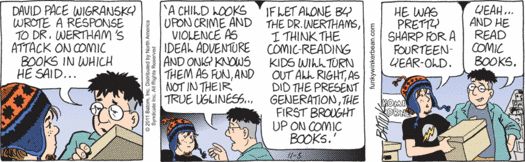
At long last, after many a long day on the tractor and a long night at the computer box, the promised post on David Pace Wigransky. I am finally ready to dissect the second real-world personage mentioned in this stupid little one week arc from ten years ago from a defunct comic strip that literally no one else on this earth but you guys, me, and the writer himself, cares about.
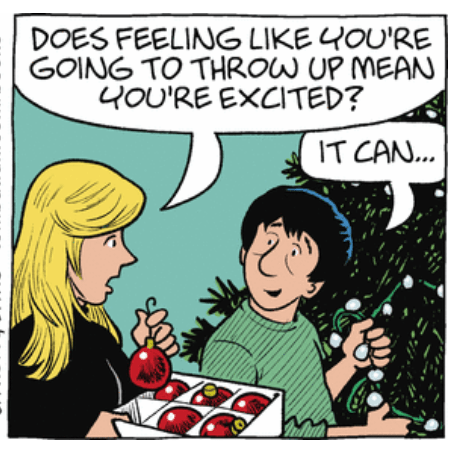
ARE YOU EXCITED?
To recap, since this has been an overwrought process of dragging things out that would make even GRRM and Patrick Rothfuss blush.
Day One: Chullo Head to Skunky: “Did u here vidya gamez iz bad 4 kidz?”
Day Two: Skunky to Chullo Head: “Did u no in 1950’s dude said comix wuz bad 4 kidz?”
Day 3: Skynky to Nobuddy: “Videya Gamerz are against the system dude.”
Day 4: Video Gamers and Comic Readers = People wrongly accused and hanged for witchcraft.
Day 5. Chullo: Did no one stand up for poor little comic books? Skunky: Yes, a literal child man.
And that brings us to today, the last day of that week, and my last post on this stupid subject.
Neat and tidy and preachy. So you know there’s something wrong with this story. I had to know the truth.
And my research tangled me into a multitiered web of intersecting obsessives and obsessions.
My first Google journey on Wigransky, (born Sidney David Wigransky, Jr.) led quickly to the comic book collectors chat forum of the Certified Guaranty Company. There, an incredibly and wonderfully obsessed poster going by the handle ‘sfcityduck’ had already done all the hard work for me. He’d gone on a multi-year frenzy of fact-finding on the life of David Pace Wigransky and this post will really just be a belabored summation of his exhaustive work. I can’t reinvent the wheel when this man has already built an atomic superwheel capable of crushing millions. So sfcityduck, whoever you are, I salute you good sir. Here is a link to the forum thread itself. Come for the thesis level research on an obscure subject, stay for the typical forum slapfight.
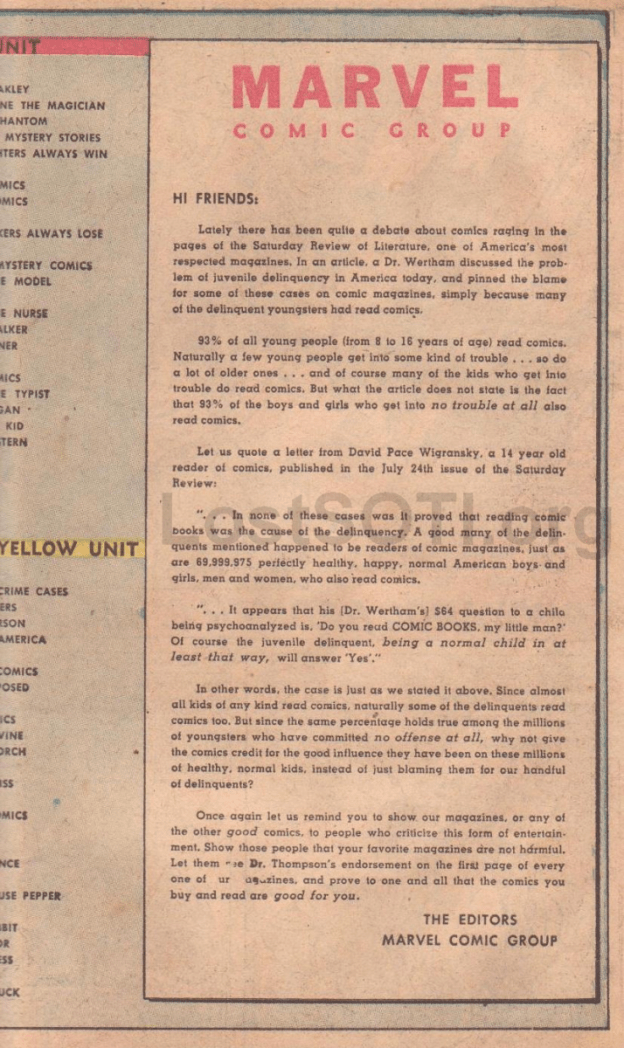
First, a little clarification. In this arc Batiuk lays it out as if David Wigransky wrote his rebuttal directly to Seduction of the Innocent, published in 1954. But this isn’t true. Wigransky was writing in response to an article by Dr. Wertham published in May 1948 edition of Saturday Review. The arguments in the article, “The Comics…Very Funny,” are nearly identical to the more detailed arguments from Wertham’s later book. David Wigransky’s rebuttal was also written in 1948 and excerpts of it were published in the July edition of Saturday Review of that same year.
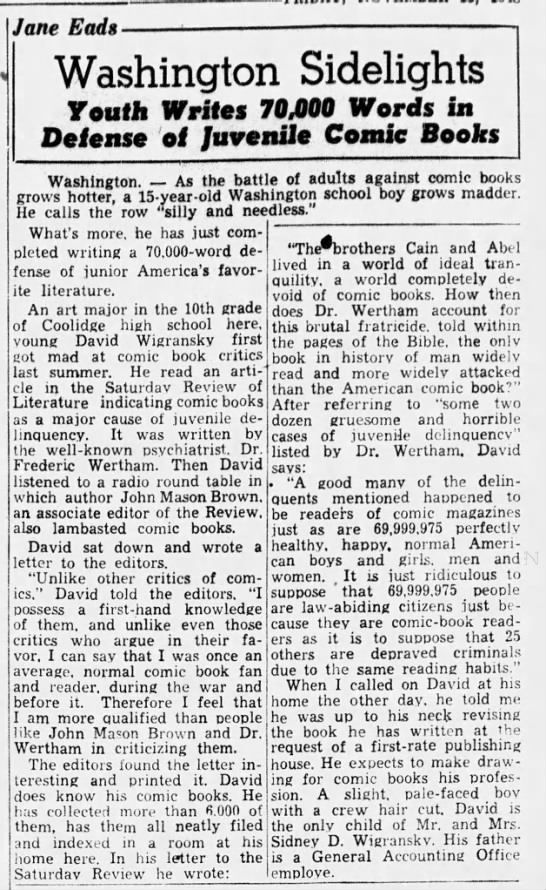
Why only excerpts? Well, according to at least one news article sfcityduck found, little Davey’s rebuttal was tens of thousands of words long.
Tens, of thousands, of words. Obviously, David Pace Wigransky was far from an average comic book reading kid.
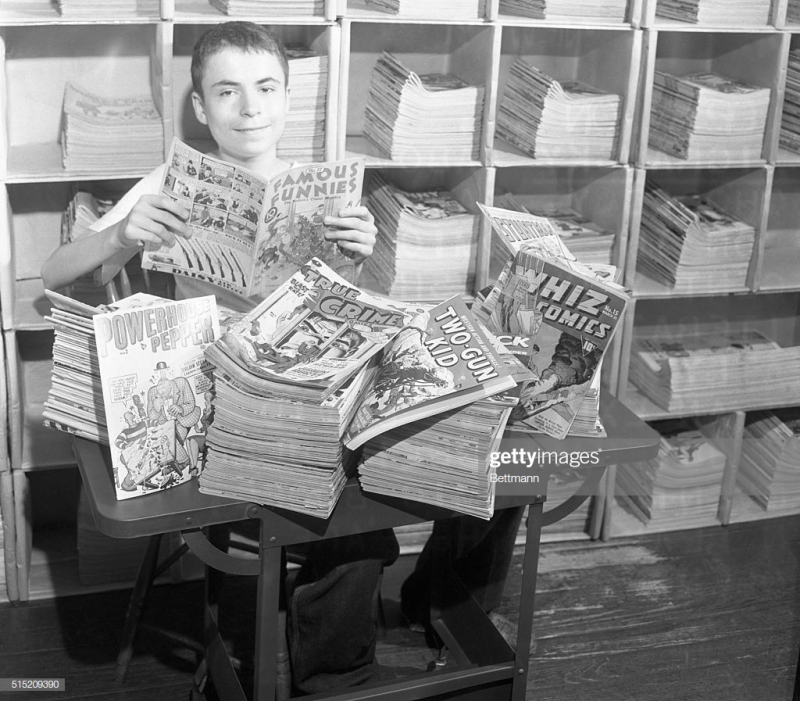
Here’s a picture of him in 1948, in his comic book room.
sfcityduck points out all the interesting facts he can surmise from the comic room picture.
First, take a look at the easily identifiable comics. They span in time from 1935 to 1948. They cover a wide array of genres. They are:
* Famous Funnies 17 (Dec. 1935)
* Whiz 15 (March 1941)
* Stuntman 1 (April/May 1946)
* True Crime Comics vol. 1, no. 2 (May 1947)
* Powerhouse Pepper 2 (Spring 1948)
* Two Gun Kid 1 (March 1948)
Second, look at the comic storage. All of his comics are very neatly stacked and separated in their respective cubes. Clearly, they are organized. And this guy had a frigging comic book room in 1948!
Third, look at the comics themselves. These aren’t comics “showing too much love.” Instead, they are flat (unless “newsstand fresh”), with square corners, and aren’t showing rips or creases.
Fourth, look at him. He’s relatively young. Only 14. Yet, he is holding a copy of a comic from 1935 (13 years old) that is in really nice shape! He clearly was not only pursuing back issues, he was pursuing really nice looking back issues!
In sum, this guy was a serious collector, with a serious collection, being kept in great shape.
Oh … one other thing, the photo is obviously a professional photo. This collector had already, at his obvious young age achieved a degree of fame that the news media was photographing him.
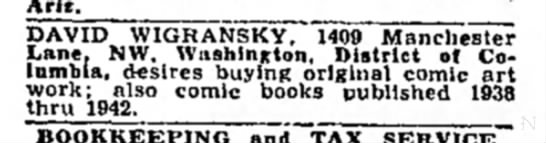
Due to sfcityduck’s research, we know that Wigransky wasn’t just a kid picking up his favorite issues at the newsstand to read. He collected back issues, he wrote to artists and writers, he put out ads in newspapers hundreds of miles from where he lived looking for more old comics. He was an obsessive nerd, full stop.
The other thing I’d like to point out is the tone and vocabulary of Wigransky’s insanely long letter. It’s written at a beyond a college level. And to my modern, meme-rotted brain seems almost overly wordy and pedantic. I don’t know if it’s an adolescent over-emphasizing a style that he thinks will give his arguments more weight, or if this is just how all snooty doctoral dissertations were written in 1948. But the kid is obviously very well read in more than just fiction.
Dr. Wertham seems to believe that adults should have the perfect right to read anything they please, no matter how vulgar, how vicious, or how depraving, simply because they are adults. Children, on the other hand, should be kept in utter and complete ignorance of anything and everything except the innocuous and sterile world that the Dr. Werthams of the world prefer to keep them prisoner within from birth to maturity.
David Pace Wigransky
It’s easy to see why Wigransky became the darling and poster boy for comic book supporters at the time. Other adults had written very well reasoned and educated arguments against Wertham. Other children had sent letters saying they read comics and they were fine. But here was the two combined.
Wigransky’s letter got several shout outs across different publications and newspapers. He was quoted, by name, in an editorial included in the pages of most Marvel/Timely comics published in February and March 1949. The editorial was likely penned by then editor-in-chief, Stan Lee.
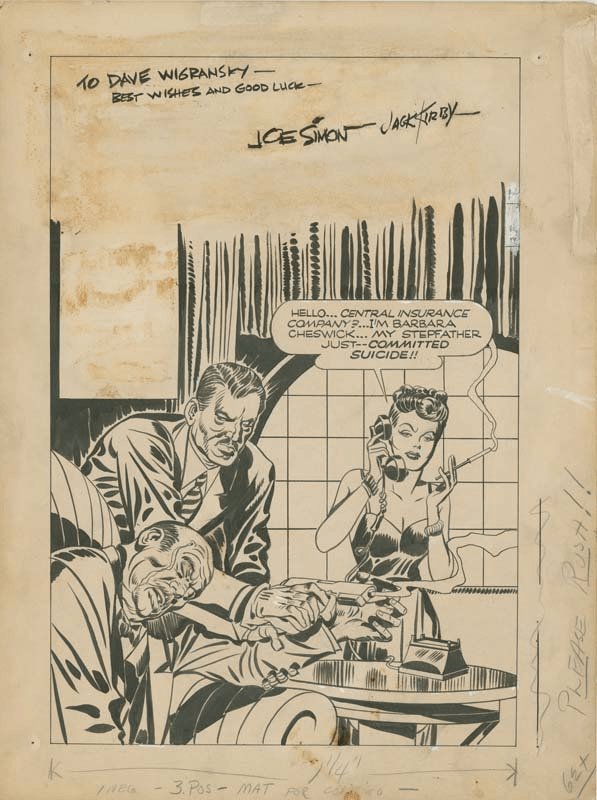
Wigransky was even gifted original art by comics artists like Joe Simon and Jack Kirby.
Wigransky’s letter was quoted again during the 1954 hearings of the Senate Subcommittee on Juvenile Delinquency, which led to comics publishers adopting the Comics Code Authority.
But what became of David Pace Wigransky, that precocious whiz-kid? Did he ever become a comic author and artist like he’d hoped?
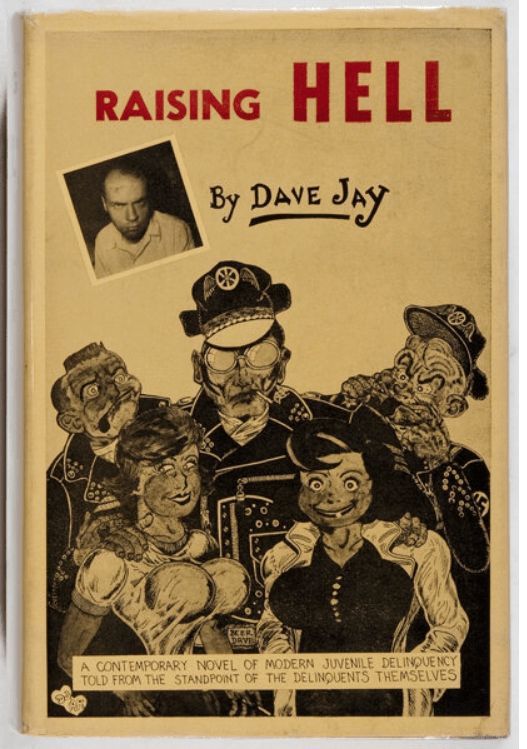
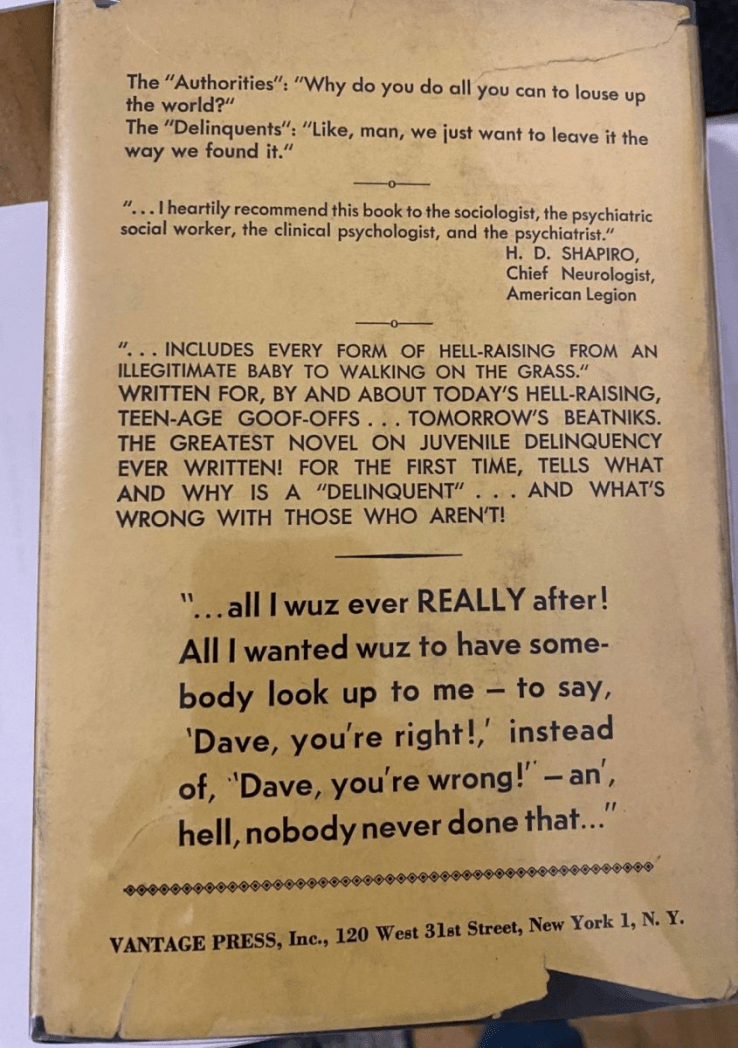
Nope, he became a juvenile delinquent. At least according to himself in his self-published 1963 novel, Raising Hell, written under the psuedonym Dave Jay.
The book is full of his art and illustrations which sfcityduck says show Wolverton and Crumb influence.
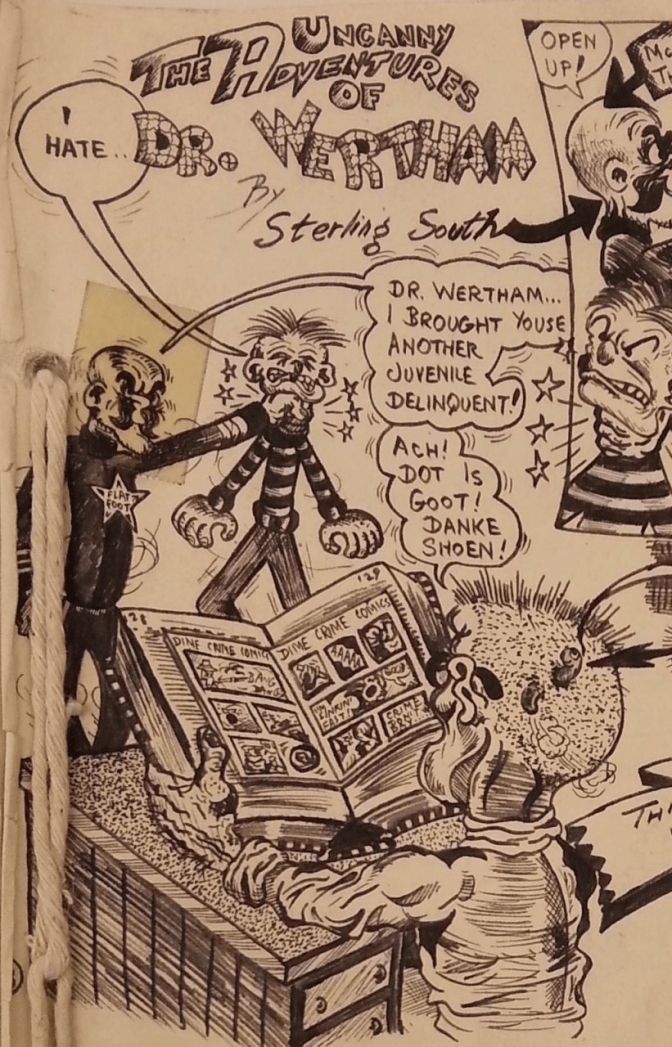
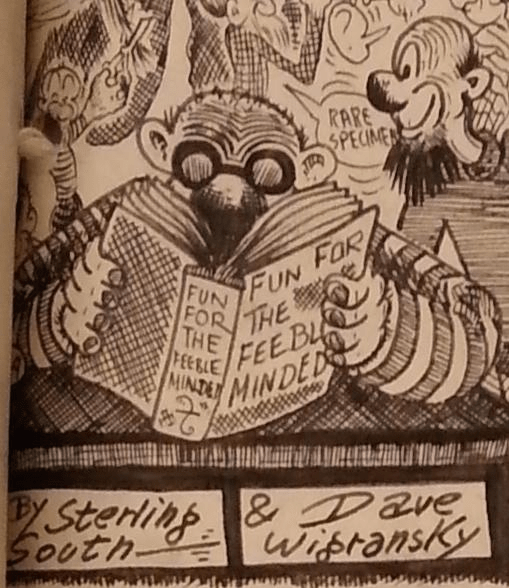
The only comic we have of his creation is “The Uncanny Adventures of (I Hate) Dr. Wertham.” Written some time in the late 40’s. It was discovered about ten years ago in the archives of the National Cartoonist Society by Professor Carol Tilley.
Professor Tilley covers the plot of the 22-page handmade comic book in this guest post on the Ohio State University Libraries blog. Of note, “Wertham realizes the error of his anti-comics argument. He endeavors to retract it, but in doing so, he is professionally disgraced and left penniless. The comic ends with Wertham trading in the last of his worldly possessions for a revolver, which he uses to kills himself on a pier.”
If only Wertham had known his poster boy critic harbored such a dark revenge fantasy.
In 1951, Dave Wigransky graduated high school. His father died in 1955. I didn’t see any mention of Dave going to college in sfcityduck’s posts. Rather he seems to have spent the 50’s drinking and partying with his friends all while still living with his mother. He only moved out of his mother’s house in the late 60’s, a few years before he died. He spent most of his life in the D.C. area except for a time in 1966 when he lived in Berkeley CA.
In the mid-1950s, Dave made the acquaintance of guys who were members of the Bethesda Chevy Chase Rescue Squad. One of those squad members, Daniel Knowles, has published a book detailing some of the stories of the squad, including their partying. They drank a lot of beer. Knowles recalls that he had “befriended Beer Dave at the Hot Shoppe one time, and Beer Dave was a trusted cat. He was named Beer Dave because he drank beer.” Knowles also recalls that Beer Dave had “throngs of admirers at the Hot Shoppe” and that they had a lot of good times together. The “Hot Shoppe,” for those not in the know, was this drive-in:
It sold beer. Beer Dave liked hanging out there.
Knowles recalls that “Dave usually knew what he was talking about because it was said that he had graduated from BCC High School with the highest score anyone ever had in about 1952, and I had no doubt that was true.”
But, Knowles mainly tells lots of stories about excessive drinking and minor mayhem that might have amounted to delinquency in the 1950s, but didn’t really do any lasting harm to anyone.
sfcityduck
So Dave built a persona for himself, complete with a costume of a leather jacket and hat, such that years later people still remembered him.
A Bethesda College reunion website for the class of 1961 includes this message: How many of you remember “Beer Dave,” a notorious Hot Shop habitue who wore a black leather motorcycle jacket festooned with beer can openers? OK, so it’s probably a niche group; but just in case you ever wondered about Dave, he went to California and wrote a book called Raising Hell, ” . . . a contemporary novel [1963] of modern juvenile delinquency told from the standpoint of the delinquents themselves, under the nom de plume of Dave Jay”
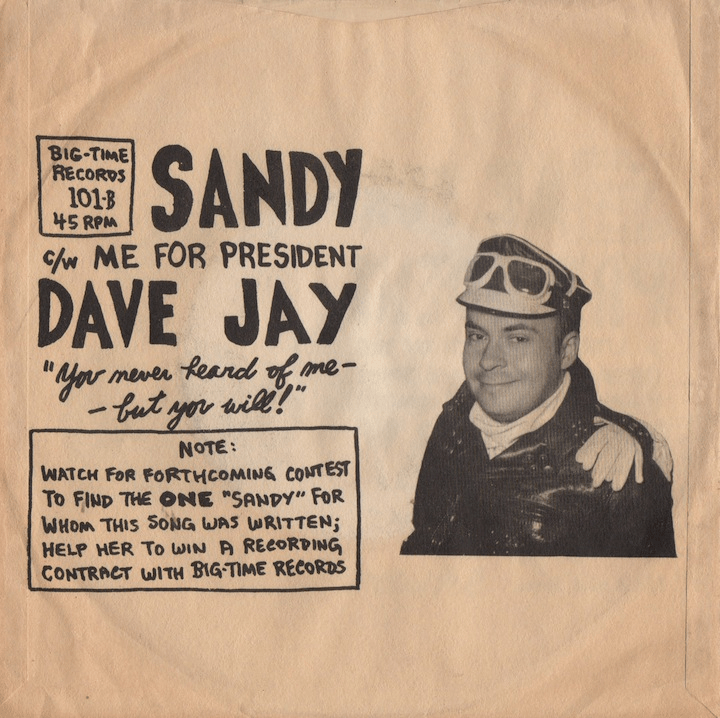
On the sleeve of a 45 record he self-released in 1960, we can see him in his costume of choice, the same one worn by the lantern jawed biker on his novel’s cover.
Wanna hear the voice of Dead Skunk Head’s hero?
Why a record? Though sfcityduck found evidence via ads and personals that Dave still collected comics through the 50’s and early 60’s, Dave Wigransky had another obsession at the time in record collecting. Specifically old jazz records and even more specifically the vaudevillian, Al Jolson.
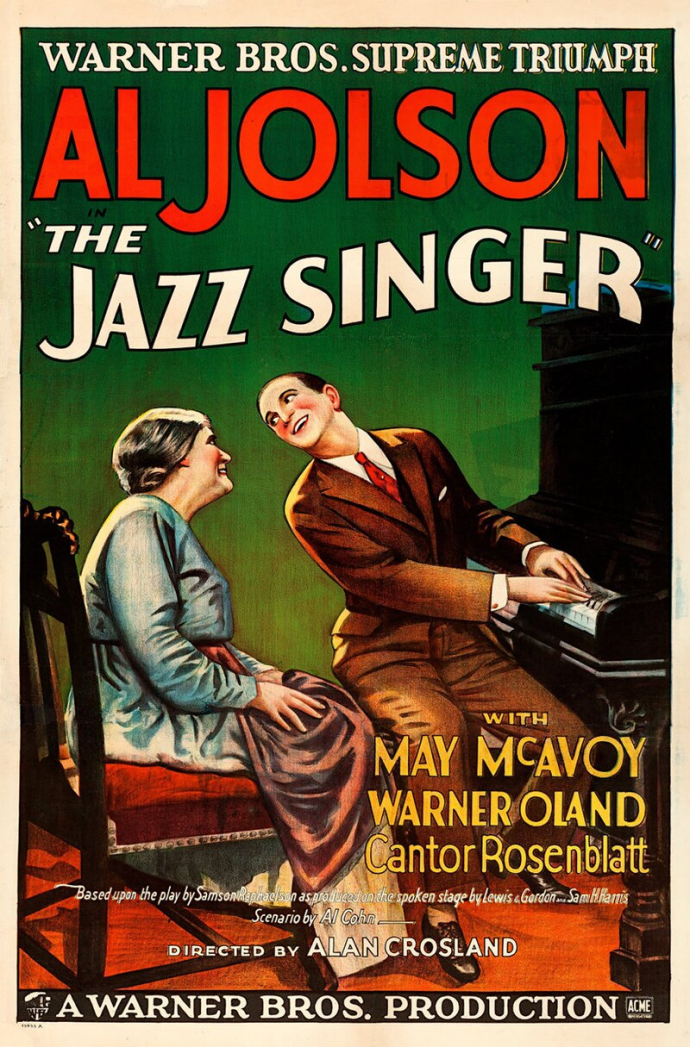
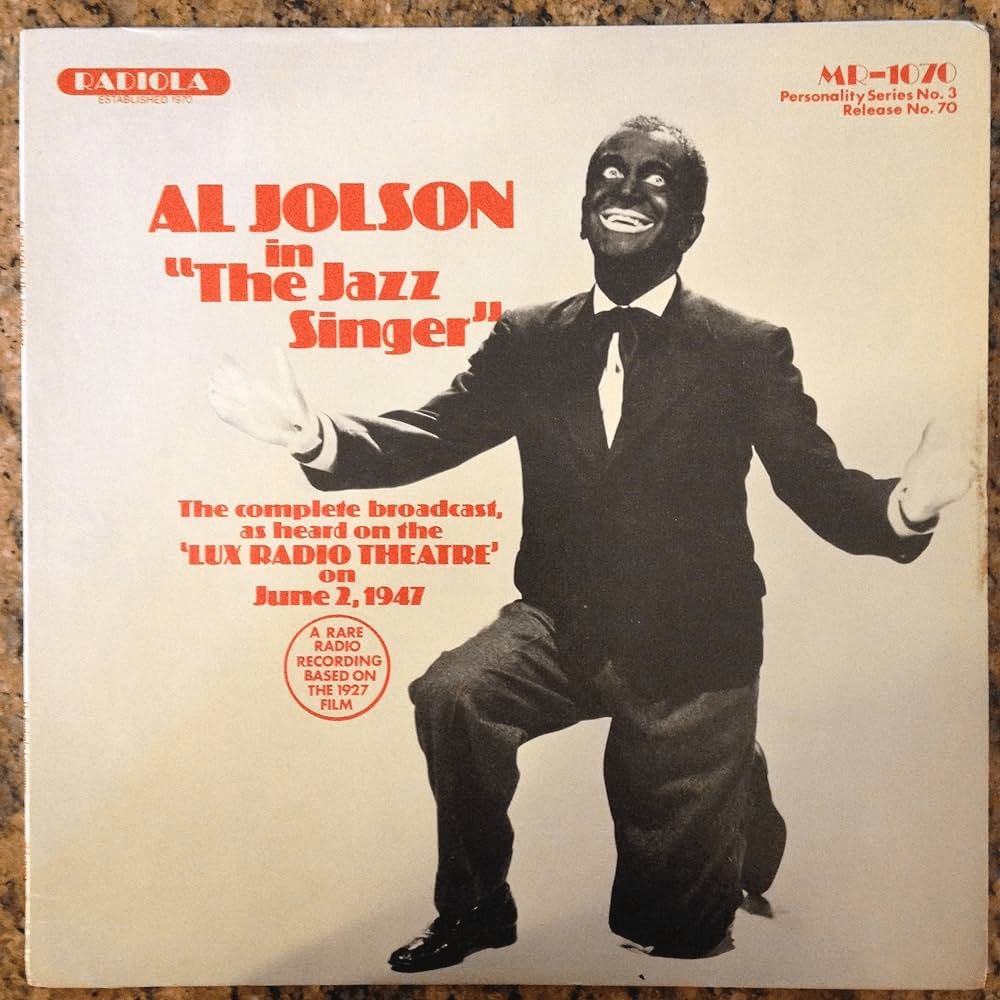
You know, THIS Al Jolson
Among the Al Jolson fan community that existed then, and still exists, Dave ‘Jay’ was THE superfan. He had the biggest collection, the most records, and all the facts and trivia. He put on a DJ show where he played old wax records of vaudeville and jazz and provided commentary.
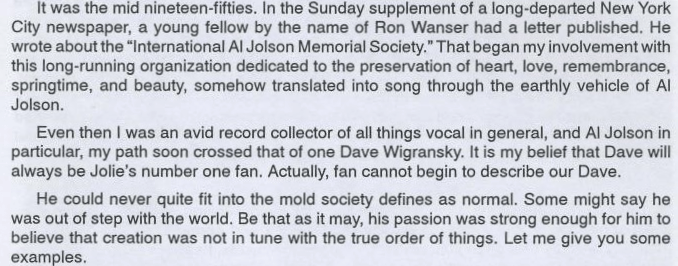
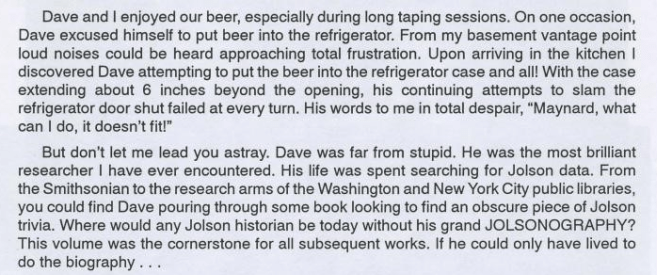
He wrote a couple of books (one of them about Irving Berlin, another about Al Jolson), wrote a bunch of articles for the International Al Jolson Society (IAJS), and was the IAJS’s first researcher. On the message boards of Al Jolson collectors (yes, they exist), Dave is referred to as Dave Jay, and he is still spoken of with awe. An original edition of his self-published “Jolsonography” is considered a major trophy. He is credited with a quote that Jolson fans revere, “An Al Jolson doesn’t come once in a lifetime. He comes once.” One of Dave’s friend’s, Maynard Bertolet (who was once considered to own the largest vinyl collection in the world, but has recently died and his collection sold), authored a very nice “memorial” to Dave for one of the Jolson collector journals (yes, those exist also).
sfcityduck
By ’67 Wigransky’s love of Jolson had completely supplanted his love of comics, sfcityduck managed to contact a fellow Jolson fan who’d visited Wigransky in 1967.
When I visited Dave at his home my girlfriend (now my wife of 50 years) joined me that day, and I just asked her tonight if she remembers anything about comic books or cartoon art in Dave’s home that day. Her answer agrees with mine—no.
Your point —how or why did he move from that passion into one involving the life and career of Al Jolson—is beyond my answering for you (or for me). During the years I knew him, he was TOTALLY obsessed with Jolson. His living room included a huge, beautifully lit, photo of Jolson—probably 3 feet by 3 feet long—which was the first thing to be seen in the house. No comics, no cartoons –nothing at all except Jolson throughout. His basement/museum included hundreds (literally) of framed 8X10 photos from Jolson;s films, lining every inch of each wall. Again…no comics, no cartoons—nothing but Jolson. Now I have one of the largest Jolson collections in the country—my wonderful “hobby” since 1960—BUT—I have wonderful loving family, wife, kids, grandkids, etc.—the whole nine yards. The Jolson thing, so very important to me, stays where it belongs—as a wonderful hobby, NOT as a life. His passion for comic books evolved into a passion for Al Jolson, ‘way beyond what you or I would consider “normal” boundaries.
Dave ‘Jay’ Wigransky never married, and seemed to have trouble connecting with women. Though he did put some suspect personal ads into the local newspapers looking for love. “WANTED: Beautiful girl partner (all girls are beautiful) with whom to join sexual freedom league and/or anyone willing to lend, share or (as last resort) rent a typewriter so that I can write the greatest satire on humanity since “Gulliver’s Travels.””
sfcityduck, taking all his research and correspondence together, comes to the conclusion that Dave Wigransky was smart, funny, obsessive, opinionated and occasionally difficult.
Dave was undoubtedly very very proud of the profile he had achieved. In fact, he was probably insufferable. A firefighter friend of Dave’s in the later part of the 1950s remembers Dave as being like E.F. Hutton – “When Dave spoke, people listened.” However, one of Dave’s friends from the record collecting world of the 1960s noted that while Dave was a charismatic presenter of arguments, and he was often swayed by what Dave argued, “disagreement was anathema to Dave.” The impression you get is that Dave loved to pontificate. Loved to argue with others (but not be questioned). Loved to delve deeply into his passions. And comics were certainly one of his passions.
sfcityduck
In 1969, Sidney David Wigransky Jr. died at the age of 36. Since then some rumours have said he died of stomach cancer, some said of an brain aneurysm. But sfcityduck found that it was very likely Dave had taken his own life. In an Al Jolson Collectors publication he found a memorial from one of Dave’s friends and fellow collectors, Maynard Bertolet.
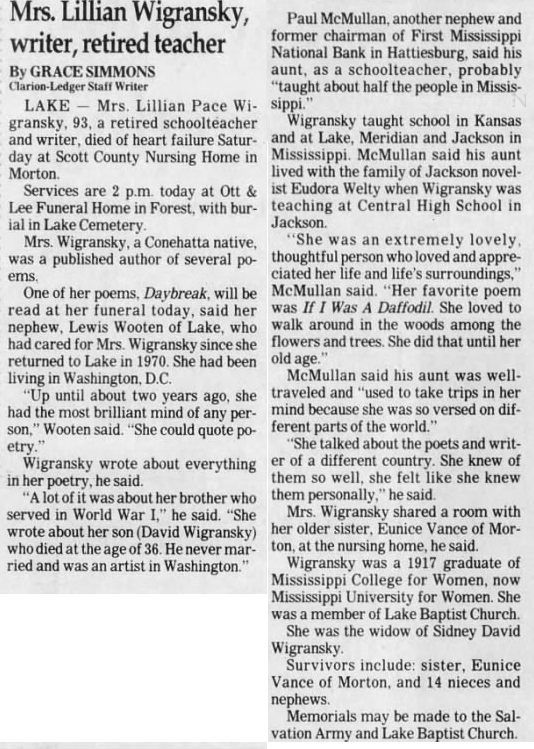
His mother, Lillian, sold her home in DC in 1970 and moved back to her childhood hometown in Mississippi. She died in 1988 at the age of 93.
And it was this sad revelation that made this post so daunting, and difficult for me to finally get out. Because David Pace Wigransky, the plucky kid that Tom Batiuk decided was the hero of his little morality play, was such a tragic, interesting, and enigmatic character.
There was a refrain that echoed in my head for the last month, as I drove tractors in the dark, as I checked cows, as I wolfed down turkey and schmoozed with family.
Comics didn’t save him.
I had a long conversation with my roommate about it. Comparing Wigransky’s life with Wertham’s. And from a cruel and cold part of my brain came the view that Wigransky had lived a selfish life, and Wertham a selfless one. Wigransky seeming a spoiled only-child who never held down a job, bouncing from one self-aggrandizing project and obsession, determined to be noticed and praised in his own narrow circles, until he selfishly took his own life, leaving his mother childless. Wertham, by contrast, had a wife and a career where he sought to guide others who desperately needed help through their darkest moments. He lived a long life, and for better (desegregation) and worse (the 50’s comics collapse) had an larger than normal impact on the world.
But that isn’t fair. People who knew Wertham describe how he was a proud, sometimes petty, man, who was put-out when he felt like his work wasn’t getting what he thought was the proper respect. And Wigransky is remembered fondly by his friends. His research, as niche as it was, remains important to its audience. And we don’t know what darkness or issues let Dave to take his life.
Wigransky’s later life also doesn’t invalidate the points he made in his letter against Wertham in 1948. Because those points were based on logic. Violence existed before comics. Violent stories existed before comics. And the vast majority of children still turned out alright. These things remain true.
But comics didn’t save Dave Wigransky.
Not that I think they did much to hurt him either. His concurrent Al Jolson obsession shows that Wigransky was the kind of guy who was going to absolutely go full nerd-mode over something. If it hadn’t been comics it would have been stamps, rocks, westerns, movies, paperbacks, trains. Modern armchair psychologists would probably say he was a high functioning autist. I think modern armchair psychologists would probably be right.
I know better than anyone the absolute refuge a nerdy obsession can be. There have been dark and stressful times in my life where knowing the names of all the Aerialbots or being able to recount the entire history of dragons in Middle-Earth served a soothing distraction from a life that had become too much.
But I’ve seen other people who let a nerdy obsession trap them. People who can’t face and accept the average awkward autist they are, because they’ve overdosed on the highfalutin world they spend all their time in. People who won’t get jobs, won’t move on, won’t grow beyond a selfish comfort zone, because all they want is to be the famous actor, artist, or writer, they just HAVE to be or their life becomes meaningless. Even though they lack the real talent or drive to achieve that state. Even though their life, as is, could be rewarding, fun, and full of real and tangible gifts to give to others.
In the best cases, fun little obsessions have led me to friendships that have been the real lifesaver when things get grim. Dave Wigransky made friends through his fandoms too, it seems, even if in the end those weren’t the lifesaver he needed. Ironically, maybe what he needed was a psychiatrist. A professional. Like a drowning man needs a lifeguard, not his untrained friends.
Comics didn’t save David Pace Wigransky. And he was far from the perfect poster child of all a young comic fan could be. It’s not a simple story of Wertham bad, Wigransky good, comics good, censorship bad. As much as Batiuk wants it to be. It’s a complex tale of real and complex humans, and of what fiction can and can’t do for people.
Batty is really going to do this, he is really going to bring back Montoni’s. This is madness.
Given what and who Cranky is, we’re probably meant to watch them spend the week trying to explain to him that a restaurant doesn’t have to be named after the person who owned it.
Mocking the last name “Winkerbean” doesn’t work when the mocker’s last name is “Crankshaft”.
I am amused by the idea that Funky and Holly moved to Florida and dragged Melinda (who moved in with them when she refused to return to Florida) down there with them. I’m guessing they left Mort at Bedside Manor…
Hey, remember those strips a few years back where Morton became a full-fledged sexual predator? Man, that was odd. No character embodies Act III better than Moron does. Early Act III, Mort is in ill health and declining rapidly, unable to do much more than stare and mutter. Then, in the second half of Act III, he just inexplicably morphed into a leering pervert AND a trombone wizard. That was Batiuk at his most beguiling. I can’t even begin to imagine what he could have been thinking with that sequence of events.
The idea of comics being peripheral to the grand scheme of things is probably not an idea Batiuk would like. It means that his mother was right about there being more to life than sitting on his duff, stuffing his face and rotting his mind.
Great post, CBH!The link to Dave Jay’s record doesn’t work for me. So here’s an alternate, with both sides of his 1956 single “Me For President” / “These Foolish Things (Remind Me Of You”.https://www.youtube.com/watch?v=6TyzCK2d7z0&t=45s
Both sides contain Al Jolson tributes. A-side is a weird, endless “cut-in” record that probably wasn’t especially funny in 1956 and certainly isn’t now; B-side is a straight-up Jolson imitation.
The Wigransky story was both more interesting and more sad than I expected. Impressive research.
I was struck by a couple of quotes.
Wigransky was writing in response to an article by Dr. Wertham published in May 1948 edition of Saturday Review. The arguments in the article, “The Comics…Very Funny,”
Here we see why TB hates Wertham…
...the Bible, the only book in the history of man widely read and more widely attacked than the American comic book?
And here we see why TB loves Wigransky. There is logic to Wigransky’s point about Cain and Abel, or rather, the widespread existence of violence and evil prior to the creation of the “American comic book”… however, he then distracts from that point so he can martyr himself and his precious comic books. Whether he borrowed it from Wigransky or not, this is definitely a page in TB’s playbook.
<i>But I’ve seen other people who let a nerdy obsession trap them. People who can’t face and accept the average awkward autist they are, because they’ve overdosed on the highfalutin world they spend all their time in. People who won’t get jobs, won’t move on, won’t grow beyond a selfish comfort zone, because all they want is to be the famous actor, artist, or writer, they just HAVE to be or their life becomes meaningless. Even though they lack the real talent or drive to achieve that state. Even though their life, as is, could be rewarding, fun, and full of real and tangible gifts to give to others.</i>
This is a perfect description of every major character in the Funkyverse. It’s Les. It’s Summer. It’s Lisa. It’s Cindy. It’s Dinkle. It’s Funky. It’s John Howard. It’s Pete. It’s Darrin. It’s Crazy Harry. It’s “The Eliminator.” They all craved some kind of fame they didn’t have the talent or drive to achieve… but the story just handed it to them anyway.
Les can’t write. Summer can’t write, or even graduate from college. Lisa wouldn’t have survived the first day of law school. Cindy was a dime-a-dozen high school queen bee. Dinkle, Funky, John Howard, Pete and Darrin all suck at their jobs. If Harry and Space Helmet Girl were that good at Defender, they would have been fantastic at almost any video game.
You can almost reframe the entire Funkyverse as a satire of people like this. They achieved success beyond what their ability or effort warranted, and believed they didn’t need anything else. It’s like en episode of Behind The Music, without the third act when it all comes crashing down on them.
This is a perfect description of every major character in the Funkyverse.
And an even more perfect description of Tom Batiuk.
Naw, respectfully disagree. Tom, whatever his man-child hangups, has a 50 year marriage, a son that he seems to get along with, and a 50 year career that supported his family’s upper middle class lifestyle and got him some very minor accolades. Maybe his obsessions stunted him, maybe they had no effect, but the guy at least produced, created, and gave to others.
By any metric he’s lived a perfectly decent to great life, and more power to him in that.
I agree with Harriet. Batiuk certainly qualifies as “won’t grow past a selfish comfort zone” and “overdosed on his highfalutin world.” But the rest of it isn’t fair to him. He has a lot of flaws, but he’s not THAT bad.
Who’d you’d rather get stuck with on a broken elevator? Tom? Or Scott Adams?
“I’m sorry, officers! We were forced to kill Adams for food!”
“You…were trapped for an hour…”
“Yeah, and he tasted like CRAP!”
TOM: (burps)
🤪😎🤣
Thank you, CBH!
Dave Jay created his own niche in life, and then he took his own. Between the two statements is a world of mystery. Publicly, he was successful with comics and Al Jolson. Privately, he was lonely and to some degree self medicated. But that doesn’t lead to conclusions. Too many in between moments that we will never learn. We are not the sum of our parts. Too many parts are buried in the subconscious. Other parts we do not know enough facts. I had something similar happen this week. A little 6 year old died with a heart attack. I was asked to lead the prayer and read the obituary. The boy’s dad committed suicide last year at age 36. I hurt so much for both. Yet I force myself not to hate the dad. Please don’t judge me. I am being honest. Suicide is so contagious. The sufferer thinks he is helping out the family, but in reality, he or she is deadening the living, never to fully recover. So I tell myself to forgive the dad. He just could not cope anymore. I understand that, and actually respect him. I believe he tried, but saw no way out. He left a young wife and 2 little autistic sons.
On a lighter note, Al Jolson was big in my house. My Dad loved him. My older brother loved him. We had many of his 78’s. We saw some films of his. Many variety shows played clips. Anonymous Sparrow could tell me which film company made the “Al Jolson Story”. We watched it every Saturday or Sunday it was on. Jolson gets a lot of criticism for the blackface. Big deal. Yes, it couldn’t be made today, and it shouldn’t. But then, Al Jolson was a godsend to the black community. Every night after he performed in NYC, he went up to Harlem and made those clubs thousands of dollars by appearing. How? People followed him, and spent good money. He made a film where he performed the entire movie in blackface. Yes, it looks as bad as it sounds. But every other actor in the movie was African American. In the midst of the depression, he helped those men and women make money. Everyone of us has hidden parts. I know more of Anonymous Sparrow and Be Ware Of Eve Hill because they feel it easier being more open and transparent. Others such as the Duck of Death and Banana Jr. 6000 stay on topic within the bounds of SOSF. Neither way is wrong or better. I respect all four commenters because all four come across as real people. That is what makes SOSF enjoyable.
SP:
Since you asked, Columbia Pictures made “The Al Jolson Story” and its sequel “Jolson Sings Again.”
There are two other versions of “The Jazz Singer,” one from 1952 with Danny Thomas and one from 1980 with Neil Diamond; however, times being what they are, I doubt that there’ll be a fourth, as there was with “A Start Is Born.”
Anonymous Sparrow
This is why I enjoy you so much. I did not know there was a sequel. As I mentioned before, we watched the original many times. So I looked up, “Jolson Sings Again” and I find out that it has the marvelous Barbara Hale. Tremendous. The actual Jolson reminds me of Eddie Cantor. Similar styles that were not camera friendly, but perfect for the stage.
SP:
I have heard a few radio shows with Cantor (most notably a “Baby Snooks” episode in which he helps Daddy look for a missing Snooks) and I found them very funny. Perhaps he bore out the “face for radio” line best of all. (Not sure who coined that; I tend to associate it most with Jackson Beck, who was Beany, the *Daily Planet’s* copy boy, and Alfred, Bruce Wayne’s butler, on radio’s
“Adventures of Superman.”)
Desi Arnaz once got on Bob Hope’s bad side for not preventing Jolson from doing some upstaging when he guested on Hope’s radio show. Apparently Jolson was quite the prima donna!
Barbara Hale was Verity Wade in a look at a Southern demagogue, a la Huey P. Long, called “A Lion Is in the Streets,” which “All the King’s Men” displaced. (Both from books: oddly, *A Lion Is in the Streets* came out in 1945, and *All the King’s Men* the following year, but the first would be last: “All the King’s Men” came out in 1949, “A Lion Is in the Streets” in 1953.) It’s eluded me so far, but now I have an extra reason to see it beyond James Cagney (who plays the Long character) and Anne Francis (my friend Carey is a big Francis fan and cringes over her fate in “Bad Day at Black Rock”).
All the same, Hale will always be Della Street for me, while Raymond Burr, her Perry Mason, keeps surprising me in where he turns up, be it in “Rear Window,” “Godzilla,” “Raw Deal,” “A Place in the Sun” or, on radio, as “Lee Quince, Captain of Cavalry” on radio’s “Fort Laramie” from 1956.
Anonymous Sparrow,
As we hail Barbara Hale, she turns up in the most unlikely places. By which I mean “The Falcon in Hollywood” and “The Falcon Out West”. I don’t know much about the first movie. I have seen it but do not remember her part, but the second movie, out West, she is a major player. I doubt that she did her own stunts, but she was very athletic in the film: smart and pretty. Her presence elevates the film and plays off of Tom Conway very well. It amazes me that Conway and his brother George Sanders have totally different British accents. There is no way that Conway could ever replace his brother as the Tiger Shere Khan. Yet it went very smoothly as the Falcon. Good day my friend!
SP:
Many thanks for the Barbara Hale information and for the reflection on Tom Conway and George Sanders.
Sanders is in two “Best Picture” winners (“Rebecca” and “All About Eve”) and gets a lovely mention in the Kinks’s “Celluloid Heroes” (“if you covered him with garbage, George Sanders would still have style”). Conway’s career doesn’t seem to invite that sort of salute. (Though he is in a “Best Picture” winner, too: he has an uncredited role in “Mrs. Miniver.” I was intrigued to learn that he was in “One Touch of Venus,” for I’d been listening to the full score CD recently. Conway is Whitfield Savory, who on Broadway is Whitelaw Savory. Don’t ask me why.)
Did you know that Sanders had a novel ghostwritten for him by Craig Rice called *Crime on My Hands*? It’s well worth checking out, as are Rice’s books featuring John J. Malone, the hard-drinking lawyer who never lost a client (though at least one was sentenced to life plus ninety-nine years). Rice worked on several of the “Falcon” movies, which was how she came to know Sanders
(and Conway, presumably, though she never ghost-wrote for him).
Rolanda would want me to note that Craig Rice was a pseudonym for Georgiana Ann Randolph Walker Craig.
I can’t help feeling that the current *Crankshaft* storyline is a good place to reveal that Funky Winkerbean’s real name is Algernon or Adonis, or something like that. But it probably won’t happen.
Anonymous Sparrow,
1) (“if you covered him with garbage, George Sanders would still have style”).
That is one of the greatest compliments in the world. It is so true about Mr. Sanders.
2) Desi Arnez and Bob Hope. I do not understand professional insecurity at Mr. Hope’s stature. Yet it is not uncommon. I understand that Kevin Costner resented the scene stealing (in his opinion) of Alan Rickman in Robin Hood. I never heard Bruce Willis complain about Mr. Rickman in “Die Hard”. Even the giant John Wayne resented the acting of Jack Elam in “Rio Lobo”. I guess few stars are of the quality of Jack Benny. He once said, “I don’t care who gets the laughs on my show, as long as the show is funny.” That’s a star.
3) I always take your book recommendations seriously. I have a question for you that you may completely ignore if you are busy. If I had to have one murder/mystery author among my library, would you choose Craig Rice, Erle Stanley Gardner, Elery Queen, or Ed McBain? (an aside: I’ve never heard why the Duke chose to use the name Ed McBain in his film, “the Comancheros”.
I do hope your weekend is a blessing. My wife begins her birthday fortnight on Sunday. We are meeting my daughter and her husband at an Indian restaurant to celebrate.
SP:
Best wishes to your wife!
Ego is a terrible, if understandable, thing in the entertainment world, which is why we cherish the details about Jack Benny (Benny had no trouble getting guest stars for his radio and television show, because the guests knew that they’d get the jokes when they appeared on the program) and Gregory Peck (who insisted that Audrey Hepburn receive top billing for “Roman Holiday” because she was stealing the picture and was going to win the Oscar…which she did). For that matter, there’s Bob Denver insisting that the “Gilligan’s Island” theme song be changed to include “the Professor and Mary Ann” rather than dismiss them as “and the rest.”
With Wayne, I wonder whether as late as 1971 (the year of “Rio Lobo”), he still remembered how long it took for him to become a star (“The Big Trail” should have done it in 1930, but didn’t, and after its failure, he had to wait for John Wayne and “Stagecoach” nine years later) and was too protective of his status to be comfortable with Jack Elam. (After a little research, I see that Peck wasn’t immune to it himself, being very unhappy with Robert Mitchum’s work on “Cape Fear”: “I had given him the role and had paid him a terrific amount of money. It was obvious he had the better role. I thought he would understand that, but he apparently thought he acted me off the screen. I didn’t think highly of him for that.”)
As for your request:
I feel sort of like the guys discussing make-out music in “Diner,” when Boogie says that he uses neither Johnny Mathis or Frank Sinatra, but Elvis Presley. Of the authors you list, I feel like I should say “Ross Macdonald,” particularly with his run of Lew Archer novels beginning with *The Galton Case* and ending with *The Instant Enemy.*
But you didn’t include him, so I would choose Ed McBain. Gardner, as a reviewer in *Ellery Queen’s Mystery Magazine* noted, isn’t someone you read for style or characterization (you go for pace, plotting and the legal lore the TV show couldn’t use in an hour installment), although as A.A. Fair with Bertha Cool and Donald Lam, he loosens up a bit; Rice sometimes becomes too funny for her own good; and Ellery Queen I know better as an editor (or editors, as there were two behind the name, Dannay and Lee) than as an author. The 87th Precinct books I’ve read I’ve liked very much, and I pick up McBain’s standalone work when I can find it, as happened recently with *The Paper Dragon.*
By the way, speaking again of Gregory Peck, if you look closely at the duty roster in a scene in “Cape Fear,” you’ll see that the names on it are those of cops from the 87th Precinct.
Thank you for your kind wishes. I shall do my best to make my December 2nd worthwhile, but not will not emulate Napoleon I (coronation and Austerlitz) or Napoleon III (overthrow of the Second Republic).
Anonymous Sparrow,
Thank you for the info on the different styles of the murder/mystery authors. Thank goodness for kindle. I will get a couple from each, and read them. I will make it a point to include Ross Macdonald.
It’s serendipitous that you mention Desi Arnaz. I’ve been reading his autobiography, drolly titled “A Book.”
Arnaz was, of course, not just a great comedian, but a savvy businessman and one of the most important and influential creators and producers in the history of television.
I immediatly thought of our dear Puff Batty when I read what Desi had to say about “I Love Lucy”:
“Some people called it superficial, with no literary or intellectual values — only escapism. Okay, but I see nothing wrong with a show that is just that.
“We always had in mind the guy who has worked eight or ten hours a day driving a truck or taxi, or putting down bricks and mortar, or fixing faucets, or driving nails, or sitting at a desk, or whatever his job is. When he gets home at night, kicks off his shoes, puts his feet up on a chair, opens a cold can of beer, and, by turning his television on, has a half-hour of laughs and relaxation, I’m all for it.
“I think it is very important to allow him to escape, for a while at least, from all the goddam worries and struggles of our everyday life. Television should not be ashamed but proud to help him do so.”
What an idjit! HA! Imagine thinking that something could be valuable without bludgeoning its audience with NPR-lite hot takes on last year’s controversies, or Scenes of the Dead, Dying, and Despairing. What a shame Arnaz didn’t have a mentor like Tom to teach him what makes a creative endeavor truly valuable.
Anonymous Sparrow:
My only memory of Raymond Burr is the Americanized original Godzilla. He just looks out the window at Godzilla’s devastation, and says “Well, this can’t be good.”
Animaniacs did a kaiju parody. It switched twice to a B&W bit of an unidentified Burr holding a pipe and saying “Yes, I see!” Which kinda was his whole contribution to Godzilla.
And he was named “Steve Martin”! They couldn’t have named him “Steve Martin Short,” so that he could do “Only Murders in the Prefecture”?
I assume you’re being sarcastic, but Godzilla came out well before Steve Martin was famous, so the name was a total coincidence. But what’s really amusing is that, in 1984, Toho released The Return of Godzilla as a direct sequel to 1954’s Gojira. It was released in the States the following year as Godzilla 1985… including new footage of Raymond Burr spliced in! (Though they rarely, if ever, refer to his character by his full name; usually it’s just “Mr. Martin” or somesuch.)
(I loved that Animaniacs episode.)
Always a thumbs-up for Animaniacs. I still can’t believe they got away with the “fingerprints” joke.
The most charitable way to describe him is to liken him to Lynn Johnston as she too has written an unintentional satire of a certain type of person. In her case, the figure to be pilloried is a bored, frustrated middle class woman too obsessed with minor annoyances to notice, care or believe that her life is pretty sweet. In his case, it’s people who substitute passivity for moral courage. If they’re going to be ground down by life anyway, why make even a token effort to resist……..
Great comparison, with an important difference:
The “unintentional parody” interpretation of Elly Patterson is an archetype people can relate to. She’s a Karen. And a professional victim. And a meddling parent who won’t let her adult children live their own lives. We’ve all known real people with these traits.
“Passivity for moral courage” isn’t a common flaw in human beings, because we have a self-preservation instinct. When the hospital screws up our test results, we don’t say “oh well, guess I’ll just die then”. We fight anyway. We get mad. We seek justice. And if it’s inevitable, we do the best we can with the time we’ve got left.
Lisa fails to be an inadvertent parody of cancer sufferers, because cancer sufferers – even obnoxious, selfish ones – don’t act like this. And to they extent they do, they’re not worth making fun of, or even having any opinions about. Oh, you’re going sit there and die just because the hospital made a mistake? You’re not even going to sue them? Or plan for your family’s future? Well… bye.
I can actually imagine a situation in which a young mother decides, “A bunch of legal actions and crusading isn’t how I want to spend my last months. I want to spend them with my little child, who needs me.”
However, this isn’t what happened. And it’s so inconsistent with the Lisa we had previously been shown, the crusading lawyer who fought for the poor downtrodden murderer, the justice warrior, etc.
Suing the hospital and doctor for malpractice is virtually a moral necessity here. It’s the only way to make sure future patients don’t die from the same messed-up procedures that led to the mixup with Lisa. You’d be surprised how many procedures used today are the direct result of past lawsuits lost by other hospitals or doctors. Once one hospital is sued “back to a ball of dirt,” as TB would say, others have the fear of God put into them. They have a damn good incentive to put in safeguards, if only for their own self-interest.
But instead of using her law degree to help future patients, she piggybacked on someone else’s trip to go tell Congress that cancer is bad, mmkay? Wow, way to change the world, Little Miss Activist. [massive eyeroll]
This is why I find Lisa’s Story so appalling. Lisa and Les never spend a nanosecond thinking about anyone other than themselves. Least of all, their daughter. You can see it in everything they do.
And Congress would have absolutely roasted Lisa. They don’t let themselves get ambushed like that. By the nature of their job, politicians are very good at researching people. They would have known her story before they turned the microphone on.
“Tell us, Ms. Moore, what cancer treatments are you taking right now? And what actions did you take after the hospital got your diagnosis wrong? And what arrangements have you made for after you pass away? I remind you, you are under oath. Please face the camera and answer the questions.”
If Lisa really tried to pull this shit, they would have let her hang herself live on C-SPAN. Which would have been the most entertaining thing that ever happened on that channel. Or this comic strip. Especially if they could show Les reacting to it.
Also, the reaction of standing around passively allowing bad stuff to happen but being thought well of for not liking it much only makes what little sense it does is if the situation is “having a man in a powder blue parka who has Elton John’s taste in eyewear point a freeze ray at you.”
Everywhere else, it just makes the person hard to sympathize with.
It baffled me that she and Les didn’t sue Doctor Lethal back into a ball of dirt for dropping the ball. Elly Patterson would have hunted the woman down and destroyed her if she gave her the wrong meds for her hot flashes so what was Lisa’s deal?
Oh, Jesus.
David Pace Wigransky and Al Jolson is Mitchell Knox and John Darling.
I need a moment.
[Duck mops brow. Drinks from a glass of water. Stares, stricken, at nothing in particular. Clears throat.]
Seriously, this is a Magnum Opus, CBH. I know my fellow Duck, sfcityduck, did a lot of the research, but culling research into a digestible and coherent story is just as hard, if not harder, than doing the research itself.
Wow.
Yes, comics didn’t save him. Precociousness and excessive coddling are a terribly damaging combination. (I’m deducing from the story that he was privileged — the comics room! — and perhaps over-praised. And when reality intrudes in the grand fantasy, it can be devastating. All the brains, all the cleverness in the world won’t salve the disappointment.)
The detail that he apparently never had a relationship with a woman also makes me wonder whether diving headfirst into consuming obsessions wasn’t some form of sublimating a desire he found unacceptable.
Anyway, a fascinating, compelling, and ultimately very sad story that any superfan of anything can identify with, and hopefully take warning from.
And thanks for open-mindedly defending Wertham, at least a little. Crusaders like him may be wrong-minded, but the older I get, and the more experience I have in parenting, the more I understand where they are coming from. Most of us would agree that toddlers should be allowed to watch Blue’s Clues; most of us would agree that they should not be allowed to watch härdcöre p0Ⓡn. But exactly where the line should be drawn is difficult to discern, and I no longer feel comfortable mocking people who would draw it in a different place from where I would.
You have to understand the man’s background a bit more than Wiganksky bothered doing. His religion, his raising, everything he was taught to believe told him that children should be spared the harshness of the world as long as is possible. Knowledge of dark things will come too soon anyway……..
Honestly, I was thinking the same thing about Mitchell Knox. Which, I think, probably indicates that Batiuk really wasn’t aware of what happened to Wigransky later in life; Knox was clearly intended to be… not right. (Flash and Undead Phil even said he was pretty odd for someone who worked in comics.) But Skunky (and, by extension, Batiuk) seems to hold Wignarsky in high regard. I can’t imagine Batiuk making a character who resembled later-in-life Wignarsky that much and treating him with such derision while also holding Wignarsky in such esteem.
Although, with Batiuk, one never knows. A complete lack of consistency is called writing!
Wow. CBH, that is one amazing story.
I do wonder if TB knows it. Probably not.
As for Al Jolson… my dad used to play his records a lot when I was a kid; I can still hear those songs playing in the Jukebox of My Mind, even though it’s been probably fifty years since I actually heard them with my ears. What to make of Jolson? He sure could sing. But I can still recall those album covers, in blackface, and they make me cringe.
Alright, so going by the combined research effort of SFCityDuck and you CBH it sounds that Wigransky, was an obsessive that had a strong want to be seen as the best at what he did and didn’t like it when people tried to disagree, question him, or point out his faults, and spoke/wrote with a style that was clearly an attempt to sound extra intelligent by using more words than necessary and choosing fancier words.
Based on that I can see why TB is so quick to put Wigransky on a pedestal, at least young Wigransky since his obsession at that time was also comics, Batty probably looks at Wigransky as a version of himself if he was more popular in the comic book niche.
Not relayed to Dave Wingransky but related to Pedoskunk John: If I were Owen and/or Cody, I would stay at least 30 feet from Pedoskunk John because judging by Pedoskunk’s appearance, I would be concerned that he might do something extremely atrocious to me
Fascinating. Thank you CBH
CBH Fascinating research and info… Thank you! Great book on the comics scare is “The Ten Cent Plague” by David Hadju written about 10 years ago. I highly recommend.
This is probably one of the single best articles that I’ve read on the entirety of the Internet this year, full stop. Research, nuance, personal insight, self reflection – edifying and directly revelatory. There’s many things here that I didn’t know, and it prompted me to reread the details behind Al Jolson in the process. What a roller coast.
Whether Tom knew anything about Wigransky beyond comic book evangelism is possible but unlikely to have mattered. I think it more likely that he would have recalled some details about that name and what he said as it appeared in other comic books and for his opinion being propped against Wertham, then quoted what he needed to quote for the sake of that singular strip. However, I don’t think that quoting some otherwise unknown 14 year old nobody with no life experience is as poignant as Tom may have thought it to be.
Grandkids!?
Rocky and Cory spawn confirmed?
This is Batiuk, so…
– he could forget he ever mentioned grandkids, and never refer to them in a future strip
– he could make the grandkids be an impossible age, like 14, so that there is no way they could fit into the continuity
– he could retcon them into nephews or some random kids that live nearby
– he could forget it was supposed to be Funky who now owns Montoni’s and have Tony show up, with the grandkids being Tony’s
No matter what continuity snarl lies ahead, though, you can put your faith in Tom Batiuk to make it both boring and stupid.
Or:
— it’s just shitty writing.
And Cory and Rocky live in Florida now? Or did those two flit off to Seattle and leave the grandkids in Florida with Funky and Holly?
It’s not worse than when “remember that cranky old bus driver from Centerville?” was a recurring annoyance in FW, but the constant expository clarification of “the owner of Montoni’s” is getting real old real fast. Worse, it is being delivered for the in-universe benefit of Crankshaft and Mindy, two people who were literally employees of Montoni’s under Funky’s management.
“…as you know…”
Batiuk is gonna forget they exist 2 days after the storyline ends
Wait, Cory had kids with Crankshaft’s co-worker? How?
Oh, right, that’s the OTHER Rocky Rhodes. Silly me.
(But it was Sadie who brought character confusion, redundancy, and overpopulation, right, Tom?)
Anyway, should we really be surprised that Cory and Rocky had kids? I mean, remember when they left for their honeymoon?
Ah, that one never gets old.
I’m flattered to see my own parody referenced in this way. Thank you.
You’re very welcome.
“See you tomorrow, then.”
Hi, @Banana Jr. 6000. It’s tomorrow. I’m glad you’re still here. Nice to see you. I appreciate the support.
Narration:
@be ware of eve hill stares glumly at the bare section of pavement where the assault of a GoComics commenter occurred. The authorities have already processed and cleared away any evidence related to the crime. Only artificial flowers and teddy bears are left to mark the scene.
💐💐💐🧸🧸🧸
#NeverAgain
And I will always support you. I’m glad you’re here too.
🤟😊
Explanation:
About the above comment. I wasn’t trying to be flippant. I understand the decision to remove the comments. It was bullying, and I went too far by naming the person.
The above comment was posted because I found it humorous that the only comment to survive moderation was @Banana Jr. 6000’s reply, “See you tomorrow, then.” It struck me funny that he was there all alone. It was as if he was staring at something, waiting for me. I felt compelled to sidle up and inquire, “It’s tomorrow. What ya looking at there, buddy?”
I want to make sure the hosts don’t think I mocked them. You guys are super. When I mature, I hope to be like you. A better hashtag would have been “#WillNotHappenAgain”.
FWIW, the GoComics commenter I bullied was seen in the discussion of a completely different GoComic strip, telling people not to read Crankshaft because of the hateful comment section. Yikes.
Not taken that way at all. I also noticed my orphaned comment, and was amused by it. But I missed your joke about it now being tomorrow. Improv foul on me. 15 yards for Failure to Listen.
That being the case, I wasn’t sure how to respond, so I gave you a general message of support. And hey, there’s never a wrong time for that.
Very good article, CBH. The full truth of Wigransky’s parable is a fairly typical trap that a “good vibes” story can sometimes fall into with some stories people tell, or at least the expectations people have. There’s more to the story, and sometimes that greys out the simpler “black-and-white” ideas that the intent goes for. It ties back rather neatly into the comic-shop-lawsuit story in how the nuances of the issue are easily glossed over. Not necessarily negating his point, but there is a parallel in “comic shop sued for selling hentai in spite of their attempts to keep kids away” and “nerd with varying obsession habits writes long takedown to comic alarmist” for sure. And it’s funny how both of them aren’t really applicable to the issues (no pun intended) your average superhero comic of the 2010s has to really worry about.
And I can’t help but wonder just how deep Batiuk’s opinions on modern comics and their shenanigans go, considering how much he nostalgia-“members” on the silver age. Sure he’ll talk about grabbing any modern comic that “cover-me”‘s his eyes, even a random complication book themed around Transformers’ Hot Rod/Rodimus (who some would say is the TF equivalent to Funky’s Sadie Summers, for all the implications that has), but he’ll also rant about comic publishers being too greedy for a randomized “scratch-off” cover gimmick making variant-hunting too hard. Is he even finding good stories in a modern Superman/Flash/Speedball storyline when the best he could echo today’s trends is “Pete creates a new villain for Superman to fight”?
Meanwhile in Funkyshaft, it’s tempting to call TimeMop shenanigans again, but he did full a fast one on us last time making us think Monotoni’s was still open to begin with (for dumb reasons, but still), so I’ll relent calling that foul. Maybe he is just getting really eager for another generation to pass the torch to in spite of how little he failed to do that with Corey (anyone with actually comprehensive US military understanding could’ve done good stories with him and Wally both as opposed to all the off-screen straightening out he supposedly did).
If we can accuse Funky’s current getaway anything weird, it’s how “thin-crust profit margins” allowed him and Holly to move to Florida to begin with. Did they inherit Tony’s house as well as ownership with his Schrodinger’s death?
Mod Note: We removed a couple comments about GoComics commenters. Since they listed specific commenters by name, it was skating kinda close to ‘personal attacks’. All commenters whose comments were deleted are, of course, still very welcome here and valued. We hope that they will continue to join us to snark about how awful Crankshaft is and Funky Winkerbean was.
Just take this as a gentle reminder.
Who’s Ready To Play Everyone’s Favorite Interactive Game?!
Find! That! Funky!
To be honest the strip would be funnier just leaving in the original panels in random juxtaposition. You read that second line and tell me it’s not the best Crankfunky you’ve read all week.
Holy cow, that’s more blatant than Disney’s early 70s retraced animation.
Look, Funky, this is very simple. You play “zone” defense when there are more children than parents, or “man to man” defense when you have more parents, or the same number of each.
Also, “single coverage” and “man to man” are not the same thing. “Cover” defenses have some people playing man-to-man, with at least one also playing zone. By definition, this requires multiple players.
You can just see Batiuk’s thought process for this one. “Hmm, calling it ‘zone’ and ‘man to man’ would be too obvious, and not very writer-y at all. I know! I’ll call it ‘single coverage’! They say that on TV all the time!” He doesn’t know, or care, that this word change completely undermines the joke.
You know what would make this actually funny? If Batiuk called it “4-3-5” or some concept that only exists in Canadian football. But that would require Batiuk to actually care about Canadian football, and not jusy use a CFL team name as a random plug for some reason.
“I never really felt like I was a part of things in high school” says the one woman from her generation who still looks like she could blend in at one at a glance. Still can’t get over that being the theme of the final reunion story.
So the younger Winkerbeans did get busy in the whole 10 months since we last saw them in St. Lost Lisa’s church choir purgatory. I guess they could’ve conceived any time since the marriage last year, but it feels like cheating the old title character that we didn’t even get any sign of good news for his family legacy before he was shoved out the door by TimeMop and the Moore dynasty. Though how old are we to assume they are to make a big deal of football allegories to watch over them? Or or twin babies just that tricky for seniors to wrangle? And why no mention of their parents’ role in guardianship (I’m reminded of some commercial where some new parents surprise their grandparents by leaving them behind as guardians as they run off for vacation)?
There’s also something to be said about choosing now of all years for three generations to abandon Ohio for Florida, but beyond the climate damage Batiuk sometimes spends a week speculating that it’ll reduce the state to an outcrop of Georgia that’s outside the topics of this blog.
Nobody did more to make people feel unwanted than Cindy Summers. Her life revolved around deciding who was and wasn’t cool enough to exist.
Another case of an obnoxious character begging to be called out by the other characters. Especially considering where that happened. Imagine being one on the unpopular people in that school, going to the reunion, and hearing that.
“Really, Cindy? Your high school parties were covered by MTV, you became a national news reporter, you married a movie star 40 years younger than you, and that STILL isn’t enough? You have to come here and prance around like you’re some kind of victim? You have to be a bigger outcast than the one you made me?”
I would have slugged her.
Cynthia Summers-Jarre deserves more than one punch in the face, she deserves a brutal beating (just like Les “Dick Facey” Moore and Ed Crankshaft deserve to have that happen to them)
My “I’d like to punch Cindy in the face” moment came when Les visited her and Mason in California and she hinted that in high school she “may” have had a crush on Les. She drove away from Les exclaiming “You’ll never know!” when we all know darn well that she never would have given him the time of day. Secretly pining for Les would never be part of her character. Ever. The first time I read that particular strip I remember saying out loud, “OMG you lying b&^%!” If this group were ever to do another FW voting panel and there was a category for “strip that induced the most fury”, this would be my pick.
I remember one art that had her try to apologize to one of her victims. She was asked who was supposed to feel better. She stood there like a wooden Jesus in a country graveyard because she didn’t know how to react to having her vanity questioned.
I remember that arc! That was a legit Armor Piercing Question, in Funky Winkerbean of all places. And Cindy’s inability to even process the question had no impact on her. Another great story tease that was dropped as fast as possible.
I get that sometimes you have to drop an exposition bomb to move the plot, especially in a limited format space such as a comic strip. That’s what he’s doing here, but…what the heck does knowing his wife’s name mean to the CS readers? “My wife” wasn’t enough? Why not tell us her maiden name and astrology sign?
Just once–once!–I want a heist movie to begin with “Okay, let’s go over the plan one more time–”
Henchman: “AGAIN?! Jesus, do you think we’re stupid?! That’s it, I’m out, what are you going to tell me next, ‘And drop pants before you shit’? CRIMINEY!”
The only time it worked for me was The Dirty Dozen, with instructions given as nursery rhymes. It made it clear–these brutal criminals are really kinda dumb.
It’s exactly what I was talking about with Pseudoexposition: it’s backstory no one needs to know. The story could be telling us so many useful things instead:
– What are they buying, exactly, given that we saw Montoni’s auction off everything? (Except the winter vehicles they mysteriously had aftey they closed.)
– What is Tony Montoni’s role? As far as I know, he’s the one who opened the restaurant – Funky just operated it. Shouldn’t he at least be involved, considering it’s his name? (Assuming he’s still alive, which the strip has been very unclear about.)
– What is the Pizza Box Monster’s role? Why is the PBM not at this meeting?
– What grandchildren? If Rocky and Cory’s wedding was so important the strip spent three weeks on it, why has their offspring never even been mentioned? If it’s not their offspring, whose is it? And did they move to Florida as well?
– How are Pete and Mindy going to run this restaurant with no practical experience?
– Why has no one reacted to this news? Pete quitting Atomik Komix and taking Mindy with him puts them out of business. This is devastating news to Darrin, Flash, Phil, Chester, and the entire Westview comic books industrial complex. It also damages Pete’s lifelong friendship with Darrin.
– Why is Mindy going along with this when she has expressed reservations at every step? (I mean, we all know why, but it’s a question that other characters should ask.)
If nothing else, Tom Batiuk needs to learn to use exposition better, just to clean up his past mistakes.
Actually, it was Tony’s father who opened Montoni’s. And during Act II, Tony bought Funky in as a co-owner; I’m not sure if Tony ever divested himself of his share entirely to Funky, but Funky was the one calling the shots by the time Act III came around. (Franchising out the Montoni’s brand was 100% Funky, as was cheapening the ingredients. I think Tony was brought in for the “intervention” on the latter point, but that just proves he wasn’t involved in any of the actual decisions being made by that point, or else he surely would have insisted against it to begin with.)
This is the sort of exposition the story should be providing, if not in this much detail. Someone, ideally Mindy, could ask “I always thought Tony Montoni owned Montoni’s?” and Funky could explain it. This informs the audience, in a way that feels natural within the story.
And it’s fine if it doesn’t have a punchline. Tom Batiuk is not a gag-a-day writer anyway. He’ll tell you that himself.
SO many great questions. Especially the one about how this will affect Batiuk’s beloved “Atomik Komix,” the company he dreamed about from the age of 10, according to him, and finally made real in his strip.
It’s just dropped? No one cares? Not even TB? That’s the single biggest argument that his career is drawing to a close.
OR… is it that he ran out of his preadolescent ideas for comic books? I’m not trying to insult him here; he’s blogged quite a bit about how “Inedible Pulp,” “Amazing Mr Sponge,” etc, were ideas he came up at the age of 10 or so.
And the Pizza Monster — if he really is a partner, where is he? Does he sign his name “Pizza B. Monster” on the legal documents? Or was that just a throwaway joke? Were we meant to understand that the PM is doomed to be the “invisible partner” to anyone who buys the pizzeria? Is this some form of legalized slavery, that the PM is in thrall to any owner of Montoni’s?
Yeah, it’s weird for TB to put the story at odds with his own twisted comic book priorities. Combined with the “Burnings” narrative, it is a strong hint that the Funkyverse is ending in the near future.
Coming back to DOD Re Desi Arnez—Because of the character he played, and the lack of behind-the-scenes coverage in those days, few in the public knew of what he accomplished (in fairness, as with many innovations, their importance didn’t become clear immediately).
He innovated what is now a standard sitcom technique, 3-camera production. This is where scenes are shot on a set with no halts. Actors face different cameras as the scene progresses to show different angles, physical relationships among the characters. This is in contrast to single camera production, used in dramatic video and film, where each scene is lit, and actors are shot in various compositions, which are later edited into a complete scene.
But Desi’s most important contribution was to essentially invent “the rerun.” Prior to Lucy giving birth, they filmed a number of episodes ahead of time. They later realized they could film episodes and use them again (and again forever.
BTW, if you don’t know the story, Lucy greenlit DesiLu’s production of Star Trek, over some corporate opposition.
I met Ms. Ball once as part of a group of students touring LA production studios. She was very nice!
Here’s another fun fact: Karl Freund, the director of photography for I Love Lucy, who worked closely with Desi to achieve these innovations, is the same cinematographer who shot films like “The Last Laugh” (1924) and “Metropolis” (1927), both very innovative in their time. After moving to Hollywood from Germany, he shot “Dracula” (1931) and countless other films.
When I found out that the guy who shot the very workmanlike, grey-scale, low-contrast ILL was the same one who gave us the artistic, expressionist light and shadows in the above-named films, it blew my little mind.
(Not to cast aspersions on the man’s work; I’m sure that the lack of contrast was deliberate and appropriate, given the poor quality of TV sets in the early 50s. It becomes much more noticeable on modern 4K screens.)
It shows he had a great sense of when NOT to use the fancy techniques, and just be simple. That’s a hard skill to get.
I was in web design in the 90s and early 2000s, and boy howdy, the overuse of web baubles was a huge problem. People (and even companies that should know better) always wanted to use the new fancy javascript snippet when it didn’t make any sense for their site’s tone or content. Nowadays there’s a better sense of what a restaurant website should look like, what a high-end fashion retail website should look like, what a bank website should look like, etc. And WordPress automates a lot of that for you.
So it’s not in any way a put-down to call someone workmanlike. There’s a time and place to be workmanlike; if anything, it’s most of the time. It is the sign of a master craftsman that they use the correct tool for each job, and save the advanced/difficult/expensive tricks for when they are most effective.
Agreed. I think “workmanlike” is high praise. It signifies someone who is focused on doing a job for their employer/audience, not on puffing up their own ego.
It’s interesting to compare ILL, which premiered in 1951, with The Honeymooners, which premiered four years later. ILL still has a professional gloss to it; the cinematography in The Honeymooners is far simpler and more primitive, perhaps reflecting Gleason’s rough-and-ready approach to his work.
They are both effective in their way, of course. The Ricardos lived in comfort on the Upper East Side, while the Kramdens lived in a two-room walkup in Bensonhurst. Perhaps it’s best that the cinematography reflects their different circumstances.
The Kramdens’ apartment looks downright claustrophobic now. But that’s just how small apartments work on camera. And those were primitive times, when creators had to innovate everything, and there were no existing standards for such things.
The counter-example is Friends, which got criticism for the characters’ massive NYC apartments being unrealistic for coffee shop workers. The show defended it as a stylistic choice, because showcasing the interactions between the characters was more important than the realism of their socioeconomic circumstances. They were probably right; the show wouldn’t have worked in a closet.
But on the other hand, you had shows like Laverne and Shirley with its iconic “doors hitting each other” sequence in the opening themes. The 70s wanted more gritty realism in its working-class sitcomes; the 90s, more glamour. They’re both effective in their own way.
I’m not unbiased here, because I love The Honeymooners and always loathed Friends. However, in any good production, whether it’s theater, film, or television, the set functions as a character in itself. It tells us so much about who the human characters are.
Imagine the Kramdens, not crammed in, but in a spacious, self-consciously upper-class apartment like Frasier Crane’s. Imagine Frasier Crane in Jerry Seinfeld’s boyish apartment, Superman figurine and all. Imagine Jerry Seinfeld in the blue-collar Connors’ house from “Roseanne.” None of those things could possibly work.
And the sets in Friends, IMO, said nothing about the characters or their lives except the possible implication that some or all of them had trust funds they never discussed. Perhaps the sets were intentionally anodyne; regardless, I think the critics were right.
This is probably more germane to BJ6000’s follow-up comment, but my wife is a Yale-drama school trained costume designer (/humble brag//), and she has explained to me what the costumes
of characters reveal
The most unbelievable thing about the movie “Elf” wasn’t that Santa was real. It was that Zooey could afford that apartment in Manhattan on the pay of a part-time seasonal retail worker.
Why does every movie based on “Santa isn’t real!” always end with “SANTA IS REAL!” but no one loses their entire world view? And then, next Thanksgiving Lifetime or Hallmark makes a movie that proves “SANTA IS REAL!” and everyone forgets that, too.
“Ghostbusters” proved that the Afterlife exists! At least Hell does! Ghostbusters II: No one remembers that.
Elf just annoys me. That movie thinks it’s way more funny and heartwarming than it actually is. It thinks it’s the new Scrooged. It’s not.
Let’s not forget that Ed is worried about scams for a reason: Beanball Bushka.
Come to think of it, how often have Funky and Crankshaft been in the same panels together in a strip? Those moments seem like few and far between and likely a majority of them were back in Act 1 when they were more likely to meet through the bus routes.
In other news, maybe the reason the business/building hasn’t sold in a year is that Funky refuses to use a broker (has Lois Flagston retired after her big Valentine score?). He also refuses to give the keys to anyone local so they can show interested parties around the place. And he refuses to discuss business over the phone, via emails, through his lawyer, or in Zoom meetings.
Nope, every time he gets a nibble he flies up from Florida to have a sidewalk meeting, regardless of weather.
“Oh, do, Ma, help him get his head out of the cookie jar!”
I’d be a dumb ass not to see what you did there!
Well, it’s not as if they can play *Vingt Ans Apres,* is it?



 Son of Stuck Funky
Batty is really going to do this, he is really going to bring back Montoni’s. This is madness.
Given what and who Cranky is, we’re probably meant to watch them spend the week trying to explain to him that a restaurant doesn’t have to be named after the person who owned it.
Mocking the last name “Winkerbean” doesn’t work when the mocker’s last name is “Crankshaft”.
I am amused by the idea that Funky and Holly moved to Florida and dragged Melinda (who moved in with them when she refused to return to Florida) down there with them. I’m guessing they left Mort at Bedside Manor…
Hey, remember those strips a few years back where Morton became a full-fledged sexual predator? Man, that was odd. No character embodies Act III better than Moron does. Early Act III, Mort is in ill health and declining rapidly, unable to do much more than stare and mutter. Then, in the second half of Act III, he just inexplicably morphed into a leering pervert AND a trombone wizard. That was Batiuk at his most beguiling. I can’t even begin to imagine what he could have been thinking with that sequence of events.
The idea of comics being peripheral to the grand scheme of things is probably not an idea Batiuk would like. It means that his mother was right about there being more to life than sitting on his duff, stuffing his face and rotting his mind.
Great post, CBH!The link to Dave Jay’s record doesn’t work for me. So here’s an alternate, with both sides of his 1956 single “Me For President” / “These Foolish Things (Remind Me Of You”.https://www.youtube.com/watch?v=6TyzCK2d7z0&t=45s
Both sides contain Al Jolson tributes. A-side is a weird, endless “cut-in” record that probably wasn’t especially funny in 1956 and certainly isn’t now; B-side is a straight-up Jolson imitation.
The Wigransky story was both more interesting and more sad than I expected. Impressive research.
I was struck by a couple of quotes.
Wigransky was writing in response to an article by Dr. Wertham published in May 1948 edition of Saturday Review. The arguments in the article, “The Comics…Very Funny,”Here we see why TB hates Wertham…
...the Bible, the only book in the history of man widely read and more widely attacked than the American comic book?And here we see why TB loves Wigransky. There is logic to Wigransky’s point about Cain and Abel, or rather, the widespread existence of violence and evil prior to the creation of the “American comic book”… however, he then distracts from that point so he can martyr himself and his precious comic books. Whether he borrowed it from Wigransky or not, this is definitely a page in TB’s playbook.
<i>But I’ve seen other people who let a nerdy obsession trap them. People who can’t face and accept the average awkward autist they are, because they’ve overdosed on the highfalutin world they spend all their time in. People who won’t get jobs, won’t move on, won’t grow beyond a selfish comfort zone, because all they want is to be the famous actor, artist, or writer, they just HAVE to be or their life becomes meaningless. Even though they lack the real talent or drive to achieve that state. Even though their life, as is, could be rewarding, fun, and full of real and tangible gifts to give to others.</i>
This is a perfect description of every major character in the Funkyverse. It’s Les. It’s Summer. It’s Lisa. It’s Cindy. It’s Dinkle. It’s Funky. It’s John Howard. It’s Pete. It’s Darrin. It’s Crazy Harry. It’s “The Eliminator.” They all craved some kind of fame they didn’t have the talent or drive to achieve… but the story just handed it to them anyway.
Les can’t write. Summer can’t write, or even graduate from college. Lisa wouldn’t have survived the first day of law school. Cindy was a dime-a-dozen high school queen bee. Dinkle, Funky, John Howard, Pete and Darrin all suck at their jobs. If Harry and Space Helmet Girl were that good at Defender, they would have been fantastic at almost any video game.
You can almost reframe the entire Funkyverse as a satire of people like this. They achieved success beyond what their ability or effort warranted, and believed they didn’t need anything else. It’s like en episode of Behind The Music, without the third act when it all comes crashing down on them.
And an even more perfect description of Tom Batiuk.
Naw, respectfully disagree. Tom, whatever his man-child hangups, has a 50 year marriage, a son that he seems to get along with, and a 50 year career that supported his family’s upper middle class lifestyle and got him some very minor accolades. Maybe his obsessions stunted him, maybe they had no effect, but the guy at least produced, created, and gave to others.
By any metric he’s lived a perfectly decent to great life, and more power to him in that.
I agree with Harriet. Batiuk certainly qualifies as “won’t grow past a selfish comfort zone” and “overdosed on his highfalutin world.” But the rest of it isn’t fair to him. He has a lot of flaws, but he’s not THAT bad.
Who’d you’d rather get stuck with on a broken elevator? Tom? Or Scott Adams?
“I’m sorry, officers! We were forced to kill Adams for food!”
“You…were trapped for an hour…”
“Yeah, and he tasted like CRAP!”
TOM: (burps)
🤪😎🤣
Thank you, CBH!
Dave Jay created his own niche in life, and then he took his own. Between the two statements is a world of mystery. Publicly, he was successful with comics and Al Jolson. Privately, he was lonely and to some degree self medicated. But that doesn’t lead to conclusions. Too many in between moments that we will never learn. We are not the sum of our parts. Too many parts are buried in the subconscious. Other parts we do not know enough facts. I had something similar happen this week. A little 6 year old died with a heart attack. I was asked to lead the prayer and read the obituary. The boy’s dad committed suicide last year at age 36. I hurt so much for both. Yet I force myself not to hate the dad. Please don’t judge me. I am being honest. Suicide is so contagious. The sufferer thinks he is helping out the family, but in reality, he or she is deadening the living, never to fully recover. So I tell myself to forgive the dad. He just could not cope anymore. I understand that, and actually respect him. I believe he tried, but saw no way out. He left a young wife and 2 little autistic sons.
On a lighter note, Al Jolson was big in my house. My Dad loved him. My older brother loved him. We had many of his 78’s. We saw some films of his. Many variety shows played clips. Anonymous Sparrow could tell me which film company made the “Al Jolson Story”. We watched it every Saturday or Sunday it was on. Jolson gets a lot of criticism for the blackface. Big deal. Yes, it couldn’t be made today, and it shouldn’t. But then, Al Jolson was a godsend to the black community. Every night after he performed in NYC, he went up to Harlem and made those clubs thousands of dollars by appearing. How? People followed him, and spent good money. He made a film where he performed the entire movie in blackface. Yes, it looks as bad as it sounds. But every other actor in the movie was African American. In the midst of the depression, he helped those men and women make money. Everyone of us has hidden parts. I know more of Anonymous Sparrow and Be Ware Of Eve Hill because they feel it easier being more open and transparent. Others such as the Duck of Death and Banana Jr. 6000 stay on topic within the bounds of SOSF. Neither way is wrong or better. I respect all four commenters because all four come across as real people. That is what makes SOSF enjoyable.
SP:
Since you asked, Columbia Pictures made “The Al Jolson Story” and its sequel “Jolson Sings Again.”
There are two other versions of “The Jazz Singer,” one from 1952 with Danny Thomas and one from 1980 with Neil Diamond; however, times being what they are, I doubt that there’ll be a fourth, as there was with “A Start Is Born.”
Anonymous Sparrow
This is why I enjoy you so much. I did not know there was a sequel. As I mentioned before, we watched the original many times. So I looked up, “Jolson Sings Again” and I find out that it has the marvelous Barbara Hale. Tremendous. The actual Jolson reminds me of Eddie Cantor. Similar styles that were not camera friendly, but perfect for the stage.
SP:
I have heard a few radio shows with Cantor (most notably a “Baby Snooks” episode in which he helps Daddy look for a missing Snooks) and I found them very funny. Perhaps he bore out the “face for radio” line best of all. (Not sure who coined that; I tend to associate it most with Jackson Beck, who was Beany, the *Daily Planet’s* copy boy, and Alfred, Bruce Wayne’s butler, on radio’s
“Adventures of Superman.”)
Desi Arnaz once got on Bob Hope’s bad side for not preventing Jolson from doing some upstaging when he guested on Hope’s radio show. Apparently Jolson was quite the prima donna!
Barbara Hale was Verity Wade in a look at a Southern demagogue, a la Huey P. Long, called “A Lion Is in the Streets,” which “All the King’s Men” displaced. (Both from books: oddly, *A Lion Is in the Streets* came out in 1945, and *All the King’s Men* the following year, but the first would be last: “All the King’s Men” came out in 1949, “A Lion Is in the Streets” in 1953.) It’s eluded me so far, but now I have an extra reason to see it beyond James Cagney (who plays the Long character) and Anne Francis (my friend Carey is a big Francis fan and cringes over her fate in “Bad Day at Black Rock”).
All the same, Hale will always be Della Street for me, while Raymond Burr, her Perry Mason, keeps surprising me in where he turns up, be it in “Rear Window,” “Godzilla,” “Raw Deal,” “A Place in the Sun” or, on radio, as “Lee Quince, Captain of Cavalry” on radio’s “Fort Laramie” from 1956.
Anonymous Sparrow,
As we hail Barbara Hale, she turns up in the most unlikely places. By which I mean “The Falcon in Hollywood” and “The Falcon Out West”. I don’t know much about the first movie. I have seen it but do not remember her part, but the second movie, out West, she is a major player. I doubt that she did her own stunts, but she was very athletic in the film: smart and pretty. Her presence elevates the film and plays off of Tom Conway very well. It amazes me that Conway and his brother George Sanders have totally different British accents. There is no way that Conway could ever replace his brother as the Tiger Shere Khan. Yet it went very smoothly as the Falcon. Good day my friend!
SP:
Many thanks for the Barbara Hale information and for the reflection on Tom Conway and George Sanders.
Sanders is in two “Best Picture” winners (“Rebecca” and “All About Eve”) and gets a lovely mention in the Kinks’s “Celluloid Heroes” (“if you covered him with garbage, George Sanders would still have style”). Conway’s career doesn’t seem to invite that sort of salute. (Though he is in a “Best Picture” winner, too: he has an uncredited role in “Mrs. Miniver.” I was intrigued to learn that he was in “One Touch of Venus,” for I’d been listening to the full score CD recently. Conway is Whitfield Savory, who on Broadway is Whitelaw Savory. Don’t ask me why.)
Did you know that Sanders had a novel ghostwritten for him by Craig Rice called *Crime on My Hands*? It’s well worth checking out, as are Rice’s books featuring John J. Malone, the hard-drinking lawyer who never lost a client (though at least one was sentenced to life plus ninety-nine years). Rice worked on several of the “Falcon” movies, which was how she came to know Sanders
(and Conway, presumably, though she never ghost-wrote for him).
Rolanda would want me to note that Craig Rice was a pseudonym for Georgiana Ann Randolph Walker Craig.
I can’t help feeling that the current *Crankshaft* storyline is a good place to reveal that Funky Winkerbean’s real name is Algernon or Adonis, or something like that. But it probably won’t happen.
Anonymous Sparrow,
1) (“if you covered him with garbage, George Sanders would still have style”).
That is one of the greatest compliments in the world. It is so true about Mr. Sanders.
2) Desi Arnez and Bob Hope. I do not understand professional insecurity at Mr. Hope’s stature. Yet it is not uncommon. I understand that Kevin Costner resented the scene stealing (in his opinion) of Alan Rickman in Robin Hood. I never heard Bruce Willis complain about Mr. Rickman in “Die Hard”. Even the giant John Wayne resented the acting of Jack Elam in “Rio Lobo”. I guess few stars are of the quality of Jack Benny. He once said, “I don’t care who gets the laughs on my show, as long as the show is funny.” That’s a star.
3) I always take your book recommendations seriously. I have a question for you that you may completely ignore if you are busy. If I had to have one murder/mystery author among my library, would you choose Craig Rice, Erle Stanley Gardner, Elery Queen, or Ed McBain? (an aside: I’ve never heard why the Duke chose to use the name Ed McBain in his film, “the Comancheros”.
I do hope your weekend is a blessing. My wife begins her birthday fortnight on Sunday. We are meeting my daughter and her husband at an Indian restaurant to celebrate.
SP:
Best wishes to your wife!
Ego is a terrible, if understandable, thing in the entertainment world, which is why we cherish the details about Jack Benny (Benny had no trouble getting guest stars for his radio and television show, because the guests knew that they’d get the jokes when they appeared on the program) and Gregory Peck (who insisted that Audrey Hepburn receive top billing for “Roman Holiday” because she was stealing the picture and was going to win the Oscar…which she did). For that matter, there’s Bob Denver insisting that the “Gilligan’s Island” theme song be changed to include “the Professor and Mary Ann” rather than dismiss them as “and the rest.”
With Wayne, I wonder whether as late as 1971 (the year of “Rio Lobo”), he still remembered how long it took for him to become a star (“The Big Trail” should have done it in 1930, but didn’t, and after its failure, he had to wait for John Wayne and “Stagecoach” nine years later) and was too protective of his status to be comfortable with Jack Elam. (After a little research, I see that Peck wasn’t immune to it himself, being very unhappy with Robert Mitchum’s work on “Cape Fear”: “I had given him the role and had paid him a terrific amount of money. It was obvious he had the better role. I thought he would understand that, but he apparently thought he acted me off the screen. I didn’t think highly of him for that.”)
As for your request:
I feel sort of like the guys discussing make-out music in “Diner,” when Boogie says that he uses neither Johnny Mathis or Frank Sinatra, but Elvis Presley. Of the authors you list, I feel like I should say “Ross Macdonald,” particularly with his run of Lew Archer novels beginning with *The Galton Case* and ending with *The Instant Enemy.*
But you didn’t include him, so I would choose Ed McBain. Gardner, as a reviewer in *Ellery Queen’s Mystery Magazine* noted, isn’t someone you read for style or characterization (you go for pace, plotting and the legal lore the TV show couldn’t use in an hour installment), although as A.A. Fair with Bertha Cool and Donald Lam, he loosens up a bit; Rice sometimes becomes too funny for her own good; and Ellery Queen I know better as an editor (or editors, as there were two behind the name, Dannay and Lee) than as an author. The 87th Precinct books I’ve read I’ve liked very much, and I pick up McBain’s standalone work when I can find it, as happened recently with *The Paper Dragon.*
By the way, speaking again of Gregory Peck, if you look closely at the duty roster in a scene in “Cape Fear,” you’ll see that the names on it are those of cops from the 87th Precinct.
Thank you for your kind wishes. I shall do my best to make my December 2nd worthwhile, but not will not emulate Napoleon I (coronation and Austerlitz) or Napoleon III (overthrow of the Second Republic).
Anonymous Sparrow,
Thank you for the info on the different styles of the murder/mystery authors. Thank goodness for kindle. I will get a couple from each, and read them. I will make it a point to include Ross Macdonald.
It’s serendipitous that you mention Desi Arnaz. I’ve been reading his autobiography, drolly titled “A Book.”
Arnaz was, of course, not just a great comedian, but a savvy businessman and one of the most important and influential creators and producers in the history of television.
I immediatly thought of our dear Puff Batty when I read what Desi had to say about “I Love Lucy”:
“Some people called it superficial, with no literary or intellectual values — only escapism. Okay, but I see nothing wrong with a show that is just that.
“We always had in mind the guy who has worked eight or ten hours a day driving a truck or taxi, or putting down bricks and mortar, or fixing faucets, or driving nails, or sitting at a desk, or whatever his job is. When he gets home at night, kicks off his shoes, puts his feet up on a chair, opens a cold can of beer, and, by turning his television on, has a half-hour of laughs and relaxation, I’m all for it.
“I think it is very important to allow him to escape, for a while at least, from all the goddam worries and struggles of our everyday life. Television should not be ashamed but proud to help him do so.”
What an idjit! HA! Imagine thinking that something could be valuable without bludgeoning its audience with NPR-lite hot takes on last year’s controversies, or Scenes of the Dead, Dying, and Despairing. What a shame Arnaz didn’t have a mentor like Tom to teach him what makes a creative endeavor truly valuable.
Anonymous Sparrow:
My only memory of Raymond Burr is the Americanized original Godzilla. He just looks out the window at Godzilla’s devastation, and says “Well, this can’t be good.”
Animaniacs did a kaiju parody. It switched twice to a B&W bit of an unidentified Burr holding a pipe and saying “Yes, I see!” Which kinda was his whole contribution to Godzilla.
And he was named “Steve Martin”! They couldn’t have named him “Steve Martin Short,” so that he could do “Only Murders in the Prefecture”?
I assume you’re being sarcastic, but Godzilla came out well before Steve Martin was famous, so the name was a total coincidence. But what’s really amusing is that, in 1984, Toho released The Return of Godzilla as a direct sequel to 1954’s Gojira. It was released in the States the following year as Godzilla 1985… including new footage of Raymond Burr spliced in! (Though they rarely, if ever, refer to his character by his full name; usually it’s just “Mr. Martin” or somesuch.)
(I loved that Animaniacs episode.)
Always a thumbs-up for Animaniacs. I still can’t believe they got away with the “fingerprints” joke.
The most charitable way to describe him is to liken him to Lynn Johnston as she too has written an unintentional satire of a certain type of person. In her case, the figure to be pilloried is a bored, frustrated middle class woman too obsessed with minor annoyances to notice, care or believe that her life is pretty sweet. In his case, it’s people who substitute passivity for moral courage. If they’re going to be ground down by life anyway, why make even a token effort to resist……..
Great comparison, with an important difference:
The “unintentional parody” interpretation of Elly Patterson is an archetype people can relate to. She’s a Karen. And a professional victim. And a meddling parent who won’t let her adult children live their own lives. We’ve all known real people with these traits.
“Passivity for moral courage” isn’t a common flaw in human beings, because we have a self-preservation instinct. When the hospital screws up our test results, we don’t say “oh well, guess I’ll just die then”. We fight anyway. We get mad. We seek justice. And if it’s inevitable, we do the best we can with the time we’ve got left.
Lisa fails to be an inadvertent parody of cancer sufferers, because cancer sufferers – even obnoxious, selfish ones – don’t act like this. And to they extent they do, they’re not worth making fun of, or even having any opinions about. Oh, you’re going sit there and die just because the hospital made a mistake? You’re not even going to sue them? Or plan for your family’s future? Well… bye.
I can actually imagine a situation in which a young mother decides, “A bunch of legal actions and crusading isn’t how I want to spend my last months. I want to spend them with my little child, who needs me.”
However, this isn’t what happened. And it’s so inconsistent with the Lisa we had previously been shown, the crusading lawyer who fought for the poor downtrodden murderer, the justice warrior, etc.
Suing the hospital and doctor for malpractice is virtually a moral necessity here. It’s the only way to make sure future patients don’t die from the same messed-up procedures that led to the mixup with Lisa. You’d be surprised how many procedures used today are the direct result of past lawsuits lost by other hospitals or doctors. Once one hospital is sued “back to a ball of dirt,” as TB would say, others have the fear of God put into them. They have a damn good incentive to put in safeguards, if only for their own self-interest.
But instead of using her law degree to help future patients, she piggybacked on someone else’s trip to go tell Congress that cancer is bad, mmkay? Wow, way to change the world, Little Miss Activist. [massive eyeroll]
This is why I find Lisa’s Story so appalling. Lisa and Les never spend a nanosecond thinking about anyone other than themselves. Least of all, their daughter. You can see it in everything they do.
And Congress would have absolutely roasted Lisa. They don’t let themselves get ambushed like that. By the nature of their job, politicians are very good at researching people. They would have known her story before they turned the microphone on.
“Tell us, Ms. Moore, what cancer treatments are you taking right now? And what actions did you take after the hospital got your diagnosis wrong? And what arrangements have you made for after you pass away? I remind you, you are under oath. Please face the camera and answer the questions.”
If Lisa really tried to pull this shit, they would have let her hang herself live on C-SPAN. Which would have been the most entertaining thing that ever happened on that channel. Or this comic strip. Especially if they could show Les reacting to it.
Also, the reaction of standing around passively allowing bad stuff to happen but being thought well of for not liking it much only makes what little sense it does is if the situation is “having a man in a powder blue parka who has Elton John’s taste in eyewear point a freeze ray at you.”
Everywhere else, it just makes the person hard to sympathize with.
It baffled me that she and Les didn’t sue Doctor Lethal back into a ball of dirt for dropping the ball. Elly Patterson would have hunted the woman down and destroyed her if she gave her the wrong meds for her hot flashes so what was Lisa’s deal?
Oh, Jesus.
David Pace Wigransky and Al Jolson is Mitchell Knox and John Darling.
I need a moment.
[Duck mops brow. Drinks from a glass of water. Stares, stricken, at nothing in particular. Clears throat.]
Seriously, this is a Magnum Opus, CBH. I know my fellow Duck, sfcityduck, did a lot of the research, but culling research into a digestible and coherent story is just as hard, if not harder, than doing the research itself.
Wow.
Yes, comics didn’t save him. Precociousness and excessive coddling are a terribly damaging combination. (I’m deducing from the story that he was privileged — the comics room! — and perhaps over-praised. And when reality intrudes in the grand fantasy, it can be devastating. All the brains, all the cleverness in the world won’t salve the disappointment.)
The detail that he apparently never had a relationship with a woman also makes me wonder whether diving headfirst into consuming obsessions wasn’t some form of sublimating a desire he found unacceptable.
Anyway, a fascinating, compelling, and ultimately very sad story that any superfan of anything can identify with, and hopefully take warning from.
And thanks for open-mindedly defending Wertham, at least a little. Crusaders like him may be wrong-minded, but the older I get, and the more experience I have in parenting, the more I understand where they are coming from. Most of us would agree that toddlers should be allowed to watch Blue’s Clues; most of us would agree that they should not be allowed to watch härdcöre p0Ⓡn. But exactly where the line should be drawn is difficult to discern, and I no longer feel comfortable mocking people who would draw it in a different place from where I would.
You have to understand the man’s background a bit more than Wiganksky bothered doing. His religion, his raising, everything he was taught to believe told him that children should be spared the harshness of the world as long as is possible. Knowledge of dark things will come too soon anyway……..
Honestly, I was thinking the same thing about Mitchell Knox. Which, I think, probably indicates that Batiuk really wasn’t aware of what happened to Wigransky later in life; Knox was clearly intended to be… not right. (Flash and Undead Phil even said he was pretty odd for someone who worked in comics.) But Skunky (and, by extension, Batiuk) seems to hold Wignarsky in high regard. I can’t imagine Batiuk making a character who resembled later-in-life Wignarsky that much and treating him with such derision while also holding Wignarsky in such esteem.
Although, with Batiuk, one never knows. A complete lack of consistency is called writing!
Wow. CBH, that is one amazing story.
I do wonder if TB knows it. Probably not.
As for Al Jolson… my dad used to play his records a lot when I was a kid; I can still hear those songs playing in the Jukebox of My Mind, even though it’s been probably fifty years since I actually heard them with my ears. What to make of Jolson? He sure could sing. But I can still recall those album covers, in blackface, and they make me cringe.
Alright, so going by the combined research effort of SFCityDuck and you CBH it sounds that Wigransky, was an obsessive that had a strong want to be seen as the best at what he did and didn’t like it when people tried to disagree, question him, or point out his faults, and spoke/wrote with a style that was clearly an attempt to sound extra intelligent by using more words than necessary and choosing fancier words.
Based on that I can see why TB is so quick to put Wigransky on a pedestal, at least young Wigransky since his obsession at that time was also comics, Batty probably looks at Wigransky as a version of himself if he was more popular in the comic book niche.
Not relayed to Dave Wingransky but related to Pedoskunk John: If I were Owen and/or Cody, I would stay at least 30 feet from Pedoskunk John because judging by Pedoskunk’s appearance, I would be concerned that he might do something extremely atrocious to me
Fascinating. Thank you CBH
CBH Fascinating research and info… Thank you! Great book on the comics scare is “The Ten Cent Plague” by David Hadju written about 10 years ago. I highly recommend.
This is probably one of the single best articles that I’ve read on the entirety of the Internet this year, full stop. Research, nuance, personal insight, self reflection – edifying and directly revelatory. There’s many things here that I didn’t know, and it prompted me to reread the details behind Al Jolson in the process. What a roller coast.
Whether Tom knew anything about Wigransky beyond comic book evangelism is possible but unlikely to have mattered. I think it more likely that he would have recalled some details about that name and what he said as it appeared in other comic books and for his opinion being propped against Wertham, then quoted what he needed to quote for the sake of that singular strip. However, I don’t think that quoting some otherwise unknown 14 year old nobody with no life experience is as poignant as Tom may have thought it to be.
Grandkids!?
Rocky and Cory spawn confirmed?
This is Batiuk, so…
– he could forget he ever mentioned grandkids, and never refer to them in a future strip
– he could make the grandkids be an impossible age, like 14, so that there is no way they could fit into the continuity
– he could retcon them into nephews or some random kids that live nearby
– he could forget it was supposed to be Funky who now owns Montoni’s and have Tony show up, with the grandkids being Tony’s
No matter what continuity snarl lies ahead, though, you can put your faith in Tom Batiuk to make it both boring and stupid.
Or:
— it’s just shitty writing.
And Cory and Rocky live in Florida now? Or did those two flit off to Seattle and leave the grandkids in Florida with Funky and Holly?
It’s not worse than when “remember that cranky old bus driver from Centerville?” was a recurring annoyance in FW, but the constant expository clarification of “the owner of Montoni’s” is getting real old real fast. Worse, it is being delivered for the in-universe benefit of Crankshaft and Mindy, two people who were literally employees of Montoni’s under Funky’s management.
“…as you know…”
Batiuk is gonna forget they exist 2 days after the storyline ends
Wait, Cory had kids with Crankshaft’s co-worker? How?
Oh, right, that’s the OTHER Rocky Rhodes. Silly me.
(But it was Sadie who brought character confusion, redundancy, and overpopulation, right, Tom?)
Anyway, should we really be surprised that Cory and Rocky had kids? I mean, remember when they left for their honeymoon?
Ah, that one never gets old.
I’m flattered to see my own parody referenced in this way. Thank you.
You’re very welcome.
“See you tomorrow, then.”
Hi, @Banana Jr. 6000. It’s tomorrow. I’m glad you’re still here. Nice to see you. I appreciate the support.
Narration:
@be ware of eve hill stares glumly at the bare section of pavement where the assault of a GoComics commenter occurred. The authorities have already processed and cleared away any evidence related to the crime. Only artificial flowers and teddy bears are left to mark the scene.
💐💐💐🧸🧸🧸
#NeverAgain
And I will always support you. I’m glad you’re here too.
🤟😊
Explanation:
About the above comment. I wasn’t trying to be flippant. I understand the decision to remove the comments. It was bullying, and I went too far by naming the person.
The above comment was posted because I found it humorous that the only comment to survive moderation was @Banana Jr. 6000’s reply, “See you tomorrow, then.” It struck me funny that he was there all alone. It was as if he was staring at something, waiting for me. I felt compelled to sidle up and inquire, “It’s tomorrow. What ya looking at there, buddy?”
I want to make sure the hosts don’t think I mocked them. You guys are super. When I mature, I hope to be like you. A better hashtag would have been “#WillNotHappenAgain”.
FWIW, the GoComics commenter I bullied was seen in the discussion of a completely different GoComic strip, telling people not to read Crankshaft because of the hateful comment section. Yikes.
Not taken that way at all. I also noticed my orphaned comment, and was amused by it. But I missed your joke about it now being tomorrow. Improv foul on me. 15 yards for Failure to Listen.
That being the case, I wasn’t sure how to respond, so I gave you a general message of support. And hey, there’s never a wrong time for that.
Very good article, CBH. The full truth of Wigransky’s parable is a fairly typical trap that a “good vibes” story can sometimes fall into with some stories people tell, or at least the expectations people have. There’s more to the story, and sometimes that greys out the simpler “black-and-white” ideas that the intent goes for. It ties back rather neatly into the comic-shop-lawsuit story in how the nuances of the issue are easily glossed over. Not necessarily negating his point, but there is a parallel in “comic shop sued for selling hentai in spite of their attempts to keep kids away” and “nerd with varying obsession habits writes long takedown to comic alarmist” for sure. And it’s funny how both of them aren’t really applicable to the issues (no pun intended) your average superhero comic of the 2010s has to really worry about.
And I can’t help but wonder just how deep Batiuk’s opinions on modern comics and their shenanigans go, considering how much he nostalgia-“members” on the silver age. Sure he’ll talk about grabbing any modern comic that “cover-me”‘s his eyes, even a random complication book themed around Transformers’ Hot Rod/Rodimus (who some would say is the TF equivalent to Funky’s Sadie Summers, for all the implications that has), but he’ll also rant about comic publishers being too greedy for a randomized “scratch-off” cover gimmick making variant-hunting too hard. Is he even finding good stories in a modern Superman/Flash/Speedball storyline when the best he could echo today’s trends is “Pete creates a new villain for Superman to fight”?
Meanwhile in Funkyshaft, it’s tempting to call TimeMop shenanigans again, but he did full a fast one on us last time making us think Monotoni’s was still open to begin with (for dumb reasons, but still), so I’ll relent calling that foul. Maybe he is just getting really eager for another generation to pass the torch to in spite of how little he failed to do that with Corey (anyone with actually comprehensive US military understanding could’ve done good stories with him and Wally both as opposed to all the off-screen straightening out he supposedly did).
If we can accuse Funky’s current getaway anything weird, it’s how “thin-crust profit margins” allowed him and Holly to move to Florida to begin with. Did they inherit Tony’s house as well as ownership with his Schrodinger’s death?
Mod Note: We removed a couple comments about GoComics commenters. Since they listed specific commenters by name, it was skating kinda close to ‘personal attacks’. All commenters whose comments were deleted are, of course, still very welcome here and valued. We hope that they will continue to join us to snark about how awful Crankshaft is and Funky Winkerbean was.
Just take this as a gentle reminder.
Who’s Ready To Play Everyone’s Favorite Interactive Game?!
Find! That! Funky!
To be honest the strip would be funnier just leaving in the original panels in random juxtaposition. You read that second line and tell me it’s not the best Crankfunky you’ve read all week.
Holy cow, that’s more blatant than Disney’s early 70s retraced animation.
Look, Funky, this is very simple. You play “zone” defense when there are more children than parents, or “man to man” defense when you have more parents, or the same number of each.
Also, “single coverage” and “man to man” are not the same thing. “Cover” defenses have some people playing man-to-man, with at least one also playing zone. By definition, this requires multiple players.
You can just see Batiuk’s thought process for this one. “Hmm, calling it ‘zone’ and ‘man to man’ would be too obvious, and not very writer-y at all. I know! I’ll call it ‘single coverage’! They say that on TV all the time!” He doesn’t know, or care, that this word change completely undermines the joke.
You know what would make this actually funny? If Batiuk called it “4-3-5” or some concept that only exists in Canadian football. But that would require Batiuk to actually care about Canadian football, and not jusy use a CFL team name as a random plug for some reason.
“I never really felt like I was a part of things in high school” says the one woman from her generation who still looks like she could blend in at one at a glance. Still can’t get over that being the theme of the final reunion story.
So the younger Winkerbeans did get busy in the whole 10 months since we last saw them in St. Lost Lisa’s church choir purgatory. I guess they could’ve conceived any time since the marriage last year, but it feels like cheating the old title character that we didn’t even get any sign of good news for his family legacy before he was shoved out the door by TimeMop and the Moore dynasty. Though how old are we to assume they are to make a big deal of football allegories to watch over them? Or or twin babies just that tricky for seniors to wrangle? And why no mention of their parents’ role in guardianship (I’m reminded of some commercial where some new parents surprise their grandparents by leaving them behind as guardians as they run off for vacation)?
There’s also something to be said about choosing now of all years for three generations to abandon Ohio for Florida, but beyond the climate damage Batiuk sometimes spends a week speculating that it’ll reduce the state to an outcrop of Georgia that’s outside the topics of this blog.
Nobody did more to make people feel unwanted than Cindy Summers. Her life revolved around deciding who was and wasn’t cool enough to exist.
Another case of an obnoxious character begging to be called out by the other characters. Especially considering where that happened. Imagine being one on the unpopular people in that school, going to the reunion, and hearing that.
“Really, Cindy? Your high school parties were covered by MTV, you became a national news reporter, you married a movie star 40 years younger than you, and that STILL isn’t enough? You have to come here and prance around like you’re some kind of victim? You have to be a bigger outcast than the one you made me?”
I would have slugged her.
Cynthia Summers-Jarre deserves more than one punch in the face, she deserves a brutal beating (just like Les “Dick Facey” Moore and Ed Crankshaft deserve to have that happen to them)
My “I’d like to punch Cindy in the face” moment came when Les visited her and Mason in California and she hinted that in high school she “may” have had a crush on Les. She drove away from Les exclaiming “You’ll never know!” when we all know darn well that she never would have given him the time of day. Secretly pining for Les would never be part of her character. Ever. The first time I read that particular strip I remember saying out loud, “OMG you lying b&^%!” If this group were ever to do another FW voting panel and there was a category for “strip that induced the most fury”, this would be my pick.
I remember one art that had her try to apologize to one of her victims. She was asked who was supposed to feel better. She stood there like a wooden Jesus in a country graveyard because she didn’t know how to react to having her vanity questioned.
I remember that arc! That was a legit Armor Piercing Question, in Funky Winkerbean of all places. And Cindy’s inability to even process the question had no impact on her. Another great story tease that was dropped as fast as possible.
I get that sometimes you have to drop an exposition bomb to move the plot, especially in a limited format space such as a comic strip. That’s what he’s doing here, but…what the heck does knowing his wife’s name mean to the CS readers? “My wife” wasn’t enough? Why not tell us her maiden name and astrology sign?
Just once–once!–I want a heist movie to begin with “Okay, let’s go over the plan one more time–”
Henchman: “AGAIN?! Jesus, do you think we’re stupid?! That’s it, I’m out, what are you going to tell me next, ‘And drop pants before you shit’? CRIMINEY!”
The only time it worked for me was The Dirty Dozen, with instructions given as nursery rhymes. It made it clear–these brutal criminals are really kinda dumb.
It’s exactly what I was talking about with Pseudoexposition: it’s backstory no one needs to know. The story could be telling us so many useful things instead:
– What are they buying, exactly, given that we saw Montoni’s auction off everything? (Except the winter vehicles they mysteriously had aftey they closed.)
– What is Tony Montoni’s role? As far as I know, he’s the one who opened the restaurant – Funky just operated it. Shouldn’t he at least be involved, considering it’s his name? (Assuming he’s still alive, which the strip has been very unclear about.)
– What is the Pizza Box Monster’s role? Why is the PBM not at this meeting?
– What grandchildren? If Rocky and Cory’s wedding was so important the strip spent three weeks on it, why has their offspring never even been mentioned? If it’s not their offspring, whose is it? And did they move to Florida as well?
– How are Pete and Mindy going to run this restaurant with no practical experience?
– Why has no one reacted to this news? Pete quitting Atomik Komix and taking Mindy with him puts them out of business. This is devastating news to Darrin, Flash, Phil, Chester, and the entire Westview comic books industrial complex. It also damages Pete’s lifelong friendship with Darrin.
– Why is Mindy going along with this when she has expressed reservations at every step? (I mean, we all know why, but it’s a question that other characters should ask.)
If nothing else, Tom Batiuk needs to learn to use exposition better, just to clean up his past mistakes.
Actually, it was Tony’s father who opened Montoni’s. And during Act II, Tony bought Funky in as a co-owner; I’m not sure if Tony ever divested himself of his share entirely to Funky, but Funky was the one calling the shots by the time Act III came around. (Franchising out the Montoni’s brand was 100% Funky, as was cheapening the ingredients. I think Tony was brought in for the “intervention” on the latter point, but that just proves he wasn’t involved in any of the actual decisions being made by that point, or else he surely would have insisted against it to begin with.)
This is the sort of exposition the story should be providing, if not in this much detail. Someone, ideally Mindy, could ask “I always thought Tony Montoni owned Montoni’s?” and Funky could explain it. This informs the audience, in a way that feels natural within the story.
And it’s fine if it doesn’t have a punchline. Tom Batiuk is not a gag-a-day writer anyway. He’ll tell you that himself.
SO many great questions. Especially the one about how this will affect Batiuk’s beloved “Atomik Komix,” the company he dreamed about from the age of 10, according to him, and finally made real in his strip.
It’s just dropped? No one cares? Not even TB? That’s the single biggest argument that his career is drawing to a close.
OR… is it that he ran out of his preadolescent ideas for comic books? I’m not trying to insult him here; he’s blogged quite a bit about how “Inedible Pulp,” “Amazing Mr Sponge,” etc, were ideas he came up at the age of 10 or so.
And the Pizza Monster — if he really is a partner, where is he? Does he sign his name “Pizza B. Monster” on the legal documents? Or was that just a throwaway joke? Were we meant to understand that the PM is doomed to be the “invisible partner” to anyone who buys the pizzeria? Is this some form of legalized slavery, that the PM is in thrall to any owner of Montoni’s?
Yeah, it’s weird for TB to put the story at odds with his own twisted comic book priorities. Combined with the “Burnings” narrative, it is a strong hint that the Funkyverse is ending in the near future.
Coming back to DOD Re Desi Arnez—Because of the character he played, and the lack of behind-the-scenes coverage in those days, few in the public knew of what he accomplished (in fairness, as with many innovations, their importance didn’t become clear immediately).
He innovated what is now a standard sitcom technique, 3-camera production. This is where scenes are shot on a set with no halts. Actors face different cameras as the scene progresses to show different angles, physical relationships among the characters. This is in contrast to single camera production, used in dramatic video and film, where each scene is lit, and actors are shot in various compositions, which are later edited into a complete scene.
But Desi’s most important contribution was to essentially invent “the rerun.” Prior to Lucy giving birth, they filmed a number of episodes ahead of time. They later realized they could film episodes and use them again (and again forever.
BTW, if you don’t know the story, Lucy greenlit DesiLu’s production of Star Trek, over some corporate opposition.
I met Ms. Ball once as part of a group of students touring LA production studios. She was very nice!
Here’s another fun fact: Karl Freund, the director of photography for I Love Lucy, who worked closely with Desi to achieve these innovations, is the same cinematographer who shot films like “The Last Laugh” (1924) and “Metropolis” (1927), both very innovative in their time. After moving to Hollywood from Germany, he shot “Dracula” (1931) and countless other films.
When I found out that the guy who shot the very workmanlike, grey-scale, low-contrast ILL was the same one who gave us the artistic, expressionist light and shadows in the above-named films, it blew my little mind.
(Not to cast aspersions on the man’s work; I’m sure that the lack of contrast was deliberate and appropriate, given the poor quality of TV sets in the early 50s. It becomes much more noticeable on modern 4K screens.)
It shows he had a great sense of when NOT to use the fancy techniques, and just be simple. That’s a hard skill to get.
I was in web design in the 90s and early 2000s, and boy howdy, the overuse of web baubles was a huge problem. People (and even companies that should know better) always wanted to use the new fancy javascript snippet when it didn’t make any sense for their site’s tone or content. Nowadays there’s a better sense of what a restaurant website should look like, what a high-end fashion retail website should look like, what a bank website should look like, etc. And WordPress automates a lot of that for you.
So it’s not in any way a put-down to call someone workmanlike. There’s a time and place to be workmanlike; if anything, it’s most of the time. It is the sign of a master craftsman that they use the correct tool for each job, and save the advanced/difficult/expensive tricks for when they are most effective.
Agreed. I think “workmanlike” is high praise. It signifies someone who is focused on doing a job for their employer/audience, not on puffing up their own ego.
It’s interesting to compare ILL, which premiered in 1951, with The Honeymooners, which premiered four years later. ILL still has a professional gloss to it; the cinematography in The Honeymooners is far simpler and more primitive, perhaps reflecting Gleason’s rough-and-ready approach to his work.
They are both effective in their way, of course. The Ricardos lived in comfort on the Upper East Side, while the Kramdens lived in a two-room walkup in Bensonhurst. Perhaps it’s best that the cinematography reflects their different circumstances.
The Kramdens’ apartment looks downright claustrophobic now. But that’s just how small apartments work on camera. And those were primitive times, when creators had to innovate everything, and there were no existing standards for such things.
The counter-example is Friends, which got criticism for the characters’ massive NYC apartments being unrealistic for coffee shop workers. The show defended it as a stylistic choice, because showcasing the interactions between the characters was more important than the realism of their socioeconomic circumstances. They were probably right; the show wouldn’t have worked in a closet.
But on the other hand, you had shows like Laverne and Shirley with its iconic “doors hitting each other” sequence in the opening themes. The 70s wanted more gritty realism in its working-class sitcomes; the 90s, more glamour. They’re both effective in their own way.
I’m not unbiased here, because I love The Honeymooners and always loathed Friends. However, in any good production, whether it’s theater, film, or television, the set functions as a character in itself. It tells us so much about who the human characters are.
Imagine the Kramdens, not crammed in, but in a spacious, self-consciously upper-class apartment like Frasier Crane’s. Imagine Frasier Crane in Jerry Seinfeld’s boyish apartment, Superman figurine and all. Imagine Jerry Seinfeld in the blue-collar Connors’ house from “Roseanne.” None of those things could possibly work.
And the sets in Friends, IMO, said nothing about the characters or their lives except the possible implication that some or all of them had trust funds they never discussed. Perhaps the sets were intentionally anodyne; regardless, I think the critics were right.
This is probably more germane to BJ6000’s follow-up comment, but my wife is a Yale-drama school trained costume designer (/humble brag//), and she has explained to me what the costumes
of characters reveal
The most unbelievable thing about the movie “Elf” wasn’t that Santa was real. It was that Zooey could afford that apartment in Manhattan on the pay of a part-time seasonal retail worker.
Why does every movie based on “Santa isn’t real!” always end with “SANTA IS REAL!” but no one loses their entire world view? And then, next Thanksgiving Lifetime or Hallmark makes a movie that proves “SANTA IS REAL!” and everyone forgets that, too.
“Ghostbusters” proved that the Afterlife exists! At least Hell does! Ghostbusters II: No one remembers that.
Elf just annoys me. That movie thinks it’s way more funny and heartwarming than it actually is. It thinks it’s the new Scrooged. It’s not.
Let’s not forget that Ed is worried about scams for a reason: Beanball Bushka.
Come to think of it, how often have Funky and Crankshaft been in the same panels together in a strip? Those moments seem like few and far between and likely a majority of them were back in Act 1 when they were more likely to meet through the bus routes.
In other news, maybe the reason the business/building hasn’t sold in a year is that Funky refuses to use a broker (has Lois Flagston retired after her big Valentine score?). He also refuses to give the keys to anyone local so they can show interested parties around the place. And he refuses to discuss business over the phone, via emails, through his lawyer, or in Zoom meetings.
Nope, every time he gets a nibble he flies up from Florida to have a sidewalk meeting, regardless of weather.
“Oh, do, Ma, help him get his head out of the cookie jar!”
I’d be a dumb ass not to see what you did there!
Well, it’s not as if they can play *Vingt Ans Apres,* is it?