Let’s face it: Tom Batiuk is giving us nothing to talk about anymore.
In What’s The Story, Morning Glory, I lamented the lack of any kind of actual story since Max and Hannah’s wedding in March. The two months since then have been more of the same: aimless filler weeks, tired Crankshaft tropes, and forced references to unloved latter-day topics like buck rub and the Winnipeg Blue Bombers.
I’ll let a recent comment get me started:
I almost feel like Crankshaft has to be ending next year. It all feels like a man who’s reached the end of the flight and is (clumsily) getting ready to land the plane.
I didn’t think this at first, but it’s getting harder to deny. I originally classified the tedious “In The Name Of The Father” as a non-story. But at least it was a Batiukian attempt at one: full of word zeppelins and pretentious award bait, signifying nothing. At least it was snark fodder. We’re not even getting that anymore. And his blog hasn’t mentioned any upcoming stories.
I’ll let Narshe continue:
We know [Batiuk] loves his anniversaries and 2027 contains a quite a few nice round(ish) numbered ones: 55 years since the debut of Funky Winkerbean, 40 years since the debut of Crankshaft, 30 years since he closed the book on John Darling by having Les solve his murder, 20 years since the death of Lisa, 10 years since Mopey met Mindy and 5 years since the end of FW. TomBa himself will also turn 80 next year.
This is all true. And if the awards-obsessed Batiuk hasn’t gotten his Golden T-Square by now, additional years aren’t going to get him one. (Though I still think he’s totally earned it.)
It’s hard to tell what’s going on in Tom Batiuk’s head. His own blog, and occasional mainstream news articles which he appears to write himself, have a very consistent tone. He presents his work as a combination of Charles Schulz and James Thurber: a cultural icon full of memorable, beloved characters, while also being a realistic literary look into the lives of downtrodden Ohioans. Except that “downtrodden” means “denied access to comic books” and “so passive they won’t lift a finger to solve their own problems.”
But man, it has to be taking a toll on his ego, especially considering how massive it is. It’s hard to keep doing something you think deserves a reward, and never getting that reward, and never even be mentioned for it anymore. The man peaked with that one Pulitzer nomination in 2008. And that second one is never coming.
I’m a generation younger than Tom Batiuk – I was born only two months after Funky Winkerbean was – and I can feel my own mortality starting to kick in. I also have a living parent who’s in their 80s now, and whose increasing limitations are obvious. Batiuk has to be noticing this in himself. And somebody has to be talking about it, if only his own wife, and other close friends who are going through the same thing.
I recently commented that Act IV (post-Funky Winkerbean) has now devolved into a gelatinous Act V. But I don’t think there’s a real reason to distinguish them. Crankshaft is still maintaining the low standard it’s had for decades; it hasn’t turned into Apartment 3-G, at least not any worse than it has been for years. The attempts at ambition are just fewer and farther between.
The end of the Funkyverse is now an inevitability. Even if it isn’t next year, it won’t be long after.
Act III began with so much promise for Summer Moore. As the daughter of what had become the strip’s ostensible lead character and his holy bride — the focal points of the Most Important Stories Ever — most would assume that Summer would naturally fall into the role of being the focus of the new generation. In a sense that is indeed what happened as of all of the so-called Funky Kids she’s clearly the one who up to this point had gotten the most attention… but that’s mostly because of how little Tom Batiuk seemed to care about them. She got her place as the centerpiece of the high school stuff almost by default and even then, by this point she had begun fighting for that position with Owen and Cody, characters that clearly resonated more with Batty as they were the requisite Funky/Les duo.
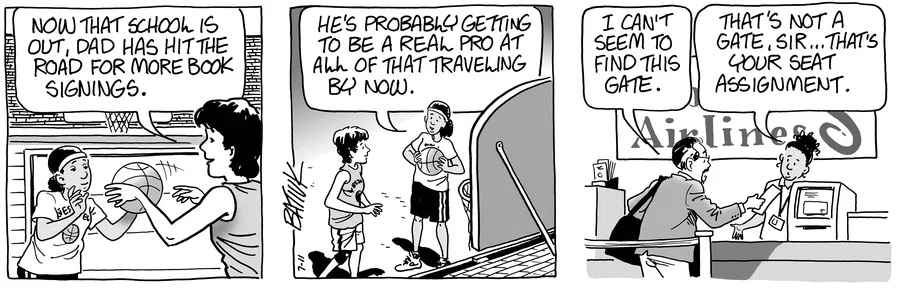
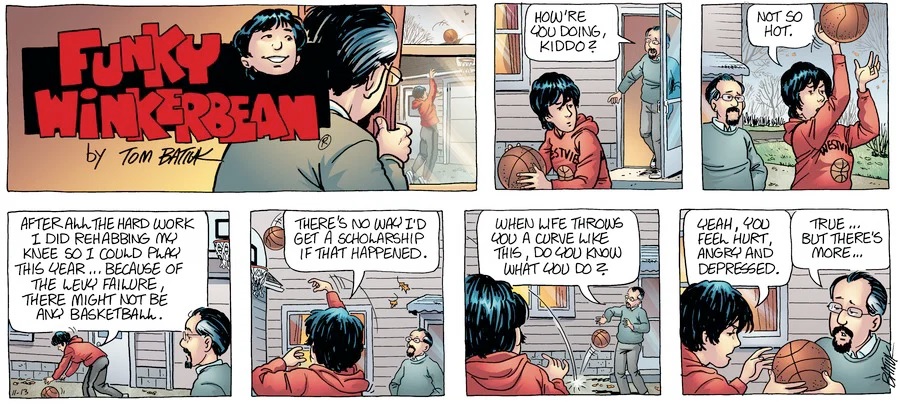
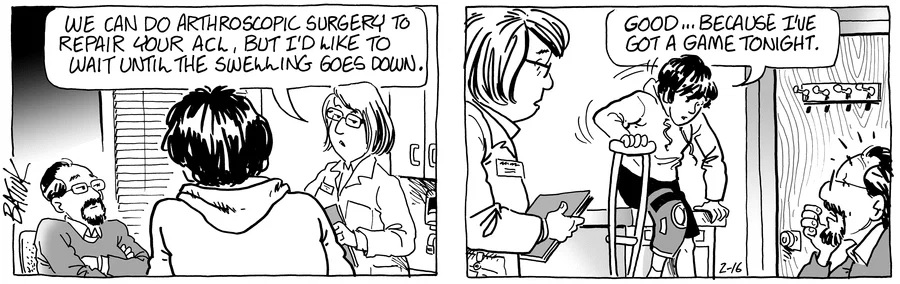
Outside of basketball stories taking place in the winter, Summer’s presence is mostly just that; present. A character who hangs around but doesn’t do much of anything. For her final year of high school that’s really not going to be changing all that much. Her knee having exploded earlier in the year, by the summer it looks to be mostly healed as she’s back to shooting hoops with Keisha in a set up for a week of already tired “Les meets weirdos at a book signing” strips.
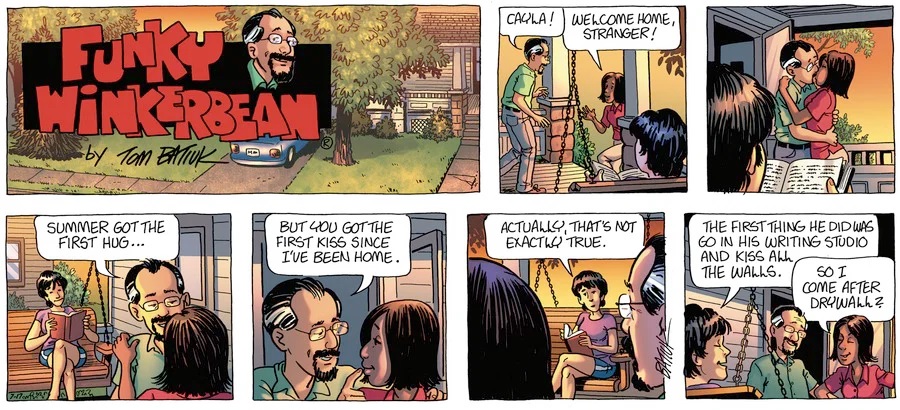
She does at least make fun of him upon his arrival home, however.
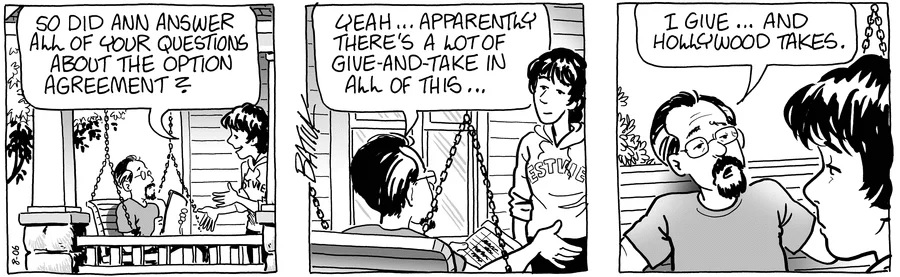
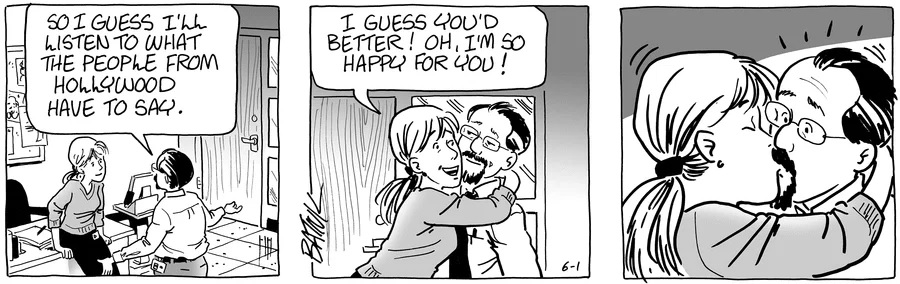
She also gets to be a sounding board for Les’ complaints about how Hollywood is mucking up the Lisa’s Story adaptation.
“They asked if the masked death concierge was necessary and I was just so offended!”
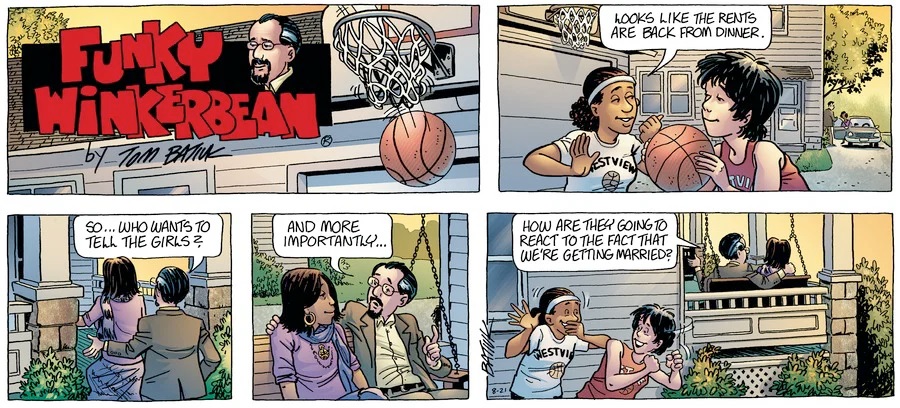
With the ghastly gold digger exiled from both Westview and the strip, there’s nothing standing between Cayla and the man of every woman’s nightmares. Les decides that it’s time to do the most important thing he’ll need to do in his post-Lisa life which means a fancy dinner at Montoni’s and sitting Cayla down on Lisa’s bench to tell ask her if she’d be willing to be his favorite runner-up. Cayla, of course, gleefully accepts and they arrive back at Les’ wondering how to spring the news on their kids. But of course the “rents” don’t realize that Summer and Keisha are eavesdropping on them like 8-year-olds.
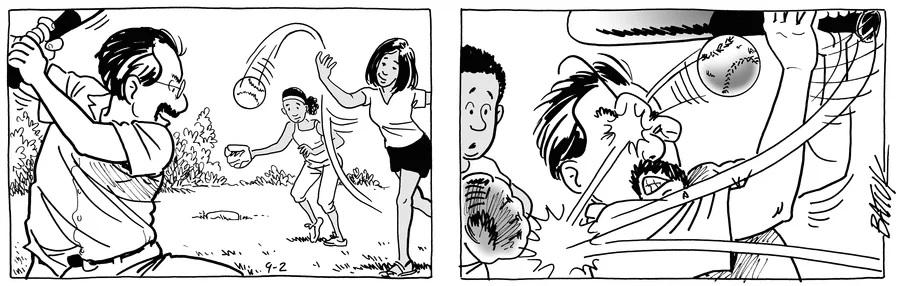
In celebration of his new engagement, Les gets invited to the cookout and spends labor day with Cayla’s family. Summer gets half-assedly drawn in the background of a couple of panels but the main event is getting to see Les hit in the face with a softball.
Hahaha!
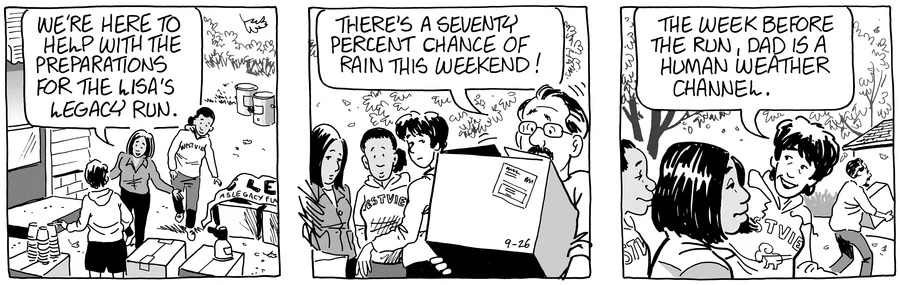
Summer also gets to show up kicking off the requisite Lisa’s Legacy week which by now is beginning to feel like something Batty includes more out of obligation than interest.
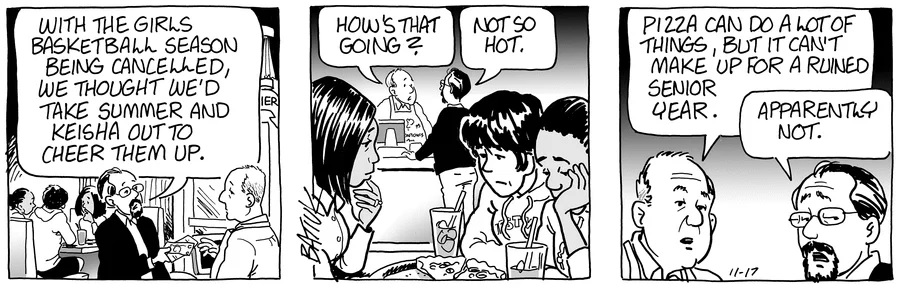
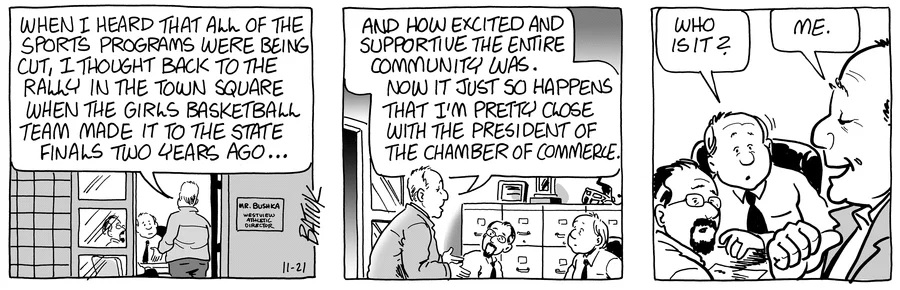
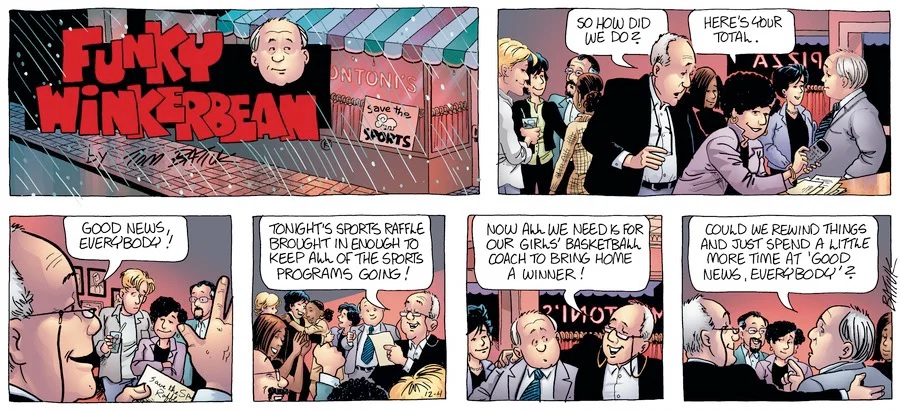
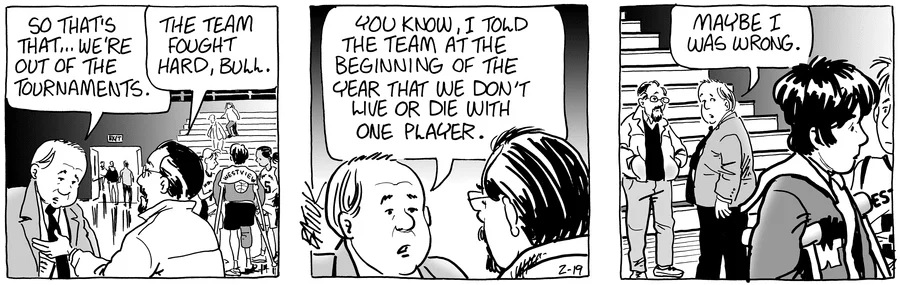
Fall and the start of the new school year also brings with it one of Batty’s favorite stories: school levies! And surprise surprise, the ignorant clods once again voted it down so now the raises of Linda Bushka, Jim Kablichnick and the other two teachers at WHS are in jeopardy. But not just that, funding for athletics have been gutted too. Bull had earlier tried getting around this by implementing a “pay to play” scheme for the teams but that’s not enough and with the failure of the levy, it’s announced that the sports programs are being shuttered.
To add insult to injury, Les and Cayla decide to “cheer up” their kids by feeding them some Montoni’s slop.
But while everyone else mopes, Funky decides to do what characters in this series very rarely do and take some initiative. It turns out that he’s the head of the local Chamber of Commerce and he’s not about to take this problem lying down.
His genius idea is to hold a raffle and go around to local businesses so that they’ll offer prizes for it. I’m not really up on how all of this stuff works so I’m not sure if a raffle would actually be enough to subsidize an entire school’s athletic programs for the year which I assume would be in the range of hundreds of thousands of dollarydoos. But I suppose that’s why Batiuk is the somehow reasonably successful cartoonist while I’m snarking on his comic strip for free.
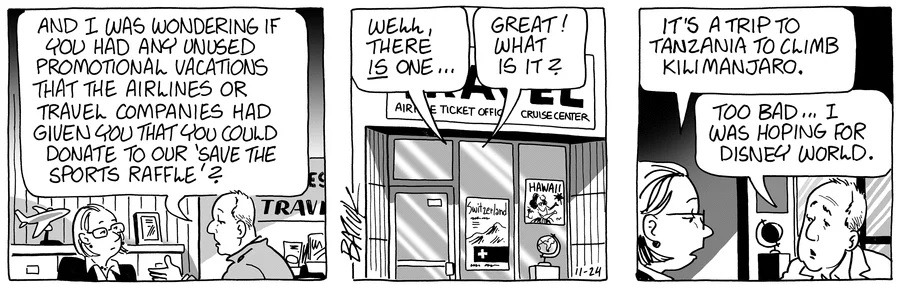
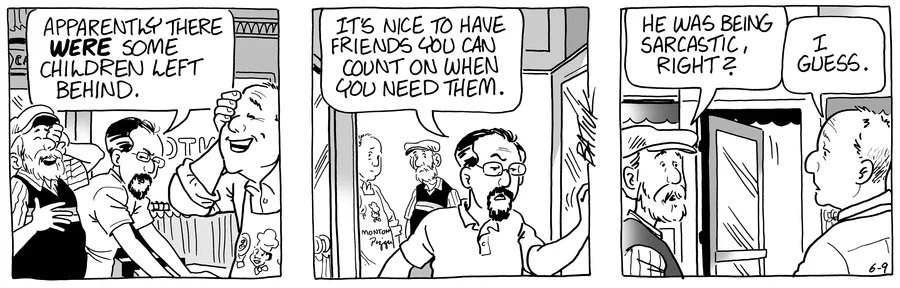
Funky gets to work and by “gets to work” I mean we get a couple of days of a travel agent pawning off onto him a trip to climb Kilimanjaro that they weren’t able to get rid of in something that is totally not foreshadowing.
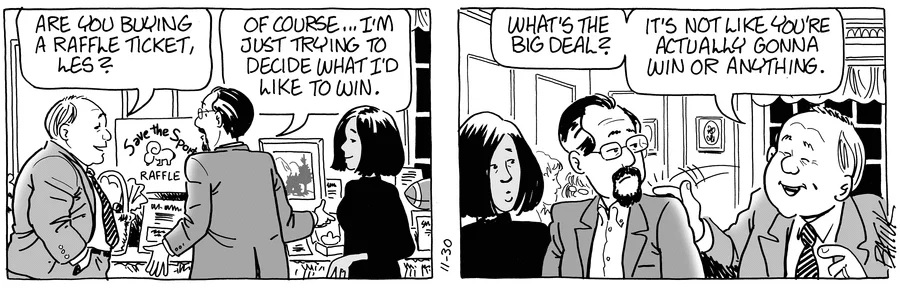
Come the day of the big raffle, Les is naturally there to buy a ticket and Bull is there to, in a roundabout way, call him a loser. That’s how I’m interpreting it at least.
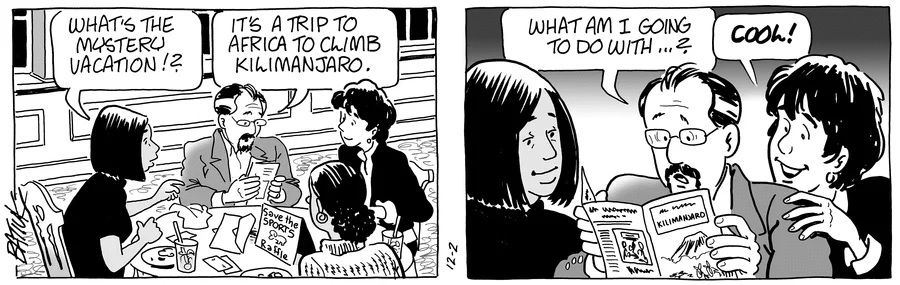
But TB is the master of dramatic irony so of course Les does in fact win a prize and what prize does he win? Why that Kilimanjaro trip! Beacuse like a master bowler, Batty sets ’em up and knocks ’em down. Les being who he is, he’s not exactly thrilled but Summer, being who she is, is excited.
But good news, Funky’s raffle scheme somehow worked and the season is saved. Summer gets her final season after all!
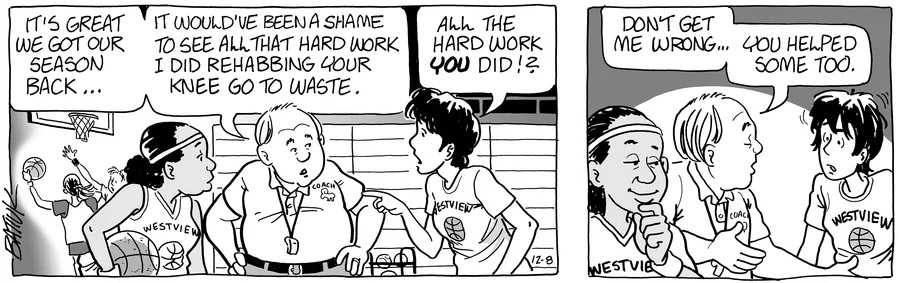
TB, being the master storyteller that he is, decides to wrap up this year of tribulation for Summer with some levity by having Bull rile her up a bit about her rehab.
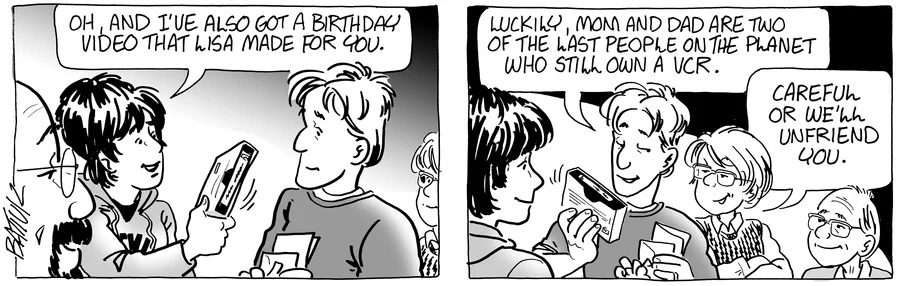
It’s also Dopey’s birthday so Summer decides to rile him up by giving him AARP membership; LMAO. And of course St. Lisa has a tape for just this moment as well. Why she’d have a tape for a random birthday instead of a milestone one is beyond me but Lisa’s going to do what she’s going to do and inserting her desiccated visage at inopportune times seems to be her final act of revenge on the world and the people in it.
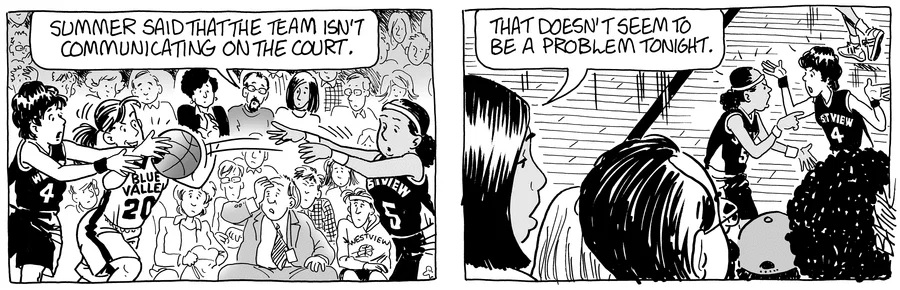
But with all the rehab, all the effort to save the sports programs, the Lady Goats begin the season with a losing streak potentially flushing everything down the crapper.
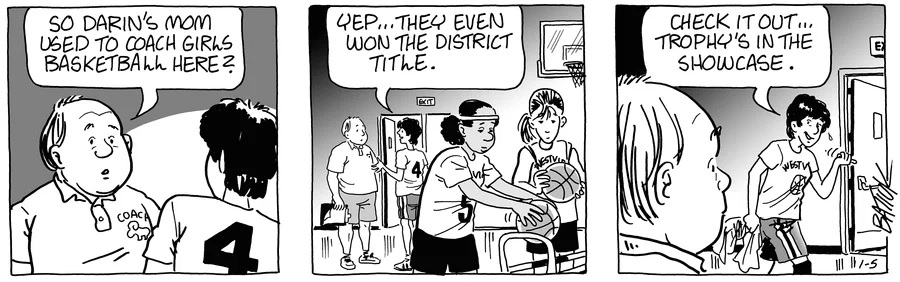
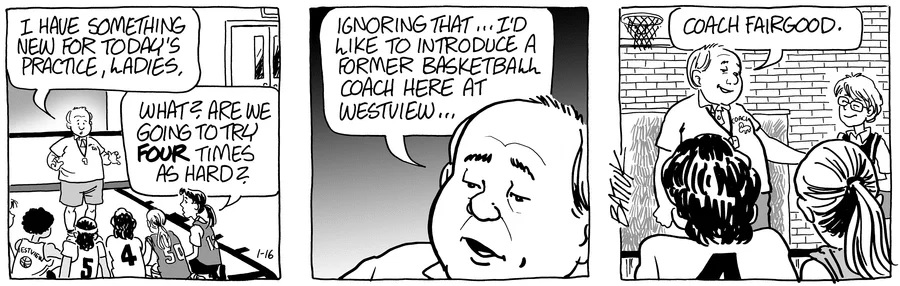
But Summer realizes there may be a solution and tells Bull of a mythical figure: someone who, prior to his arrival, managed to actually bring a championship to Westview. None other than Ann Fairgood, her half-brother’s adoptive mother.
Why Bull wouldn’t know this considering he was a student at Westview while Ann was a teacher and coach is beyond me but by this point we know that continuity for Batty basically only exists when the immediate story calls for it to. Whatever, he goes to the Fairgoods’ home to talk to Ann and brings her in to give a motivational speech about her own history.
But when she suggests some plays he decides to go one step further and name her the new assistant coach. This winds up paying off, unsurprisingly, and the Goats snap their losing streak.
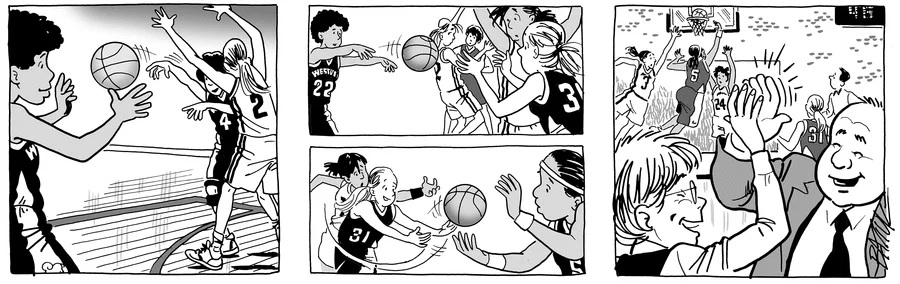
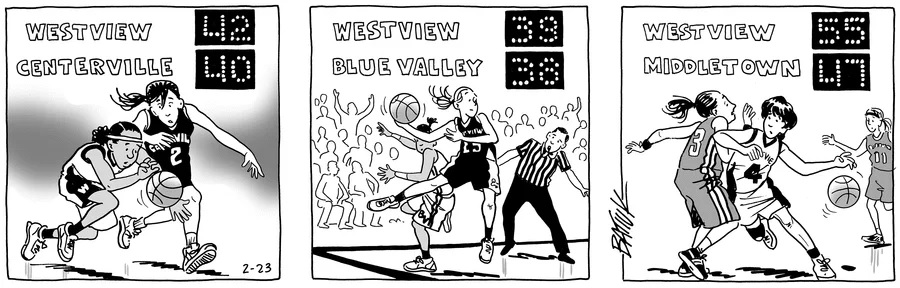
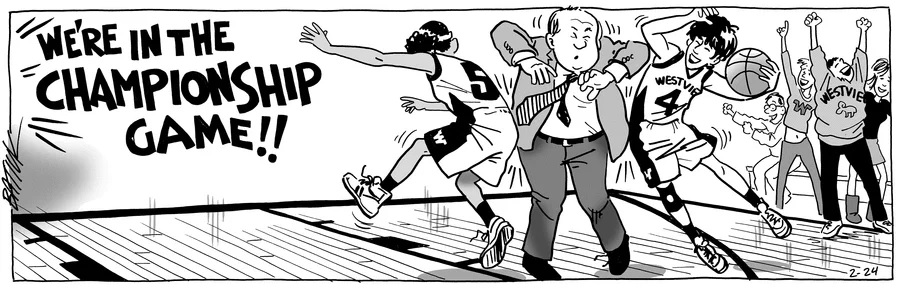
With this, the Westview girls proceed to turn things around and tear up the (regional? conference?) tournament.
By knocking off Big Walnut Tech they’ve made it to the state championship game in a rematch from two seasons prior against Our Lady of the Cedars.
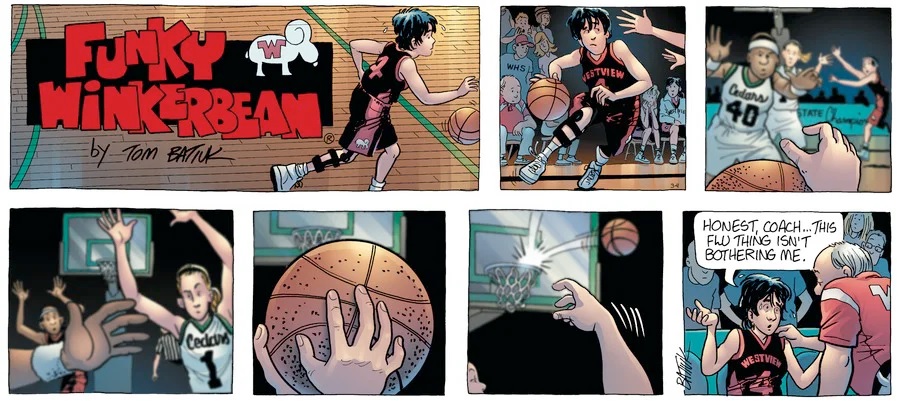
But alas, TB throws in a swerve when on the way to the game it turns out that Summer has become ill.
Yes indeed, in deciding to pull from reality Batty decides to reach 15 years into the past and equate Summer with the greatest basketball player ever by recreating the famous “Flu Game” from the 1997 NBA Finals where a violently ill Michael Jordan dominated and hit a legendary shot in the closing moments.
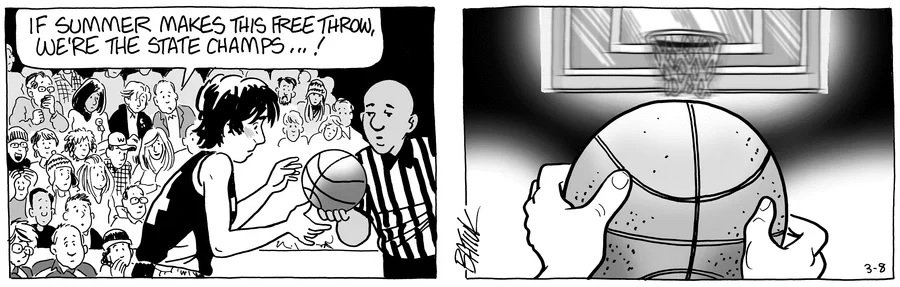
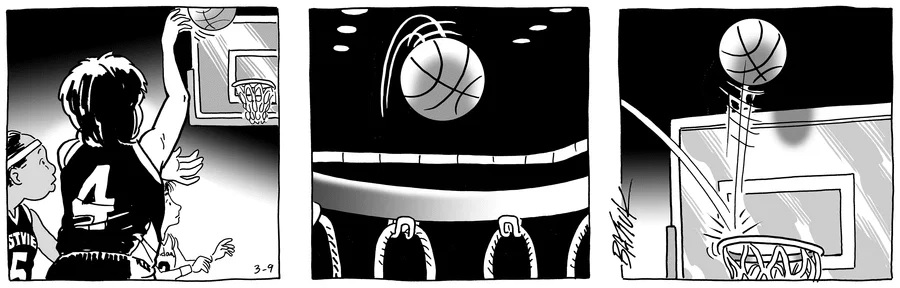
In the closing seconds, Summer takes a hard foul and it’s up to her to sink the free throws.
She takes the shot. Tension builds…
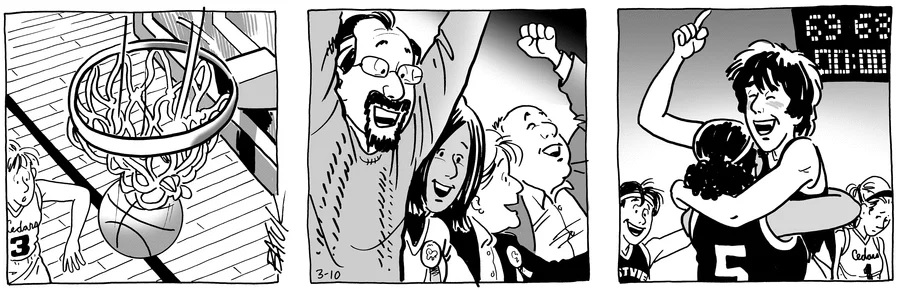
But of course, she did it! The Lady Goats are your new state champions!
One teeny-tiny problem though: this is not how basketball works. There’s no such thing as a “walk off free throw” as there would still be some time on the clock and the other team would have been able to either inbound or rebound (assuming Summer misses the second shot) and try to heave it for a miracle if there was enough time to do that. The game isn’t going to end then and there just because Summer hit a free throw even if it was effectively over. And the worst part? Batty knows this because there’s a strip prior to this where Les admonishes Bull about how there are no walk off free throws. So Batty is disregarding a basic rule of the sport that he himself acknowledged some weeks prior just for nonsensical drama.
If this is what he wanted to do, why do the free throws in the first place? Why not just have Summer hit a buzzer beater? This is not hard and yet he makes it more difficult than it needs to be by not taking five seconds to think about if what he’s writing actually makes any sense.
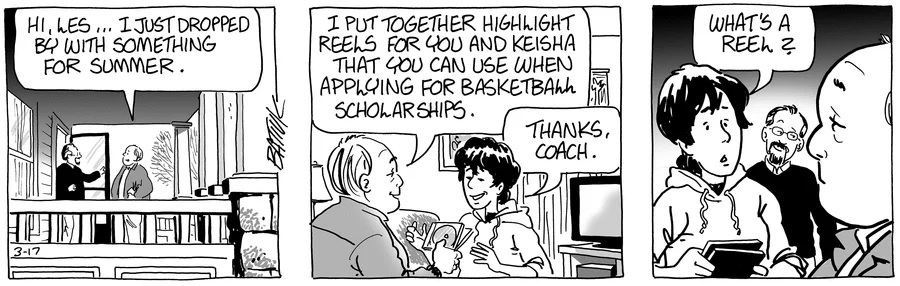
Anyway, having coached Summer to a championship and rehabbed her knee, Bull does one more solid and presents her with a highlight reel of her high school play that she can send off to colleges. A nice enough gesture although with Summer being such a highly regarded player wouldn’t she have been scouted and approached by recruiters long before this point anyway?
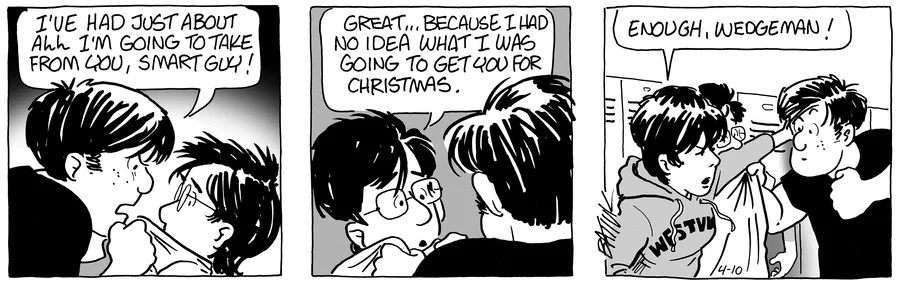
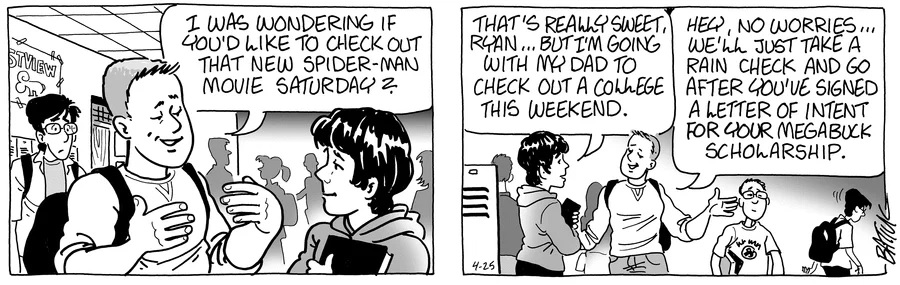
In April, the two tracks of high school that Batty has been working with finally come together when Summer shows up to save Cody from getting pounded by Wedgeman. Much like every high school generation has its loser male geek duo and its vapid popular girl so too must it have its loutish bully and Wedgeman is the current one in the line that goes back to Bull and Stoneironmarblehead Morton. And just like the vapid popular girl, it’s diminishing returns in terms of his characterization i.e. it’s nonexistant beyond “is a bully.”
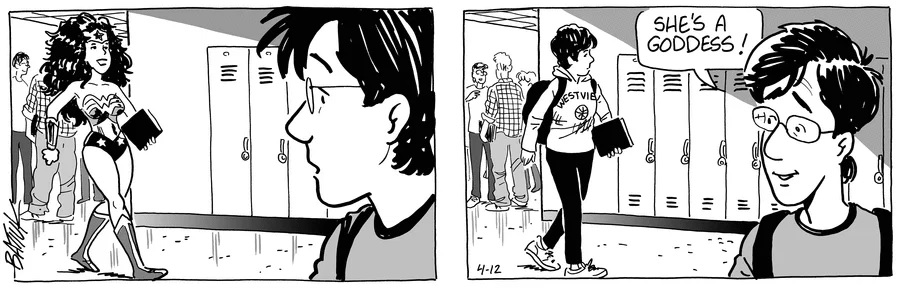
Cody, of course, falls in love with her and can’t help but see Summer as Wonder Woman who I assume is also Tom Batiuk’s own waifu.
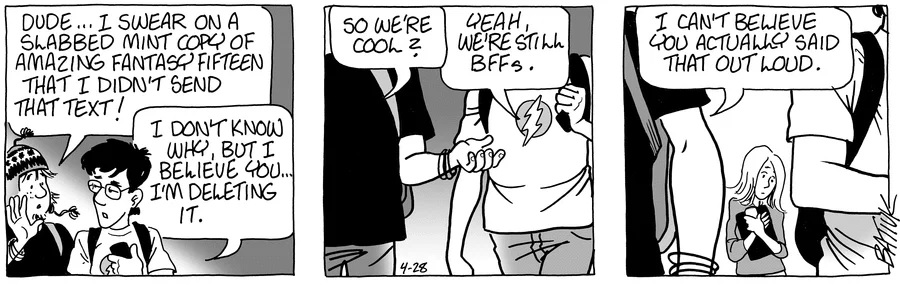
Thus starts a rather nonsensical storyline for the next few weeks where Cody decides to send an anonymous text to Summer declaring his love for her and, can you believe it, she sends an anonymous text back! How Cody would have her number to even do this I have no idea. Owen, though, spends the whole thing acting dismissive and when she fails to show up for a promised date at Montoni’s (of course) the ruse is revealed. See, it was actually Owen sending those texts to Cody the entire time because he was also in love with Summer and he wanted to I guess disappoint Cody so he’d have her all to himself? I don’t know, none of it makes sense.
But Cody is undeterred and decides he’s just going to tell Summer how he feels in person. However, he sees her talking to Chad and decides to slink away in disappointment even though she’d turned down Chad’s request for a date.
Of course there’s one final twist as someone sends Cody an anonymous text declaring how much they like him. Because of Owen’s stunt Cody dismisses it oh ho it turns out it was a real girl who really does like him. This is of course just an ending stinger and is never again followed up on.
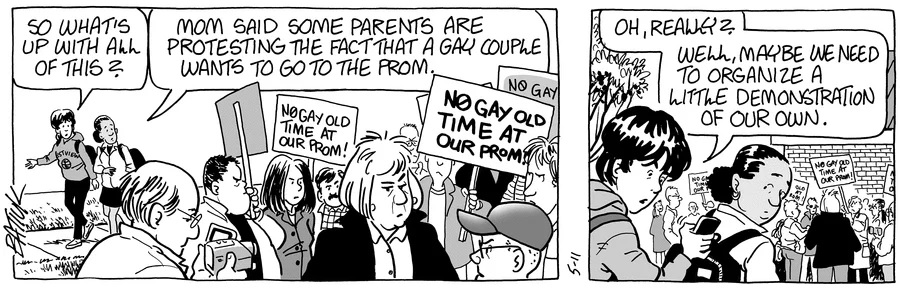
Truthfully, that’s really about it for Summer’s importance during the waning days of her time in high school. The next big storyline is Roberta’s protest over a gay couple being allowed to attend the prom and Summer does seem to be the instigator in starting a counter demonstration against it.
But aside from that she otherwise has nothing to do with the story which is mostly about Nate giving a big speech about how there will be no discrimination at his school. Then Becky’s father tells his wife to shut up and that’s effectively the end of Roberta Blackburn’s time as an antagonist in the strip. The most notable thing about the storyline — besides the milquetoast way that Batty presents his stance — is the biggest unsolved mystery in Funky Winkerbean — who was behind the castle?
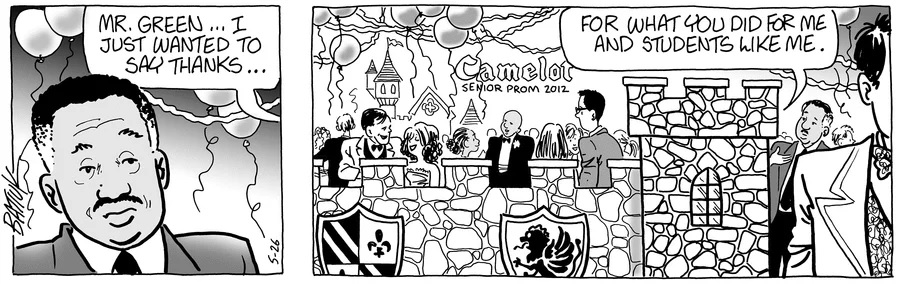
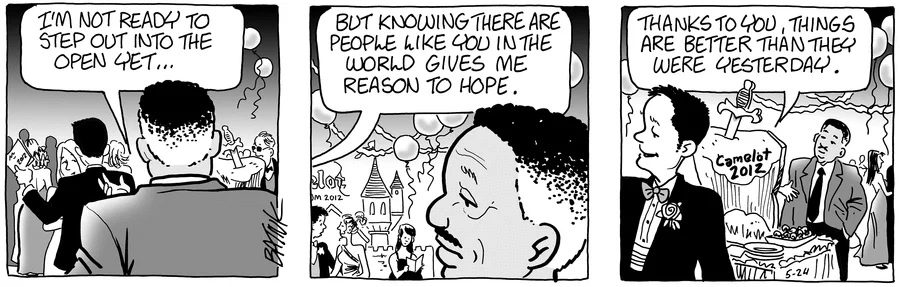
During the prom there’s a couple of strips where a person — of who only an arm can be seen — thanks Nate for what he did for “me and students like me” while declaring that they’re not ready to come out just yet. All while Nate looks like he couldn’t care less. Seriously, why does he look so bored?
So who is Nate talking to? We can really only use process of elimination to narrow it down to a few options. Given that the character is hidden that would obviously imply it’s a known character, otherwise why hide their identity? Of the seniors, the only notable male from this generation is Cory who for reasons of “marries and later has kids with a woman” doesn’t fit; also the person looks shorter which implies it’s probably a girl.
Given the light skin that also rules out Keisha. It probably can’t be Rana given later developments that would make her being gay, although not impossible, very unlikely. So you’re left with three options: Summer, Maddie and Jinx.
Summer did very briefly date a boy early in Act III but at this point that seems like an abberation. But on the other hand, the sporty short-haired tomboy also being a lesbian seems to be such a trite stereotype that it might even give Batty second thoughts. Maddie is (supposed to be) the eccentric girl who marches to her own beat but she’s also effectively a non-character.
Jinx was there for the start of this story and is the one who announced that Nate and his wife were voted prom king and queen. Based on that I’d say there’s a reasonable chance it could be her, you know clumsy hinting from Batty and all. But who knows?
Maybe later strips can be read in a way to make you look back on this and think it was Summer or Maddie. Maybe they’re all gay. Or maybe that hand poking out from the castle wasn’t a real character and was just the representation of gay teenagers which seems like the kind of cop out Batty would do. But unless someone ever asks him directly or he does another Untold Tales (fat chance) we’ll never know.
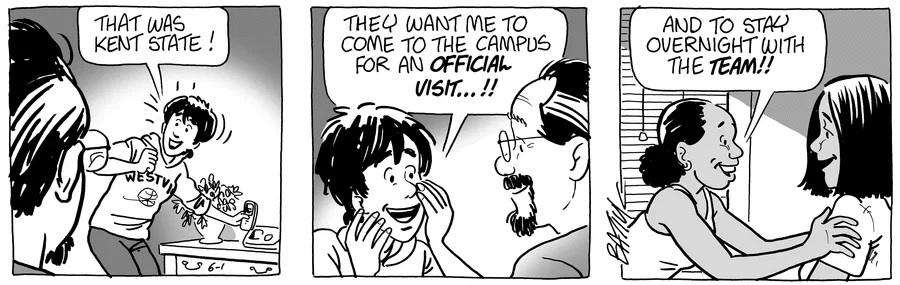
We can speculate until we’re blue in the face but seeing as we’re likely never getting an answer we may as well just move on. In the final few weeks of school Summer and Keisha receive invitations get evaluated by, where else, Kent State. Things go well and they both receive athletic scholarships thus putting a bow on the last lingering bit of their high school storylines.
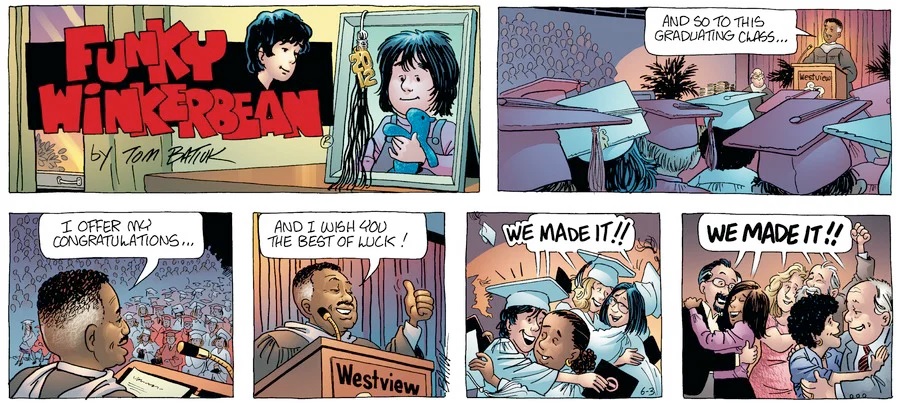
And with that done it’s now time for them to die graduate.
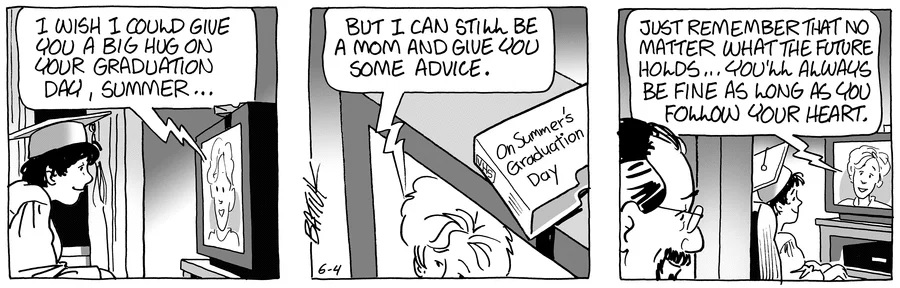
Which is immediately followed up by yet another cancer tape.
Just where will Summer’s heart take her? That’s for next time in what will be, for a long time, Summer’s last hurrah.
Because by the middle of next year Summer’s appearances are going to dwindle drastically. She will continue to pop up for the odd appearance or week once or twice a year post-2012 but once Batty shipped her off to Kent State he was also effectively putting her into semi-exile as his interest shifts more and more to comic books, Hollywood and characters like Darin, Pete and the yet-to-be-introduced Mason Jarr(e) and in the exciting world of elderly geekery, there’s neither time nor place for a jock who doesn’t fawn over the latest MCU flicks and Star Wars movies.
The Batty Blog has been slow lately, but there’s something to talk about this week.
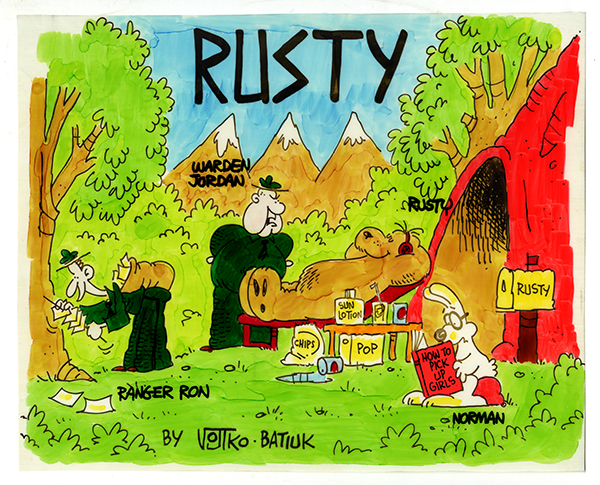
In addition to Funky Winkerbean, Crankshaft, John Darling and the thankfully never-published Dick and Jane, we now learn that Tom Batiuk tried foisting a fifth comic strip onto the world. Meet Rusty:
When you were atRoger Bollen’s house, did you tell him were planning to do this?!
Tom Batiuk confirms what you’re already thinking:
Basically a hipper Yogi Bear, a cartoon that was long in the review mirror by that point.
Clearly Yogi’s hipness was only updated from 1961 to 1973, since one of the three example strips we’re shown was a fondue joke.
I’ll let Batiuk tell you the rest of the story as only he can:
I’d only been doing Funky for a few months when Bob Votjko showed up at our apartment wanting some advice on his work and wanting to know how to get syndicated. I was barely started myself at that point so I don’t know how much help I was (none),
Through Batton Thomas, Tom Batiuk has told us at great length how he went to a cartoonist’s home, wanting some advice on his work and how to get syndicated. And now he’s received the same visit, and he’s being all self-deprecating about it? Did Batiuk fail to recognize the role reversal from his own life, just a few months ago?
“Oh, I’m sure I was no help, even though I did the exact same thing, and could have easily passed along all the information I collected from much more accomplished cartoonists than myself.” He’s so quick to play the self-deprecating card that he doesn’t notice when it makes him look like an asshole.
We didn’t have any luck syndicating it, although it did prove providential in a couple of ways down the road.
“We were unlucky, but we were lucky.”
Its strong ecological bent probably wouldn’t fly in today’s political environment, but nevertheless it holds up rather nicely.
“It didn’t age well, but it aged well.”
But just because we couldn’t get it in the papers, doesn’t mean that you can’t enjoy it.
This sentence seems like another instant self-contradiction, but it’s actually completely meaningless. Being in the papers and being enjoyable have nothing to do with each other.
There are comic strips in the newspaper that you can enjoy (Calvin & Hobbes, The Far Side, Peanuts). There are comic strips in the newspaper that you can’t enjoy (most of them these days, especially the Funkyverse, except for the perverse enjoyment we get from it). There are comic strips not in the newspaper that you can enjoy (Penny Arcade, dozens of other good webcomics). And finally, there are comic strips not in the newspaper that you can’t enjoy (because many talented creators never got the exposure they needed to reach you).
I’m going to roll it out day by day just like you would have seen it had it appeared in your daily newspaper.
In 17 days, we’ve gotten three strips that don’t appear to be in any kind of chronological order, or look like an introduction to the comic strip. So Lord knows what he’s even trying to say here.
Last time, we saw Summer’s on-the-court play take a step up only to run into a wall when she and her team got trounced. She’d also gotten caught up in the ongoing love triangle between her father and two women with rather poor taste. Despite Les and Cayla officially being a thing, TB saw need to throw doubt on the relationship as Susan Smith — that sinister suicidal succubus — proceeded to butt her way into things, a process made all the easier because Les is an oblivious moron and Cayla is a character with absolutely no spine. Summer’s importance after the first few months took a backseat as Batty began diving into fiction’s most laughably unbelievable love triangle and unfortunately for her, 2011 is going to go much the same way as 2010 for a while.
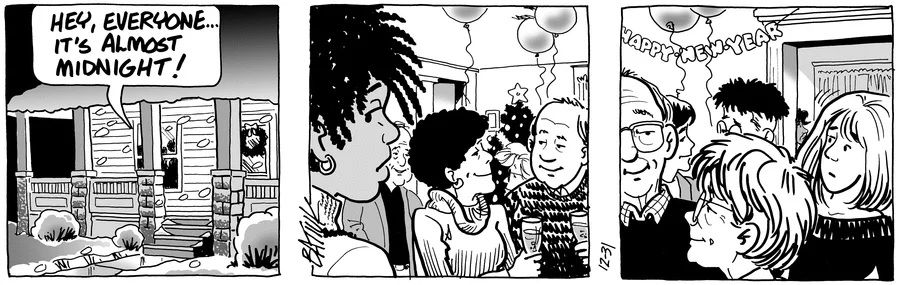
But there is a light at the end of the tunnel as Batty will finally put this interminable storyline to rest. But not before he goes in guns blazing, pushing Summer out of the way in the process. Right from the jump, 2010 ends with Cayla and Susan at Les’ New Year’s party. As the clock ticks closer and closer to midnight, they both anxiously look around for their dickheaded dreamboat, each hoping to be the one that he rings in 2011 with.
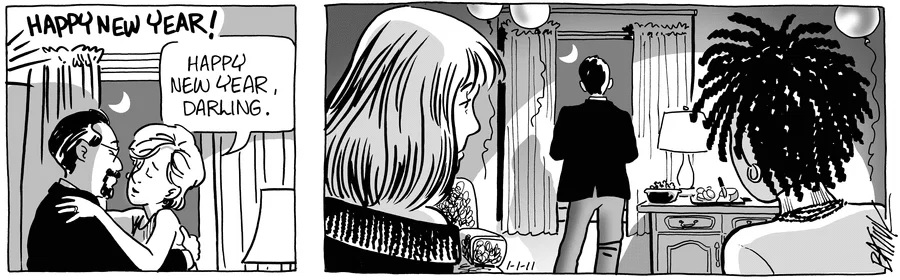
But alas, the bespectacled beefcake is already claimed as they find him instead making out with the ghost of his dead wife who, need I remind you, called in a bomb threat just a week or so earlier.
“It was romantic,” he later thought to himself. “Her ghostly lips tasted of Ecto Cooler.”
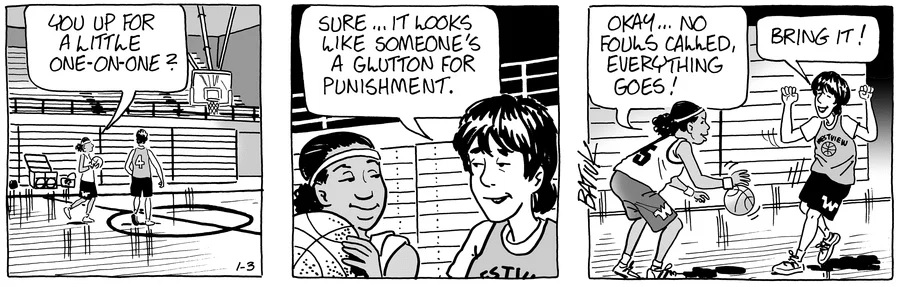
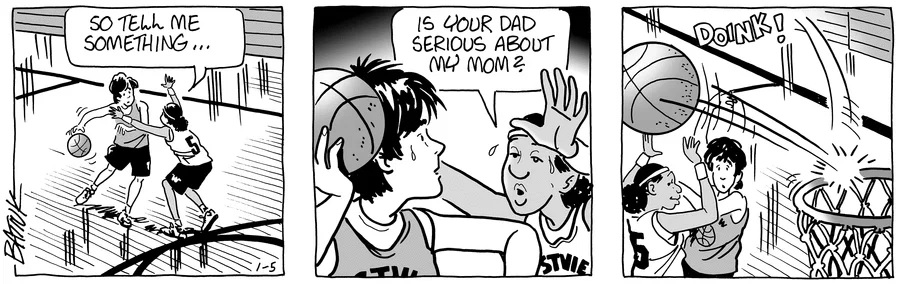
Summer and Keisha, meanwhile, decide to ring in the new year with a little one-on-one.
But Keisha either intended this whole game as a ruse to talk about important issues or she simply resorted to dirty tricks once she started losing to Summer. Both are equally plausible.
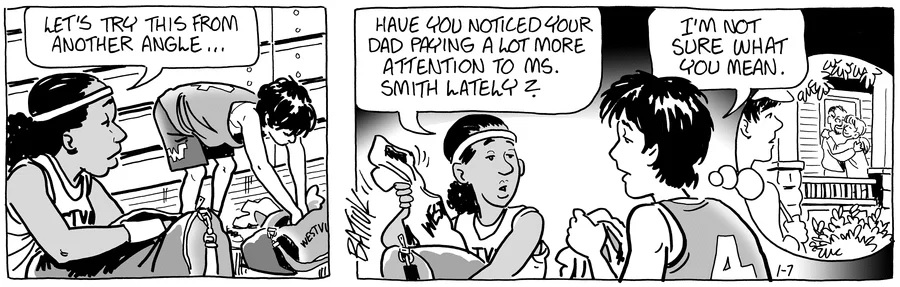
Dissatisfied with Summer’s inability to know what her dad is thinking at all times, Keisha then decides to switch it up.
“She’s a whore, Summer, that’s what i mean. Anyone who stands against my mother and that handsome stud muffin is.”
Keisha says that maybe the two of them should try nudging their parents closer together and Batty decides to end the week with a fancy (for him) narrative transition to show Les being an absolute prick under the guise of him just being a little frazzled. Of course, we know better.
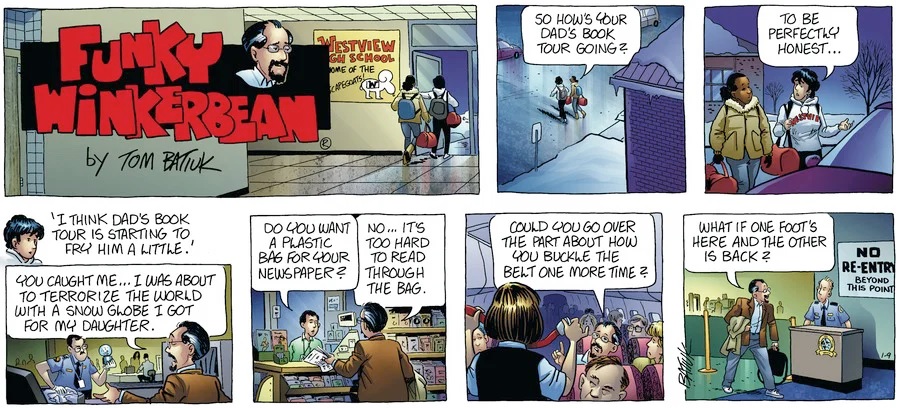
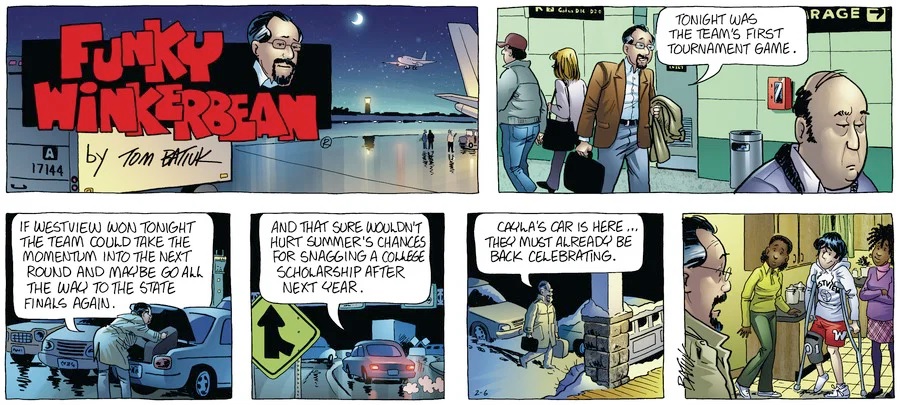
After some “hilarious” Dinkle and the Band shenanigans, it’s another of Les’ endless book tours with some never before seen college friend of Les, since Batty never ever shows his characters actually attending college 99% of the time. He spends the entire trip back from the airport muttering to himself like a complete lunatic about Summer’s chances in the tournament but it seems fate had different plans.
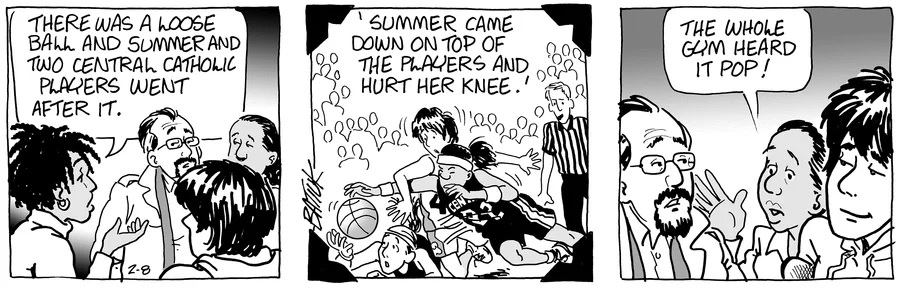
We’re then regaled with the tale of the destruction of Summer’s knee along with the death Les’ dreams of not having to shell out money for his daughter’s higher education.
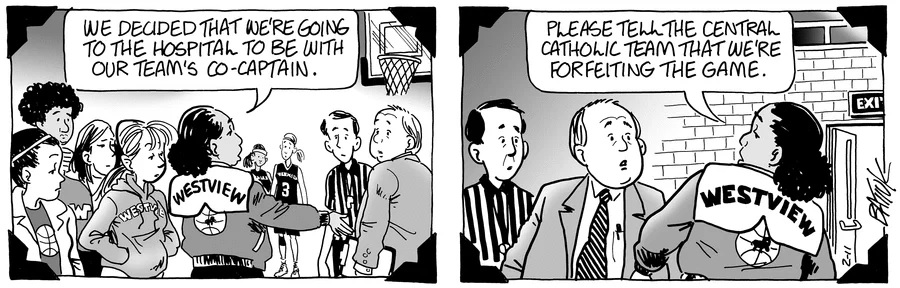
Having watched five too many inspirational sports movies and conflating them with real life, Batty decides to have the Lady ‘Goats do the logical thing and forefeit the friggin’ game to “be with their co-captain.” Because that’s something real teams do all the time of course and not just a cheap attempt at trying to wring sentimental pathos out of this wet rag of a story.
And then the ghost of Brian Piccolo showed up and said “If you build it, you can win one for the Gipper,” while Rudy stood in the doorway and nodded.
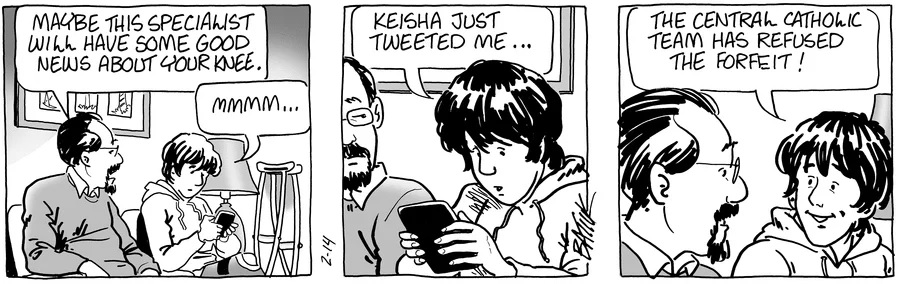
In a show of good sportsmanship, the other team refused the forfeit meaning the game was going to be replayed (does this actually happen?) much to Summer’s delight.
Summer will, of course, need surgery but not quite yet which she’s also happy about because it means she gets to inspirationally cheer her teammates on.
But alas, this strip is a quarter-inch from reality and thus unlike an inspirational sports movie or an anime where good vibes and the power of friendship can will even the smallest minnow to victory, Summer’s encouragement doesn’t prevent the team from losing and ending their season. Which kind of makes it seem like Central Catholic was so offended by the whole forfeit thing that they refused it simply so they could kick the asses of the She-Goats once more for good measure. Just to show them who’s boss.
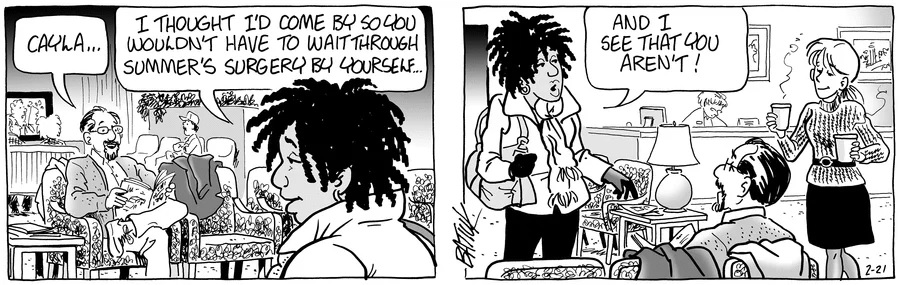
With the tournament done, Summer now has to get her knee surgery and Cayla’s there to support Les in what’s obviously his hour of need. But oh no, that horrible harlot has decided to make her presence known here too!
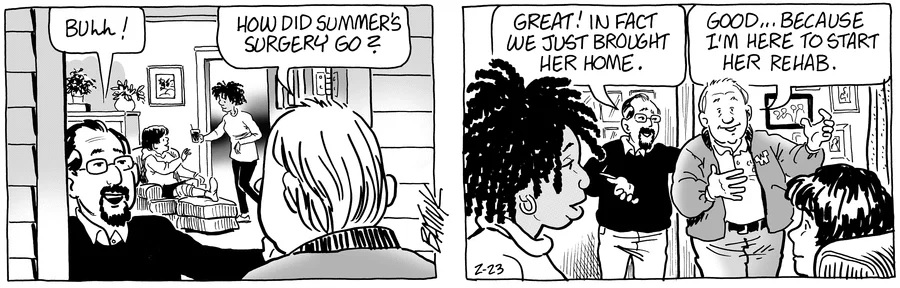
But that’s not all! With Summer’s surgery a success, Bull shows up at Chateau Moore to offer his services and help Summer rehab her knee.
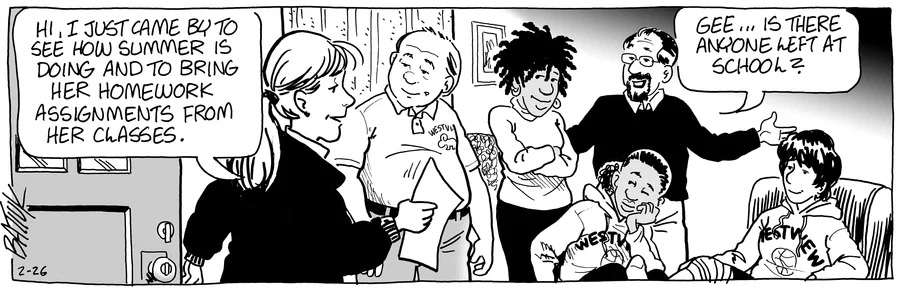
This is but one of the many acts of kindness that Bull has paid and will pay to his former victim that will go unappreciated by Les. Instead, Les and Cayla will opine about how awkward it is that his former bully is now helping his daughter as if he and Bull hadn’t been friends since before Summer was even born. To cap things off, the vile vixen also stops by to bring Summer’s homework and of course Les has to get in a snide little remark.
At least Linda didn’t come by to kill the mood and tell Summer that trying to rehab her knee would be pointless.
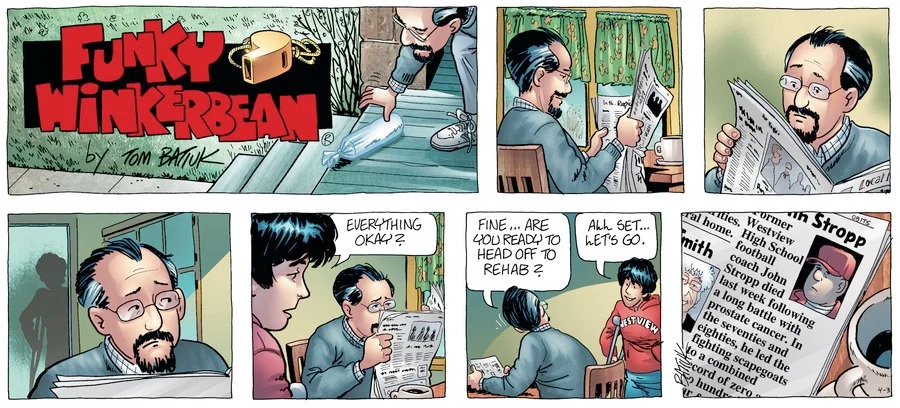
After a month or so of Dinkle, Owen and Cody’s nonsense, it’s back to Summer’s knee but not before TB decides to off the long-retired Coach Stropp.
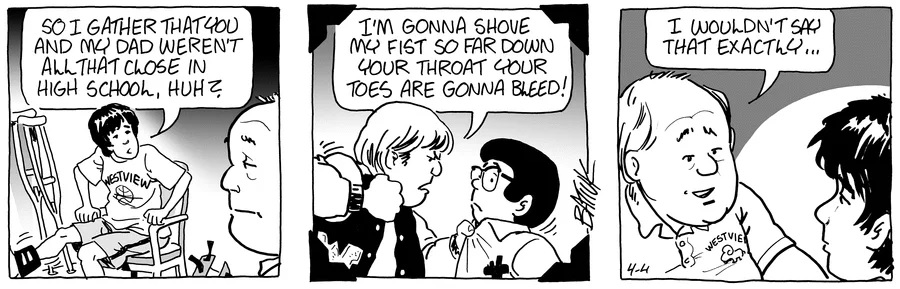
Summer talks to Bull a bit about he and her dad knowing one another. This is the infamous week where it’s revealed that Bull’s bullying of Les was actually a ruse the whole time cooked up to protect Les from even worse bullies. A revelation that is utterly pointless as like so many other things with Bull and Les after Act I, it’s promptly ignored.
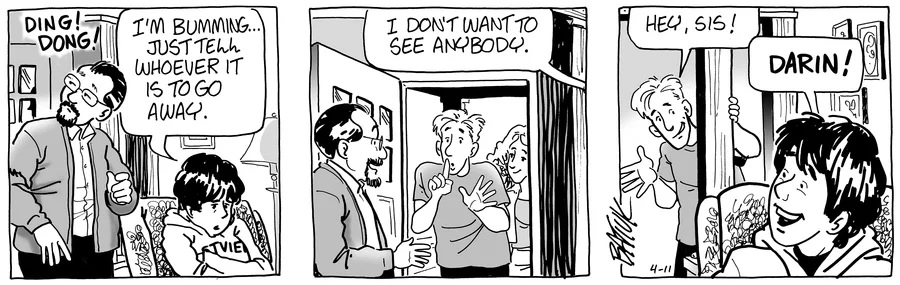
Summer, who’d been largely positive about her rehab, is now starting to feel the effects of inactivity which has made her cranky. But she’s about to get cheered up by a certain Saint’s Son.
She will always be the only person in existence, both in reality and probably in-universe, excited to ever see him.
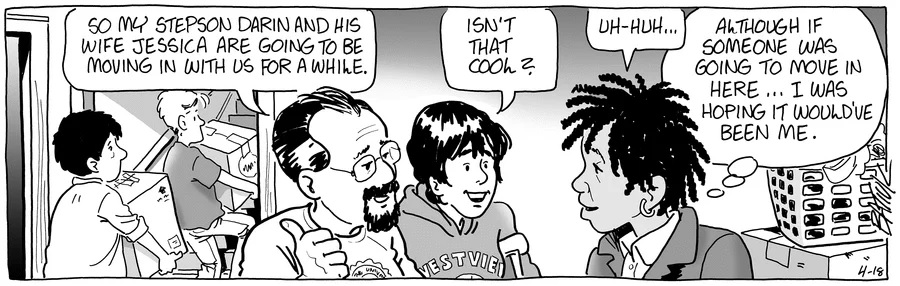
After about 3 and a half years, Darin and his bride creep their way back into the comic to take their rightful place amongst the main cast. Well Darin does anyway as he and his funny books crew will come to increasingly dominate the strip; Jessica just kind of hangs around. We learn that he accepted a buy out from wherever he was working for unspecified reasons (they went under? who knows) and is effectively a jobless, homeless bum. Except not really because Les immediately gets him a job at, where else, Montoni’s and allows Darin to move in with them.
Summer’s excited but Cayla isn’t because god forbid she ever be proactive about anything in her life.
“Oh, I did nothing and got nowhere because of it! Woe is me!”
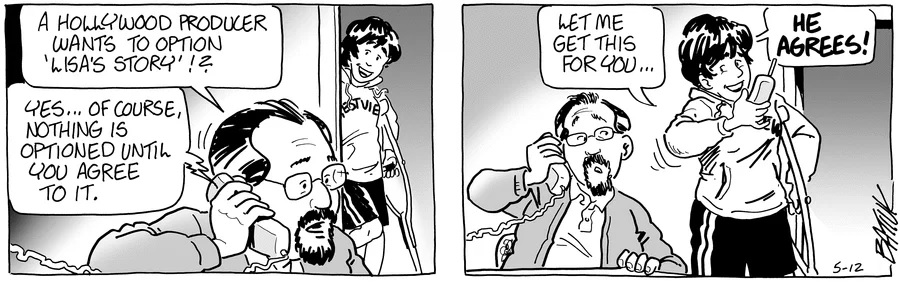
After the requisite month’s worth of strips is spent on reintroducing Darin to the strip’s dozens of readers, we move on to the next part of this grand tapestry that Tom Batiuk so skillfully weaves. Ann Apple, the homeless schizoid-turned-literary agent, calls to tell Les that someone wants to option Lisa’s Story into an actual movie. And not just anyone, but Hollywood! Yes, the entirety of the film industry is apparently just some monolithic entity and it needs to feed itself on the self-pitying misery literature produced by a mediocre and delusionally self-important high school English teacher.
Summer, being slightly more proactive than either her father or his milksop girlfriend, decides to take matters into her own hands when Les begins to falter.
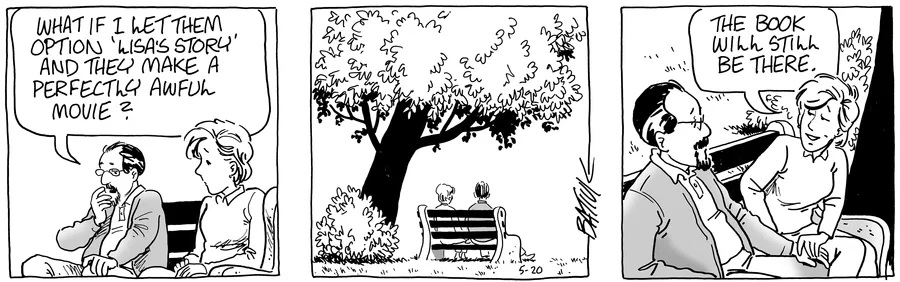
Well that should be the end of it but Les himself has to agree which means a week of him sitting on a bench and talking to Ghost Lisa about all the ways in which Hollywood will ruin it. Personally I feel like all they’d need to do is give it a more accurate title; Tuesdays with Boring should work.
In the end, the spectral Lisa is able to set Les straight and get him to agree to it.
Why experience the awfulness in just one format?
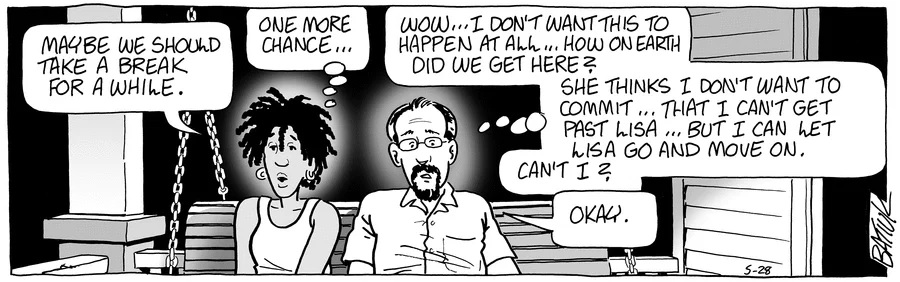
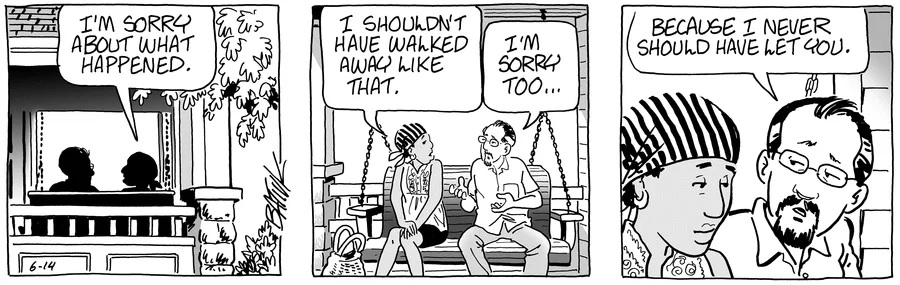
With everything coming up Les, he and Cayla sit on the Sacred Throne aka the porch swing and Cayla decides to tell Les “I love you.” Les can only fumble around like an idiot and not say the words back which upsets Cayla who decides they should put the brakes on things for the moment. This is mostly a test to try and get Les to stop being an idiot and Les, predictably, fails it.
But Cayla has made a mistake and the terrible temptress decides to make her move and fill the newly opened up woman-shaped hole in Les’ life. Alone in a classroom, Susan locks lips with the hunky man of her dreams.
Les now, finally, realizes that he has two women in love with him and decides to tell Funky and Crazy Harry about his dilemma. Funky and Crazy do what any reasonable people would do when confronted with the idea of Les the Lothario and proceed to laugh in his face. This pisses him off and causes him to storm out of Montoni’s like a baby.
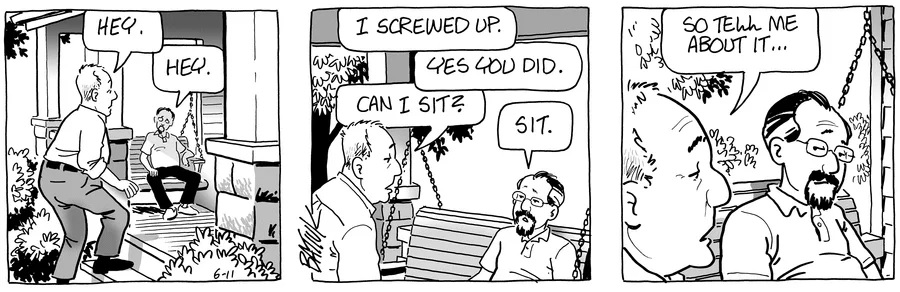
We then get what is an all-timer in terms of Les’ unwarranted self-importance where Funky is forced to apologize to him and he snidely tells Funky “yes you did” to Funky’s admission that he went too far.
And it’s not just Funky as Cayla comes by to also apologize to Les for getting upset at him being an emotionally stunted dunce.
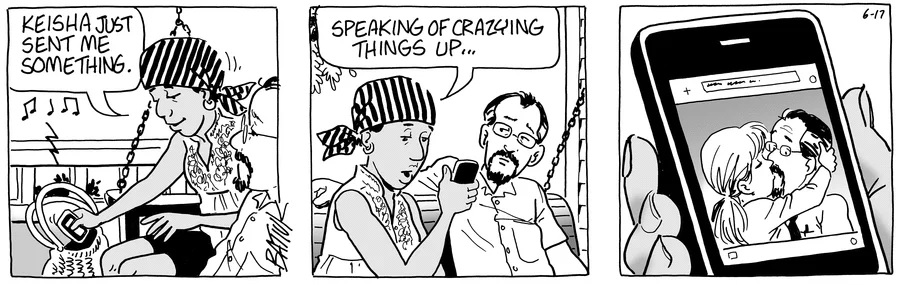
Keisha decides to send her mother a little image she just so happened to have.
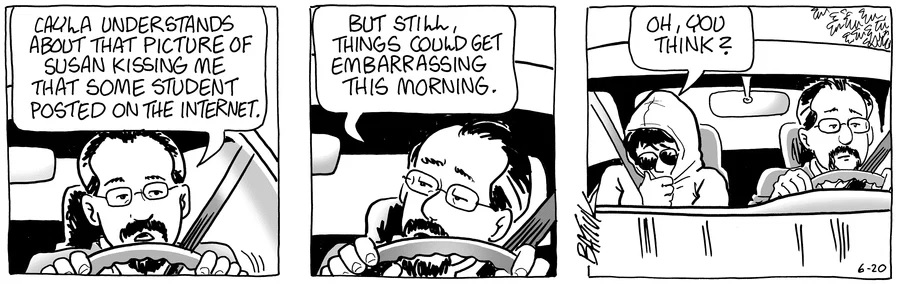
Les explains the whole deal of what happened with Susan to Cayla who accepts it with little hesitation but worries about the reaction of others as the picture gets passed around. Summer, embarassed over the whole thing, decides to cosplay as the Unabomber to hide her identity.
Check out her forgotten first book: Infunkstrial Society and Its Future.
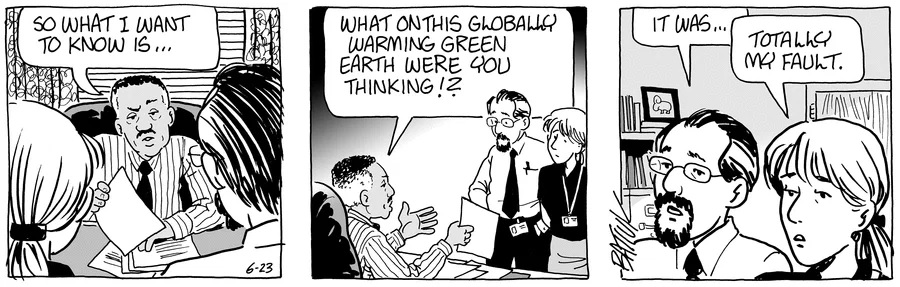
The photo has quickly spread around school so Nate calls Les and Susan in so they can explain what it’s about. Any blowback Les could have received is immediately dealt with by Susan sacrificing herself and taking all the blame instead.
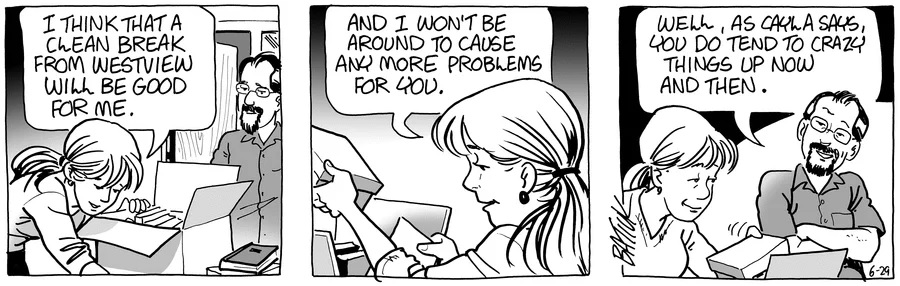
Susan decides to resign from her position and tells Les that she’s making a clean break from Westview entirely. Les makes a bunch of pithy and somewhat insulting remarks over the whole thing like the giant tool that he is.
And then decides to bid goodye to Susan with what might be one of the most eyerollingly stupid and infuriating things he says in the entire 50 year run of the strip.
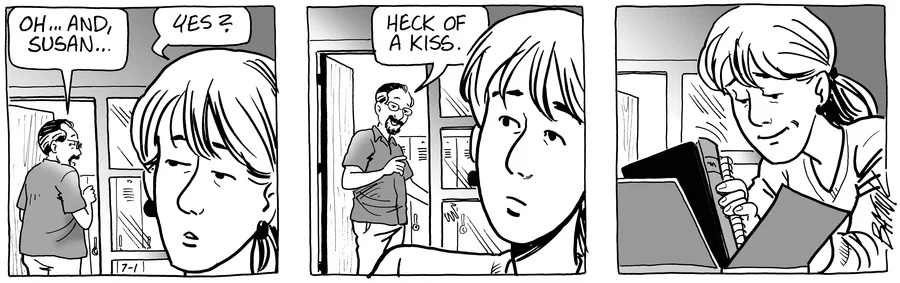
“Heck of a kiss,” are you fucking kidding me? What a Grade-A turbo douche.
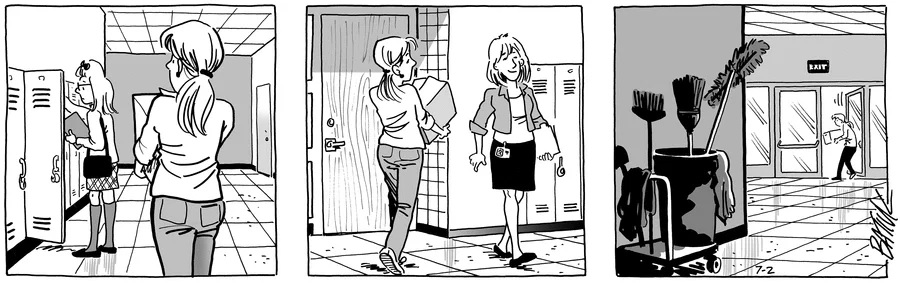
Susan gets one final sad and lonely trip down the halls of Westview High, reminiscing over her life there before exiting the school and thus the strip entirely.
Perhaps because people might have thought that Susan went off to try and kill herself once more, in the waning days of the strip Batty will randomly follow up this story with the immediate aftermath. Susan stops at a bridge, gets out and looks over the side but gets a pep talk by the conveniently passing by Ed Crankshaft.
But, and this is a real knee slapper, it turns out that Susan’s car merely ran out of gas. Ha ha, you thought she was going to toss herself off of the bridge because she’d tried to commit suicide before! Isn’t that hilarious!? Suicide Suzy, that’s what they call her!
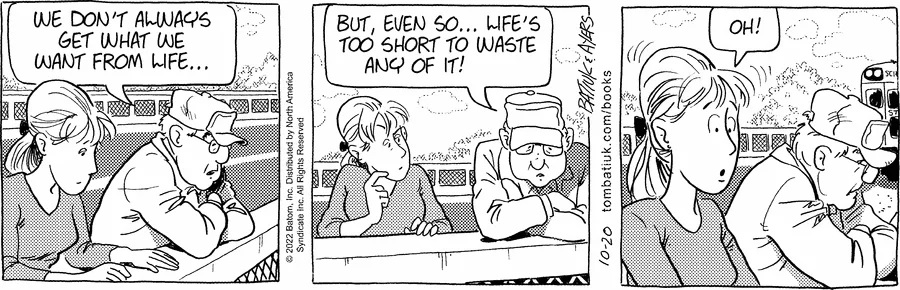
Thus ends the dumbest love triangle in history and all I really got out of it, besides Les being insufferable and Cayla being Cayla, is that for whatever reason TB really seemed to develop a strong dislike for Susan. Why that is, I can’t really say. I’m sure if you asked him he would say he was just adding some drama and didn’t mean anything by it but come on, I don’t think it’s possible to read that love triangle storyline and Susan’s role in it as an antagonist and roadblock for Cayla, who Keisha actively dislikes and who Summer doesn’t seem overly fond of either, and then get that week in October 2022 clearly playing off of her long ago suicide attempt and think that Batty has anything other than disdain for Susan. It’s one of the most baffling things about the entire strip, there’s no real reason for it but it’s there, clear as day.
Speaking of, while the identity of who took and spread around that photo is unknown I’m 100% convinced it was Keisha. I don’t really have any reason not to think otherwise and completely ruining another person’s life would be an easy way to get that person out of her mother’s way. I’d wonder why she cares so much about making sure that Cayla gets with Les, of all people, but I think in reality it’s not like Cayla could do much better. She’s such a nonentity as a person that I think it would drive most people insane but Les loves someone like that who exists to feed his own ego. Also, if we’re going off the idea that Keisha was behind the photo then that makes her easily one of the most rotten characters in the entire strip.
You’ll notice that once again, Summer pretty quickly disappeared from this little recap because as I’ve said before Batty obviously lost interest in her pretty quickly. After she blows out her knee she mostly exists as scene filler for the first half of the year. But that will change at least a little bit because next time will cover the rest of Summer’s time in high school.
Sorry for the hiatus. Harvest season is gearing up here. And for my poor cohosts, the stupid pizza robot has a secret special robot power to suck organized creative discourse right out of their brains through their eyes. We’re all trying. I mean, they’re trying. I sadly have reserved only a quarter ass for blogging since I need at least half of my ass for farm chores. (The final half-cheek is dedicated to napping.)
Summary for those not wanting four tabs open at once: Eugene brought Lil a box of old Summit Park photos. She saw Larry Dinkle’s band in one and asked Harry about it during choir practice. Harry and Lil and Cranky went to Harry’s house, where Harry explained that his dad was the scatterbrained genius trope.
I have changed the formatting for these final installments, since all the paint editing, even with just text boxes, was fiddly as all hell and took up more time than it was worth IMO. If you hate it enough, let me know and I’ll back to higher effort posting.
MONDAY:
Panel 1: everyone sitting in living room. Moon outside window to show it’s laaate. DINKLE: “On weekends, my mom would take me to see my father perform. She never missed a chance to see him in his element.”
Panel 2:sepia toned flashback of Larry directing his family sitting by, mom looks smitten, boy Dink looks amazed. DINKLE: “When he was standing on that podium, controlling all that sound with just the flick of a stick, I was in awe.”
Panel 3:living room again, Harriet looks lovingly at Dink because she’s dumb. DINKLE: “In that moment, I wanted to be him.”
LIL: A director?
DINKLE: A wizard.
TUESDAY:
Panel 1:living room, Crank is flipping through a photo album in the background. LIL: “Your father was only known locally?” DINK: “Yes, but he dreamed of making it big. Every piece he wrote, he’d say…”
Panel 2: flashback of Larry scribbling in his office in the dark, wife looks on from the door with a flashlight, little Harry peering around her. LARRY: “This is it, this is going to be my breakout hit!”
WIFE: “Dearest, did you forget to pay the electric bill again?”
Panel 3: Living room. LIL: How many compositions did your dad write?
DINK: Hundreds.
WEDNESDAY:
Panel 1: Living room: CRANK: “So every song was a dud?”
DINK indignant: “No! His songs were perfect! He was a master craftsman! Every tune more masterful than the last!”
Panel 2: Living room, CRANK: “Then why did…?”
LIL smug: “As an artist myself, I can guess what he was lacking.”
LIL and DINK at same time: “Salesmanship.”
THURSDAY
Panel 1: Living room: DINK: “I remember the last piece my father ever wrote, ‘Concerto for Trumpet’ He seemed twice as excited as normal about it. Twice as sure it would finally be his big hit.”
Panel 2: “He was set to debut the composition at a performance at the Wisteria Ballroom at Summit Beach Park on the night he died.”
Panel 3: LIL hand to heart, tearful: “He died?”
CRANK: “What’s your problem? It would be more surprising if he was still alive.”
FRIDAY
Panel 1: sepia toned flashback of an empty stage with a crowded dancehall and frantic Larry. DINKLE: “We heard that his band never showed up that night. We never found out why.”
Panel 2: sepia toned flashback of Larry driving away at night with Summit Beach in the background. DINKLE: They found my father’s car the next morning half sunk in a canal. Maybe he’d fallen asleep, or he’d veered for a deer, or another car had run him off the road.
Panel 3: Harriet has her hand on Dink’s shoulder. DINKLE: “Maybe he just got distracted.”
SATURDAY:
Panel 1:Living room. LIL: “How old were you when your father died?”
Panel 2:Sepia toned back yard, young Dink stands with his bat, ball in the dirt in front of him.: DINK: “Young enough to miss him. Just old enough to blame him.”
Panel 3: DINK frowning: “Not old enough to forgive him.”
SUNDAY
Panel 1: word bubble coming from Dink house sky is rosy. LIL “Do you have a recording of ‘Concerto for Trumpet’?
Panel 2: Living room, Cranky is looking at album again. DINK: “I wish! I don’t even have a copy of the sheet music.”
Panel 3: sepia flashback of sad lil Dink and Mrs Dink with boxes walking past the still packed music room. DINK: “Money was so tight after my dad passed that we lost the house.
Panel 4:Sepia flashback of driving away in a taxi, Mrs Dink clings to a trumpet. DINK: “We had to move in a rush, so we couldn’t even begin to sort through the chaos of papers my dad left behind.”
Panel 5: living room. DINK: “Some photo albums, records, and a few instruments are all I have left.”
Panel 6: DINKLE “Sadly, ‘Concerto for Trumpet’ is lost media.”
Crank: not looking up from photo album “Naw.”
Panel 7: closeup of a picture from the album, young Ralph is standing with the band. CRANK: “I know who would have it.”
NOTE: I did change the dumb song, it was spurred by this comment.
Instead I picked a more period appropriate piece as inspiration. Something eclectic sounding, composed in the big band era, that people really danced to.