The Batty Blog has been slow lately, but there’s something to talk about this week.
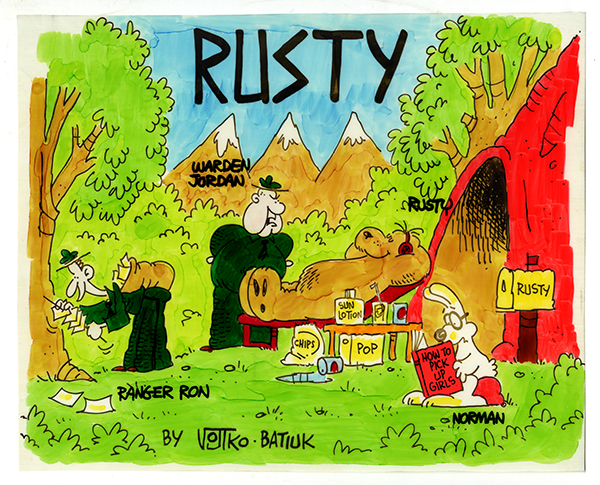
In addition to Funky Winkerbean, Crankshaft, John Darling and the thankfully never-published Dick and Jane, we now learn that Tom Batiuk tried foisting a fifth comic strip onto the world. Meet Rusty:
When you were atRoger Bollen’s house, did you tell him were planning to do this?!
Tom Batiuk confirms what you’re already thinking:
Basically a hipper Yogi Bear, a cartoon that was long in the review mirror by that point.
Clearly Yogi’s hipness was only updated from 1961 to 1973, since one of the three example strips we’re shown was a fondue joke.
I’ll let Batiuk tell you the rest of the story as only he can:
I’d only been doing Funky for a few months when Bob Votjko showed up at our apartment wanting some advice on his work and wanting to know how to get syndicated. I was barely started myself at that point so I don’t know how much help I was (none),
Through Batton Thomas, Tom Batiuk has told us at great length how he went to a cartoonist’s home, wanting some advice on his work and how to get syndicated. And now he’s received the same visit, and he’s being all self-deprecating about it? Did Batiuk fail to recognize the role reversal from his own life, just a few months ago?
“Oh, I’m sure I was no help, even though I did the exact same thing, and could have easily passed along all the information I collected from much more accomplished cartoonists than myself.” He’s so quick to play the self-deprecating card that he doesn’t notice when it makes him look like an asshole.
We didn’t have any luck syndicating it, although it did prove providential in a couple of ways down the road.
“We were unlucky, but we were lucky.”
Its strong ecological bent probably wouldn’t fly in today’s political environment, but nevertheless it holds up rather nicely.
“It didn’t age well, but it aged well.”
But just because we couldn’t get it in the papers, doesn’t mean that you can’t enjoy it.
This sentence seems like another instant self-contradiction, but it’s actually completely meaningless. Being in the papers and being enjoyable have nothing to do with each other.
There are comic strips in the newspaper that you can enjoy (Calvin & Hobbes, The Far Side, Peanuts). There are comic strips in the newspaper that you can’t enjoy (most of them these days, especially the Funkyverse, except for the perverse enjoyment we get from it). There are comic strips not in the newspaper that you can enjoy (Penny Arcade, dozens of other good webcomics). And finally, there are comic strips not in the newspaper that you can’t enjoy (because many talented creators never got the exposure they needed to reach you).
I’m going to roll it out day by day just like you would have seen it had it appeared in your daily newspaper.
In 17 days, we’ve gotten three strips that don’t appear to be in any kind of chronological order, or look like an introduction to the comic strip. So Lord knows what he’s even trying to say here.
I’ve been updating the Act 4 section of this website, to write weekly summaries for all the post-Funky Winkerbean Crankshaft arcs. Here are the entries I’ve written about the past six months:
August 24-September 19: Montoni’s hires a robot waiter.
August 17-22: In the name of the Father reprise. Ed Crankshaft spots a photograph of Larry Dinkle at Montoni’s, even though they both would have known about it for decades.
August 10-15: Ed, Pam and Jeff visit the fair.
August 3-9: Ed runs over his own cell phone with his riding lawnmower.
July 27-August 2: A pair of 1970s-looking video game developers approach Ed about creating a game called Grill Blast. It flops.
July 20-25: Batton Thomas gushes about The Flash #123 again.
June 1-July 18: In The Name Of The Father. Eugene comes to tell Lillian he’s moving to “a place.” After a series of fetch quests, we learn about that Larry Dinkle, who is of course Harry’s father. Larry was exactly the same asshole his son is, but no one ever notices this. Eugene slowly says goodbye to Lillian, without ever addressing the issue of where he’s moving.
May 25-30: Ed’s grilling creates a black hole. It was all just a dream. Maybe.
May 18-23: Batton Thomas discusses his band director character Harry Finkle.
May 11-17: Starts out as an aimless week at Comics Corner, but Batton Thomas shows up on Wednesday and turns it into yet another book signing.
May 4-10: Miscellaneous gags.
April 27-May 2: Lillian has another book signing at the Ohioana Book Festival.
April 20-25: The Batton Thomas interview continues.
April 13-18: Ed buys more Bean’s End crap.
April 6-11: Emily and Amelia talk Lillian into opening a newsletter for her blog.
March 23-April 4: Miscellaneous gags.
March 16-22: Batton Thomas tells Skip about his drawing board.
March 2-15 was the wedding of Max and Hannah, whose backstory I explored here and here. At least this resolved a long-running relationship. But everything more recent than this is missing the same thing:
Crankshaft hasn’t told a story in six months.
Because I don’t consider any of the things in that list a story. There is no plot, no conflict, no action, no resolution, no theme in any of them. Act IV Crankshaft is almost 100% filler. It’s endless backstory that never turns into anything (Glup Shittos, most recently Holtron and Tony Montoni); excessive focus on small events that never turn into anything either (Eugene taking two weeks to not tell Lillian where he’s moving); gag-a-day strips, with their usual problems of being disjointed and inconsistent; characters smirking at each other about things that happened off-panel; and Tom Batiuk monologuing through one of his characters, usually Batton Thomas.
Not only that, Batiuk seems to be going out of his way to avoid telling a story even accidentally. The Larry Dinkle arc – which I refuse to call by its pretentious title – is a pointless info dump about an irrelevant, never-seen character. The most compelling part of it was the part about Eugene having to move… well, somewhere, for some reason. People genuinely wanted to know the resolution to this, probably because it was the only shred of humanity to be found anywhere.
The arc had potential. It was begging for Harry to have an epiphany about how he turned into his father, despite his apparently ambivalent feelings about the man. Which we can only guess at, because they were never clearly stated either.
Ambiguous endings can work sometimes. Batiuk tries to do this, but he fails by making everything in the story ambiguous. There isn’t a single hint or clue as to where Eugene is moving or why, or how Dinkle feels about his father. And Lord knows none of the Greek chorus for his pity party is going to bring it up. Not even Ed Crankshaft, whose usual characterization is “easily-annoyed old guy who blurts out whatever’s on his mind at all times.”
Side note: this is why I’m not one of those “Where’s Crankshaft?” guys. When he is in the strip, it doesn’t help. Because Batiuk sacrifices his personality to the ancient god Finallygettingthatpulitzer.
Similarly, the pizza robot arc has been dropping “people don’t like AI” comments left and right. But it ignores the fact that this bland, unfunny robot is now doing a job that three humans used to do. And incompetently at that. Which is exactly the reason people don’t like AI! This massive story flaw is never addressed at all.
I fear this is the shape of Act IV. After Funky Winkerbean ended, Tom Batiuk moved in certain FW characters like he’s trying to gentrify Centerville, but also trying to better refine it for his incomprehensible purposes. Lord knows why Pete and Mindy, Max and Hannah, Mason Jarre and Cindy Summers, and Harry Dinkle made the cut, while more important characters (in terms of their genuine importance to Funky Winkerbean, and how much Tom Batiuk seemed to like them) didn’t. Just another baffling choice in a universe that runs on baffling choices.
In the Star Wars fandom, Glup Shitto is a general term for any small character with its own goofy name, home planet, job, species, and way too much backstory for the minor role it plays.
Think of some of the minor characters from the original 1977 movie, like the weirdos in the cantina. Thanks to the sequels, prequels, spinoff movies, TV series, animated series, novels, comic books, and the Star Wars Holiday Special, you can learn way more about them than you ever wanted to know.
You can understand why Glup Shittos exist. There was an insatiable demand for more Star Wars content, but the movies were very expensive and time-consuming to make. There was also a need to explain continuity problems, like “making the Kessel run in less than 12 parsecs” when a parsec is a measure of distance, not time. Now there are all kinds of explanations about how the challenge was to get from Point A to Point B via the most hazardous route possible. I think the movie Solo also expanded on this, but I might have fallen asleep during that scene.
The Funkyverse is full of Glup Shittos. But Tom Batiuk misses the point of them.
Harry Dinkle has become a Glup Shitto, especially recently. In the original trilogy — Acts 1, 2, and 3 of Funky Winkerbean — Dinkle was an important character with an important role to play. When the main cast graduated from Westview High School at the end of Act 1, Dinkle could no longer be an effective antagonist. His power to bully the main cast ended when they were no longer his students anymore.
But of course, Tom Batiuk doesn’t realize this. So he started inventing more and more convoluted ways to write Dinkle stories. In Act 2, these were pretty reasonable. They centered on his interactions with his wife, later high school students, their parents, the targets of his door-to-door selling, the increasingly strange products he sold, and the Claude Barlow gags.
By Act 3, Dinkle was going deaf (but not really), anointing a successor in Becky (but not really), retiring (but not really), leading a nursing home band on a recording contract and a tour (yes, really) and weaseling his way into being a choir director (really). This was all a blatant attempt to keep writing Dinkle gags. Because, as we all know, Tom Batiuk is a serious artist and not a gag writer. Nope. He’s definitely not that.
Those were all bad stories, but at least they were stories. Which is more than you could say about Glup Shitto in Act 4 (post-2022 Crankshaft).
The recent In The Name Of The Father series explored Harry Dinkle’s upbringing, then never did anything with that information. We learned that his father Larry was a selfish, insufferable bandleader, so obsessed with music and fame that he was indifferent to his performers, and to his own family. It’s obvious that Harry Dinkle is a chip off the old block, but this was never acknowledged. Not even by his current performers, who are frequent recipients of his abusive behavior. One of whom is Ed Crankshaft, who’s supposed to be the guy who speaks his mind at all times.
It added additional information to Harry Dinkle’s life, like Glup Shitto stories do. But it never did anything with that information. It didn’t tell a new story, or even give us any new insight into the character. And there were a lot of tacked-on, irrelevant details, like the fact that Larry Dinkle loved noir movies, and died when he crashed his bus due to a heart attack and/or alcoholism. Batiuk couldn’t even be bothered to clarify which it was.
So we have the hallmarks of a Glup Shitto story — additional backstory for a minor character in the major story — but none of the benefits of it. Least of all, fun. Which is another reason stories get written about these minor characters. Often by unsanctioned writers:
Richard Pryor’s “Star Wars Bar” skit would have been very NSFW. It’s on Youtube though. Hint.
Last week, we had a Glup Shitto experience with Pete and Mindy. Their stories in Funky Winkerbean were bad enough, but they were more or less stories, like “awkward nerd hooks up with out-of-his-league attractive girl.” You can do this kind of story, but Batiuk botched the details.
Pete ran out of money at the county fair despite being a highly-paid, world class writer in this world. He also treats Mindy like garbage, a topic my friend Narshe will be exploring on Wednesday. And the fact that Pete and Mindy are both in their 50s by now, and it’s way too late for the “young kids just starting out” shtick.
Pete and Mindy have become relevant characters in Crankshaft, all to tack on a bunch of unnecessary backstory that goes nowhere. They revived Montoni’s! And the whole town brought all the decorations back! And they teamed up with the Pizza Box Monster! And they have a robot waiter! And… that’s it. Nothing was ever done with any of this. Montoni’s itself hasn’t even been the town hangout it used to be, which was at least a narrative purpose.
Act 4 has been running on Glup Shitto stories for a while, without those stories ever serving the unifying or narrative purposes they should. And we don’t see stories about minor characters that might be interesting to explore. Whatever happened to Chien? Why weren’t Cory, Rocky, Wally, Rachel, and Adeela rehired when Montoni’s re-opened? What are they doing instead? What effect did the short-lived strip club era have on Centerville? What happened to Cindy’s pregnancy? The sheer number of loose ends Tom Batiuk has left over his career should be a gold mine of material to explore. But it isn’t being used that way.
Tomorrow, we’re probably getting another deep dive into a character nobody cares about, and which serves no storytelling purpose. And that character is way overdue for an appearance.
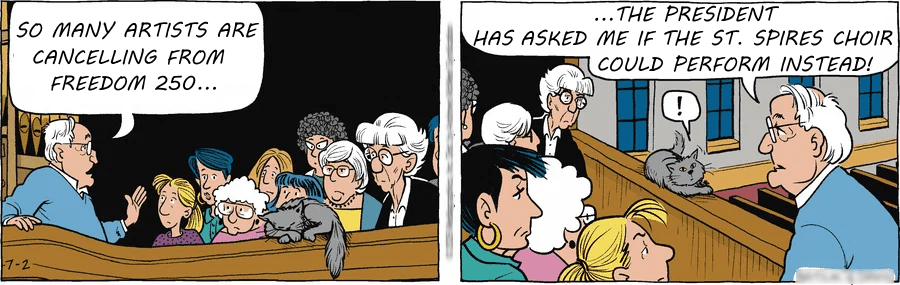
This blog has a longstanding “no politics” rule. But we have to tiptoe into it sometimes, such as when Tom Batiuk makes another saving throw for relevance. The July 25 Crankshaft was one such strip. It’s such a mess I have to respond to it in bullet point form rather than an essay.
Tom Batiuk must have really liked this joke, because he shortened a week of Batton Thomas gushing over The Flash #123 at Komix Korner to squeeze it in. I wonder if we’ll get today’s Batton Thomas strip as bonus content, as an alrernate version on Arcamax, or if there will be a later week where… never mind, I answered my own question.
Timing! July 25 is not the time for a joke about July 4 celebrations. It’s still better than this, though:
Vuvuzelas were the symbol of the 2010 World Cup. At least the 2026 World Cup just ended.
Nice epiphany, Dinkle. It shouldn’t be distracting that the focus of a long story arc makes his next appearance in a one-off joke strip. But putting Dinkle back in front of his choir destroys anything that In The Name Of The Father might have been about. It is the final proof that Dinkle never realized that he is a clone of his father: an egotistical, abusive, widely despised band director.
The fake name destroys the joke. Tom Batiuk loves his phony brand names… sometimes. And there’s no pattern to it. Today’s strip names the “Celebrate America 250” concert. The real names of the two competing celebrations were America250, established by Congress in 2016, and the Freedom 250, established by Donald Trump and the Trump Administration for their usual reasons.
Freedom 250 – not America250 – is the one that had the problem of artists cancelling once they found out what they’d signed up for. Country singer Martina McBride had an eloquent response:
I’ve been blessed with the opportunity to be a voice for those who have felt like they didn’t have one. It greatly upsets me that any fan who has been moved by my music may now feel like I’m abandoning the meaning behind those songs. I assure you, that is not the case. I appreciate every single fan who has reached out.
Today’s strip is clearly referencing the problem of big artists like McBride cancelling their appearances at Freedom 250. The made-up name of the wrong celebration confuses the joke. But the clear intent also means:
Batiuk picked a side, even if he thinks he didn’t. Poster Marty DaVille made this point. Mocking the cancellation fiasco technically puts Batiuk in the same category as comedians like Jimmy Kimmel and Stephen Colbert, who came under fire for daring to suggest that any Donald Trump project wasn’t quite as successful as its press releases claimed.
He missed an actual good joke. The above problems aside, this would have worked:
The punchline makes no sense if you don’t follow the Funkyverse closely. Dinkle – and other “content creator” characters like Pete and Les – spend their entire lives being handed every opportunity they want on a silver platter. If you didn’t know that, the punchline revealing that an elderly church choir had a gig at a national Independence Day celebration would be confusing. (I know I’ve been using the word “confusing” a lot.)
And it misses another actual good joke. Considering the generally unimpressive roster of artists who did perform at Freedom 250, Harry Dinkle might as well have been a real-life headliner. You know who else cancelled? Milli Vanilli.
(Well, kind of. There’s some drama over who Milli Vanilli even is. But the band name is such a universal joke that there’s no need to process semantics. Or whether they performed or not. Or whether they performed or not, even if they did go on stage. Like I said previously, I did stand-up in the late 1980s. Piling on Milli Vanilli is practically a reflex.)
The church’s tax exempt status is an unnecessary detail. Batiuk seems to draw his word balloons before he writes what they contain. This often results in them being full of words that detract from the strip’s point. A better joke would have landed on something that actually happened in real life. Such as, Dinkle losing his job like Colbert did. But Batiuk wouldn’t dare even joke about that.
Batiuk crammed everything he could think of into this joke. None of it works, works together, resembles the real-life event it’s riffing from, or makes any sense.
Tom Batiuk’s latest attempt at a prestige arc, which he pretentiously titled “Dinkle, I Am Your Father” or something like that, is over.
Well, it’s not officially over. But I’m calling it over as of Thursday, because that’s the best place for it to end. I’m sure Friday, Saturday and maybe Sunday will be full of Lillian smirking at us, and explaining how we’re supposed to interpret the ending. Which insults the reader, and undermines the point of leaving it ambiguous. But I’m done showing Tom Batiuk how to do his job.
This will also be the last leg of the strangest multi part post in SoSF history. Weather forecast: clear, smooth sailing. No trauma dumps or cluster f-bombs on the horizon. This post draws on elements of Destroy Everything You Touch, so read that if you haven’t already. Be warned: that post is also a M*A*S*H-level dive into my own psyche, tied into the two subplots of this tedious story. This post will continue that analysis, focusing on the Eugene and Lucy half of the story.
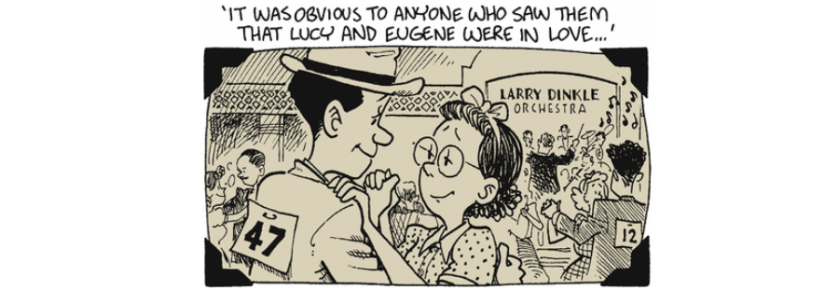
The problem is easy to explain. Eugene and Lucy is not a love story. Eugene and Lucy is a limerence story. Let’s start at the beginning:
Was it, Lillian? Was it really? Who besides you was even looking at them? It’s a dance! People are looking at their own dance partners! Like they should be! Get over your Main Character Syndrome! (No theory of mind, a central problem in all of Tom Batiuk’s writing, rears its ugly head again.)
This is not love, this is limerence. Also known as “putting someone on a pedestal,” “in love with being in love,” “infatuation”, “obsessive love”, and similar things that are bus stops between “crush” and “creepy.” It’s when you’ve built a fantasy version of someone in your mind, independent of any actual information you have about the person. This is a great explanation:
“Eternal Sunshine” is all about limerence. And it’s a damn good movie too.
Eugene and Lucy are a concept to each other. They’re both in love with the imaginary versions of each other they think will fulfill them. We don’t know anything about Eugene and Lucy, and they don’t know anything about each other, beyond one pleasant night at a pre-World War II dance, and an implied brief relationship. The story makes a lot of bold assertions about true love, but it provides zero evidence of that.
Most romantic relationships in the Funkyverse are actually limerence. They’re all arranged marriages between minor characters who don’t seem to have any reason to be together. This happens when your only source of how adult relationships work are comic books for 9-year-olds, and a marriage to your high school girlfriend.
John Howard and one-armed Becky are the most mismatched couple you could possibly create. She’s a disabled person with genuine talent, and is using it the best she can, hyper-motivated to prove she still has worth. He’s a lazy slob who only wants to spend all day in a comic book store, without ever contributing income to the family, or changing his T-shirt.
John and Becky, Bull and Linda, Mason and Cindy, Pam and Jeff, even Les and Lisa don’t even seem to like each other that much. (Exception: Funky and Holly genuinely do like each other, and have some sweet moments.)
I’ve long struggled with limerence, and it was a key reason many of my adult relationships fell apart. I took every relationship way too seriously, far more than my partner took it. Because I immediately turned any girl who gave me the time of day into a potential wife. I filled in any unknown data with what I wanted to be true. Limerence and low self-esteem is one hell of a cocktail.
The key is separating limerence from tangible qualities.
In high school, I didn’t see anything but attractiveness and popularity as being important. I learned in adulthood that confidence, personality, positivity, values and common interests are far more important.
Let’s revisit Christine, my unrequited love from high school I introduced in Destroy Everything You Touch. (Inverted trope: I was her unrequited love.) She had personality, positivity, shared values and interests with me, and enough confidence to approach me when she otherwise didn’t have a flirty or forward nature.
This is not limerence. This isn’t me filling in the blanks with what I wanted her to be. These are genuine qualities I observed, based on many real interactions over a year or two. She was legitimately a very good potential partner, and would have been at any age. But in high school, I picked Ken O’Brien when Dan Marino was available. (Please note that Ken O’Brien was still a pretty good NFL quarterback, and two-time Pro Bowler. Susan, if you’re somehow reading this, I don’t regret picking you at all. You were awesome. My first kiss with you was one of the few romantic milestones in my life that actually went really well.)
Limerence can even make you idealize yourself! I caught myself comparing Christine’s 16-year-old self to my 54-year-old self, not my 17-year-old self. She was calm and easygoing, which I am now, but 17-year-old me very much was not. I was high-strung, and hadn’t learned how to manage my anger and frustration yet. Which might have been a serious obstacle in any real relationship with Christine. And I’ve had partners in my life who were attracted to me for qualities I definitely didn’t possess.
In the Funkyverse, limerence can apparently affect other people. Lillian seems to have swallowed the notion that Eugene and Lucy were some kind of destined couple that only didn’t get together because of her own selfish act. This is ridiculous.
If anything, Lillian should have been the one to tell her sister “oh come on, it was just one guy, get over it already.” Which is yet another way she should could have reversed her misdeed, but didn’t, even though she could have still covered up what she did. Lucy’s Story has a comprehensive list of the others.
It’s time for the lightning round! Today’s topic is Why This Story Sucks, Even By The Usual Low Standards Of The Funkyverse.
It’s too easy to move on. Despite my low romantic potential, I still preferred hoping for future opportunities in college over lamenting missed ones in high school. As any 18-year-old would.
Eugene never got a response to his letter, and interpreted that as a rejection of his marriage proposal. He served in the military until the end of World War II, and then came home. Imagine a returning soldier with a broken heart while V-J Day in Times Square is going on. No war veteran is going to be moping about the girl who said “no” years ago when they return home to a demographic abundance of females. Many of whom are throwing her panties at him, eager to start creating future baby boomers.
It should have been extremely easy for Eugene to forget Lucy and find a new girl. We’ll soon see why it wasn’t.
Something triggered my nostalgia. I haven’t been pining for Christine for 38 years. I never even thought of her for 37.95 of those years. Eugene has been in a consonant state of pining for Lucy since 1946, even though she died in 2009.
I don’t idealize the past. I realize that a relationship between Christine and I might not have worked out, for a million different reasons. Which would have been fine.
I spent most of my high school nights dreaming of random, unremarkable girls who caught my fancy at some point, but whom I never had the nerve to approach. They seemed unattainable to me. I daydreamed about how receptive they’d be to me, and how well-suited they’d be, even though I had no reason to think that. All while I ignored someone who actually was those things, and was trying to tell me she was interested. That’s what limerence does to you.
I recognize my own mistakes. Despite everything I wrote previously, I ultimately don’t blame anybody but myself. I could have started a relationship with Christine almost anytime I wanted to.
The failed relationship was a symptom of a much bigger emotional problem. This was obviously the case with me. My inner demons caused me to do an irrational, self-destructive thing to a desired relationship. We’ve often said that Eugene simply should have re-proposed to Lucy, or gotten a clarification of what her answer was. Why didn’t he?
Because Eugene was so afraid of rejection that he chose “no response means no” over Lucy actually telling him no. Why else would Eugene act like his “I’ll never bother you again” promise was more important to keep than his “I want to spend the rest of my life with you” promise? Which he didn’t keep anyway, because Eugene and Lucy had some kind of contact after that?
The four days of wordless, actionless panels imply that Eugene is moving into some kind of senior care facility, or hospice. And he’s ashamed of this. To be fair, dying at age 99 would be early compared to people like Lillian Mckenzie, Ed Crankshaft, and Mort Winkerbean. But I think there’s a much better explanation.
Eugene is moving into a mental institution.
Just like Lucy did.
And for the same reason Lucy did: because he was so in love with a concept that he let it destroy his entire life. And it also took Lillian down with it.
In a psychology class in college, I heard a story I’ll never forget. There was a psychologist who worked in a home of people having severe detachments from reality, to the extent that a woman would tell him she had a new baby every single day. The doctor said “even if I could push a button and cure her, I wouldn’t. She’s much happier where she is.”
So this is a bittersweet ending, which is an improvement from the just plain bitter we usually get. In the end, Eugene and Lucy got together, in a way. Unless this story is somehow still continuing. And if it is, then let me say with no irony whatsoever: bring on Batton Thomas!