Rival Fools

It’s been another overly hot summer and where I am, we just got out of a heatwave. I’m sure plenty of readers know how muggy summers in the Southeast tend to be so compound that with even higher temperatures and a poor A/C that’s already not much of anything and the last week or so has been rather brutal.

And yet while summer is entering its end stage (come on, we all know that once the calendar switches over to September, it’s fall no matter what The Man says), Summer continues to roll on. When last we left her, she was spying on dear ol’ dad to see if he was putting the moves on that hot new secretary that replaced boring cat lady Betty. For the start of 2009 we pick up with her hanging out with Jinx in a strip which sets up a story where Rana spends a week freaking out over the fact that guys are going to be added to the cheerleading squad.
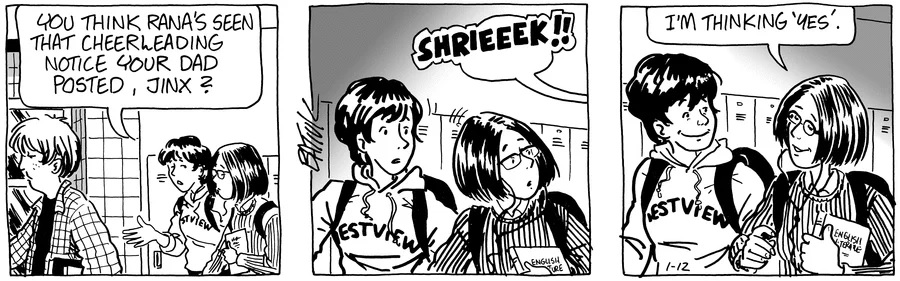
Yeah, it’s obvious Batty never had a clue what to actually do with Rana.

The next week starts the story arc that will be Summer’s big focus for the first quarter of the year.
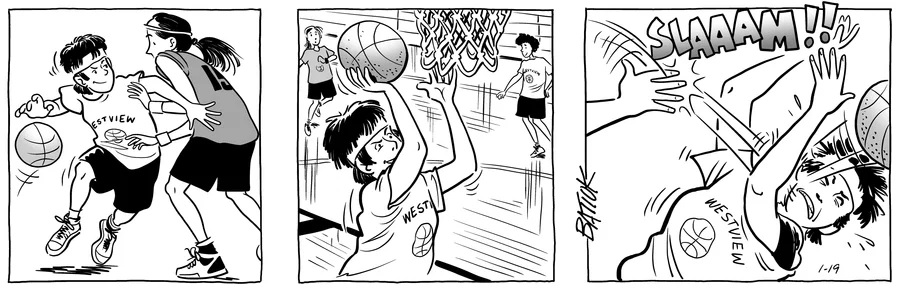
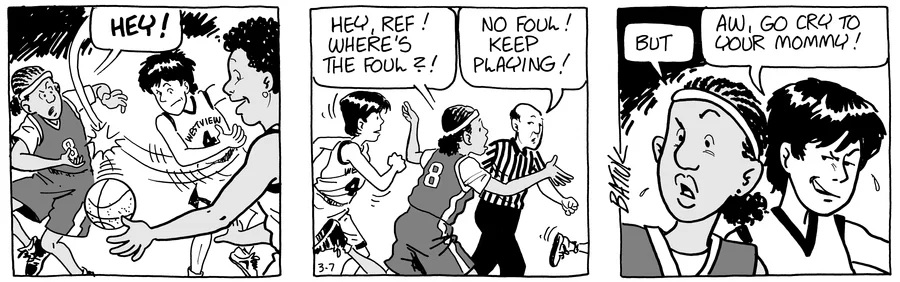
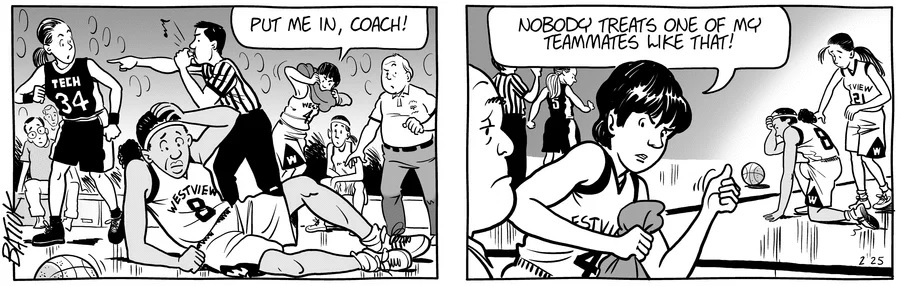
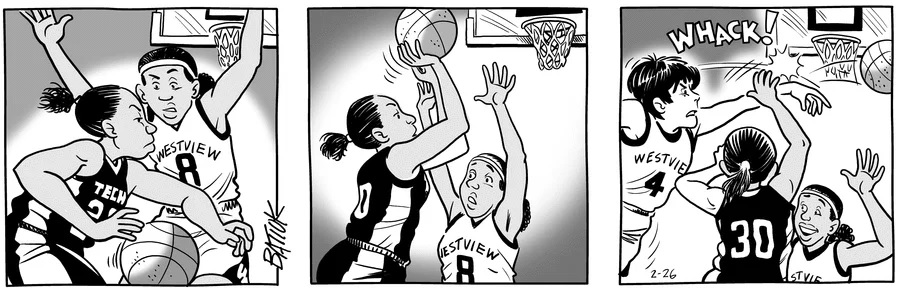
Summer gets Dikembe Mutombo’d and is all out of sorts as she wonders just who could have done that to her. She’s surprised to see that it’s none other than her new teammate Keisha.
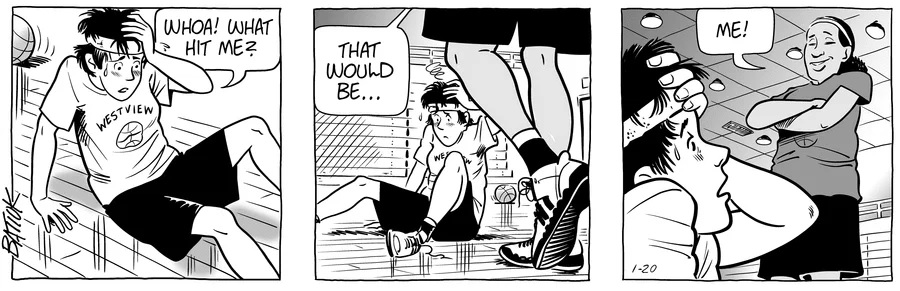
Asserting dominance.

Summer seems kind of surprised by this and quite frankly so am I because look at that previous comic; that shot blocker was whiter than the audience of a Dave Matthews Band concert. If I found out that my teammate was a shapeshifter or racebender I would be pretty shocked too. Naturally this whole thing leaves Summer completely out of wack and she complains to Les about how Keisha made her look like a joke.
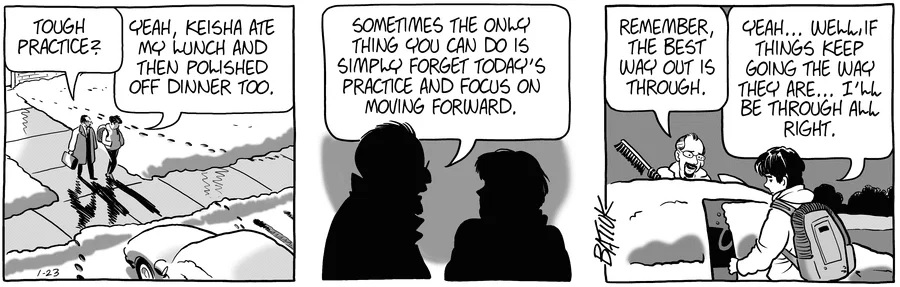
At the game the next night (?) Les and Cayla talk about how Keisha was the star which presumably has left Summer in a bad mood. Les decides to take Cayla out to eat at Westview’s fanciest restaurant. Not Olive Garden fancy, mind you, but close!
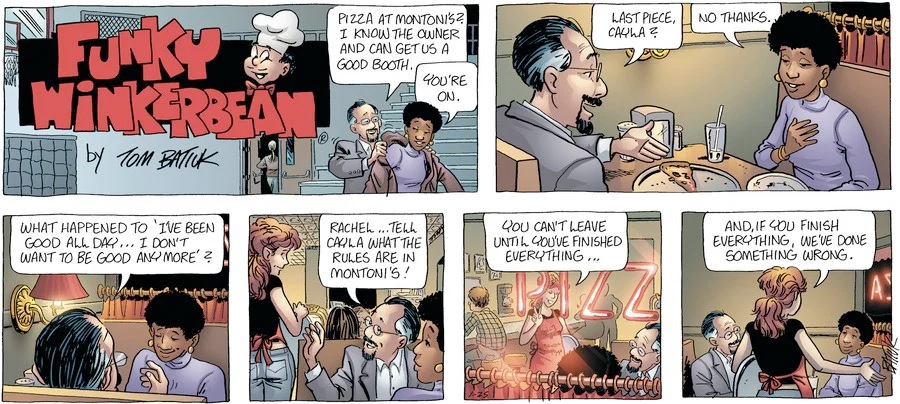
Rachel then contemplated slugging Les for making her recite such a stupid motto.

Les, by the way, is still doing this stupid song and dance of “Oh, uh, we’re totally not dating,” even though they went to the Winterfest together and he’s now taking Cayla to the holiest of Westview’s temples. We’ve seen this crap, we know how it goes. By bringing her to Montoni’s Les is practically proposing to her. But no, we’ve still got the world’s stupidest love triangle to deal with.

Back to the main, Keisha’s presence on the team has completely sapped Summer of her confidence and led to the team playing badly. So far, the Williamses are a complete net negative on things both in and out of universe.
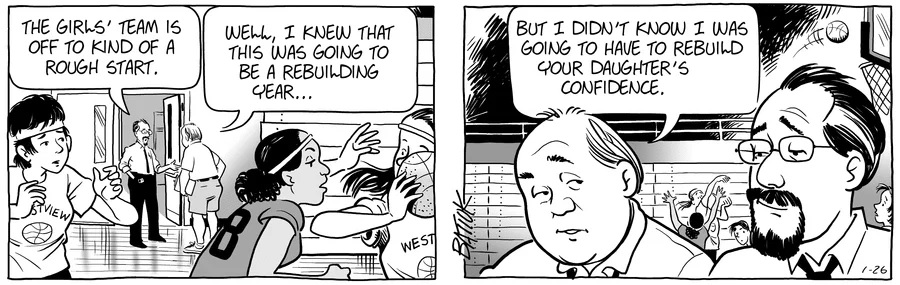
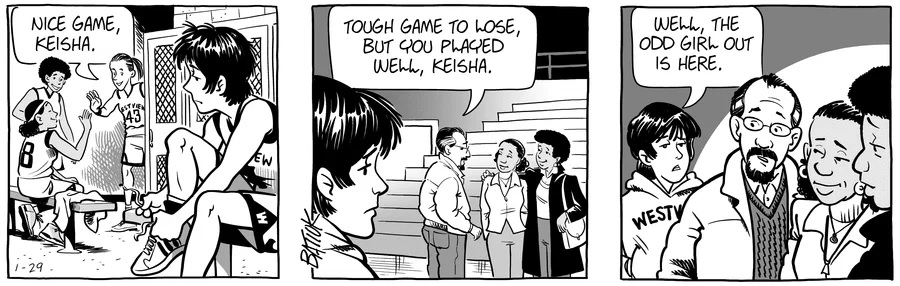
At this point, Summer is a complete disaster and winds up being benched while Keisha continues to get all the praise.
Which then leads to this complete nonsequiter.
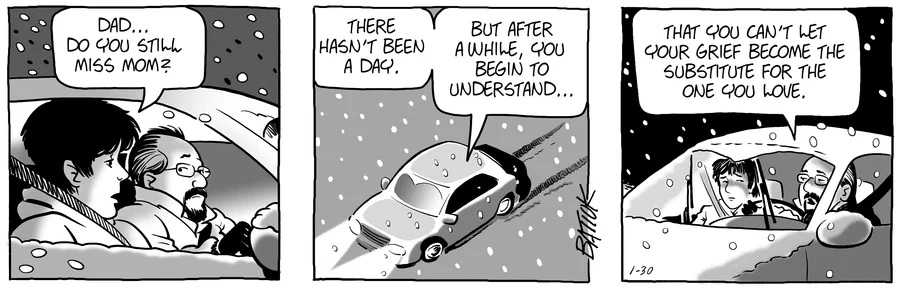
Now suddenly bringing up Dead St. Lisa could just be a sign of Summer’s depression, like she’s going to off herself over basketball or something. But no, it’s simply an excuse to then transition into yet another example of Les insisting that he and Cayla are NOT DATING SO BACK OFF AND SHUT UP SUMMER, GOOOOOD YOU’RE NOT MY MOM YOU HAVEN’T EVEN THROWN AWAY MY COMIC BOOKS!

Summer’s on-the-court woes continue and even at home she’s bricking shot after shot when she’s greeted with a surprise that’s pleasant to her but not to the readers.
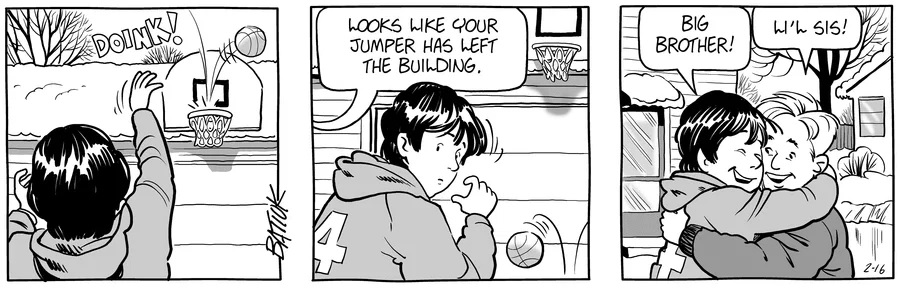
Darin, unfortunately, makes another appearance to dazzle the readers with his sparkling personality and memorable traits like… uh…

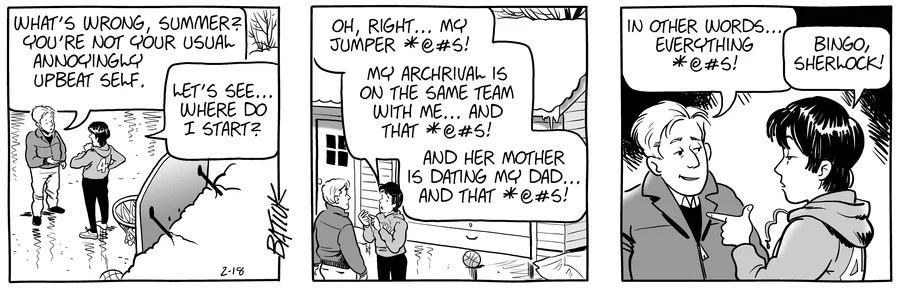
Summer takes the opportunity to vent about how things have been going for her since Keisha transferred over and gives us a nice little Batiukism in the process.
Darin naturally does what any loving brother would do in this situation and gives his baby sister some advice on how to fix her shooting woes.
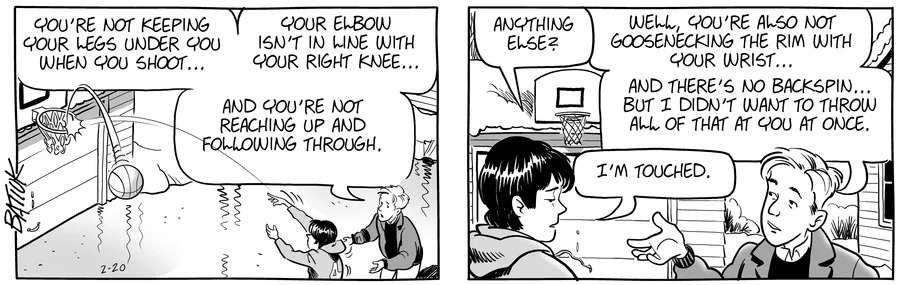
It’s a nice little moment, I guess, except for one tiny little insignificant nitpick: why is Darin giving Summer basketball advice!?

Darin, as established throughout basically all of Act II, is a grade A geek. He was a low-on-the-totem-pole loser and the closest he ever got to any athlete was whenever Jessica would throw herself at him. He was never hinted at having anything in the way of athletic ability so why, WHY, is he telling a basketball star who is light years beyond where he ever was what to do? And why is Summer even listening to him? I mean sure, okay, in real life you don’t necessarily have to play a sport or be an elite athlete to have some knowledge of things but typically those coaches who weren’t athletes were at least around the game all the time in other capacities, that’s why they’re good at what they do. Darin never been any closer to athletic competition than mocking it in his and Pete’s dumb comic strips.

Well whatever, I guess in the end it doesn’t matter because aside from showing up at her next game that’s really about all we see out of Darin. For as important as he was in Act II and as much as he’ll take over the strip in the 2010s, in the first few years of Act III Darin barely exists.

Anyway, it’s the final game of the season which of course is against Big Walnut Tech and Keisha’s former teammates are showing her how they deal with traitors while Cayla also shows the reader that she has her daughter’s raceswapping properties in what retroactively turns out to be a genius bit of foreshadowing of Cayla’s eventual visual evolution. Bravo Tom!
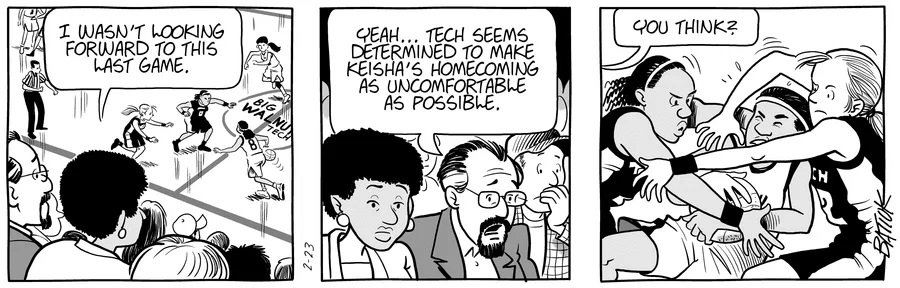
Summer decides she’s had enough and pretty much inserts herself into the game.
And then swoops in when Keisha’s in trouble.
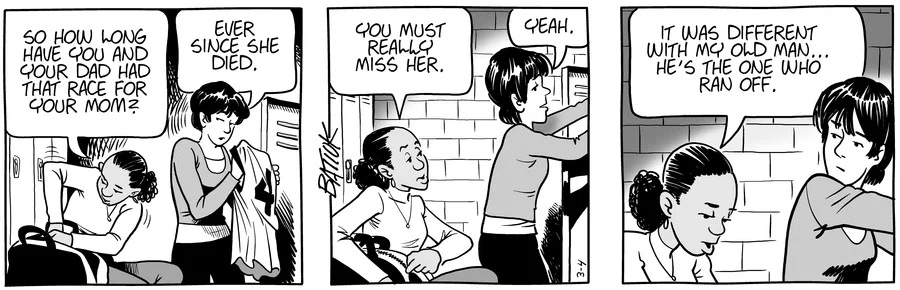
Westview loses but Summer’s back to her old self and her and Keisha are now on the same page and bonding over their dads. Well, one of them has a dad anyway.
Which of course transitions into more Les insisting he’s not dating Cayla nonsense.
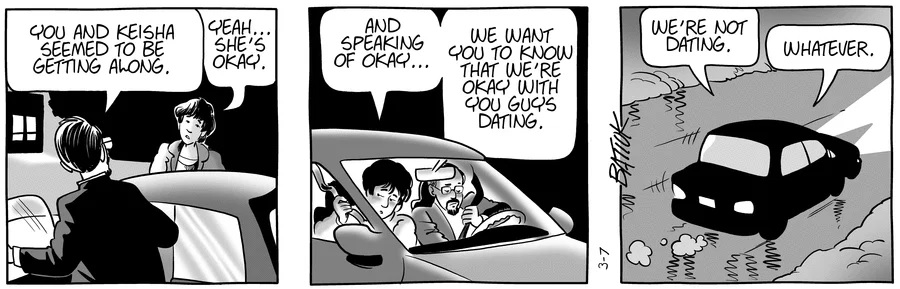
Which I think gets into the core of what Batty was actually doing with this storyline. It wasn’t about Summer per se and lord knows it wasn’t about Keisha who doesn’t have much of a character to speak of. It was mostly just flavor, giving Summer something to do, in service of the real story which was Les, Cayla, and the world’s lamest love triangle. That said, it at least is a story about Summer that’s based on something she’s into and that’s important to her and doesn’t end with her becoming the trophy for a lame nerdy male character like so many other female characters in this comic. So she’s got that going for her.

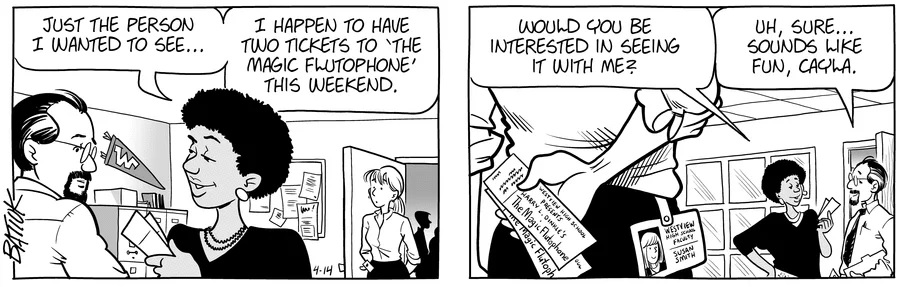
That love triangle is also where we’ll be detouring to for a little bit as well. After a month of shenanigans focused on Dinkle, Cory, and Funky’s suicide inducingly bad day, Dinkle’s comic opera (because it’s laughably bad you see) The Magic Flutophone is set to open and Susan decides that this will be a great date for her and the hunky English teacher of her dreams. Unfortunately, Cayla’s snapped him up first.
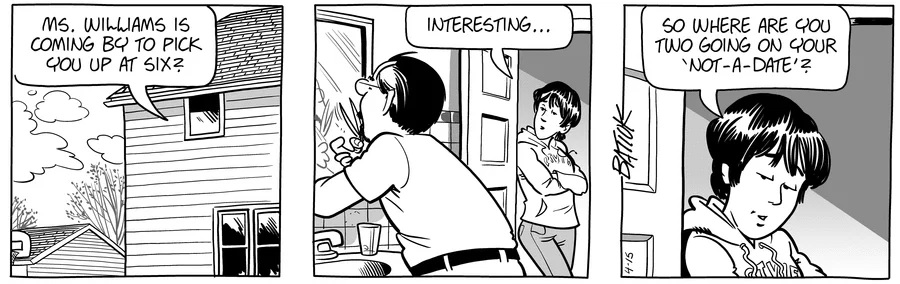
Summer teases Les over the fact he’s still insisting that going to a concert with Cayla is not a date and that he and Cayla aren’t dating.
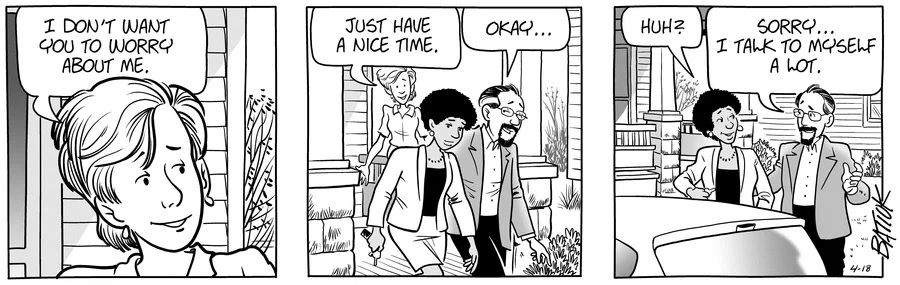
Cayla comes by to pick up Les, because if nothing else Les is consistent in being a lazy jackass and making his girlfriend drive him around everywhere, and proceeds to have a little schizo break.
Cayla apparently doesn’t mind dating a lunatic who talks to the ghost of his dead wife and the two go to Dinkle’s undoubtedly awful concert and somehow enjoy themselves. At this point Les finally stops dancing around things and acknowledges that he and Cayla are indeed dating. The two lovebirds share a kiss in what is surely one of the most infamous and unintentionally hilarious strips in the history of Funky Winkerbean.
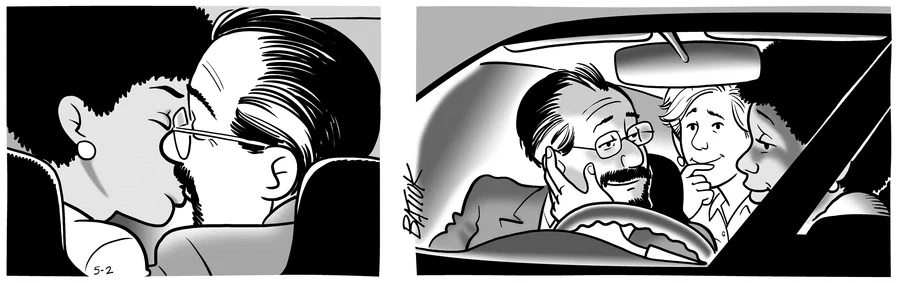
With Lisa the Ghostly Cuckquean’s approval, Les and Cayla are official.

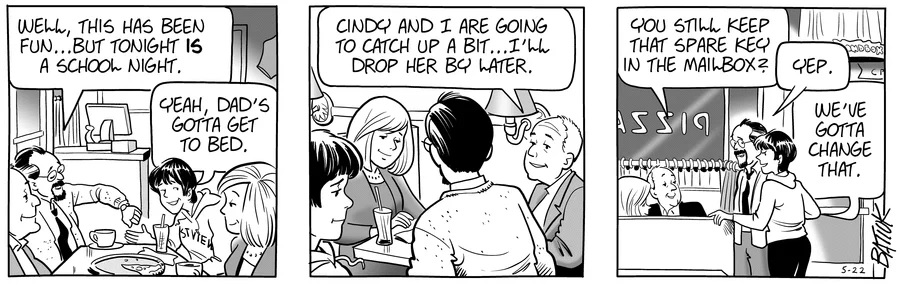
As for the main subject of this series, Summer shows up for the requisite random installment of the Dead Lisa Tapes and also makes an appearance during Cindy Summers’ (who insists she’s going by Cynthia now but that doesn’t last long) return to Westview.
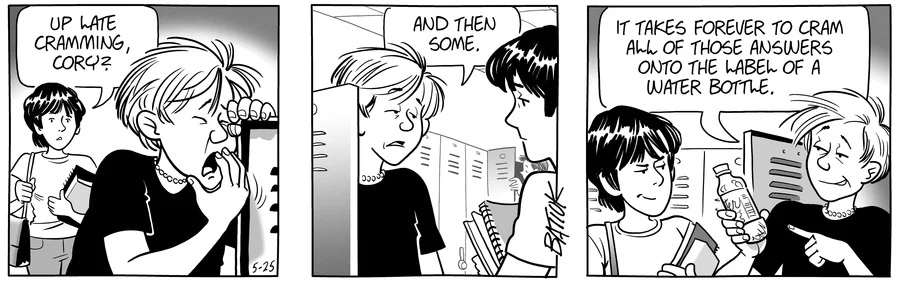
She also shows up for an insipid story where Cory attempts to cheat by writing his answers on his water bottle. Now that I think of it, I feel like the only times in Act III where Les is shown actually teaching his class is for these stupid “a student has cheated and Les puts them in their place” stories.
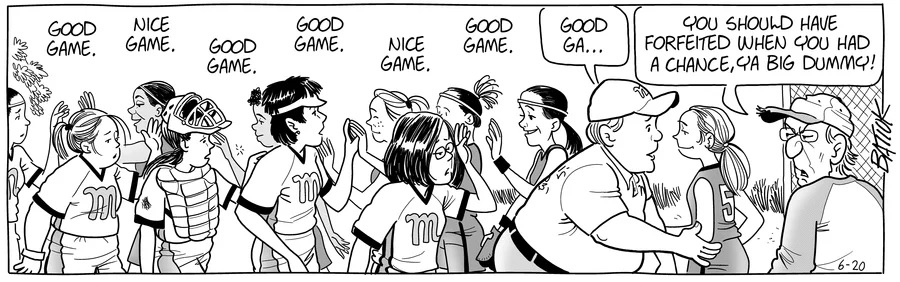
We then get another summer story of Summer and Jinx’s softball shenanigans.
But this was all light fare to relax the reader for most of the rest of the summer after this is taken up by what is undoubtedly the most infuriating story in the entire strip. Wally comes marching home to find DSH John has cuckoo birded his way into his nest, beady-eyed nitpickers complain, Wally walks off into depression. It’s called writing.

Batty bookeneds that story with another Montoni’s Softball one.
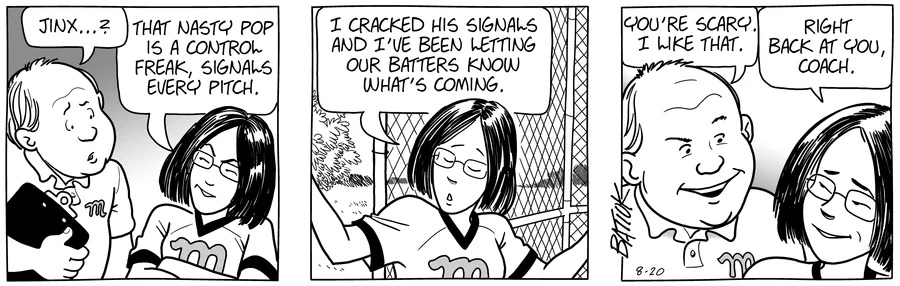
He seems to have quickly grown bored of this setup though for this is the last we’ll see of the softball team and poor Jinx’s relevance to the strip disappears with it. Her spot as Summer’s best friend (I guess? She sure seemed to be) has by now been usurped by Keisha and eventually Jinx will disappear so thoroughly from the strip that she won’t even make it to the St. Spires Christmas concert which features damn near every other Act III character.

By this point Summer has just turned 16 and drops the news to her dad that she wants to get her license and that Bull is teaching driver’s ed.
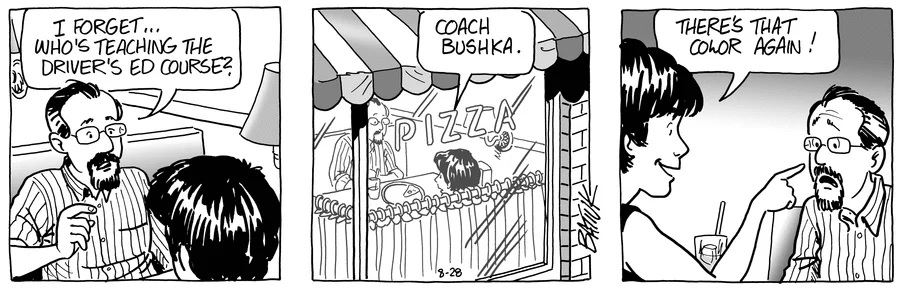
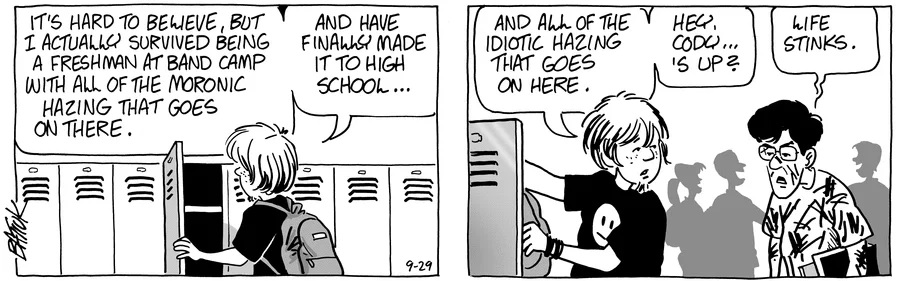
Les spends the next week fretting over this showing that everything Bull has done for him since high school has been for naught. And with school starting up again, Batty also begins seeding the post-Summer class with the first appearances of Funky and Les IV: Owen and Cody.
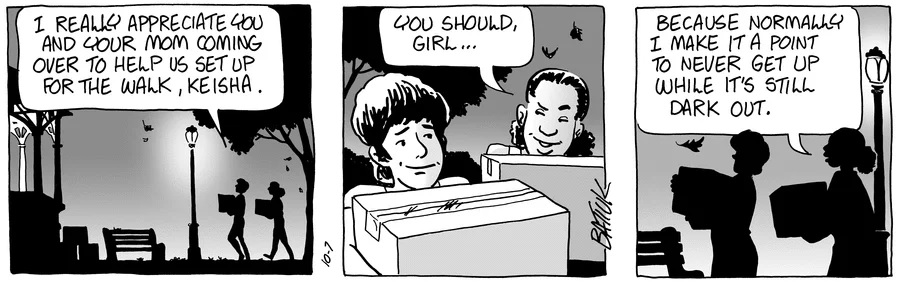
In October, Keisha learns the benefits of being “part of the family” when it comes to the Moores: acting as free labor for Les’ ego stroking charity event.
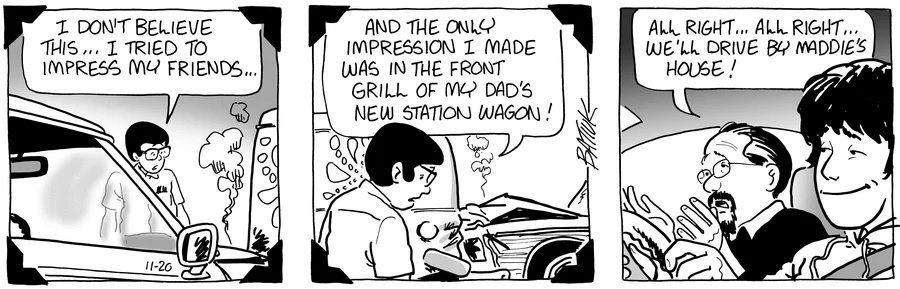
Summer also engages in some practice driving and Les acquiesces to her desire to stunt all over Maddie.
Summer also wants to be able to get a car once she has her license and Keisha pushes her to get a job. Oh no. Summer and Keisha are female. They are young. They want jobs. You know what that means…
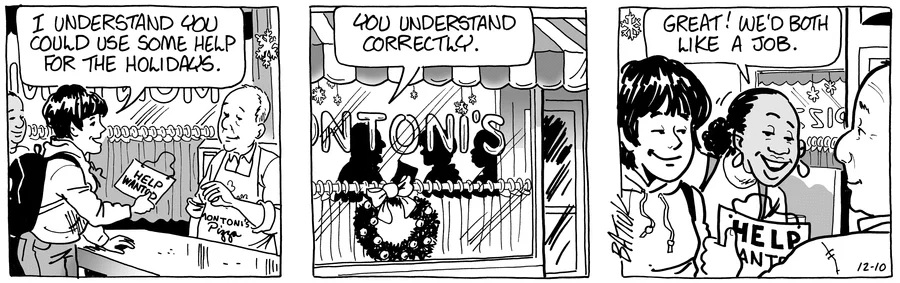
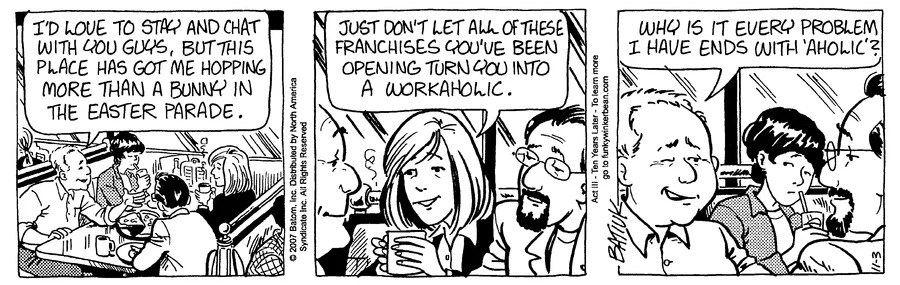
Say hello to the newest residents of Westivew’s Home for Wayward Young Women. Because Pete sure as hell is about to.
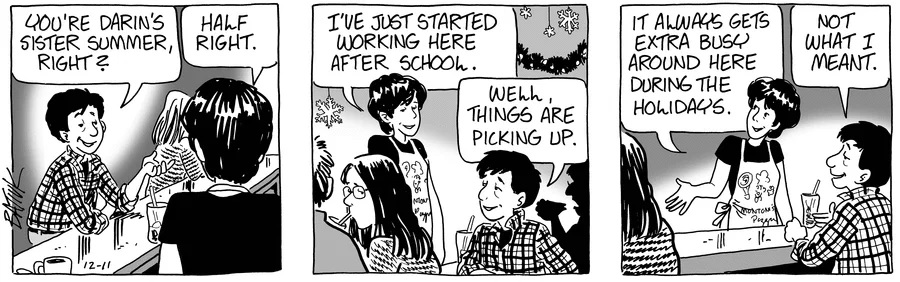
Just in case he wasn’t clear enough…
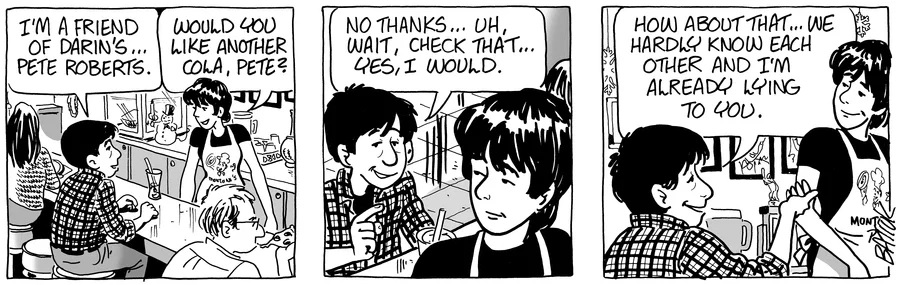
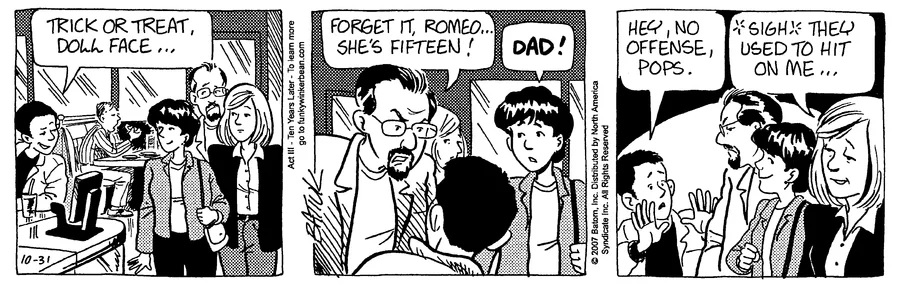
Yes, here is Pete trying, like the creepy little dweeb he is, to flirt with Les’ daughter and the half-sister of his best friend. Let’s ignore how awkward and nonsensical his flirting is and focus on what’s important. He knows, he fucking knows how old Summer is and still he’s trying to put the moves on her. Let me reiterate this: Pete Roberts is a man of around 30 trying to flirt with an teenage girl roughly half his age. A girl that he undoubtedly knows is underage because she’s the half-sister of his best friend.

What the hell was even Batty’s intention with these two strips? Was he trying to make Pete come off as cool and confident? Because he not only failed, he backfired in spectacular fashion. Pete looks like a giant tool. He looks like a creep. He looks like someone who buys a lot of Mike’s Hard Lemonade.

I hate Pete. I really, really detest him. Darin is the world’s most boring person to be sure. Les is a punchable smug douchebag. Dinkle is an unbearable egomaniac. But Pete is something else entirely. He’s an annoying gnome who gets constantly rewarded for no real reason. At twentysomething he was the top writer in the comics industry. He bounces around from publisher to publisher, being given opportunity after opportunity and when he inevitably fails out of this or that one — because he’s a talentless hack — he fails upwards into better jobs. And it’s not just jobs. By the end of Act II he has Chien interested in him though thankfully Batty jettisoned her before he could shackle Pete to her.

Later on he’ll have poor Mindy enamored with him because… well, I don’t know. And how does he treat Mindy? He whines and berates her for daring to create a character he doesn’t like for his stupid comic book. He quits his well-paying and seemingly dependable screenwriting gig to force her to help him run a pizza restaurant and live in the shitty small apartment above it. There’s a strip later on in Act III where it’s heavily implied that Mindy is sending him erotic photos of herself and what does Pete do? Like the giant irredeemable asshole that he is, he shows them off to Darin as some kind of flex.

But it’s okay because Pete is a wish fulfillment self-insert for Batty in a way that not even Les is. He can never fail even when he objectively does and he can never, ever face a negative consequence for any action he undertakes. He can do stupid and despicable things, he can be the shittiest writer of comics this side of Chuck Austen and for some reason will be rewarded for it. He can be a giant creep and still get women way out of his league and everyone treat him like he’s just such a lovable cool guy.

Calling him a tool would be understating what a rotten ugly little troll man Pete is. I hate him. I loathe him. And I can only hope the end of Crankshaft is a nuclear missile striking Montoni’s after Mindy has finally wised up, grown a spine and locked him and his precious comic books inside.

Moving on to actual matters, we close out the for Summer with a family gathering.
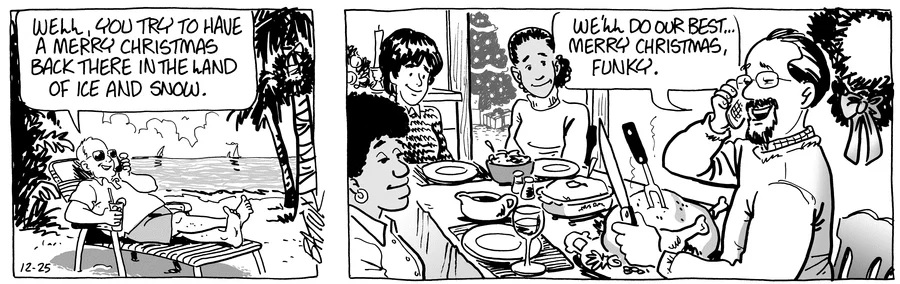
That will likewise close out this entry. But while 2009 may have been a down year for our budding little savior, 2010 will be a year that’s looking much brighter. Probably because I won’t have any more reason to rant about how much I hate Pete.

Funk Them Kids

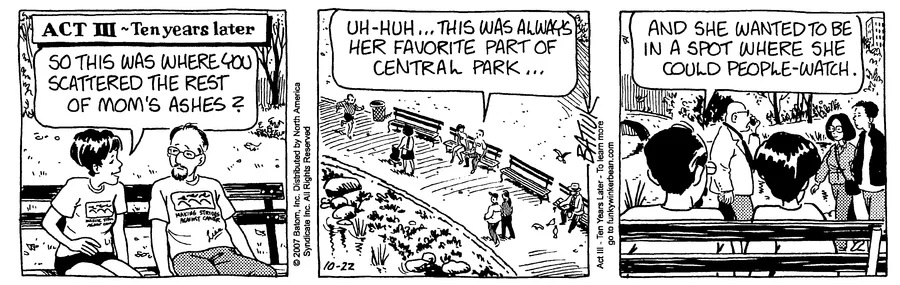
They laid Lisa Moore to rest in 2007, scattering her from Ohio to New York. It was a sad thing; so very sad that Tom Batiuk didn’t want to deal with it and have Lisa’s death drag the whole strip down. No sooner had she croaked than we were thrust a decade into the future. Les and the other Act I characters were now middle aged; 46-going-on-60. But they weren’t the only ones who’d aged up as Act III was promoted with a promise. It wouldn’t just be the old men and women getting the stories but their children as well.

That’s right…

It’s like an ad for a new totally radical syndicated Saturday morning teen show from 1994.

First off, I wonder who they got to do this art because these characters all bear only the vaguest of similarities to the characters from the comic itself. Second, we were indeed intended to be getting stories about the sons and daughters of the Westview High School Class of ’92 ’88 ’78 but as we’ll see, Batty eventually seemed to have his own ideas.

Why that is, who can say? In the last couple of years of he’d been getting some writing help from Sean McKeever, a comic book writer who’d been making a name for himself at Marvel on books starring teenaged and college-aged characters. His scripting duties (for I assume he was scripting based on Batty’s plots) included the Senior Skip Day story that started the Dopey/Jessica romance and I suspect almost all of the stuff with them was done by him as well as he’d also done the story about Darin learning that Lisa was his birth mother. I was, and am, a fan of the stuff he was doing for Marvel from that time period and a lot of those strips read like watered down versions of the kind of things he had been writing. McKeever, in an old interview from the COVID times, had said that Batty actually wanted to bring him on full time as a co-writer but by 2007 he’d just signed with DC to write Teen Titans which had been his dream book so turned it down.

I suspect that had McKeever taken up Batty’s offer, he would have been doing stories with the high school characters and without him Batty, who showed less and less interest in younger characters the older he got, just kind of shrugged. But he did still make an attempt at writing them which means it’s now time for the fourth entry in our examination of Summer Moore’s history.

The very first thing Summer gets up to is tagging along with her father on a trip to New York for the (first?) Lisa’s Legacy run.

Remember, he didn’t want the spectre of Lisa’s death hanging over the strip.

And tagging along is the right term because while she’s there, she’s just sort of around to throw in a comment or something. While in New York, the Moores meet up with Cindy who takes them to the grand opening of Montoni’s NYC location where Summer promptly gets hit on.

And we also get our first look at Act III Funky who’s become balding and fat.

Summer is having no part of Funky’s crap and frankly I’m right there with her.

In November we also get the reveal that she’s a jock as Summer takes the opportunity to make fun of her father. Also, her teammate looks like she could be the sister of that one balding kid from the final generation of WHS students.

Around this time is also when we’re properly introduced to the rest of the Funky Kids, the next generation who will theoretically be carrying the strip. Aside from Summer we have Jinx Bushka, adopted daughter of Bull and Linda Bushka. She’s introduced in a way that would make you think she’s a performative theater kid type but if she was that disappears immediately.

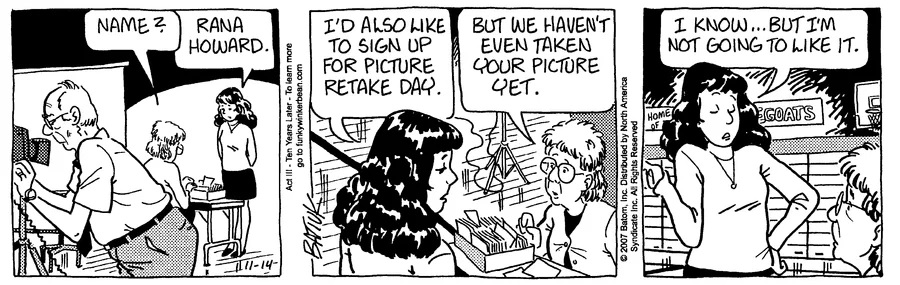
There’s Rana Howard, formerly Rana Winkerbean. Batty seemed keen on the idea that all the kids were the opposite of their parents so while Rana’s the daughter of a band geek and comic store owning dweeb, she gets to be the requisite Most Popular Girl In School right down to what I believe is stealing an old Cindy joke.

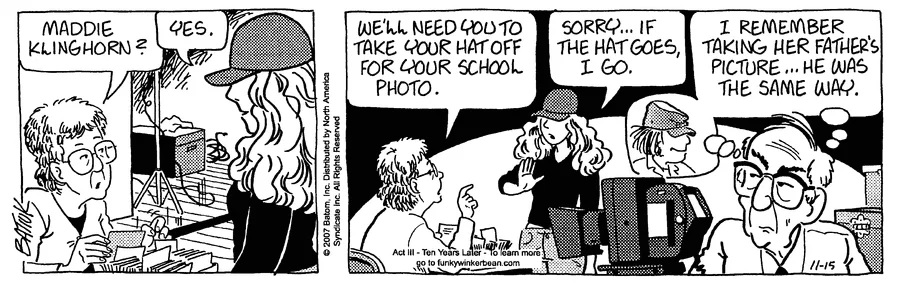
But on the flipside there’s Maddie Klinghorn who’s set up as being her father’s daughter. Except you’ll never know it because she gets absolutely zero focus and thus very little in the way of actual personality. Like even Jinx will get a couple of stories focused around her, Maddie gets absolutely nothing. She’s pure scene filler.

She’s got nice hair at least.

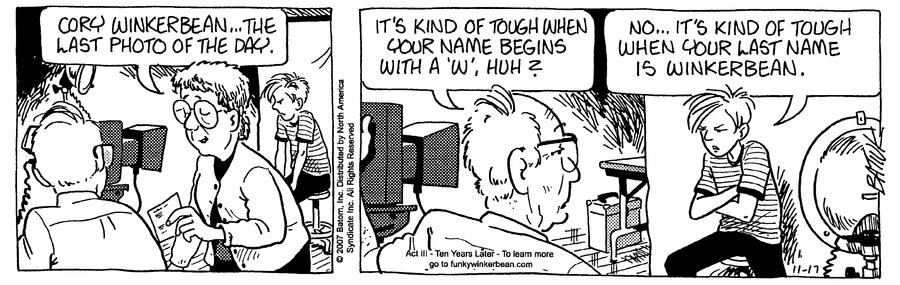
Rounding out the group is Cory Winkerbean, the bad seed. A big story throughout the first few years of Act III is how Funky’s focus on business has led to neglect of his family and so with the money that Funky provides but not the terrible puns, Cory’s turned out to be a moody troublemaker.

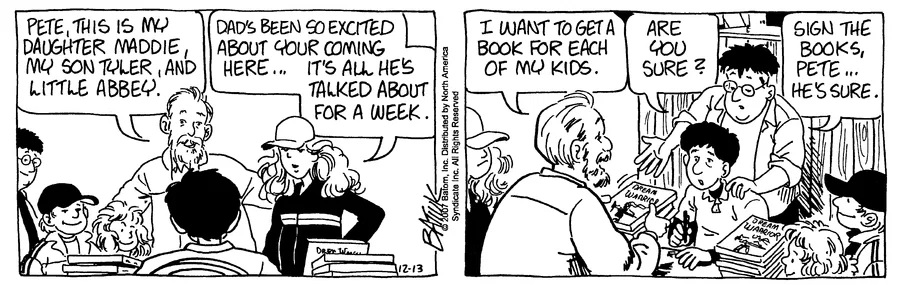
While it’s not directly related to Summer (yet), Mopey Pete Roberts (not yet Reynolds) returns to Westview having achieved the highest level of prestige in Batiukland: becoming a comic book writer. In this we’re also introduced to Maddie’s younger siblings Tyler and Abbey.

I am almost 100% sure that this is the only time in Act III that Crazy Harry’s other kids are shown or even mentioned. Donna was pregnant at the end of Act II which also makes this extra confusing. Because Maddie was born in 2003 but looks as if she’s a full decade older than her brother when at most it should be like 3 or 4 years. I guess it doesn’t matter because Batty memoryholed them but still, come on man.

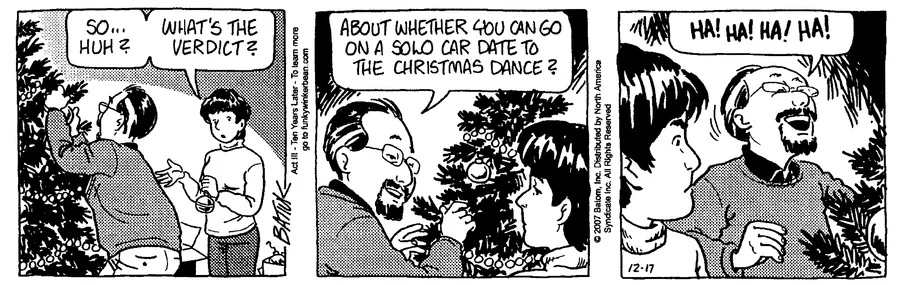
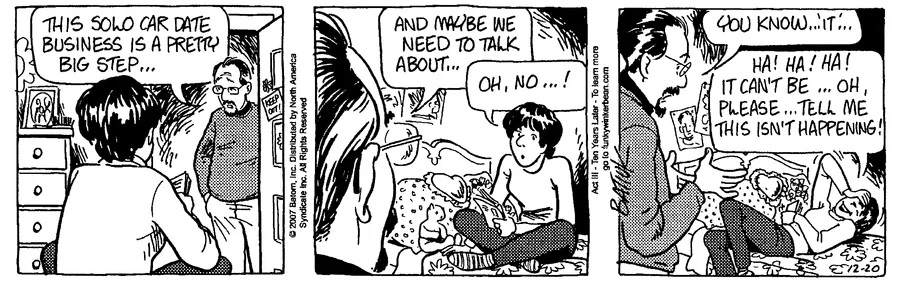
It’s Christmas time and Summer, being 15, wants to go on a “solo car date” with a guy. Les responds to this in the way that only a loving father can: by laughing in his child’s face as if she’s the biggest moron on Earth.

C’mon Summer, slug him! Right hook! Shoryuken! Something! He’s wide open!

But Les caves and decides to let Summer have her date, and Summer gets back at him by laughing at him for being a dork and trying to explain the birds and the bees to her. As she says, she’s a teenager with the internet so presumably she’s already been exposed to at a minimum Naruto and Harry Potter slash fiction.

There’s nothing you can teach her that she hasn’t already learned from the writings of xXSasukesGrlXx.

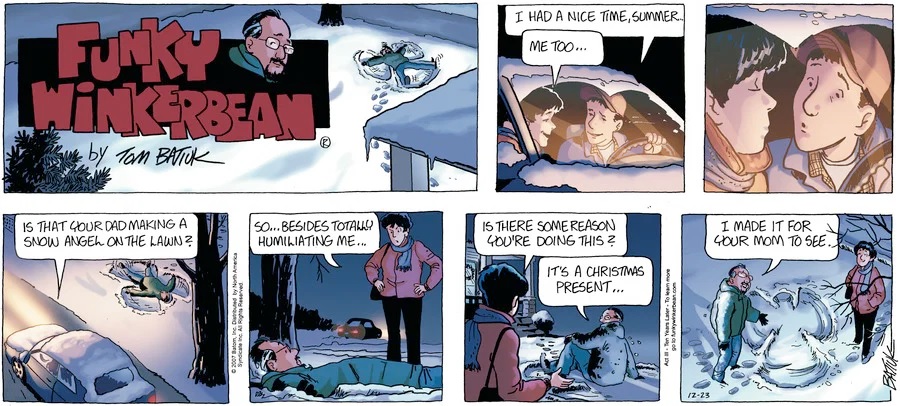
All of this is just build up to her date showing up for one strip so Les can play the role of embarassing parent while turning it into a sappy Lisa tribute.

Oddly enough, this is also the last time that Summer is shown being involved in anything romantic, at least on her end. There’s other stories that involve boys having crushes on her but never again is she shown having feelings for another boy, trying to date or anything like that really. Why that is are things we can speculate on much, much later so we’ll just move on to Summer’s last significant appearance of the year.

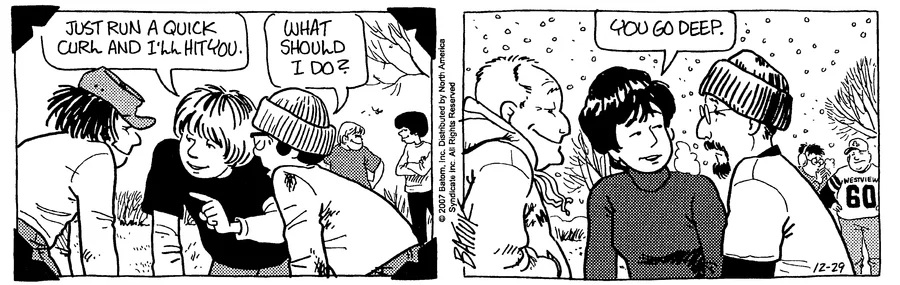
Just before New Year’s, she’s shown joining her dad and his buddies for a game of football and naturally, like the true jock she is, can’t pass up the opportunity to bully her father for being a wimp.

Meanwhile, Funky’s smug grin is growing to cover his face like lichen on a large rock.

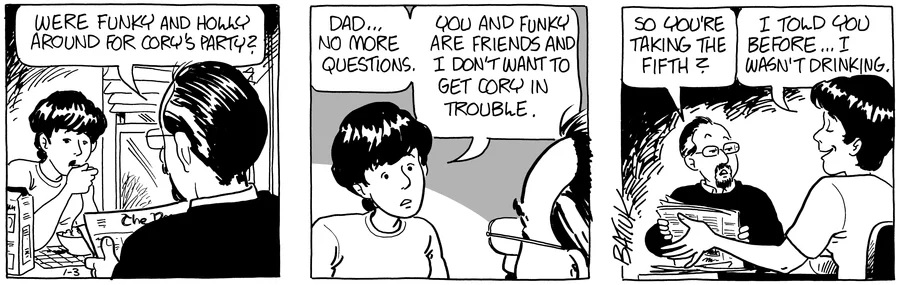
She also shows up at the beginning of the year having attended a party that Cory threw to further the story of Cory being Problem Child (1990) as he’d thrown the party while Funky and Holly were out of town.

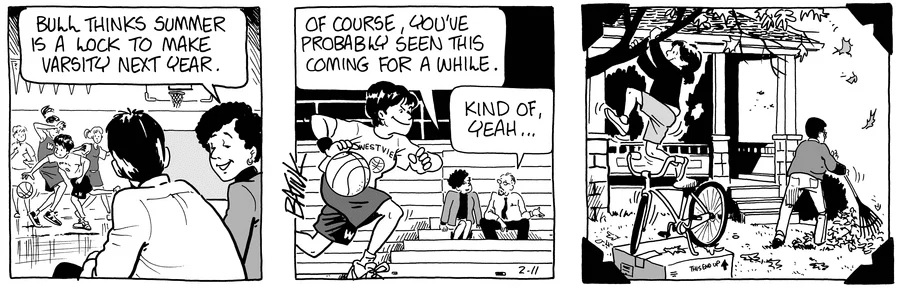
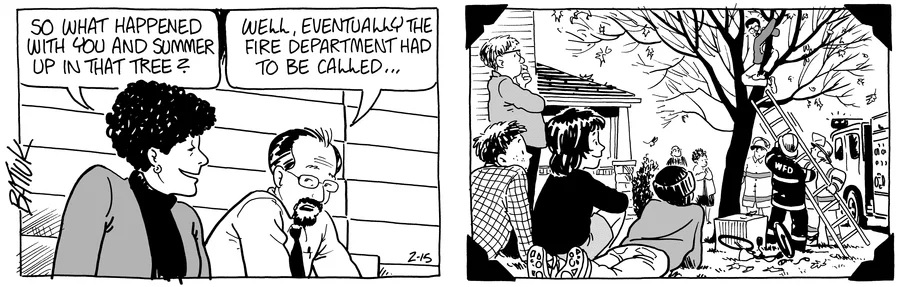
She starts getting some attention paid to the fact she’s an athlete in February which leads to a week of flashback strips where she climbed up a tree…

…and Les got stuck going up after her.

Should have left him there. I’m sure he would have been fine.


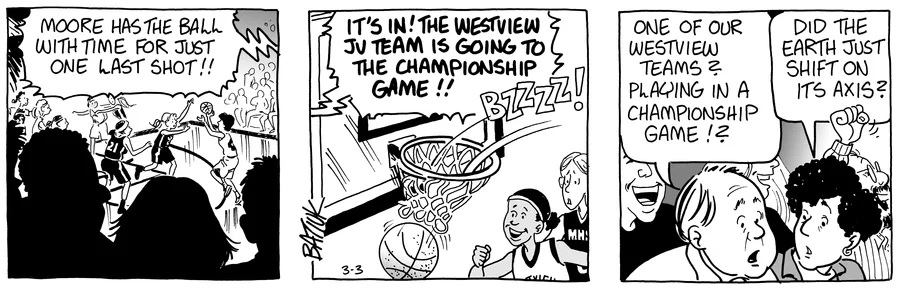
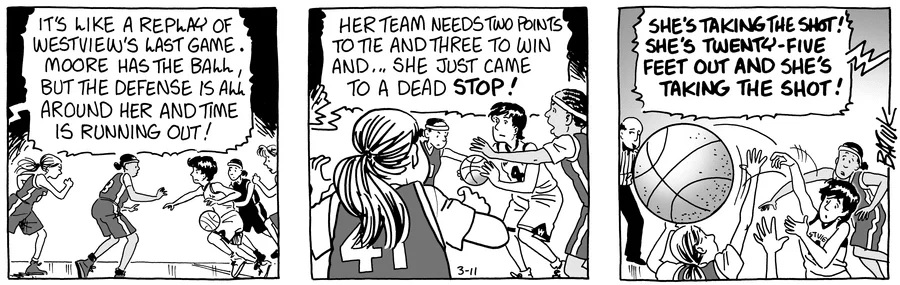
March begins a story wherein she leads the JV team to the conference finals.

Which is, of course, against Big Walnut Tech leading to the first appearance of Keisha Williams and Summer showing that, as great athletes tend to, she can be both overly aggressive and a little conceited.

She’ll eventually be your mommy too, Summer.

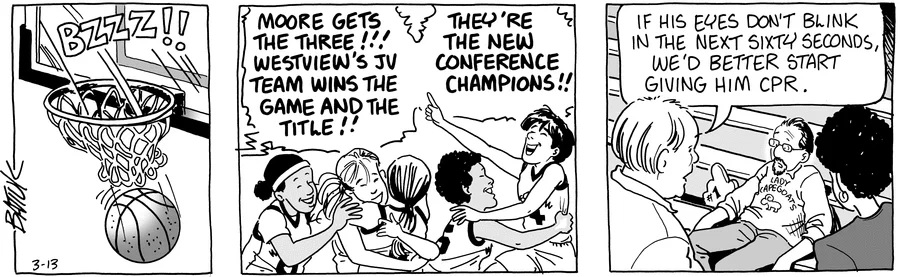
And being that kind of athlete means she eventually decides it’s time to play hero ball.

Which of course works, bringing Westview its first championship since some time during the Act II days. The excitement is so much that it almost kills Les, though unfortunately “almost” is the operative word there.

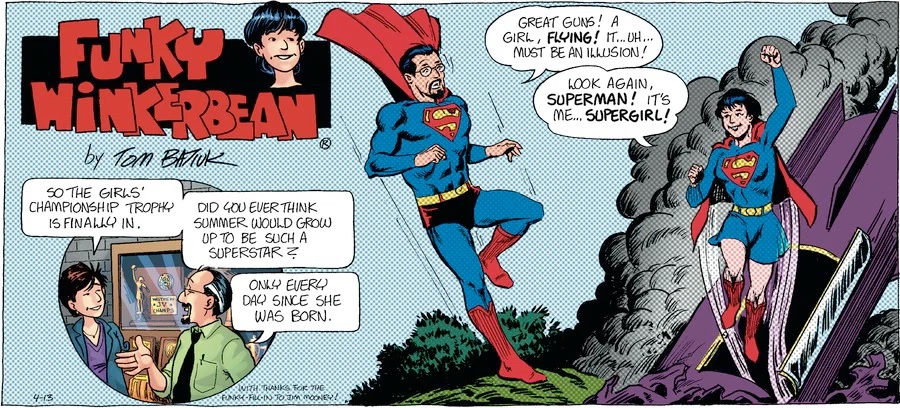
A month later the trophy arrives at Westview as Les and Becky gush over how amazing Summer is. I believe this is the first of the comic cover homages which will become an Act III staple. Apparently this is also the last professional work of the great Jim Mooney who passed away a few weeks before this strip was published.

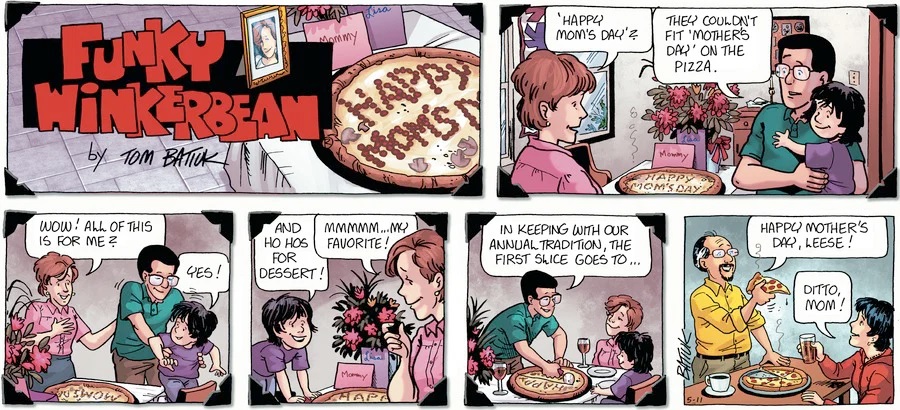
She also shows up for a Mother’s Day strip that naturally flashes back to Lisa.

There’s also a few debuts and returns around this time. First off is Summer’s half-brother Darin who returns to the strip in order to welcome back Mopey who’s going to be living in the apartment above Montoni’s as all young Westview men must do.

Also Mooch is there and then promptly disappears into the void. Should have brought him back for that L.A. fire storyline.

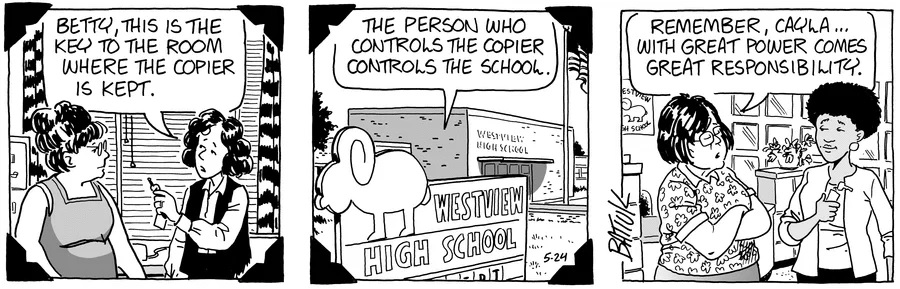
At the end of the school year, long time secretary and walking pile of nothing Betty decides to retire and turn over her duties to another woman. A transfer from Big Walnut Tech.

Cayla is here (and has yet to undergo her caucasoid metamorphosis) and she, and her daughter, will play a big role in Summer’s life going forward.

But already we can kind of see how things are going. Despite all the proclamations, a lot of that initial year or so of Act III is spent largely on Les, on Funky, on the adults in general. I didn’t mention it before for instance but at this time Les takes up a secondary job of becoming the new night manager at Montoni’s. A lot of time is spent on Funky being so focused on success that he’s letting his personal life and business go to shit while all his employees are beginning to dislike him.

Summer’s around of course and has yet to be completely sidelined (that’s for later) but aside from the month or so focused on her basketball prowess, around is all she really is. She’s just sort of there and that, I am sure, will bode well for her future usage under the Batty’s pen. That still puts her as better than Jinx and Maddie and at least she hasn’t disappeared into nonexistance like Crazy Harry’s other kids. Small miracles I suppose, but it’s a rather inauspicious start for humanity’s supposed savior.

Since we’re at the end of Summer’s freshman year of high school I figure that this is as good a place as any to leave off for now. We’ll take a look at how things go for her in her sophomore year next time.

Destroy Everything You Touch

After wandering through the wreckage of the abysmal Eugene and Lucy story, this week’s Crankshaft explored Harry Dinkle’s alleged self-esteem issues. We will talk about both of these stories today, how they’re connected, and how this led me to a surprising realization about my own life.

There are two important bits of background. The first is Lucy’s Story, which explains what the abysmal Eugene and Lucy story actually is.

Boy meets girl, boy likes girl, girl likes boy, boy is drafted into World War II, boy snail-mails marriage proposal containing “no response means no” clause, jealous older sister hides that letter, girl has mental breakdown, boy and girl somehow go another 60+ years without ever discussing the topic again, girl dies in 2009, boy is still longing for girl in 2026, boy has to move to a new home at age 99, Crankshaft readers wonder if they’ll ever find out where boy will be living now. (There will be a follow-up post about that.)

I know that summary got strange, but this is a strange storytelling world. If you asked the author to explain, he would say “It’s called writing.”

The other is Leaving Westview, which turned out to be perfect prologue for what I’m about to say. I’ll repost the important part:

I said or did every one of these things. For real. For real for real.

And now:

Narshe’s great Part 3 of Summer’s backstory included this strip:

While this looks creepy on the surface – and is being done by a known creep – it is perfectly appropriate. We saw in the previous post that Lisa died on October 4, 2007. This is 15 days after that. It’s an emotionally powerful comic strip, which Funky Winkerbean was capable of producing sometimes.

But nothing will ever make Les Moore stop sniffing his dead wife’s clothes. Not 20+ years. Not a marriage to another woman. Not raising a mixed family, both racially and in the step-parenting sense. Not a phone call from Lisa from beyond the grave. Not a house that seemed to generate new Lisa artifacts every couple years. Not being handed a freaking Oscar trophy for a Hollywood movie about Lisa, which Les was sabotaging at every turn. Not other chances Les had to work through his grief.

Les smelling Lisa’s clothes is accurate and quite sympathetic. The aromas left from loved ones onto clothing, triggers memories in a very powerful way. 

SorialPromise, https://sonofstuckfunky.com/2026/07/08/surprise-youre-on-cancer-camera/#comment-182055

This is very true. A scent or a sound or song or a noise or a place or an object can trigger long-forgotten emotions, and turn you back into the person you were when you were having those emotions.

My first experience with this was when I was 21 and in college. I’d had a particularly triumphant night out clubbing with my best friend, Todd. We were staying at his parents’ house, and when we got there, they had some cheap bathroom product. The scent reminded me of my high school girlfriend, Susan, whose bathroom had that same product. I had no active feelings about Susan at that point. But the scent of flowers and petrochemicals in a $1.50 pharmacy item turned me from a young man happy about a rare successful night meeting women into… well, Eugene.

I recently had this experience again. Something very specific reminded me of my high school The One Who Got Away story (analogous to the Eugene-Lucy story), which helped me finally understand why she got away (the Dinkle story). This is all about people and things I haven’t thought about in a very, very, very long time. Which led me to into even deeper rabbit holes in my own head. And it finally showed me the bottom of the rabbit hole.

I’ll try to keep my story from getting too cringe. But today, I’d rather be cringe than whitewash uncomfortable realities. So buckle your seatbelts. This flight will be experiencing turbulence. Trauma dump up ahead.

I went to an emotionally abusive Christian elementary school that gleefully took a flamethrower to my self-esteem. I was a shy and introverted child by nature. The people my parents trusted to educate me used me as an object of ridicule and scorn. That piled an avalanche of self-doubt, which I didn’t previously have, on top of my shyness.

Long story short, the Christian school shunned me. And I have no idea why. Apparently, at some point between 6th and 7th grade, somebody decided I wasn’t the kind of Christian they wanted their Christian school to produce. Even though I was an agreeable child who did everything he was told, read the Bible, and got mostly A’s. But I’d already seen them do the same thing to other kids who deserved no such treatment either. There seemed to be about one kid a year who randomly got on the school’s bad side. It made no sense to me. And Christian schools aren’t in the business of teaching the critical thinking skills that might result in someone questioning their judgement.

So I’ve been dealing with self-esteem problems most of my life. Mine were caused by that very specific and identifiable thing. It wasn’t a combination of factors, or a vague, whiny Freudian Excuse like Crankshaft is pushing this week.

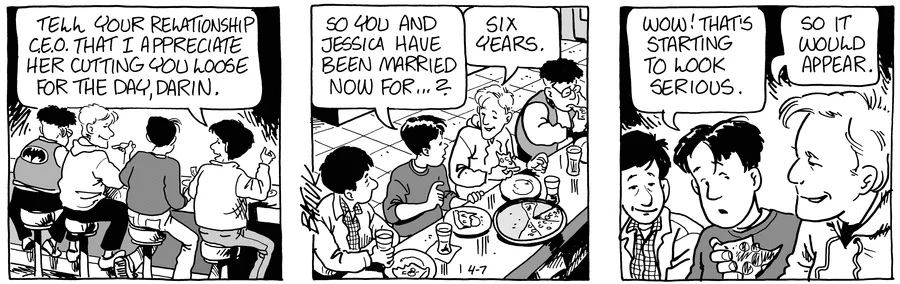
Funky Winkerbean appealed to me in 1988 because I related to Les Moore’s high school struggles, as depicted in the above strips. It was the only thing in media that seemed to understand what was going on in my head. So when its attempt at ripping off Peanuts ended with the girl wishing Les had asked her out, I felt personally betrayed. Even 16-year-old me didn’t believe that. That was the day I became a critic. It is my villain origin story. Mwahahahahaha!

I also shared something with adult Act II (1992-2006) Les Moore: wanting to be a writer, because of my perceived skill at it. I wanted to be a journalist when I grew up. It appealed to my writing skills, my sense of justice, and my failure to foresee that newspapers would become an obsolete medium. I would ultimately get a college degree in journalism, with a broadcasting focus. I promptly switched careers to Information Technology in adulthood, which I still work in today.

I’m honestly embarrassed to tell this story, because 50-something men should not be still processing failed high school relationships. But it’s too important to the larger story to omit, gloss over, or be vague about. And it’s a universe less creepy than anything Eugene does. More importantly, I refuse to worry about embarrassing myself anymore, for reasons I will soon make clear. So let’s go.

In high school in 1988 or 1989, I had creative a writing class in 2nd period, and journalism/high school newspaper class in 5th period. In both those classes was a girl named Christine. I still remember her last name; it was similar to that of a 1980s game show host.

One day, out of nowhere, Christine approached me before 2nd hour Creative Writing class about needing to talk, with this look on her face like it was something really important. I couldn’t imagine what this could be about, but I didn’t want to deal with it right then, so I said “talk to me in 5th hour.”

The truth is: despite my general cluelessness about how these things worked, I sensed Christine was going to tell me she had a crush on me. For some reason, I didn’t want that. And there was no logical explanation. There was absolutely nothing wrong with this girl. Not even by the sadistic social standards of high school. (Cindy Summers, I’m looking at you.)

I really liked Christine as a person. We worked together on the school newspaper. She was pretty. She was nice. She got along with people. She had no off-putting qualities. We had the same sense of humor. Considering that my defining trait in high school was doing open mic nights at legitimate adult comedy clubs, that should have been huge. (It was the late 80s. Everybody, including me, was trying to be the next George Carlin. Too bad none of us ever succeeded. Well, maybe Jon Stewart a little.)

By the time 5th hour arrived, I still didn’t want to deal with it, so I avoided her. The next day, we went back to being flirty/friendly with each other. That status quo remained for the rest of high school. But she never directly approached me again after that day. After graduation, we went our separate ways.

I tossed my high school yearbook in the trash decades ago. But I recently remembered what she wrote in it. “…and remember the girl who always STARES at you! Love, Christine.” With the game show host’s surname in place of her own, because that was a running gag between us. My God, how many times did this poor girl whack me with the clue-by-four?

But I had severe self-esteem problems. So severe that I sabotaged a potential relationship that I actually wanted. The idea that a desirable girl had a genuine interest in me made no sense in my mind.

It’s hard enough to approach the opposite sex when you’re an introverted, awkward, not-terribly-attractive teen. It’s impossible when you’re mentally convinced there’s zero chance of success, and that any failure will end with you being dragged in front of another classroom for another round of humiliation. So I friend-zoned myself. I threw away the chance to make a sweet, intelligent, pretty, funny girl I genuinely liked my first girlfriend. When all I had to do was stand there and let her initiate it.

I was so convinced of my own worthlessness that I couldn’t let that happen. I blocked her like Dikembe Mutombo.

I never rejected Christine. I rejected myself. I played the parts of both Lucy and Lillian. Christine tried to send me a love letter, and I hid it from myself. It was the most honest case of “it’s not you, it’s me” in the history of relationships.

That’s what a self-esteem problem looks like. So watching Crankshaft throw a pity party for Harry goddamn Dinkle severely pisses me the fuck off.

Harry Dinkle is not a person who had childhood trauma and self-esteem problems. Harry Dinkle is a person who caused childhood trauma and self-esteem problems in thousands of people over his career. (Including the elderly choralists who are following him on this journey.) He plays the role of the Christian school in my story. Not the victim.

Dinkle’s ego must be fed at all times, and doesn’t care how many people he has to grind up for meat. He’s a pervert, and this is how he gets his rocks off. The Colonel Khadafi outfit he wore like fetish gear doesn’t disprove that theory. And, as is often the case, he’s protected by a system that refuses to do anything about it.

What the Christian school did to me in 1983 made me reject Christine in 1989, and I didn’t even realize that until 2026. She liked me, and I liked her, but I rejected her. Why?

Because the Christian school psychologically abused me.

Now, I want to be very clear about a few things. One, there was never any sexual or physical component to this abuse. It was psychological only. Two, I had/still have a great family that was very loving and supportive about the whole ordeal, who made the right move. They yanked me out of that Christian school overnight, and put me in public middle school.

I probably could have used some counseling, but I think they didn’t know how to help me, and I definitely didn’t know how to ask for help. On top of all the debris that was in my head, I could be a difficult child in my own right sometimes.

Third, the psychological abuse was mostly traceable to one teacher at that Christian school. I don’t want to say that person’s name, because I’m afraid I might summon them, like Voldemort. So let’s leave that person in damnatio memoriae. And in hell, where they no doubt are today, according to the rules of their own belief system.

This is how abuse perpetuates itself. Someone hurt me, which ultimately made me hurt someone else (even though declining interest in a relationship is not a hurtful act if done tactfully). I never realized until now that tearing myself down, which was basically my coping mechanism, was also painful for the people who cared about me to watch. No wonder some them gave up on me.

Six years ago, I wrote this about the Dinkle family Thanksgiving:

Look how many details in this strip are about (Harry) Dinkle’s toxic workaholism. The house decoration and the choice of Thanksgiving meal are based on his career. The annual band turkey sale makes Harry tired of turkey, so turkey must not be served, no matter what anybody else wants. His daughter entered the same career as him, so you can guess what the table conversation is going to be about.

Look at (Dinkle’s wife) Harriet’s face as she presents the Thanksgiving non-turkey. Her weary eyes seem to be seeking his approval. Her daughter gives her companion an aside glance, as if to say “see, I warned you it’d be like this.” He seems to respond in kind, as if acknowledging he’s seen this in his own family. Harry is genuinely happy, because everything revolves around him, exactly as it should. And everyone knows it better stay that way.

This is the Thanksgiving of a family that revolves around a selfish, obsessive narcissist. And it’s a common theme in Funky Winkerbean

This is the guy we’re supposed to feel sorry for, because “his stepfather was rough on his father”? Well, let me say this as clearly as possible:

Get the fuck out of my fucking face with that fucking bullshit.

I called this post Destroy Everything You Touch, because that’s what Tom Batiuk does to every “prestige arc” he gets his grubby, comic book-stained fingers on. His writing is so shallow he trivializes everything he tries writing about. It insults anyone who’s really experienced it. Which is why all those Lisa’s Story collections aren’t selling.

And Batiuk has tried writing about every trauma you could think of. Dementia, layoffs, freedom of speech, domestic terrorism, transsexuality, illiteracy, amputation, “climate damage”, bullying, war, PTSD, alcoholism, racism, coming out of the closet, football-induced CTE, suicide, cancer, and cancer incest. He did childhood self-esteem this week. Most of these things he’s tried writing about at least once.

(Also, musical titles are a recurring theme at this blog. And “Destroy Everything You Touch” is a god-tier banger.)

You. Do not feel. Do not know. What you steal.

Funky Winkerbean and now Crankshaft are misery porn. To the extent misery porn works, it’s because the storyteller spilled their guts onto the paper. Great personal memoirs don’t hold back about embarrassing and personal details that most people wouldn’t want others to know. Their brutal honesty makes them compelling to read, and helpful to people who are going through the same things.

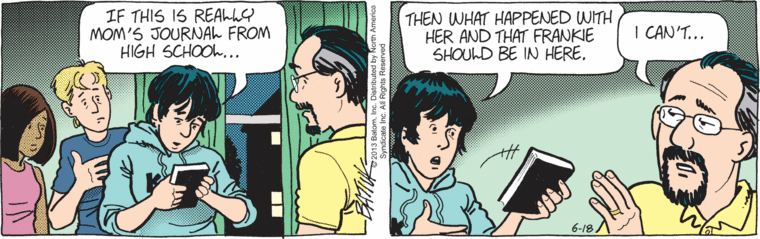
Funky Winkerbean gives us this:

The greatest writer in the Funky Winkerbean universe is a not a man who spills his guts onto the page. It’s a man who’s too emotionally fragile to even read his own wife’s diary. So he passive-aggressives their daughter to reading an entry about her own mother being sexually assaulted. Nice guy, that Les Moore.

(Narshe, I apologize if I spoiled something you were planning to use in Part 4 of your story. But please do use it again. Because this may be the single worst thing Les Moore ever did. And there’s a lot of competition for that crown.)

I consider what happened with Christine the biggest mistake of my life. Not because I’m Eugene, still sad about a girl he lost because he couldn’t be bothered to find out what her actual answer was. But because I lost the better man I might have become a lot sooner if I had given myself a chance in that relationship.

However it might have gone – and unlike Eugene, I make no assumption that life would have been perfect after that – it would have been a net positive. Whatever happened, this girl was never, ever, ever going to humiliate me. Which I now know is what I was really afraid of.

It would have ended amicably, given me confidence and experience, and probably helped me face my inner trauma a lot sooner than I did. Christine would have been a better high school girlfriend for me than Susan was, though Susan was a pretty good one. (Other than some things that were my own fault, which is the nature of high school relationships.) And I would have saved Christine a little rejection and confusion. Lord knows life already gives you enough of that. Especially in high school.

Or maybe I’ve misread this entire situation, and Christine just wanted to tell me my fly was down.

(That was a joke. This story needed to end on a lighter note. And I refuse to second-guess myself anymore.)

One other thing I want to mention, because it ties into the “some things trigger deep memories” theme, and because it’s funny. While I was working through all this, I found a playlist of 1988 hit songs on YouTube, and set it to shuffle. This was the first thing it pulled up:

Mwahahahahaha! I am the Rickroller! You fell right into my devious trap!

I’m kidding. It was actually this:

Debbie Gibson is another woman I hadn’t thought about in 30+ years. Nor has anyone else.

I have no particular memories attached to this song. But the overwhelming 1988-ness of this music video reinforced the feelings I was working through. (This isn’t what initially brought Christine back into my head. It’s not important what that actually was.)

But imagine me, a 54-year-old man, blubbering about a blown high school date while listening to an obnoxiously peppy Debbie Gibson song. That’s a pretty funny visual. Imagine that happening to Jim Carrey in one of his better movies. Or Jack Black. Or Chris Farley, if I’m being honest about who would play me in a movie. (And if I’m being too honest: Rick Moranis, if he ate Chris Farley.) Or it could be treated seriously, in a movie like Fatso.

I hope I didn’t bait-and-switch you. You came here for newspaper comics snark, and I gave you my dead chicken moment. Which is what this feels like: discovering what my real problem was. I’d been trying to find it for 40 years.

This is why I know a lot about neurodivergence, and why I frequently mention it as a factor in the creation of these comic strips. I thought for a long time that my problem was untreated neurodivergence. But I could always recognize emotions and social cues adequately. I just couldn’t act on them, because of my crippling fear of humiliation. I’ve been throwing darts at the wall for decades, trying to figure out what the fuck was wrong with me. But I think I just did.

I’d like to leave a few ground rules for the comments:

  • I’m willing to answer any questions anyone may have, though I reserve the right to be vague or silent about certain things.
  • Being an abuse victim isn’t my whole identity, and it will not become that. I have accepted that it’s a small part of who I am. But it will not destroy anything it touches, anymore. While I would never question anyone’s approach to processing their own trauma, I personally think some people lean a little too hard into the victim identity.
  • I realize a lot of people went through a lot worse than me. So there will be no Trauma Olympics.
  • I’m not looking for a pity party, safe space, psychoanalysis, therapy-speak, or anything like that. I just wanted someone to listen to my story. If you’re reading these words, you’ve done that, and you’ve done me a great service. Thank you. I actually feel really good about this whole thing.
  • I’m not looking for closure. I consider it closed. I said what I needed to say. The people who have been living rent-free in my head have been evicted.
  • I am open to reconnecting with Christine, but I’m sure she has a family that wouldn’t appreciate that. It’s not her job to help with my recovery. My only purpose was to document the key role she inadvertently played in fixing something that was very broken in me.
  • I shouldn’t have to say this, but please do not try to figure out who Christine is, or who I am. There are enough clues that someone with connections to our high school class could figure it out. But I have very little contact with any of those people anyway, I now live 1,300 miles away from my hometown, and I don’t do the social media thing.

    Calvin & Hobbes had a terrific story where they try to build a robot, so Calvin doesn’t have to make his bed. Here’s the ending (SPOILER ALERT):

Psychological abuse and self-doubt made me throw away an opportunity to get to know a delightful girl who could have helped me a great deal in life.

And in a way, she did.

Murder In The Burnings: The Trial Continues!

Yes! This story is actually continuing! It’s not an April Fool’s prank, I promise you!

BAILIFF: All rise for the Honorable Collis D. Smizer.

JUDGE: As you were. Next up is the much-delayed case 53766673, the Village Booksmith fire. Now, Mr. Moore, do you have proper counsel?

MR. BREEF: I am Amicus Breef, from the law firm of Westview Community College Discount Legal Services. I will be representing the defendant, Les Moore.

JUDGE: Very good. Welcome, Mr. Breef. Our previous session ended in the middle of cross examination. Mr. Flaherty, would you like to continue?

CONTINUED CROSS EXAMINATION

(Les Moore, having duly been sworn in, testifies as follows:)

PROSECUTOR: Mr. Moore, I was asking you if you remembered a student of yours named Eric “Mooch” Myers. This student of yours was found to have started two different fires in 1999: one during homecoming, and a second during an ordinary school day. Eric initially reported that second fire to the authorities, and was called a hero on local TV news for doing so.

PROSECUTOR: Do you remember these incidents?

LES: Yes.

PROSECUTOR: At the time, you yourself noted that Myers was seeking attention. Correct?

LES: Yes.

PROSECUTOR: I believe this is also why you started the Village Booksmith fire. You saw an opportunity to be the hero again, taking a bold stand against a non-existent enemy of literature. And you took full advantage of it.

LES: I would never put my own friends at risk.

PROSECUTOR: But you did. You already testified that you put Lillian McKenzie at risk, despite her being uncomfortable with this whole situation, when safer options were available. You also had Pete Roberts-Reynolds and Mindy Murdoch help you. Plus bookstore employees Amelia and Emily Matthews. You certainly didn’t mind putting any of them at risk! You let these people – your three friends, and two underage girls – worry about a threat that they thought was real. Eric Myers may have been your student, but it seems you learned a lot from him as well.

LES: Well, that’s what it means to be a teacher.

PROSECUTOR (ignoring Les): Which is also why the fire was laughably small. You didn’t want anyone to get hurt, or even for Lillian to suffer much property damage. Which is why you started the fire at the very bottom of the building’s wooden stairs, when copies of Fahrenheit 451, the supposed target of all this, were upstairs. And you knew that, because you just moved them up those stairs yourself!

This fire was so far away from the books that it couldn’t possibly have reached them. And, it was easily visible from the outside, so it would be seen and put out quickly. All of this is consistent with your motive of wanting to set a fire without actually burning anything.

On top of all that, creosote oil is a wood preservative, as well as a fire accelerant. Which would explain your choice of this unorthodox arson catalyst. You might as well have applied fire-resistant wood sealant to Lillian’s staircase before you set it on fire. Do you deny any of this?

LES: You’re proven nothing.

PROSECUTOR: And what of Lillian herself? She flat-out told you she didn’t feel safe, when you were the one she should have been afraid of all along! And you knew that! An elderly single woman who —

LILLIAN McKENZIE: I’m single because–

UNIDENTIFIED VOICE: We know, Lillian!

JUDGE (banging gavel): Order!

(Order is restored.)

PROSECUTOR: Mr. Moore, do you recognize this document?

LES: It appears to be a sales receipt for an online purchase.

PROSECUTOR: And can you tell the court what items were purchased?

LES: It’s– wait, what? You can’t pull this out on me at the last minute!

MR. BREEF: Your Honor, I object! I want to file a subpoena for the evidence!

LES: What?

(A brief, confused pause.)

JUDGE: Mr. Breef, all the evidence has already been presented, and provided to you. Are you suggesting there is a need to subpoena new evidence?

MR. BREEF: Umm…

JUDGE: Overruled. Lack of relevance. The counselor may continue.

PROSECUTOR: Mr. Moore, this document was given to you during discovery, as was all the other evidence, when you were effectively pro se. It was also given to Mr. Breef as soon as he notified my office that he was your new counsel. We have the electronic records to prove this exchange took place. So I will ask you again, Mr. Moore: will you please tell the court what items were purchased in this receipt? You are under oath.

LES: Ummmm, creosote oil, and a copy of the book Lisa’s Story.

LES: But so what? Anybody could have bought those things.

PROSECUTOR: “A” copy of Lisa’s Story? Can you double-check the quantity?

LES: Uh, three.

PROSECUTOR: Three?

LES: Hundred.

LILLIAN (from the audience): Hey!

PROSECUTOR (in full “the defendant is full of shit and I’m about to prove it” mode): Now, who on earth needs to buy 300 copies of the same book? Other than the man who wrote that book, and does frequent public signings of that book?

LES: Maybe the buyer wanted to read it more than once?

(No one laughs.)

LILLIAN: You bastard!

JUDGE: Order! Ms. McKenzie, no more outbursts, or I will ask you to leave.

(Lillian sits down.)

PROSECUTOR: Can you also tell me the quantity of the creosote oil?

LES: 20 liters.

PROSECUTOR: And who is the purchaser on this invoice?

LES (scanning the document): Well, I can already see it’s not me, it’s the…

LES: Lisa’s Legacy Foundation.

PROSECUTOR: And are you the director of the Lisa’s Legacy Foundation?

LES: Yes.

PROSECUTOR (blatantly hamming it up now): Why does a charitable organization need creosote oil at all? Much less 20 liters of it?

LES: Is it too late to change my plea?


April fools! It really wasn’t a prank. I let this story sit way too long, and I thought it would be a nice surprise to finally deliver the goods. My re-telling of The Burnings will resume on a more regular basis soon. Really. Also, last year’s prank was going to be hard to top.

Past installments of the story were:

Today’s installment was Chapter 9. Stay tuned for Chapter 10!

Remix

I mixed the last two Crankshaft strips into a much better joke.

Points for discussion:

  • Yes, I know Les is short for “Leslie.” But if Tom Batiuk can throw out decades of character history to make a joke work, so can I. It just makes the parody more realistic.
  • Is Lisa evil? Is she actually worse than Les? Les’ Muse Abuse sets the bar pretty high. But Lisa’s victim complex, need to be the center of attention, micromanagement of Les from beyond the grave, and complete disinterest in her child make this race closer than you’d think.
  • Have you noticed nobody in Westview actually watches or reads Lisa’s Story? As outlandish as the parody strip seems, it is 100% consistent with what we’re supposed to believe, that the movie was of Oscar quality. Pam and her dad having a nice movie night watching Lisa die again is a lot more plausible than them watching old Looney Tunes.
  • Murder In The Burnings will be resuming soon. There’s still a long way to go in the story, but I’ve been visited by Le Chat Bleu lately.