Let’s face it: Tom Batiuk is giving us nothing to talk about anymore.
In What’s The Story, Morning Glory, I lamented the lack of any kind of actual story since Max and Hannah’s wedding in March. The two months since then have been more of the same: aimless filler weeks, tired Crankshaft tropes, and forced references to unloved latter-day topics like buck rub and the Winnipeg Blue Bombers.
I’ll let a recent comment get me started:
I almost feel like Crankshaft has to be ending next year. It all feels like a man who’s reached the end of the flight and is (clumsily) getting ready to land the plane.
I didn’t think this at first, but it’s getting harder to deny. I originally classified the tedious “In The Name Of The Father” as a non-story. But at least it was a Batiukian attempt at one: full of word zeppelins and pretentious award bait, signifying nothing. At least it was snark fodder. We’re not even getting that anymore. And his blog hasn’t mentioned any upcoming stories.
I’ll let Narshe continue:
We know [Batiuk] loves his anniversaries and 2027 contains a quite a few nice round(ish) numbered ones: 55 years since the debut of Funky Winkerbean, 40 years since the debut of Crankshaft, 30 years since he closed the book on John Darling by having Les solve his murder, 20 years since the death of Lisa, 10 years since Mopey met Mindy and 5 years since the end of FW. TomBa himself will also turn 80 next year.
This is all true. And if the awards-obsessed Batiuk hasn’t gotten his Golden T-Square by now, additional years aren’t going to get him one. (Though I still think he’s totally earned it.)
It’s hard to tell what’s going on in Tom Batiuk’s head. His own blog, and occasional mainstream news articles which he appears to write himself, have a very consistent tone. He presents his work as a combination of Charles Schulz and James Thurber: a cultural icon full of memorable, beloved characters, while also being a realistic literary look into the lives of downtrodden Ohioans. Except that “downtrodden” means “denied access to comic books” and “so passive they won’t lift a finger to solve their own problems.”
But man, it has to be taking a toll on his ego, especially considering how massive it is. It’s hard to keep doing something you think deserves a reward, and never getting that reward, and never even be mentioned for it anymore. The man peaked with that one Pulitzer nomination in 2008. And that second one is never coming.
I’m a generation younger than Tom Batiuk – I was born only two months after Funky Winkerbean was – and I can feel my own mortality starting to kick in. I also have a living parent who’s in their 80s now, and whose increasing limitations are obvious. Batiuk has to be noticing this in himself. And somebody has to be talking about it, if only his own wife, and other close friends who are going through the same thing.
I recently commented that Act IV (post-Funky Winkerbean) has now devolved into a gelatinous Act V. But I don’t think there’s a real reason to distinguish them. Crankshaft is still maintaining the low standard it’s had for decades; it hasn’t turned into Apartment 3-G, at least not any worse than it has been for years. The attempts at ambition are just fewer and farther between.
The end of the Funkyverse is now an inevitability. Even if it isn’t next year, it won’t be long after.
After wandering through the wreckage of the abysmal Eugene and Lucy story, this week’s Crankshaft explored Harry Dinkle’s alleged self-esteem issues. We will talk about both of these stories today, how they’re connected, and how this led me to a surprising realization about my own life.
There are two important bits of background. The first is Lucy’s Story, which explains what the abysmal Eugene and Lucy story actually is.
Boy meets girl, boy likes girl, girl likes boy, boy is drafted into World War II, boy snail-mails marriage proposal containing “no response means no” clause, jealous older sister hides that letter, girl has mental breakdown, boy and girl somehow go another 60+ years without ever discussing the topic again, girl dies in 2009, boy is still longing for girl in 2026, boy has to move to a new home at age 99, Crankshaft readers wonder if they’ll ever find out where boy will be living now. (There will be a follow-up post about that.)
I know that summary got strange, but this is a strange storytelling world. If you asked the author to explain, he would say “It’s called writing.”
The other is Leaving Westview, which turned out to be perfect prologue for what I’m about to say. I’ll repost the important part:
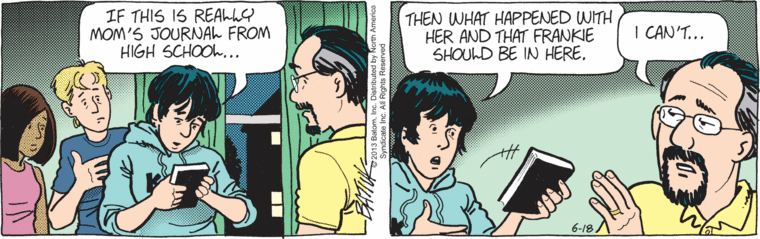
I said or did every one of these things. For real. For real for real.
While this looks creepy on the surface – and is being done by a known creep – it is perfectly appropriate. We saw in the previous post that Lisa died on October 4, 2007. This is 15 days after that. It’s an emotionally powerful comic strip, which Funky Winkerbean was capable of producing sometimes.
But nothing will ever make Les Moore stop sniffing his dead wife’s clothes. Not 20+ years. Not a marriage to another woman. Not raising a mixed family, both racially and in the step-parenting sense. Not a phone call from Lisa from beyond the grave. Not a house that seemed to generate new Lisa artifacts every couple years. Not being handed a freaking Oscar trophy for a Hollywood movie about Lisa, which Les was sabotaging at every turn. Not other chances Les had to work through his grief.
Les smelling Lisa’s clothes is accurate and quite sympathetic. The aromas left from loved ones onto clothing, triggers memories in a very powerful way.
This is very true. A scent or a sound or song or a noise or a place or an object can trigger long-forgotten emotions, and turn you back into the person you were when you were having those emotions.
My first experience with this was when I was 21 and in college. I’d had a particularly triumphant night out clubbing with my best friend, Todd. We were staying at his parents’ house, and when we got there, they had some cheap bathroom product. The scent reminded me of my high school girlfriend, Susan, whose bathroom had that same product. I had no active feelings about Susan at that point. But the scent of flowers and petrochemicals in a $1.50 pharmacy item turned me from a young man happy about a rare successful night meeting women into… well, Eugene.
I recently had this experience again. Something very specific reminded me of my high school The One Who Got Away story (analogous to the Eugene-Lucy story), which helped me finally understand why she got away (the Dinkle story). This is all about people and things I haven’t thought about in a very, very, very long time. Which led me to into even deeper rabbit holes in my own head. And it finally showed me the bottom of the rabbit hole.
I’ll try to keep my story from getting too cringe. But today, I’d rather be cringe than whitewash uncomfortable realities. So buckle your seatbelts. This flight will be experiencing turbulence. Trauma dump up ahead.
I went to an emotionally abusive Christian elementary school that gleefully took a flamethrower to my self-esteem. I was a shy and introverted child by nature. The people my parents trusted to educate me used me as an object of ridicule and scorn. That piled an avalanche of self-doubt, which I didn’t previously have, on top of my shyness.
Long story short, the Christian school shunned me. And I have no idea why. Apparently, at some point between 6th and 7th grade, somebody decided I wasn’t the kind of Christian they wanted their Christian school to produce. Even though I was an agreeable child who did everything he was told, read the Bible, and got mostly A’s. But I’d already seen them do the same thing to other kids who deserved no such treatment either. There seemed to be about one kid a year who randomly got on the school’s bad side. It made no sense to me. And Christian schools aren’t in the business of teaching the critical thinking skills that might result in someone questioning their judgement.
So I’ve been dealing with self-esteem problems most of my life. Mine were caused by that very specific and identifiable thing. It wasn’t a combination of factors, or a vague, whiny Freudian Excuse like Crankshaft is pushing this week.
Funky Winkerbean appealed to me in 1988 because I related to Les Moore’s high school struggles, as depicted in the above strips. It was the only thing in media that seemed to understand what was going on in my head. So when its attempt at ripping off Peanuts ended with the girl wishing Les had asked her out, I felt personally betrayed. Even 16-year-old me didn’t believe that. That was the day I became a critic. It is my villain origin story. Mwahahahahaha!
I also shared something with adult Act II (1992-2006) Les Moore: wanting to be a writer, because of my perceived skill at it. I wanted to be a journalist when I grew up. It appealed to my writing skills, my sense of justice, and my failure to foresee that newspapers would become an obsolete medium. I would ultimately get a college degree in journalism, with a broadcasting focus. I promptly switched careers to Information Technology in adulthood, which I still work in today.
I’m honestly embarrassed to tell this story, because 50-something men should not be still processing failed high school relationships. But it’s too important to the larger story to omit, gloss over, or be vague about. And it’s a universe less creepy than anything Eugene does. More importantly, I refuse to worry about embarrassing myself anymore, for reasons I will soon make clear. So let’s go.
In high school in 1988 or 1989, I had creative a writing class in 2nd period, and journalism/high school newspaper class in 5th period. In both those classes was a girl named Christine. I still remember her last name; it was similar to that of a 1980s game show host.
One day, out of nowhere, Christine approached me before 2nd hour Creative Writing class about needing to talk, with this look on her face like it was something really important. I couldn’t imagine what this could be about, but I didn’t want to deal with it right then, so I said “talk to me in 5th hour.”
The truth is: despite my general cluelessness about how these things worked, I sensed Christine was going to tell me she had a crush on me. For some reason, I didn’t want that. And there was no logical explanation. There was absolutely nothing wrong with this girl. Not even by the sadistic social standards of high school. (Cindy Summers, I’m looking at you.)
I really liked Christine as a person. We worked together on the school newspaper. She was pretty. She was nice. She got along with people. She had no off-putting qualities. We had the same sense of humor. Considering that my defining trait in high school was doing open mic nights at legitimate adult comedy clubs, that should have been huge. (It was the late 80s. Everybody, including me, was trying to be the next George Carlin. Too bad none of us ever succeeded. Well, maybe Jon Stewart a little.)
By the time 5th hour arrived, I still didn’t want to deal with it, so I avoided her. The next day, we went back to being flirty/friendly with each other. That status quo remained for the rest of high school. But she never directly approached me again after that day. After graduation, we went our separate ways.
I tossed my high school yearbook in the trash decades ago. But I recently remembered what she wrote in it. “…and remember the girl who always STARES at you! Love, Christine.” With the game show host’s surname in place of her own, because that was a running gag between us. My God, how many times did this poor girl whack me with the clue-by-four?
But I had severe self-esteem problems. So severe that I sabotaged a potential relationship that I actually wanted. The idea that a desirable girl had a genuine interest in me made no sense in my mind.
It’s hard enough to approach the opposite sex when you’re an introverted, awkward, not-terribly-attractive teen. It’s impossible when you’re mentally convinced there’s zero chance of success, and that any failure will end with you being dragged in front of another classroom for another round of humiliation. So I friend-zoned myself. I threw away the chance to make a sweet, intelligent, pretty, funny girl I genuinely liked my first girlfriend. When all I had to do was stand there and let her initiate it.
I was so convinced of my own worthlessness that I couldn’t let that happen. I blocked her like Dikembe Mutombo.
I never rejected Christine. I rejected myself. I played the parts of both Lucy and Lillian. Christine tried to send me a love letter, and I hid it from myself. It was the most honest case of “it’s not you, it’s me” in the history of relationships.
That’s what a self-esteem problem looks like. So watching Crankshaft throw a pity party for Harry goddamn Dinkle severely pisses me the fuck off.
Harry Dinkle is not a person who had childhood trauma and self-esteem problems. Harry Dinkle is a person who caused childhood trauma and self-esteem problems in thousands of people over his career. (Including the elderly choralists who are following him on this journey.) He plays the role of the Christian school in my story. Not the victim.
Dinkle’s ego must be fed at all times, and doesn’t care how many people he has to grind up for meat. He’s a pervert, and this is how he gets his rocks off. The Colonel Khadafi outfit he wore like fetish gear doesn’t disprove that theory. And, as is often the case, he’s protected by a system that refuses to do anything about it.
What the Christian school did to me in 1983 made me reject Christine in 1989, and I didn’t even realize that until 2026. She liked me, and I liked her, but I rejected her. Why?
Now, I want to be very clear about a few things. One, there was never any sexual or physical component to this abuse. It was psychological only. Two, I had/still have a great family that was very loving and supportive about the whole ordeal, who made the right move. They yanked me out of that Christian school overnight, and put me in public middle school.
I probably could have used some counseling, but I think they didn’t know how to help me, and I definitely didn’t know how to ask for help. On top of all the debris that was in my head, I could be a difficult child in my own right sometimes.
Third, the psychological abuse was mostly traceable to one teacher at that Christian school. I don’t want to say that person’s name, because I’m afraid I might summon them, like Voldemort. So let’s leave that person in damnatio memoriae. And in hell, where they no doubt are today, according to the rules of their own belief system.
This is how abuse perpetuates itself. Someone hurt me, which ultimately made me hurt someone else (even though declining interest in a relationship is not a hurtful act if done tactfully). I never realized until now that tearing myself down, which was basically my coping mechanism, was also painful for the people who cared about me to watch. No wonder some them gave up on me.
Six years ago, I wrote this about the Dinkle family Thanksgiving:
Look how many details in this strip are about (Harry) Dinkle’s toxic workaholism. The house decoration and the choice of Thanksgiving meal are based on his career. The annual band turkey sale makes Harry tired of turkey, so turkey must not be served, no matter what anybody else wants. His daughter entered the same career as him, so you can guess what the table conversation is going to be about.
Look at (Dinkle’s wife) Harriet’s face as she presents the Thanksgiving non-turkey. Her weary eyes seem to be seeking his approval. Her daughter gives her companion an aside glance, as if to say “see, I warned you it’d be like this.” He seems to respond in kind, as if acknowledging he’s seen this in his own family. Harry is genuinely happy, because everything revolves around him, exactly as it should. And everyone knows it better stay that way.
This is the Thanksgiving of a family that revolves around a selfish, obsessive narcissist. And it’s a common theme in Funky Winkerbean.
Get the fuck out of my fucking face with that fucking bullshit.
I called this post Destroy Everything You Touch, because that’s what Tom Batiuk does to every “prestige arc” he gets his grubby, comic book-stained fingers on. His writing is so shallow he trivializes everything he tries writing about. It insults anyone who’s really experienced it. Which is why all those Lisa’s Story collections aren’t selling.
And Batiuk has tried writing about every trauma you could think of. Dementia, layoffs, freedom of speech, domestic terrorism, transsexuality, illiteracy, amputation, “climate damage”, bullying, war, PTSD, alcoholism, racism, coming out of the closet, football-induced CTE, suicide, cancer, and cancer incest. He did childhood self-esteem this week. Most of these things he’s tried writing about at least once.
(Also, musical titles are a recurring theme at this blog. And “Destroy Everything You Touch” is a god-tier banger.)
You. Do not feel. Do not know. What you steal.
Funky Winkerbean and now Crankshaft are misery porn. To the extent misery porn works, it’s because the storyteller spilled their guts onto the paper. Great personal memoirs don’t hold back about embarrassing and personal details that most people wouldn’t want others to know. Their brutal honesty makes them compelling to read, and helpful to people who are going through the same things.
Funky Winkerbean gives us this:
The greatest writer in the Funky Winkerbean universe is a not a man who spills his guts onto the page. It’s a man who’s too emotionally fragile to even read his own wife’s diary. So he passive-aggressives their daughter to reading an entry about her own mother being sexually assaulted. Nice guy, that Les Moore.
(Narshe, I apologize if I spoiled something you were planning to use in Part 4 of your story. But please do use it again. Because this may be the single worst thing Les Moore ever did. And there’s a lot of competition for that crown.)
I consider what happened with Christine the biggest mistake of my life. Not because I’m Eugene, still sad about a girl he lost because he couldn’t be bothered to find out what her actual answer was. But because I lost the better man I might have become a lot sooner if I had given myself a chance in that relationship.
However it might have gone – and unlike Eugene, I make no assumption that life would have been perfect after that – it would have been a net positive. Whatever happened, this girl was never, ever, ever going to humiliate me. Which I now know is what I was really afraid of.
It would have ended amicably, given me confidence and experience, and probably helped me face my inner trauma a lot sooner than I did. Christine would have been a better high school girlfriend for me than Susan was, though Susan was a pretty good one. (Other than some things that were my own fault, which is the nature of high school relationships.) And I would have saved Christine a little rejection and confusion. Lord knows life already gives you enough of that. Especially in high school.
Or maybe I’ve misread this entire situation, and Christine just wanted to tell me my fly was down.
(That was a joke. This story needed to end on a lighter note. And I refuse to second-guess myself anymore.)
One other thing I want to mention, because it ties into the “some things trigger deep memories” theme, and because it’s funny. While I was working through all this, I found a playlist of 1988 hit songs on YouTube, and set it to shuffle. This was the first thing it pulled up:
Mwahahahahaha! I am the Rickroller! You fell right into my devious trap!
I’m kidding. It was actually this:
Debbie Gibson is another woman I hadn’t thought about in 30+ years. Nor has anyone else.
I have no particular memories attached to this song. But the overwhelming 1988-ness of this music video reinforced the feelings I was working through. (This isn’t what initially brought Christine back into my head. It’s not important what that actually was.)
But imagine me, a 54-year-old man, blubbering about a blown high school date while listening to an obnoxiously peppy Debbie Gibson song. That’s a pretty funny visual. Imagine that happening to Jim Carrey in one of his better movies. Or Jack Black. Or Chris Farley, if I’m being honest about who would play me in a movie. (And if I’m being too honest: Rick Moranis, if he ate Chris Farley.) Or it could be treated seriously, in a movie like Fatso.
I hope I didn’t bait-and-switch you. You came here for newspaper comics snark, and I gave you my dead chicken moment. Which is what this feels like: discovering what my real problem was. I’d been trying to find it for 40 years.
This is why I know a lot about neurodivergence, and why I frequently mention it as a factor in the creation of these comic strips. I thought for a long time that my problem was untreated neurodivergence. But I could always recognize emotions and social cues adequately. I just couldn’t act on them, because of my crippling fear of humiliation. I’ve been throwing darts at the wall for decades, trying to figure out what the fuck was wrong with me. But I think I just did.
I’d like to leave a few ground rules for the comments:
I’m willing to answer any questions anyone may have, though I reserve the right to be vague or silent about certain things.
Being an abuse victim isn’t my whole identity, and it will not become that. I have accepted that it’s a small part of who I am. But it will not destroy anything it touches, anymore. While I would never question anyone’s approach to processing their own trauma, I personally think some people lean a little too hard into the victim identity.
I realize a lot of people went through a lot worse than me. So there will be no Trauma Olympics.
I’m not looking for a pity party, safe space, psychoanalysis, therapy-speak, or anything like that. I just wanted someone to listen to my story. If you’re reading these words, you’ve done that, and you’ve done me a great service. Thank you. I actually feel really good about this whole thing.
I’m not looking for closure. I consider it closed. I said what I needed to say. The people who have been living rent-free in my head have been evicted.
I am open to reconnecting with Christine, but I’m sure she has a family that wouldn’t appreciate that. It’s not her job to help with my recovery. My only purpose was to document the key role she inadvertently played in fixing something that was very broken in me.
I shouldn’t have to say this, but please do not try to figure out who Christine is, or who I am. There are enough clues that someone with connections to our high school class could figure it out. But I have very little contact with any of those people anyway, I now live 1,300 miles away from my hometown, and I don’t do the social media thing.
Calvin & Hobbes had a terrific story where they try to build a robot, so Calvin doesn’t have to make his bed. Here’s the ending (SPOILER ALERT):
Psychological abuse and self-doubt made me throw away an opportunity to get to know a delightful girl who could have helped me a great deal in life.
I went to all the trouble of setting up a Batton Thomas betting pool, with options like “Will Skip start the week by making a comment about continuing the interview?” And the prick just rudely shows up on a Wednesday, hijacking a harmless week at Komix Korner. And re-uses that same smug drawing we’ve seen a dozen times by now.
How on earth did I fail to offer the option “yet another smug, insufferable book signing and not the actual interview”? In retrospect, that should be a standing offer in this wagering house. The Funkyverse is an endless parade of book signings for books no one would ever ready, by people who are incapable of writing them. My joss paper theory seems more plausible by the day.
(To make a house ruling: this week will not count as a Batton Death March week. So none of those wagers will be evaluated until the next fully-focused Batton Thomas interview week.)
If Tom Batiuk fulfills any promise to his readers, it’s the meta-promise he inadvertently makes to us snarkers: that his unhinged storytelling choices will be bizarrely entertaining. Who could forget Zanizbar, the talking, cigar-smoking murder chimp? Or Darrin’s decision to make a child’s toy of the handgun that killed that child’s own grandfather? Or Cindy’s late-life pregnancy, which was never resolved in any way? Or that this tiny town would have two people with almost-identical amputations, and no character would ever once comment on that? Or Timemop, and “humanity is our nation”?
But this kind of crazy is becoming less and less frequent. I often compare the Funkyverse to the infamous movie The Room. Crankshaft now feels more like 2010: The Year We Made Contact. Stanley Kubrick’s original 2001: A Space Odyssey could be dense and tedious at times, but it was also memorable and trippy, and told a strong story if you put the effort in. The sequel lost all the weird stuff, and told a straightforward, So Okay It’s Average story about interstellar Cold War cooperation, 20 years after the Soviet Union ended in real life. (The John Lithgow space walk scene is outstanding, though.)
The Funkyverse seems to be undergoing entropy. Its internal structure, what little there ever was, seems to be breaking down. I’ll tell you what I mean.
On June 1, 2024 – almost two years ago now – this blog made the decision to continue publishing, on grounds that Crankshaft was looking like a continuation of everything we that made the Funkyverse so compelling. And sometimes, it lived up to that meta-promise. The Burnings was probably the high/low point: an overhyped story about an out-of-date controversy, that did little more than demonstrate Les Moore’s complete immunity to the tiniest amounts of pushback.
But Batiuk has not been fulfilling that meta-promised. He has left certain tropes, like Atomix Komix and even Dead Lisa, mostly in Defuncty Winkerbean. Narshe recently gave an updated rotation of the frequent topics in Act IV Crankshaft:
– Batton Death March week – Ed malapropisms week – Jeff as a stand-in for Batiuk to lament something related to his interests week – Montoni’s week – [Emily and Amelia] manager for [Lillian] week – Dinkle week – Idiots at a book signing week
That’s pretty accurate, though I would add two more to that list. The first one is a category I call the Legitimate Crankshaft Week. These are weeks that were just like what this strip contained before Funky ended. “Ed malapropism week” is the most common of these, making it a super-category to one of Narshe’s categories. But even native Crankshaft stories are less creative than they used to be. They’re usually propping up some lame premise like “bus driver shortage” for another milking.
The other new type is the miscellaneous week. These used to be rare, happening mostly at year’s end. But we’ve seen more and more weeks of generic, unrelated gags. And weeks that simply don’t adhere to the traditional Monday to Saturday schedule. The recent “Ed tries to scam eclipse observers” story ended on a Monday.
On a related note, I’ve been updating the “Act IV” menu that summarizes each week of post-2022 Crankshaft. And there’s barely anything to write anymore. If I can describe a week of this comic strip as “unrelated gags,” is the whole thing even worth talking about anymore? Is the entire system breaking down too much to be recognizable, even by our own definitions of what is entertaining about it?
Josh Fruhlinger’s April Fool’s Day post at Comics Curmudgeon included this remark:
This is just another example of (the main characters of Intelligent Life) responding to any cultural reference they recognize with a sort of Pavlovian noise of general approval.
Which got me to wondering: is this blog just Pavlovian noises of general disapproval? Are we just throwing red meat at people who enjoy that particular flavor of red meat? Are we no better than the clucking, smirking, comic book-addicted clones of the Funkyverse, who stand around agreeing with each other that all Tom Batiuk’s personal tastes are really neat-o?
I think we are better. And I’ll tell you why.
If you pay $5 to go to a live show, a social contract emerges. You, the ticket-buyer, have an expectation that you will be entertained. You trust the venue to arrange a series of skilled performers that are worth $5 of your money, and two hours of your time. If they don’t deliver, you will be dissatisfied, and advise others not to visit.
The venue probably has expectations of you as well. They may have a dress code; rules about what substances you’re allowed to consume (or possibly required to consume, in the form of a two-drink minimum); and that you don’t disrupt the show to an unacceptable degree.
In comedy clubs, heckling is a part of the show, but there are well-understood standards about what’s too far. I’ve also known comedy clubs to forbid the use of certain words and subject matter. Because there’s a social contract between comedians and clubs as well: break our rules, and we’ll ruin your reputation.
Now think about newspaper comics. There’s a social contract here as well. If we turn to the comics page, then we, the readers, have the right to expect that the cartoonists have made a reasonable attempt to entertain us. We don’t pay that $5 cover charge, but we do invest a little time every day. But when we open the funny pages, what do we see? Roots country music. One man indulging his sexual fetishes. Incoherent sports drama. A parody of an 87-year-old movie. Millennial-bashing, raised to the level of gaslighting. NASCAR jokes that wouldn’t be good enough for a children’s joke book. Whatever Judge Parker is nowadays.
Who the hell is the target audience for any of that?
And I’m not even including strips like Beetle Bailey, Blondie, Curtis, Doonesbury, Garfield,Hagar The Horrible, Herb and Jamaal, Hi and Lois, the aforementioned Intelligent Life, and the many Z-grade Far Side clones. I’m not even including other strips I’m usually critical of: Luann, Mary Worth,and Pluggers. All these strips at least try to honor the social contract of being worth 10 seconds of your time. Though the word “try” is doing a lot of work here.
Now to Funky Winkerbean. It has three clearly defined eras: Act I, when it was a solid satire of high school life; Act II, when it shifted to drama but was still worth following; and Act III, when it became a self-indulgent shitshow about book signings, comic book covers, and multi-month self-interviews.
Who the hell is the target audience for any of those things?
I suspect most of us followed this pattern: liked Funky Winkerbean in Act I, tolerated it in Act II, and were disgusted by it in Act III. The social contract broke down in stages. It went from something that was pretty good, to something that was at least worth 10 seconds a day, to something that angers us so much that we spend a lot more seconds a day hating it.
And now Crankshaft seems to be trying to makepeople hate it.
Would it be possible to have a post on this blog that does a deep dive into Max and Hannah’s relationship? At least the highlights, like when they met, started dating, started living together, and had a baby. Mostly, I’m trying to figure out if we were supposed to know that they weren’t already married.
And, just for fun, I’ll give everyone a chance to guess each major story point as it arrives. The answer to each question will be revealed right after the poll question. So, to avoid spoilers, don’t scroll past each question. And I’d appreciate it if you did avoid spoilers, because I’d love to know how well our visitors collectively can guess Tom Batiuk’s intentions.
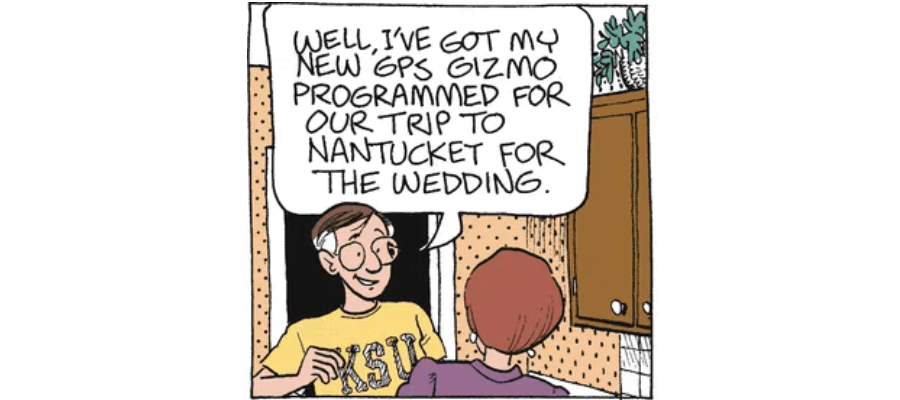
Our deep dive begins in 2003, because that’s the earliest Crankshaft archives are available at GoComics.com. Max’s first appearance in this time frame is November 2003, when Max arrives for family Thanksgiving. Mindy is still in high school, and Rose is still alive, as is Lucy McKenzie. Max is wearing his college sweatshirt. Which is question #1:
Seriously, answer the poll question before reading on. Try to guess!
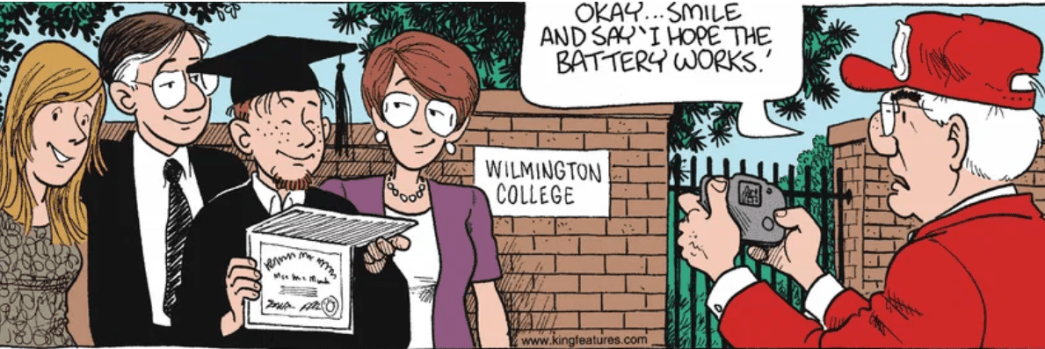
In a stunning upset right out of March Madness, Max graduated from Wilmington College in Wilmington, Ohio. The college sweatshirt he often wore at the time said those exact words. So we know it’s not a school with a similar name like UNC-Wilmington, or a fictional school like Bull Bushka’s Enormous Midwestern University.
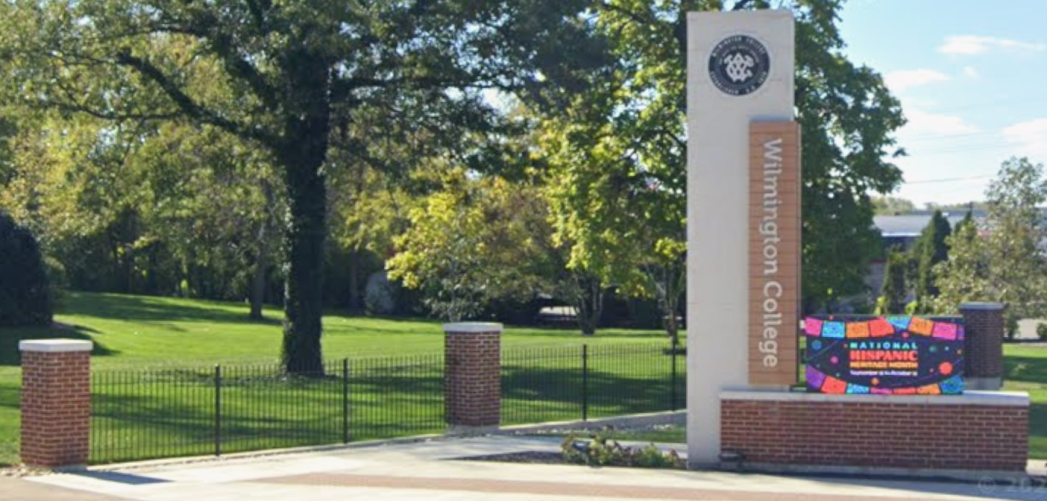
Also, Max’s graduation photo on June 3, 2006 resembles the entrance to the real-life school. And let’s be honest: the Ohio-based school was always the favorite.
Bear in mind Max’s graduation photo is 20 years old, so it’s not exactly the same. But apparently you can still major in red brick. (Courtesy of Google Maps.)
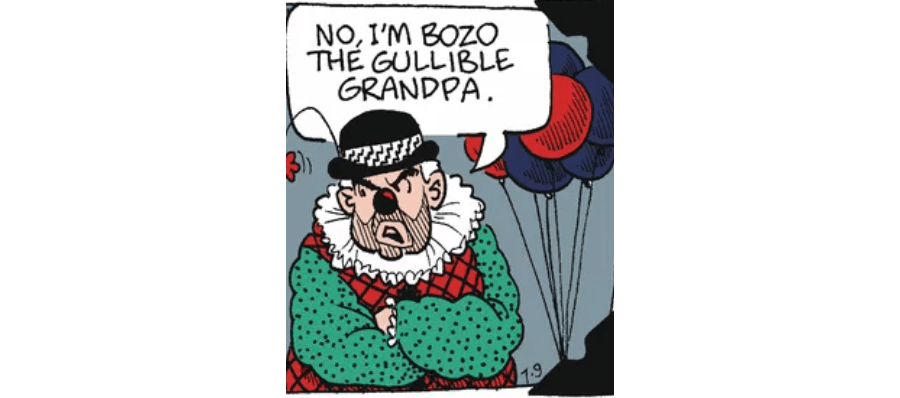
The “Max is in college and Mindy is still in high school” era continued until 2006. Max would sometimes appear at the family home, and in flashbacks, but he didn’t get his own stories. During the week of January 29, 2004, Pam reminisces about a family trip to “Mouse World.” On July 5, 2005, Pam and Jeff revisit Max’s fourth birthday. Interestingly, he requested a clown:
Well, Max asked for a clown, and he got what he asked for.
Pam was pregnant with Mindy at the time, making Mindy about four and a half years younger than Max. This isn’t a Mindy deep dive, but we’ll mention her from time to time. Max and Min’s sibling relationship is unremarkable. They’re not close, but they seem to get along just fine. During this time, Mindy was being urged to get a job. (Unlike, for example, Luann.)
Just as March Madness is full of upsets, it’s also full of games where the obvious choice has a 98.75% chance of being correct. Mindy was hired by Montoni’s on June 29, 2004, and was seen going to work there as late as December 2007. The question included the “full-time” caveat, because Mindy also served as one of Santa’s elves during Ed Crankshaft’s then-annual portrayals of Santa Claus. She was seen in this role on December 15, 2003.
Max attended family Thanksgiving again in 2006. On December 17, 2007, Max is seen leaving for a date, but we don’t know with whom. On February 11, 2008, Max seeks romantic advice from Ed Crankshaft, but no potential partner is named. Both of these were throwaway strips rather than being part of an arc.
Max gets his first real story on March 25, 2008, when he moves into an apartment. Pam says she realized that Max would “move out”, implying that he lived in his parents’ house after college graduation. Max’s random appearances were a little more frequent in 2006-07, so this checks out. Hannah isn’t a part of Max’s life yet. And she won’t be anytime soon.
On September 8, 2008, Jeff says:
We never learn whose wedding this was, because this was just to set up a week of complaining about getting your car serviced.
December 1, 2008 is our first look into Max’s career. Max announces tells the family he “has been given a show to direct”, even though this is the first we’ve heard of him having a job in television. The show airs at 4 a.m, and is called Living With Nature, starring Channel 1 veteran Phil the Forecaster.
So we can add yet another name to the list of Funkyverse characters who instantly became professional content creators. My own college degree was in broadcast news, and getting your own TV show at age 25-ish would be very, very unusual. Even for this kind of ultra-cheap local public affairs show that runs at 4 a.m. You have to pay your dues more than that.
Mindy graduated high school in summer 2009, and she would go to Kent State that fall. Her parents planned a high school graduation party, but oh no! The caterer got the days mixed up! What can they do?
The #1 seed wins again. Ed fired up his grill, but you can guess how that went. Mindy ordered from Montoni’s. No mention is made of the fact that Mindy worked for, and maybe still did work for, Montoni’s.
In June 2009 we learn that Max has a history of smoking. Rose takes up smoking at this time, and it is revealed that she found some old cigarettes that were once Max’s.
On December 1, 2014, Ralph Meckler laments that he has to close the Valentine Theater “after this week”, setting up a predictable bunch of moping about how good things never last. Of course, this is the same Valentine Theater that Max and Hannah have operated the past few years.
We’ll answer this question in a moment…
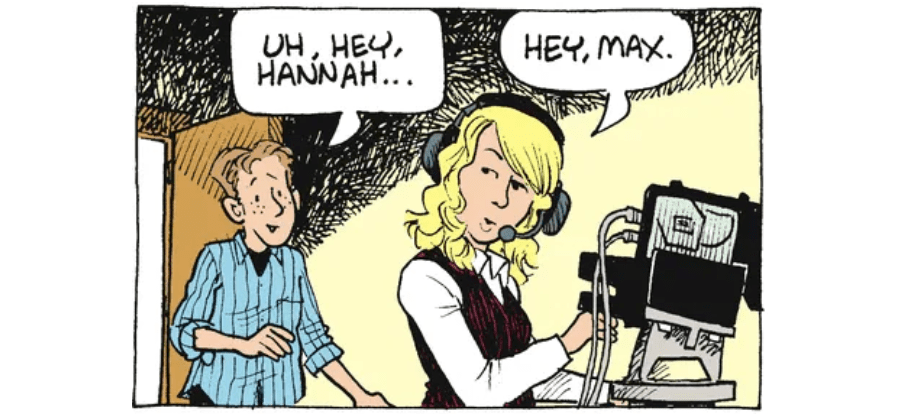
…but you can probably guess from this next piece of information. Hannah’s first mention in Crankshaft wasn’t until February 15, 2016.
Max reveals that Hannah is “someone he’s seeing from work.” We see her for the first time two days later.
So they met at Channel 1.
The following week, they go on a date to the Valentine Theater. They meet Ralph Meckler, who is still running the place. Which means the correct answer was “Not 2014.” And not in a pedantic way, as if the theater held out a couple more weeks and closed in early 2015. After a week of gloom and doom for the Valentine, it must have survived under Ralph for 14 more months.
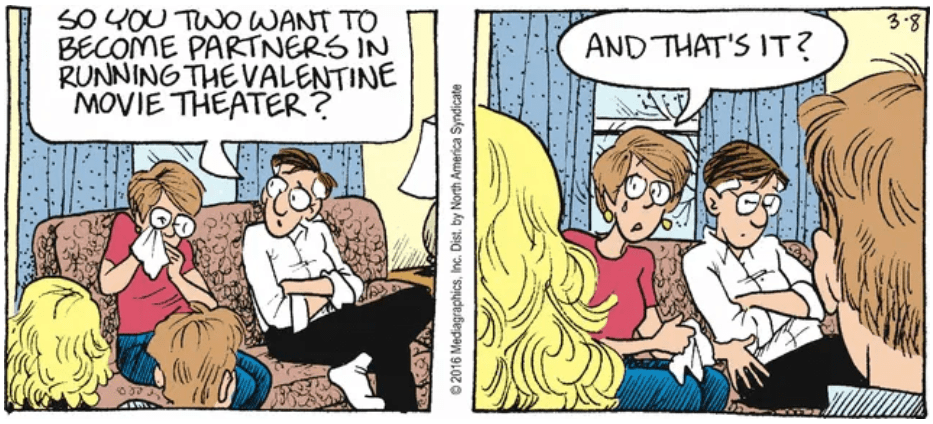
Ralph is seeking a buyer, which Max and Hannah are independently interested in. On March 7, 2016, they tell Max’s parents this. Pam’s reaction:
This is the first explicit mention of Max and Hannah’s marital status. Max and Hannah went to his parents with “something we’d like to tell you.” So Pam and Jeff were making a reasonable guess about what it was.
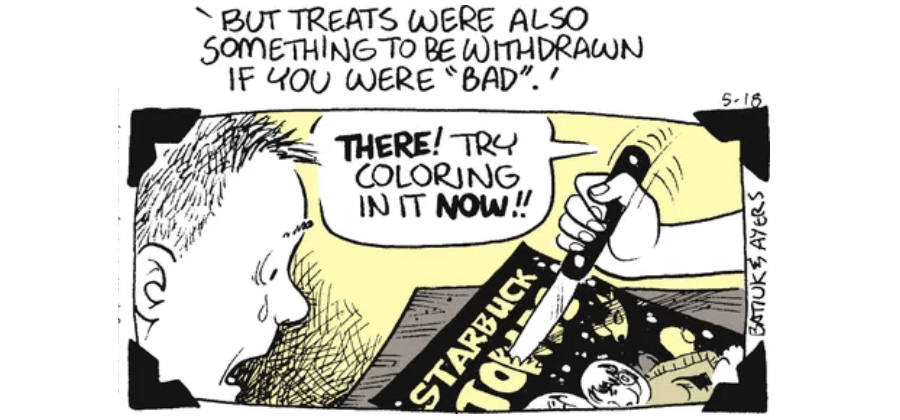
Max and Hannah raise enough money through crowdfunding to buy the Valentine Theater. Rose finally died in May 2016 – the day Jeff was about to forgive her, of course, when she’s been feeble for well over a decade. Which also gave us this indelible flashback image:
Any comment from me would just be piling on.
October 10, 2016 was the first week of Max and Hannah fixing up the Valentine Theater. And that’s where our story ends for now, because this is already a long post. Part II is coming soon.
Let’s revisit the quiz questions. Two times Batiuk took the blindingly obvious path, and two times he took the story in a bizarre direction. As if this year’s Final Four will be Duke, UConn, Long Island University, and Central Arkansas. Yes, lesser teams can, and often do, go on deep runs in the NCAA Tournament. But there’s a point below which this has never happened, and is laughably unlikely.
Which is the best analogy for Tom Batiuk’s writing I will ever come up with. Half the time the story is going somewhere stupidly obvious. Half the time it’s going in a completely random direction that defeats Batiuk’s own claims to realism. Which is which? Your guess is as good as mine.