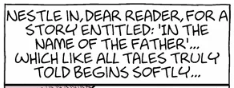
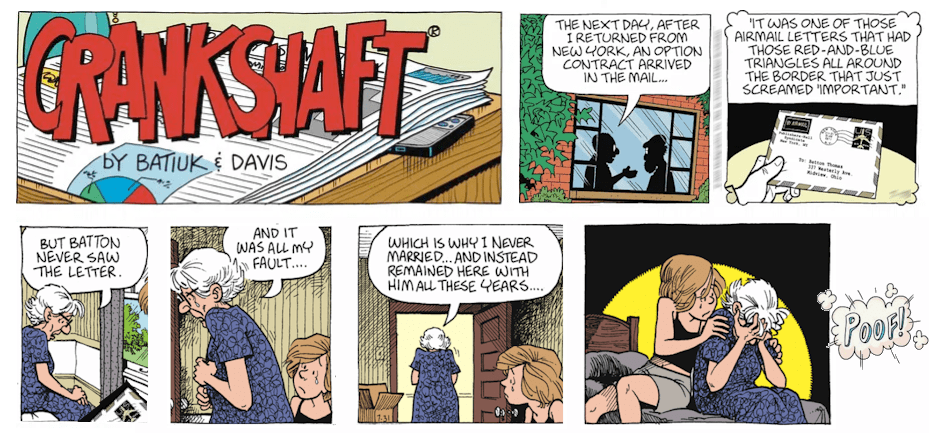
Tom Batiuk’s latest attempt at a prestige arc, which he pretentiously titled “Dinkle, I Am Your Father” or something like that, is over.
Well, it’s not officially over. But I’m calling it over as of Thursday, because that’s the best place for it to end. I’m sure Friday, Saturday and maybe Sunday will be full of Lillian smirking at us, and explaining how we’re supposed to interpret the ending. Which insults the reader, and undermines the point of leaving it ambiguous. But I’m done showing Tom Batiuk how to do his job.
This will also be the last leg of the strangest multi part post in SoSF history. Weather forecast: clear, smooth sailing. No trauma dumps or cluster f-bombs on the horizon. This post draws on elements of Destroy Everything You Touch, so read that if you haven’t already. Be warned: that post is also a M*A*S*H-level dive into my own psyche, tied into the two subplots of this tedious story. This post will continue that analysis, focusing on the Eugene and Lucy half of the story.
The problem is easy to explain. Eugene and Lucy is not a love story. Eugene and Lucy is a limerence story. Let’s start at the beginning:
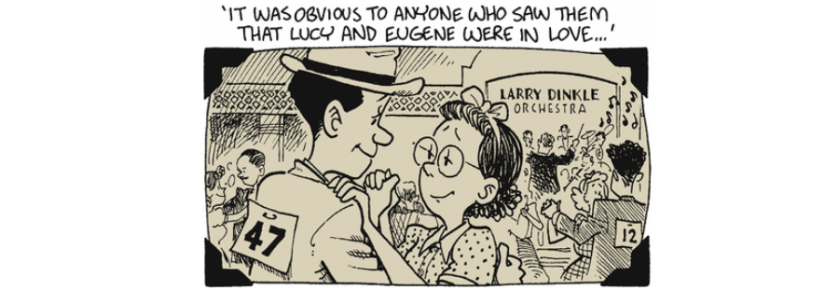
Was it, Lillian? Was it really? Who besides you was even looking at them? It’s a dance! People are looking at their own dance partners! Like they should be! Get over your Main Character Syndrome! (No theory of mind, a central problem in all of Tom Batiuk’s writing, rears its ugly head again.)
This is not love, this is limerence. Also known as “putting someone on a pedestal,” “in love with being in love,” “infatuation”, “obsessive love”, and similar things that are bus stops between “crush” and “creepy.” It’s when you’ve built a fantasy version of someone in your mind, independent of any actual information you have about the person. This is a great explanation:
Eugene and Lucy are a concept to each other. They’re both in love with the imaginary versions of each other they think will fulfill them. We don’t know anything about Eugene and Lucy, and they don’t know anything about each other, beyond one pleasant night at a pre-World War II dance, and an implied brief relationship. The story makes a lot of bold assertions about true love, but it provides zero evidence of that.
Most romantic relationships in the Funkyverse are actually limerence. They’re all arranged marriages between minor characters who don’t seem to have any reason to be together. This happens when your only source of how adult relationships work are comic books for 9-year-olds, and a marriage to your high school girlfriend.
John Howard and one-armed Becky are the most mismatched couple you could possibly create. She’s a disabled person with genuine talent, and is using it the best she can, hyper-motivated to prove she still has worth. He’s a lazy slob who only wants to spend all day in a comic book store, without ever contributing income to the family, or changing his T-shirt.
John and Becky, Bull and Linda, Mason and Cindy, Pam and Jeff, even Les and Lisa don’t even seem to like each other that much. (Exception: Funky and Holly genuinely do like each other, and have some sweet moments.)
I’ve long struggled with limerence, and it was a key reason many of my adult relationships fell apart. I took every relationship way too seriously, far more than my partner took it. Because I immediately turned any girl who gave me the time of day into a potential wife. I filled in any unknown data with what I wanted to be true. Limerence and low self-esteem is one hell of a cocktail.
The key is separating limerence from tangible qualities.
In Leaving Westview, I said:
In high school, I didn’t see anything but attractiveness and popularity as being important. I learned in adulthood that confidence, personality, positivity, values and common interests are far more important.
Let’s revisit Christine, my unrequited love from high school I introduced in Destroy Everything You Touch. (Inverted trope: I was her unrequited love.) She had personality, positivity, shared values and interests with me, and enough confidence to approach me when she otherwise didn’t have a flirty or forward nature.
This is not limerence. This isn’t me filling in the blanks with what I wanted her to be. These are genuine qualities I observed, based on many real interactions over a year or two. She was legitimately a very good potential partner, and would have been at any age. But in high school, I picked Ken O’Brien when Dan Marino was available. (Please note that Ken O’Brien was still a pretty good NFL quarterback, and two-time Pro Bowler. Susan, if you’re somehow reading this, I don’t regret picking you at all. You were awesome. My first kiss with you was one of the few romantic milestones in my life that actually went really well.)
Limerence can even make you idealize yourself! I caught myself comparing Christine’s 16-year-old self to my 54-year-old self, not my 17-year-old self. She was calm and easygoing, which I am now, but 17-year-old me very much was not. I was high-strung, and hadn’t learned how to manage my anger and frustration yet. Which might have been a serious obstacle in any real relationship with Christine. And I’ve had partners in my life who were attracted to me for qualities I definitely didn’t possess.
In the Funkyverse, limerence can apparently affect other people. Lillian seems to have swallowed the notion that Eugene and Lucy were some kind of destined couple that only didn’t get together because of her own selfish act. This is ridiculous.
If anything, Lillian should have been the one to tell her sister “oh come on, it was just one guy, get over it already.” Which is yet another way she should could have reversed her misdeed, but didn’t, even though she could have still covered up what she did. Lucy’s Story has a comprehensive list of the others.
It’s time for the lightning round! Today’s topic is Why This Story Sucks, Even By The Usual Low Standards Of The Funkyverse.
It’s too easy to move on. Despite my low romantic potential, I still preferred hoping for future opportunities in college over lamenting missed ones in high school. As any 18-year-old would.
Eugene never got a response to his letter, and interpreted that as a rejection of his marriage proposal. He served in the military until the end of World War II, and then came home. Imagine a returning soldier with a broken heart while V-J Day in Times Square is going on. No war veteran is going to be moping about the girl who said “no” years ago when they return home to a demographic abundance of females. Many of whom are throwing her panties at him, eager to start creating future baby boomers.
It should have been extremely easy for Eugene to forget Lucy and find a new girl. We’ll soon see why it wasn’t.
Something triggered my nostalgia. I haven’t been pining for Christine for 38 years. I never even thought of her for 37.95 of those years. Eugene has been in a consonant state of pining for Lucy since 1946, even though she died in 2009.
I don’t idealize the past. I realize that a relationship between Christine and I might not have worked out, for a million different reasons. Which would have been fine.
I spent most of my high school nights dreaming of random, unremarkable girls who caught my fancy at some point, but whom I never had the nerve to approach. They seemed unattainable to me. I daydreamed about how receptive they’d be to me, and how well-suited they’d be, even though I had no reason to think that. All while I ignored someone who actually was those things, and was trying to tell me she was interested. That’s what limerence does to you.
I recognize my own mistakes. Despite everything I wrote previously, I ultimately don’t blame anybody but myself. I could have started a relationship with Christine almost anytime I wanted to.
The failed relationship was a symptom of a much bigger emotional problem. This was obviously the case with me. My inner demons caused me to do an irrational, self-destructive thing to a desired relationship. We’ve often said that Eugene simply should have re-proposed to Lucy, or gotten a clarification of what her answer was. Why didn’t he?
Because Eugene was so afraid of rejection that he chose “no response means no” over Lucy actually telling him no. Why else would Eugene act like his “I’ll never bother you again” promise was more important to keep than his “I want to spend the rest of my life with you” promise? Which he didn’t keep anyway, because Eugene and Lucy had some kind of contact after that?
The four days of wordless, actionless panels imply that Eugene is moving into some kind of senior care facility, or hospice. And he’s ashamed of this. To be fair, dying at age 99 would be early compared to people like Lillian Mckenzie, Ed Crankshaft, and Mort Winkerbean. But I think there’s a much better explanation.
Eugene is moving into a mental institution.
Just like Lucy did.
And for the same reason Lucy did: because he was so in love with a concept that he let it destroy his entire life. And it also took Lillian down with it.
In a psychology class in college, I heard a story I’ll never forget. There was a psychologist who worked in a home of people having severe detachments from reality, to the extent that a woman would tell him she had a new baby every single day. The doctor said “even if I could push a button and cure her, I wouldn’t. She’s much happier where she is.”
So this is a bittersweet ending, which is an improvement from the just plain bitter we usually get. In the end, Eugene and Lucy got together, in a way. Unless this story is somehow still continuing. And if it is, then let me say with no irony whatsoever: bring on Batton Thomas!