Stop, Collaborate And Listen

My post from 9 days ago didn’t age well.

I bemoaned Tom Batiuk’s lack of ambition about his ambitionlessness, then he turns around and gives us his most ambitious ambitionless week yet.

This week is certainly trying to be something. And you don’t have to squint too hard to see what it is: a collection of noble statements about what America claims to be, juxtaposed with perceived current American realities.

A lot of commenters had great things to say about this week. Here’s the perfect place to start:

At no point has the conversation descended into arguments over politics. Though we all may have definite, even passionate, opinions on various political issues that are both compelling and well thought out, this isn’t an appropriate forum for that.

Y. Knott

To try and keep that tone, I will start by saying that I’m not here to talk about the rightness or wrongness of this week’s content. I’m here to talk about how well or poorly it is expressed. (You can probably guess which side I’m going to land on.)

Tom himself literally stated in the puff piece that he is not saying anything in the strips and is letting people make the commentary.

wherescrankshaft

Let’s dive into that puff piece! It is https://www.gocomics.com/extras/tom-batiuk-crankshaft-america-essay (hat tip to J.J. O’Malley).

Tom Batiuk Believes Comic Strips Can Do More Than Make Us Laugh

We’re not even past the headline yet, and it’s already obvious Batiuk wrote it.

As I said about Tom Batiuk’s interview with Terence Dollard awhile back: the people who interview Tom Batiuk do nothing but build strawmen out of softballs. One of Tom’s favorite notions is that he’s some kind of visionary for thinking comic strips don’t have to be funny. No one ever said they did! And some of the funniest strips are best remembered for their least funny moments.

From cancer to immigration, the “Crankshaft” creator has never shied away from difficult subjects.

OK, I’ll give him that.

For years, Tom Batiuk—creator of “Funky Winkerbean” and “Crankshaft”—has strived to expand the concept of a comic strip, challenging the idea that the art form is simply for laughs. This week’s “Crankshaft” storyline is a prime example: it uses recent news events to examine what it means to be an American today.

The center panel in four of the upcoming strips features a line of cursive handwriting plucked from a fictional essay written by Batiuk’s alter ego, cartoonist Batton Thomas, who we met back in the days of “Funky Winkerbean,” the comic Batiuk produced from 1972 to 2022. In one of the new strips, the line reads: “To me, America means home. A home where I feel safe and protected.”

In stark contrast, the very next panel features an illustration of Liam Conejo Ramos, the 5-year-old boy detained by ICE agents alongside his father in January 2026 outside their home in Columbia Heights, a Minneapolis suburb. Dressed in a bunny hat and Spider-Man backpack, the child was held with his father for nearly two weeks at a family detention center in Dilley, Texas. In a February interview with MPR News, his father said Liam continued to suffer from psychological trauma.

This sounds exactly like a high school essay, doesn’t it? The confident mastery of the obvious, the general air of pretentiousness, the tacked-on sentence clauses and irrelevant details.

Spider-Man backpack

Knowing what Tom Batiuk is really like, how important is that detail? If it was a Buzz Lightyear backpack, would Batiuk have ever learned of Ramos’ existence? He seems like the kind of guy who would have a Google News alert set up for the name of any comic book he thinks he should be the writer of.

The student essay by Batton Thomas in the “Crankshaft” strips echoes a real-life essay Batiuk wrote as a high school senior in 1965. He received an award from the local paper for the piece.

And now it has been written in a blog Tom Batiuk received an award and was written about in the newspaper. Will the next puff piece writer say “Batiuk has received an award and was written about in a newspaper and a blog”? Oh crap, now it’s a newspaper and two blogs.

A dream about that essay sparked the idea for the storyline, he says by phone

You heard it yourself, folks. Straight from the horse’s mouth. Tom Batiuk dreams about awards he won in high school 60 years ago. He said it. Not me.

In addition to young Liam Ramos, the images running this week include a masked ICE agent, the barbed wire fence outside an ICE detention center, and Jan. 6 rioters storming a barricade at the U.S. Capitol.

This article ran on Tuesday, and Batiuk just tipped off most of his shock moments for the upcoming week. And shock moments are all he has.

“The thing I like about the approach to this storyline,” Batiuk explains, “is that I don’t really say anything.

Same thing you’ve been doing for 25 years: not telling us anything. Just like you didn’t tell us where Eugene moved to or why. But you wrote two weeks of him saying goodbye slowly, and starting to go somewhere even more slowly.

I kind of left it to people to make their own decisions.

This is one of those things Batiuk likes to say about himself without really understanding it. He thinks it makes him sound noble, but he doesn’t realize how much his life’s work contradicts it. Tom Batiuk’s existence is a monument to his belief that all decisions should be made by him, or at least approved by him.

That doesn’t mean he’s not prepped for pushback—and he’s received plenty of that in his career.

Really? When? From who? Is he talking about that one time he got pulled from the Northern Wisconsin News over a joke that should have gotten him nationally roasted? Because it happened to Bobby Knight when he said a very similar thing.

Does he mean us? We don’t give pushback. We give thoughtful, critical analysis of his work. We don’t take him to task about his subject matter, except in his general choices of what to write about (“oh Lord, not another Batton Thomas week”).

Even Comics Curmudgeon rarely mentions his work anymore. And from what I’ve found on the Internet, genuine fans stopped bothering 15 years ago.

In his 54 years as a comic artist, Batiuk has used his strips to touch on thorny subjects such as teen suicide, book banning, capital punishment, and same-sex couples at the prom.

Again: I never said he didn’t try. However half-assed all four of those attempts were.

Six years ago, he penned a story arc in “Funky Winkerbean” about an Iraqi immigrant named Adeela seized by misguided ICE agents while delivering a pizza. She narrowly escaped deportation.

And we all know how she narrowly escaped deportation: by having Montoni’s ask Bill Clinton to do them a solid! During the first Trump administration. I wonder why the puff piece didn’t mention that.

Batiuk wrote himself into a corner, couldn’t write himself out, and then had to cover up his own incompetence in his own propaganda. Politics was this man’s true calling. North Korean politics.

Lisa Crawford-Moore

And here we are, folks! Somehow we went from real children and real American issues to Tom Batiuk’s Dollar Tree Lenore. Who’s been dead for 20 fucking years now. And who nobody ever really liked anyway.

But, in 2008, Batiuk was named a Pulitzer Prize finalist in editorial cartooning for this work, which is collected in the book Lisa’s Story: The Other Shoe.

10/10 no notes.

In “one of the best moments ever,” he says, he met a woman at a book signing…

You know how we always joke about there never being people at those book signings? Well, there’s your proof.

OK, I selectively quoted that to make a joke.

…who had read the strips and decided to get a mammogram.

Yet another real incident from Tom Batiuk’s life that ended up in the comic strip. Because of Lisa’s Story (available near you!) Marianne Winters discovered her own cancer, thanks to the great Les Moore! Marianne gave Les her Oscar Trophy, $1,000,000, a new car, the Pulitzer Prize, and a handjob.

Her doctors discovered a growth, which they safely removed. “I thought, wow, that’s all you can ask for from a comic strip,” Batiuk says.

It is unclear whether the growth or the comic strip was safely removed. I think they’re both equally toxic.

Batiuk is not the only comic strip artist to wrestle with challenging subject matter. Garry Trudeau used “Doonesbury”

Yes, let’s talk about Doonesbury, shall we? Let’s compare these two visionary cartoonists, since you’re trying to imply that Batiuk is on Trudeau’s level. Here’s how they each handled the same “difficult subject”:
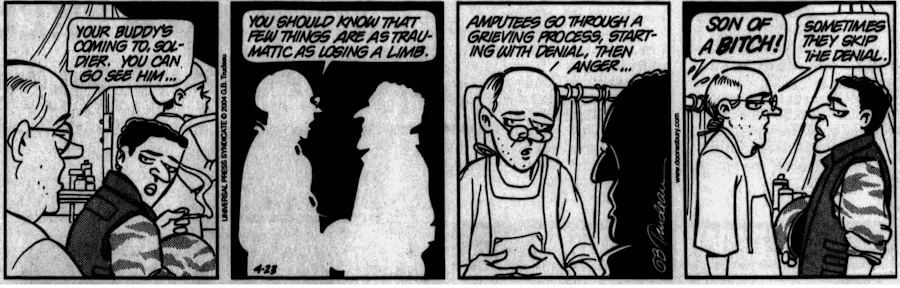
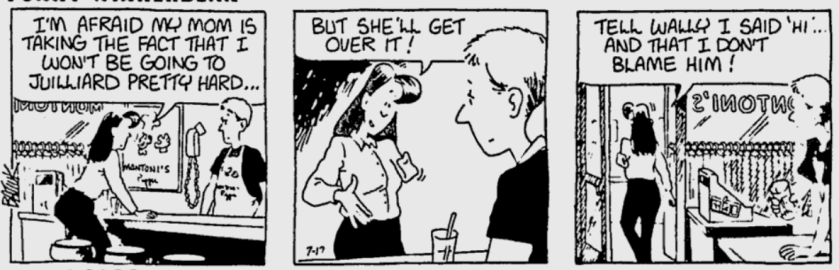
Trudeau kept the gore offscreen to center the moment on the human emotion; Batiuk did the exact opposite. Keep in mind that Trudeau’s character is a soldier who would have been trained that limb loss was a possible outcome. Batiuk’s character was a high school girl who just won a prestigious music scholarship. Notice which one isn’t the least bit bothered. And which strip actually had a joke.

Notice also that Becky leads with “tell him I said hi”, as if her monumental act of forgiveness were the less important message. And the effects on her family were even less important! “Yeah, my mom’s a little bummed that I lost a 6-figure scholarship and a direct path to a prestigious career, and she’s suddenly gonna have to figure out how to pay for Kent Fucking State like everyone else in this craphole. But she’ll get over it.” And even a socially inept high school girlfriend on an ordinary day should have something more meaningful to say than “tell him I said hi.” Ugh.

the vast majority [of newspapers] do go along for the ride [by carrying controversial FW/CS strips]

Remember what I said about Batiuk being kicked out of the Northern Wisconsin News that one time? Thanks for proving my point. That joke was pretty accurate, wasn’t it?

And Mort Walker saddled Beetle Bailey with nightmares in 2013 to raise awareness of post-traumatic stress disorder.

The “Sarge beats Beetle into a puddle for no good reason” jokes sure haven’t stopped.

[comic strips] come right to your house. There’s no privilege whatsoever.

Just like ICE!

people see their lives reflected in [the characters]

Yeah. So did I once.

With or without the laughter.

Large bet on “without.”
Beethoven’s Fifth

The Batty Blog has been slow lately, but there’s something to talk about this week.

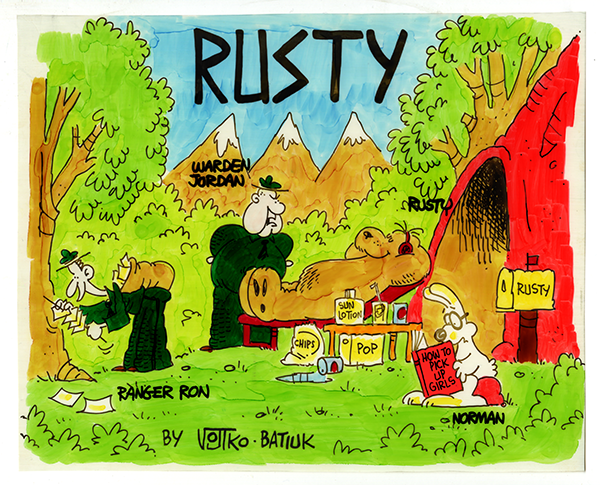
In addition to Funky Winkerbean, Crankshaft, John Darling and the thankfully never-published Dick and Jane, we now learn that Tom Batiuk tried foisting a fifth comic strip onto the world. Meet Rusty:

When you were at Roger Bollen’s house, did you tell him were planning to do this?!

Tom Batiuk confirms what you’re already thinking:

Basically a hipper Yogi Bear, a cartoon that was long in the review mirror by that point.

Clearly Yogi’s hipness was only updated from 1961 to 1973, since one of the three example strips we’re shown was a fondue joke.

I’ll let Batiuk tell you the rest of the story as only he can:

I’d only been doing Funky for a few months when Bob Votjko showed up at our apartment wanting some advice on his work and wanting to know how to get syndicated. I was barely started myself at that point so I don’t know how much help I was (none),

Through Batton Thomas, Tom Batiuk has told us at great length how he went to a cartoonist’s home, wanting some advice on his work and how to get syndicated. And now he’s received the same visit, and he’s being all self-deprecating about it? Did Batiuk fail to recognize the role reversal from his own life, just a few months ago?

“Oh, I’m sure I was no help, even though I did the exact same thing, and could have easily passed along all the information I collected from much more accomplished cartoonists than myself.” He’s so quick to play the self-deprecating card that he doesn’t notice when it makes him look like an asshole.

We didn’t have any luck syndicating it, although it did prove providential in a couple of ways down the road.

“We were unlucky, but we were lucky.”

Its strong ecological bent probably wouldn’t fly in today’s political environment, but nevertheless it holds up rather nicely. 

“It didn’t age well, but it aged well.”

But just because we couldn’t get it in the papers, doesn’t mean that you can’t enjoy it. 

This sentence seems like another instant self-contradiction, but it’s actually completely meaningless. Being in the papers and being enjoyable have nothing to do with each other.

There are comic strips in the newspaper that you can enjoy (Calvin & Hobbes, The Far Side, Peanuts). There are comic strips in the newspaper that you can’t enjoy (most of them these days, especially the Funkyverse, except for the perverse enjoyment we get from it). There are comic strips not in the newspaper that you can enjoy (Penny Arcade, dozens of other good webcomics). And finally, there are comic strips not in the newspaper that you can’t enjoy (because many talented creators never got the exposure they needed to reach you).

I’m going to roll it out day by day just like you would have seen it had it appeared in your daily newspaper.

In 17 days, we’ve gotten three strips that don’t appear to be in any kind of chronological order, or look like an introduction to the comic strip. So Lord knows what he’s even trying to say here.

What’s The Story, Morning Glory?

I’ve been updating the Act 4 section of this website, to write weekly summaries for all the post-Funky Winkerbean Crankshaft arcs. Here are the entries I’ve written about the past six months:

  • August 24-September 19: Montoni’s hires a robot waiter.
  • August 17-22: In the name of the Father reprise. Ed Crankshaft spots a photograph of Larry Dinkle at Montoni’s, even though they both would have known about it for decades.
  • August 10-15: Ed, Pam and Jeff visit the fair.
  • August 3-9: Ed runs over his own cell phone with his riding lawnmower.
  • July 27-August 2: A pair of 1970s-looking video game developers approach Ed about creating a game called Grill Blast. It flops.
  • July 20-25: Batton Thomas gushes about The Flash #123 again.
  • June 1-July 18: In The Name Of The Father. Eugene comes to tell Lillian he’s moving to “a place.” After a series of fetch quests, we learn about that Larry Dinkle, who is of course Harry’s father. Larry was exactly the same asshole his son is, but no one ever notices this. Eugene slowly says goodbye to Lillian, without ever addressing the issue of where he’s moving.
  • May 25-30: Ed’s grilling creates a black hole. It was all just a dream. Maybe.
  • May 18-23: Batton Thomas discusses his band director character Harry Finkle.
  • May 11-17: Starts out as an aimless week at Comics Corner, but Batton Thomas shows up on Wednesday and turns it into yet another book signing.
  • May 4-10: Miscellaneous gags.
  • April 27-May 2: Lillian has another book signing at the Ohioana Book Festival.
  • April 20-25: The Batton Thomas interview continues.
  • April 13-18: Ed buys more Bean’s End crap.
  • April 6-11: Emily and Amelia talk Lillian into opening a newsletter for her blog.
  • March 23-April 4: Miscellaneous gags.
  • March 16-22: Batton Thomas tells Skip about his drawing board.

March 2-15 was the wedding of Max and Hannah, whose backstory I explored here and here. At least this resolved a long-running relationship. But everything more recent than this is missing the same thing:

Crankshaft hasn’t told a story in six months.

Because I don’t consider any of the things in that list a story. There is no plot, no conflict, no action, no resolution, no theme in any of them. Act IV Crankshaft is almost 100% filler. It’s endless backstory that never turns into anything (Glup Shittos, most recently Holtron and Tony Montoni); excessive focus on small events that never turn into anything either (Eugene taking two weeks to not tell Lillian where he’s moving); gag-a-day strips, with their usual problems of being disjointed and inconsistent; characters smirking at each other about things that happened off-panel; and Tom Batiuk monologuing through one of his characters, usually Batton Thomas.

Not only that, Batiuk seems to be going out of his way to avoid telling a story even accidentally. The Larry Dinkle arc – which I refuse to call by its pretentious title – is a pointless info dump about an irrelevant, never-seen character. The most compelling part of it was the part about Eugene having to move… well, somewhere, for some reason. People genuinely wanted to know the resolution to this, probably because it was the only shred of humanity to be found anywhere.

The arc had potential. It was begging for Harry to have an epiphany about how he turned into his father, despite his apparently ambivalent feelings about the man. Which we can only guess at, because they were never clearly stated either.

Ambiguous endings can work sometimes. Batiuk tries to do this, but he fails by making everything in the story ambiguous. There isn’t a single hint or clue as to where Eugene is moving or why, or how Dinkle feels about his father. And Lord knows none of the Greek chorus for his pity party is going to bring it up. Not even Ed Crankshaft, whose usual characterization is “easily-annoyed old guy who blurts out whatever’s on his mind at all times.”

Side note: this is why I’m not one of those “Where’s Crankshaft?” guys. When he is in the strip, it doesn’t help. Because Batiuk sacrifices his personality to the ancient god Finallygettingthatpulitzer.

Similarly, the pizza robot arc has been dropping “people don’t like AI” comments left and right. But it ignores the fact that this bland, unfunny robot is now doing a job that three humans used to do. And incompetently at that. Which is exactly the reason people don’t like AI! This massive story flaw is never addressed at all.

I fear this is the shape of Act IV. After Funky Winkerbean ended, Tom Batiuk moved in certain FW characters like he’s trying to gentrify Centerville, but also trying to better refine it for his incomprehensible purposes. Lord knows why Pete and Mindy, Max and Hannah, Mason Jarre and Cindy Summers, and Harry Dinkle made the cut, while more important characters (in terms of their genuine importance to Funky Winkerbean, and how much Tom Batiuk seemed to like them) didn’t. Just another baffling choice in a universe that runs on baffling choices.

Glup Shitto

In the Star Wars fandom, Glup Shitto is a general term for any small character with its own goofy name, home planet, job, species, and way too much backstory for the minor role it plays.

Think of some of the minor characters from the original 1977 movie, like the weirdos in the cantina. Thanks to the sequels, prequels, spinoff movies, TV series, animated series, novels, comic books, and the Star Wars Holiday Special, you can learn way more about them than you ever wanted to know.

You can understand why Glup Shittos exist. There was an insatiable demand for more Star Wars content, but the movies were very expensive and time-consuming to make. There was also a need to explain continuity problems, like “making the Kessel run in less than 12 parsecs” when a parsec is a measure of distance, not time. Now there are all kinds of explanations about how the challenge was to get from Point A to Point B via the most hazardous route possible. I think the movie Solo also expanded on this, but I might have fallen asleep during that scene.

The Funkyverse is full of Glup Shittos. But Tom Batiuk misses the point of them.

Harry Dinkle has become a Glup Shitto, especially recently. In the original trilogy — Acts 1, 2, and 3 of Funky Winkerbean — Dinkle was an important character with an important role to play. When the main cast graduated from Westview High School at the end of Act 1, Dinkle could no longer be an effective antagonist. His power to bully the main cast ended when they were no longer his students anymore.

But of course, Tom Batiuk doesn’t realize this. So he started inventing more and more convoluted ways to write Dinkle stories. In Act 2, these were pretty reasonable. They centered on his interactions with his wife, later high school students, their parents, the targets of his door-to-door selling, the increasingly strange products he sold, and the Claude Barlow gags.

By Act 3, Dinkle was going deaf (but not really), anointing a successor in Becky (but not really), retiring (but not really), leading a nursing home band on a recording contract and a tour (yes, really) and weaseling his way into being a choir director (really). This was all a blatant attempt to keep writing Dinkle gags. Because, as we all know, Tom Batiuk is a serious artist and not a gag writer. Nope. He’s definitely not that.

Those were all bad stories, but at least they were stories. Which is more than you could say about Glup Shitto in Act 4 (post-2022 Crankshaft).

The recent In The Name Of The Father series explored Harry Dinkle’s upbringing, then never did anything with that information. We learned that his father Larry was a selfish, insufferable bandleader, so obsessed with music and fame that he was indifferent to his performers, and to his own family. It’s obvious that Harry Dinkle is a chip off the old block, but this was never acknowledged. Not even by his current performers, who are frequent recipients of his abusive behavior. One of whom is Ed Crankshaft, who’s supposed to be the guy who speaks his mind at all times.

It added additional information to Harry Dinkle’s life, like Glup Shitto stories do. But it never did anything with that information. It didn’t tell a new story, or even give us any new insight into the character. And there were a lot of tacked-on, irrelevant details, like the fact that Larry Dinkle loved noir movies, and died when he crashed his bus due to a heart attack and/or alcoholism. Batiuk couldn’t even be bothered to clarify which it was.

So we have the hallmarks of a Glup Shitto story — additional backstory for a minor character in the major story — but none of the benefits of it. Least of all, fun. Which is another reason stories get written about these minor characters. Often by unsanctioned writers:

Richard Pryor’s “Star Wars Bar” skit would have been very NSFW. It’s on Youtube though. Hint.

Last week, we had a Glup Shitto experience with Pete and Mindy. Their stories in Funky Winkerbean were bad enough, but they were more or less stories, like “awkward nerd hooks up with out-of-his-league attractive girl.” You can do this kind of story, but Batiuk botched the details.

Pete ran out of money at the county fair despite being a highly-paid, world class writer in this world. He also treats Mindy like garbage, a topic my friend Narshe will be exploring on Wednesday. And the fact that Pete and Mindy are both in their 50s by now, and it’s way too late for the “young kids just starting out” shtick.

Pete and Mindy have become relevant characters in Crankshaft, all to tack on a bunch of unnecessary backstory that goes nowhere. They revived Montoni’s! And the whole town brought all the decorations back! And they teamed up with the Pizza Box Monster! And they have a robot waiter! And… that’s it. Nothing was ever done with any of this. Montoni’s itself hasn’t even been the town hangout it used to be, which was at least a narrative purpose.

Act 4 has been running on Glup Shitto stories for a while, without those stories ever serving the unifying or narrative purposes they should. And we don’t see stories about minor characters that might be interesting to explore. Whatever happened to Chien? Why weren’t Cory, Rocky, Wally, Rachel, and Adeela rehired when Montoni’s re-opened? What are they doing instead? What effect did the short-lived strip club era have on Centerville? What happened to Cindy’s pregnancy? The sheer number of loose ends Tom Batiuk has left over his career should be a gold mine of material to explore. But it isn’t being used that way.

Tomorrow, we’re probably getting another deep dive into a character nobody cares about, and which serves no storytelling purpose. And that character is way overdue for an appearance.

The Cardinal Really *Was* Lisa

So Tom Batiuk’s version of Calvin’s raccoon ran in the last full week of 2025. And it went like so many other stories do in the Funkyverse:

  1. Poor, innocent, helpless creature gets injured.
  2. One of the Funkyverse’s designated heroes notices.
  3. The designated hero makes a big show out of helping the poor, innocent creature.
  4. The designated hero provides little actual help to the poor, innocent creature, and may even subject it to further injury.
  5. The poor, innocent creature gets worse, for reasons that will not be blamed on the designated hero, even when they probably should be. (Optional: the poor, innocent creature may appear to get better for awhile first.)
  6. Poor, innocent creature dies, having suffered more than they probably needed to.
  7. Designated hero congratulates themselves while smirking. Never once do they ponder their own role in the death of the poor, innocent creature.
  8. Tom Batiuk starts checking his mail for Pulitzer nominations.

This isn’t just the cardinal story we just saw. It’s also Lisa’s story. In some ways, it’s Bull Bushka’s story, Becky’s story, and other pointless tragedies in the Funkyverse. And some of you picked up on this in the comments:

  • “The actual miracle will be surviving with a broken spine.” – pj202718nbca

This is closer to the truth than you’d think. Most bird-window collisions result in the death of the bird, eventually if not immediately. Pam and Jeff made no attempt to ascertain the bird’s injuries, or take it to someone who could treat it. Though to be fair, most people wouldn’t know what to do when presented with injured wildlife. Which was part of the point of the Calvin and Hobbes raccoon story.

Calvin’s mom admits to Calvin that the raccoon looks badly injured. She also admits to Hobbes that she doesn’t really know how to help.. This concept was explored more in the story where Hobbes went missing after a break-in at the family’s home. But it’s nice to see it acknowledged here… because it’s something you’ll never, ever see in Funky Winkerbean. Characters like Jeff Murdoch and Les Moore are not allowed to acknowledge their own mistakes, must less admit them. Even when their mistakes are blatantly obvious to readers.

  • “I had predicted a ‘Christmas miracle’ with the bird getting miraculously better on Thursday. But it actually got better on Friday, albeit with the ‘Christmas miracle’ as the actual punchline.” – Green Luthor

This speaks to a huge problem in Tom Batiuk’s writing, and that is: his attempts at humor, and even ordinary banter, undermine the seriousness of the situation. Pam and Jeff stored the injured cardinal in an oven warmer when any box would have worked, which made it look like they were planning to cook it. The partial first week of 2026 has been a celebration of football helmets, after a football helmet was the symbol of Bull Bushka’s stupid death and his even more stupid life. And we saw “costs an arm and a leg” jokes in CBH’s reposted Christmas story, thankfully out of earshot of Becky. Has Tom Batiuk never encountered the concept of “too soon“?

The raccoon story has jokes in it, but they’re not at the expense of the injured raccoon. Nor are they at the expense of Calvin’s emotional investment. But this happens quite a bit in the Funkyverse.

Bull Bushka’s CTE death arc started with Linda and Buck Bedlow cracking wise about Bull’s need to do laundry – a common symptom of his condition. Similarly, Mort Winkerbean’s dementia (before it was magically cured off-panel) was played for laughs in a Sunday strip where Funky observed him repeating himself.

Though this doesn’t happen in Lisa’s Story, nosireebob. Lisa’s death is the greatest tragedy in human history, and must be treated with complete seriousness at all times. Everyone in the Funkyverse must adhere to Les Moore’s inscrutable standards of “protecting Lisa.”

  • “I can’t shake the dread that something bad is gonna happen to the cardinal even if yesterday’s strip turned out to be a cop-out.” – csroberto2854

He was right – the cardinal immediately bashed into the window again. Which was played for laughs. Which reinforces all of the above criticisms, and then some:

  1. Relying on ambiguous art to make a joke work. The artwork in the above strip suggests that the cardinal flew through the open window, and then immediately doubled back, as if wanting to return to the house. However, if we assume Rule of Funny is in effect, it’s arguable that the cardinal was just being drawn from the more comedic angle.
  2. Making the joke at the victim’s expense, again. Crankshaft hilariously says “Birds just don’t get glass!” Well, that’s exactly the problem, Ed; birds don’t perceive glass as an obstacle. If they see natural habitat on the other side, they will try to fly straight to it. This feels like mocking blind people for bumping into objects.

    Contrast: Richard Pryor. Richard’s Pryor comedy material was about poverty, racism, broken families, prostitution, gang violence, substance addiction, and other awful things. But he never once trivializes those things, or mocks anyone for being affected by them. That’s how you combine tragedy and comedy effectively: by not letting the comedy undermine the tragedy.
  3. The pervasive gloom of the Funkyverse. We initially see the cardinal recover, which threw off Green Luthor’s mental timeline for how the story would play out. But pj202718nbca turned out to be right: the recovery was a temporary respite, so Batiuk could prop up yet another tragic ending. Even though the tragic ending was going for a laugh this time.
  4. The pervasive indifference and incompetence of the Funkyverse. Which are hard to tell apart, really. Tom Batiuk wants to sell his world of noble, caring, small-town Ohio people. But their actions bely this at every turn. Pam and Jeff ultimately did nothing to help the bird. Ed laughed when it got injured again. Les had little interest in keeping Lisa alive, and great interest in leveraging her death into the writing career he thought was his birthright. Becky didn’t even care about losing her own arm.

    Maybe that’s why Tom Batiuk cured Mort Winkerbean and Harry Dinkle: nobody in Westview was capable of doing it. Or cared enough to try.