I’m hard at work narrowing down the best, worst, and slappable of 2025, don’t you worry my nitters. But in the meantime a comment by my co-captain sent me down a little rabbit hole.
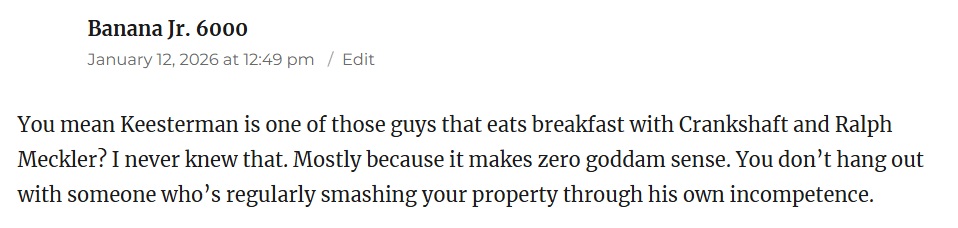
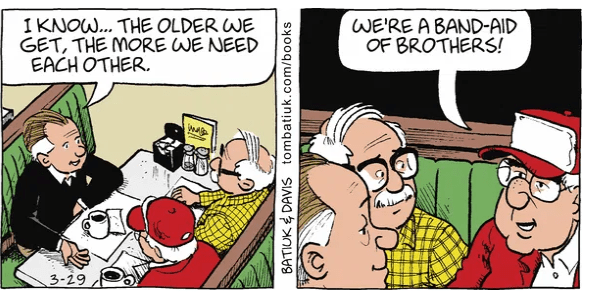
Indeed BJ6K, this George Keesterman
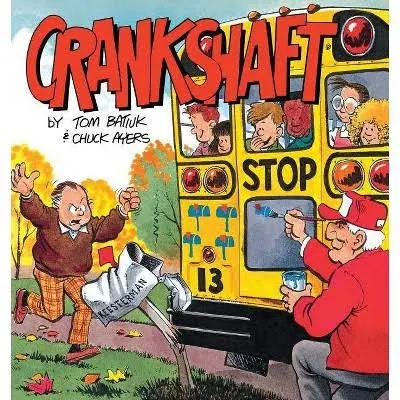
Is the same George Keesterman who appeared on the cover of the very first Crankshaft collection published in 1992.
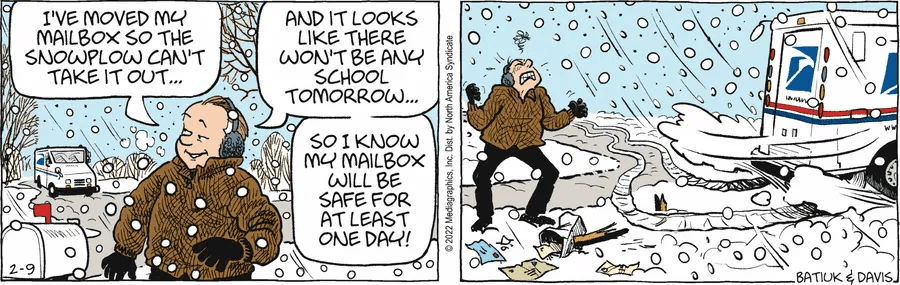
And while the mailbox gag hasn’t appeared in the last couple years, it’s only been in mothballs since 2022.
How did we get here? Who the hell is George Keesterman and why is he willing to put up with Ed’s hobby of destroying his personal property?
To clarify this deep dive, I don’t have access to all of Crankshaft. GoComics only goes back to 2003 and for many of those years Sunday strips are not included. There are Crankshaft paperbacks covering the first four or six years. Then there is the book on baseball and the book on Alzheimer’s, these pull relevant arcs and, infuriatingly, erase the dates on them. But from what I have, this is what I’ve learned.
For the first few years, Keesterman doesn’t seem to be any kind of friend of Crankshaft’s. Running over Keesterman’s mailbox is, from the beginning, inserted as a fully developed running gag.
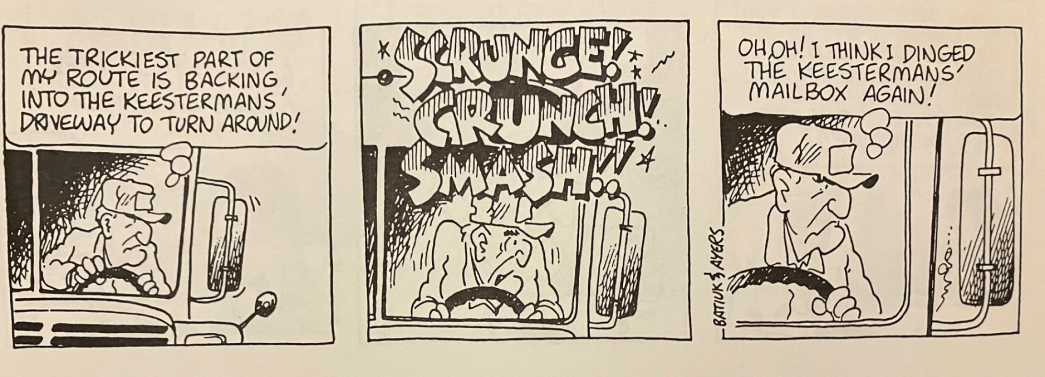
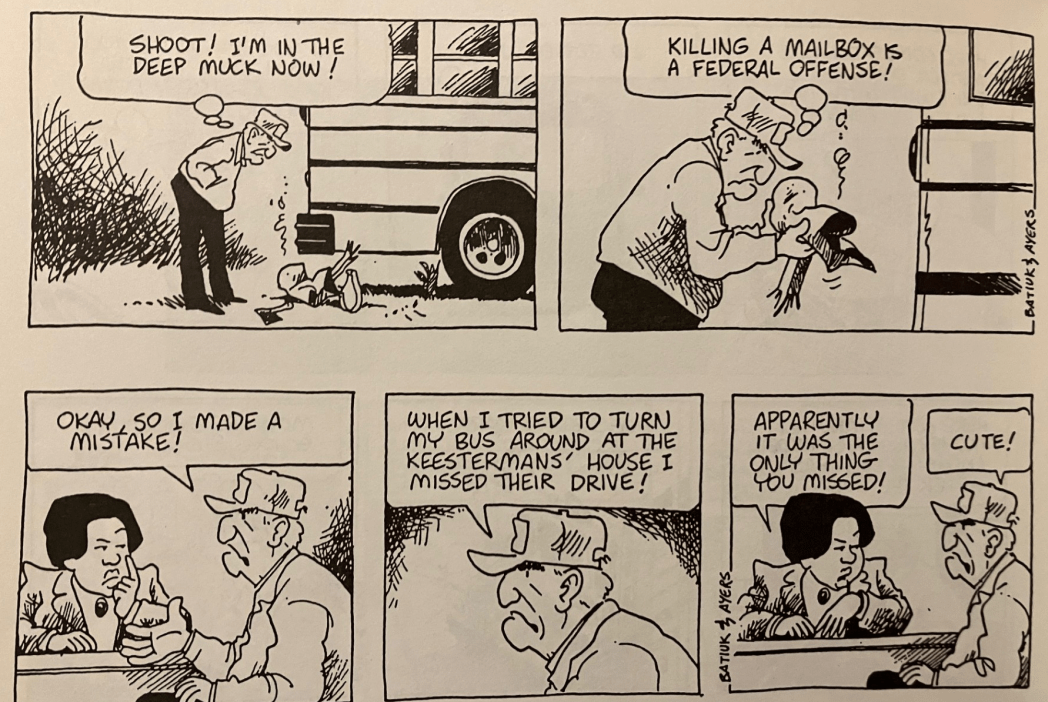
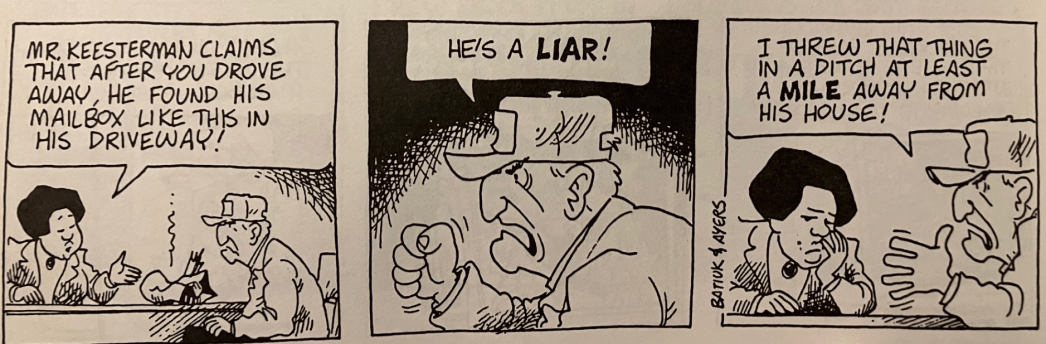
In the first visual appearance I have for him, he’s smoking the pipe he’ll be seen with through at least 2008.
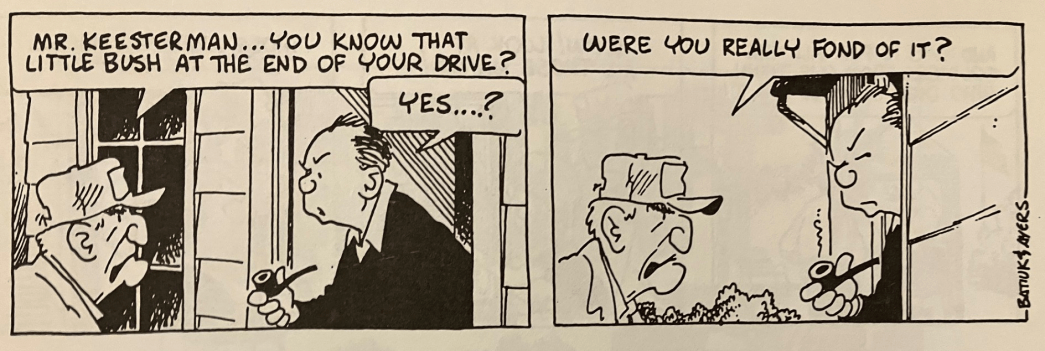
Even at the very start of the strip, it’s established that Crankshaft has been doing this for decades.

And on at least one occasion, physical violence ensued.
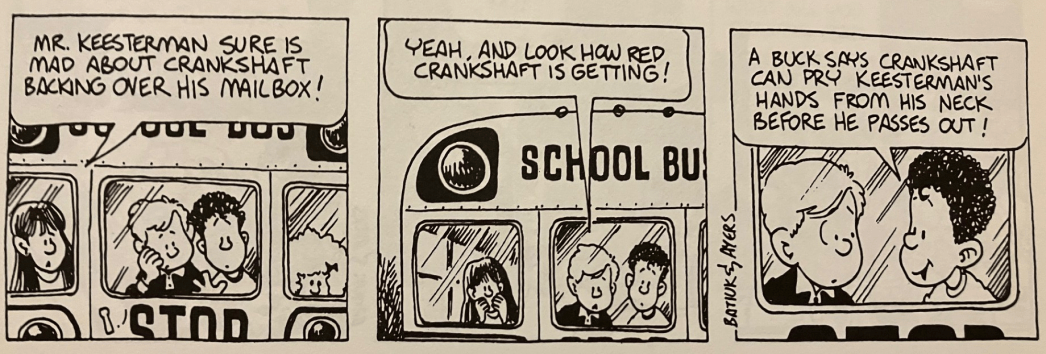
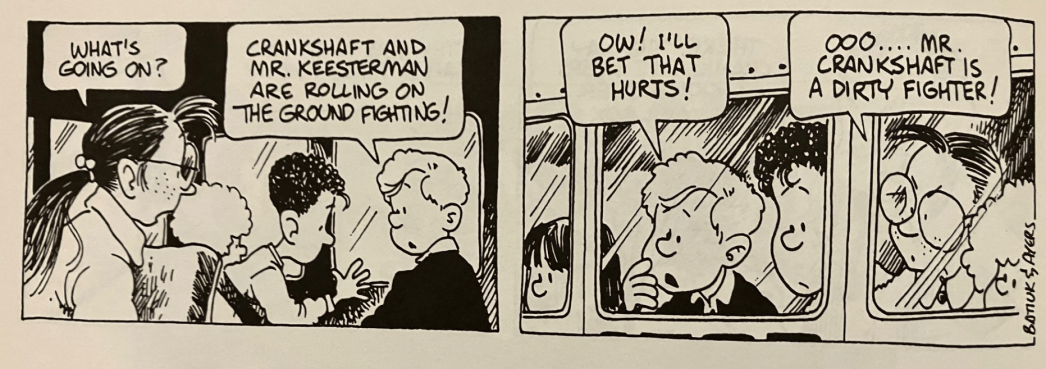
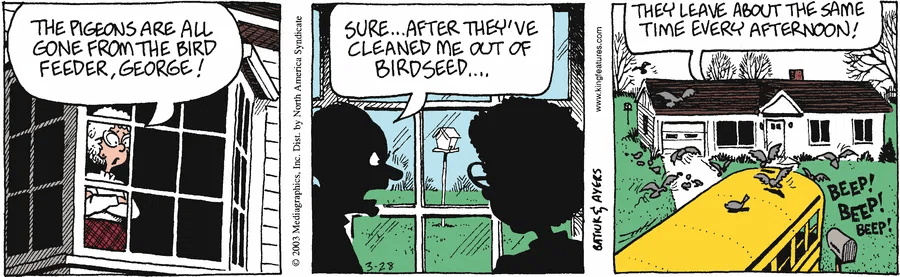
In a bit of early installment weirdness, Keesterman’s first name is given as ‘Milo’. The moment it’s reestablished as ‘George’ is in the time void I cannot see.
Cranky refers to the driveway at ‘The Keesterman’s’, and George does seem to have a wife, at least he did in 2003.
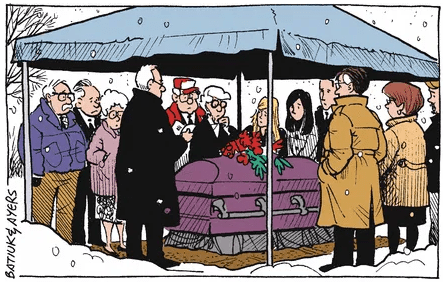
And if this woman standing next to him at Lucy’s funeral is her, then she was still alive as of 2009.
Her name might be Sally, if George married his childhood sweetheart.
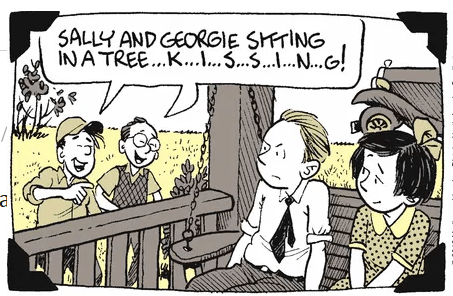
Indeed, it seems Batiuk eventually decided that Ralph, Ed, Georgie, and the McKenzie sisters all grew up together.

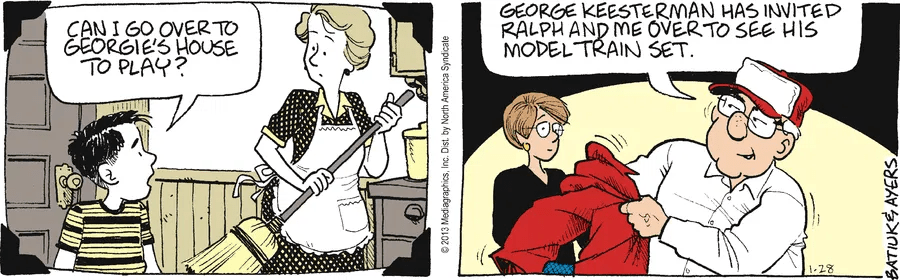

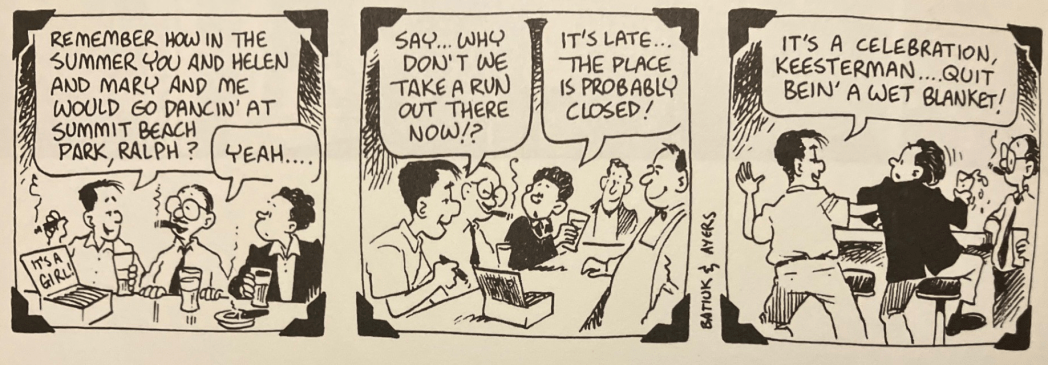
In fact, George Keesterman was partially responsible for burning down the Summit Beach Wisteria Ballroom on the night of Pam’s birth.
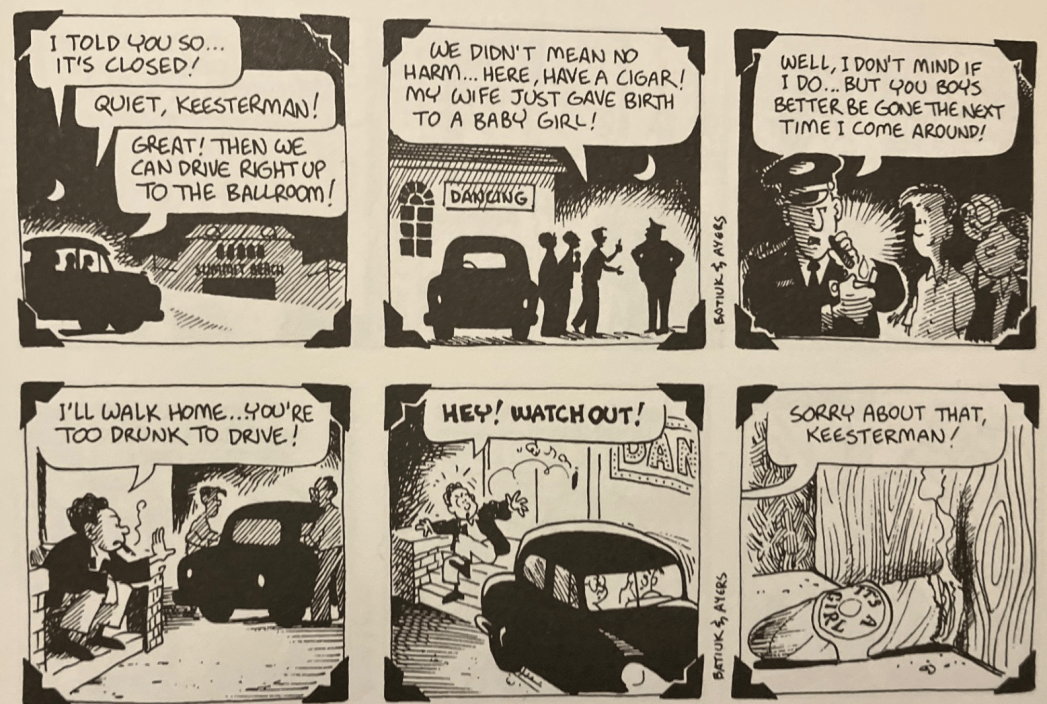
Sorry BTS, seems Keesterman has at least two kids, grandkids, and even a great-grandkid. But these are all the mentions of them I could find.
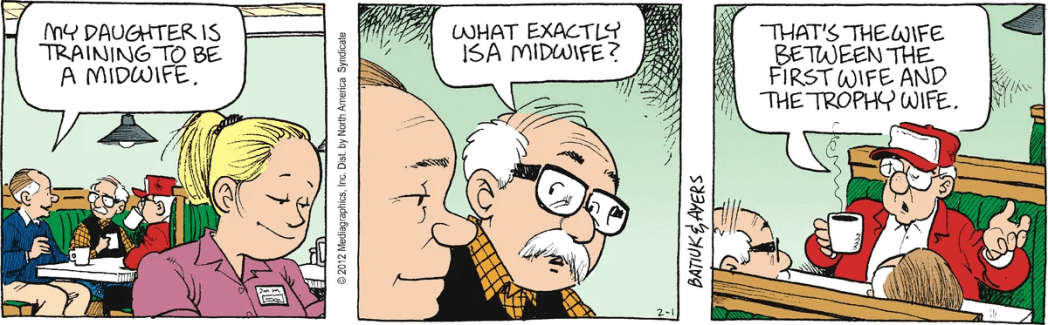
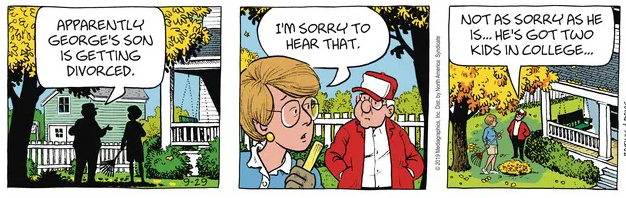
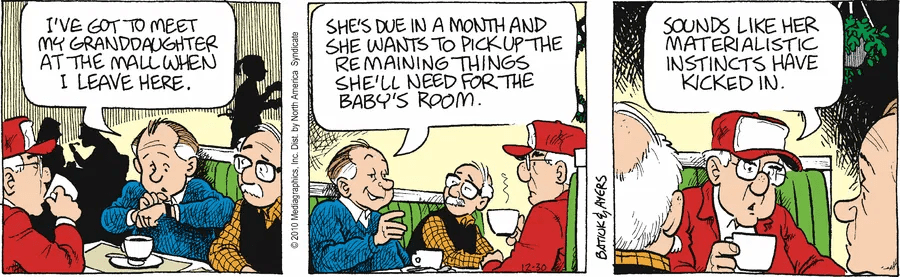
With a starting point in 2003, at first the relationship between Cranky and Keester seems to be the same purely antagonistic one.
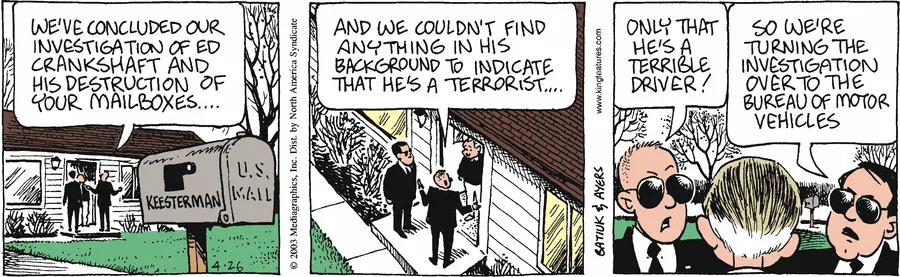
And for a couple years interactions revolved entirely around mailboxes and their destruction.
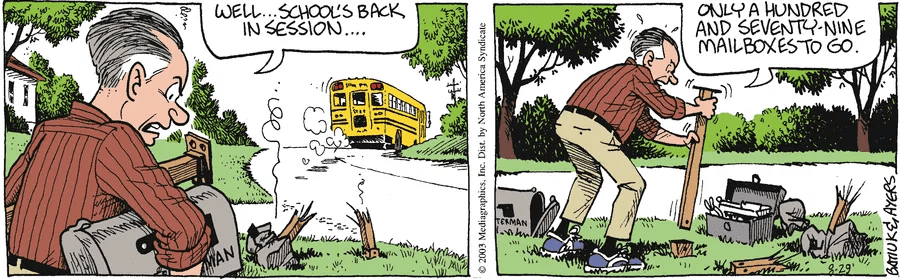
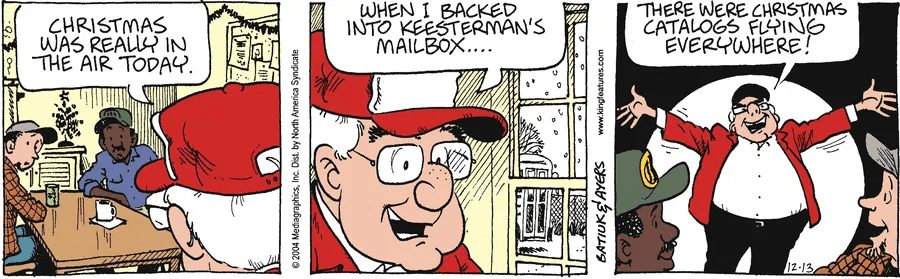

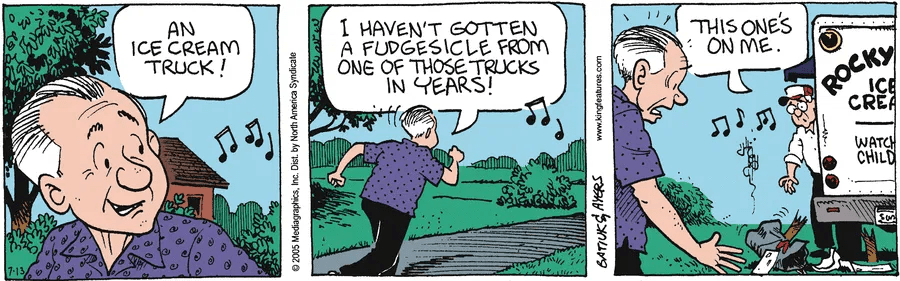
In 2006 and 2007 we get some strips of both guys talking politics at Mort’s barbershop. I don’t know if there’s earlier instances of these sort of interactions.
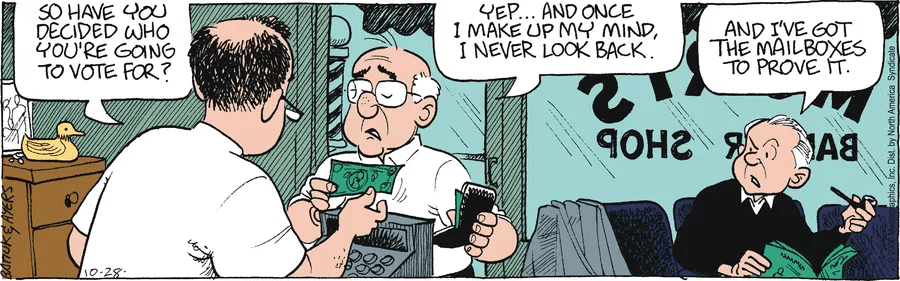
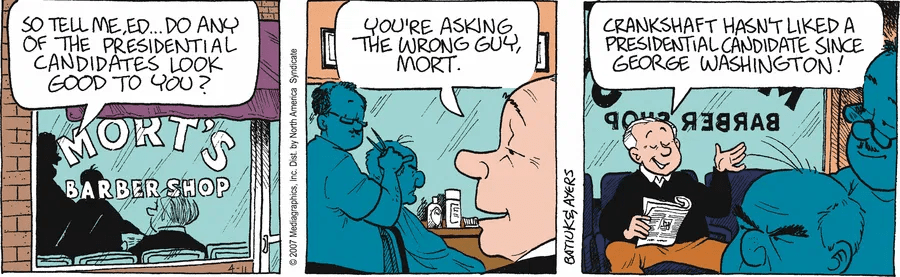
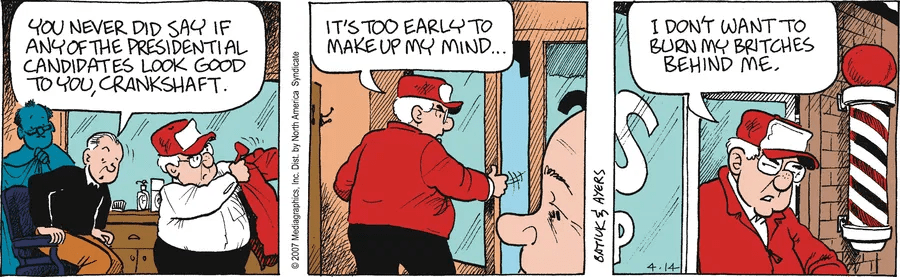
Then, on 7/12/2007 we get this strip. (And forgive the hideous coloring monkeys from GoComics)

As near as I can tell, this is the proto ‘Dale Evans strip’. We’ve got Ralph, George, Cranky, and some bald guy, eating at Pancake Barn. This was a single strip in a week of random gags.
The next month two strips with the same crew.

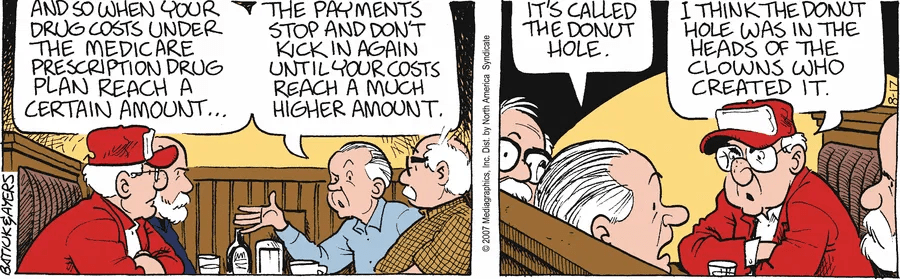
There’s nothing like this again until March 2010, when ‘The Cardiac Kids’ are formally established, sans Ringo.
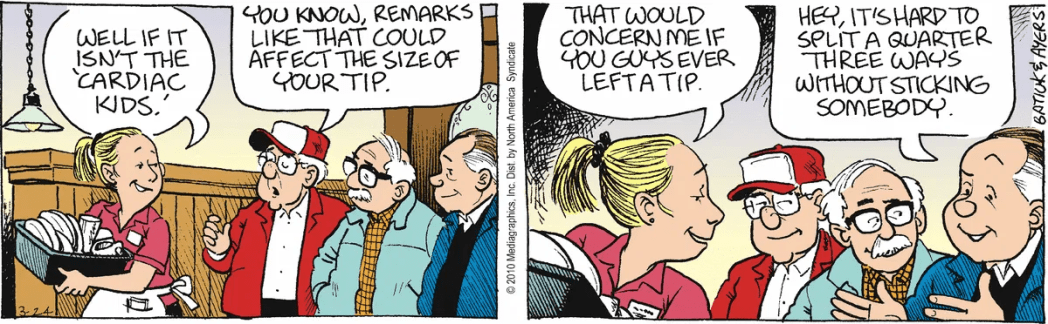
Eating at their favorite restaurant!
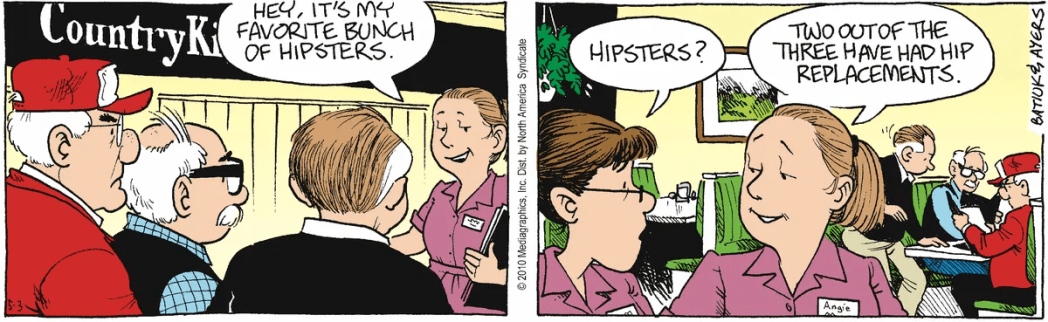

Wait, no Dale Evans it is!
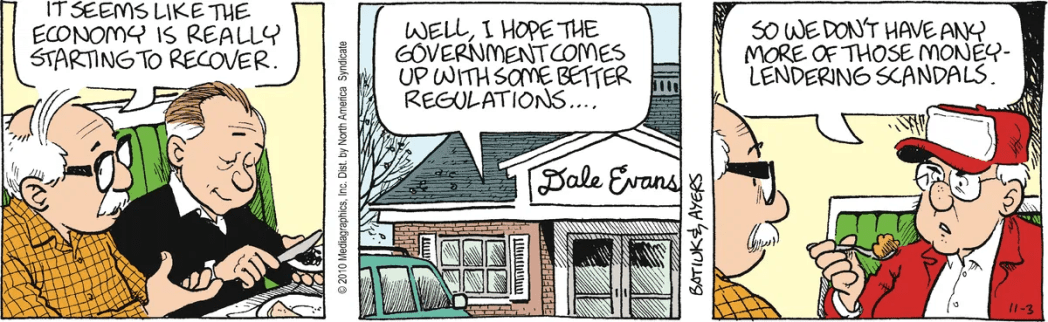
And thus the strange juxaposition between Ed and George at the Diner and Crankshaft and Keesterman at the mailbox. Where one month we would get George and Ralph visiting Ed in the hospital.
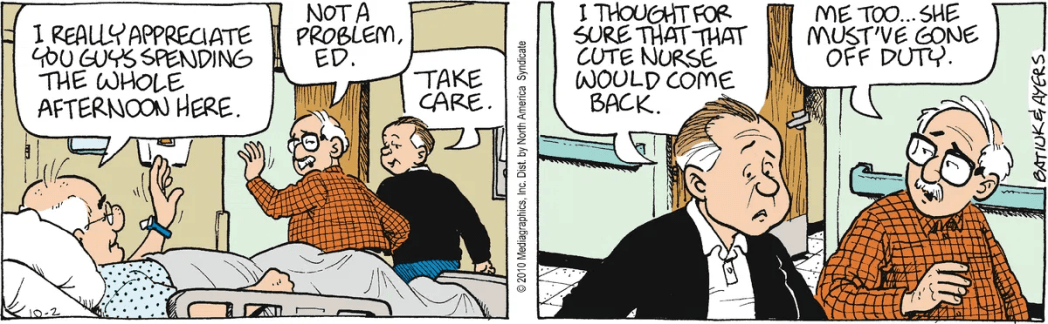
And literally two weeks later…
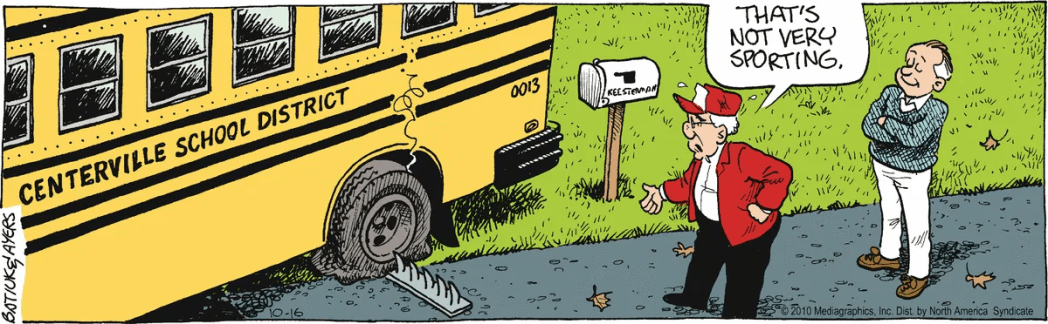
These two seemingly incompatible relationships would become the status quo.
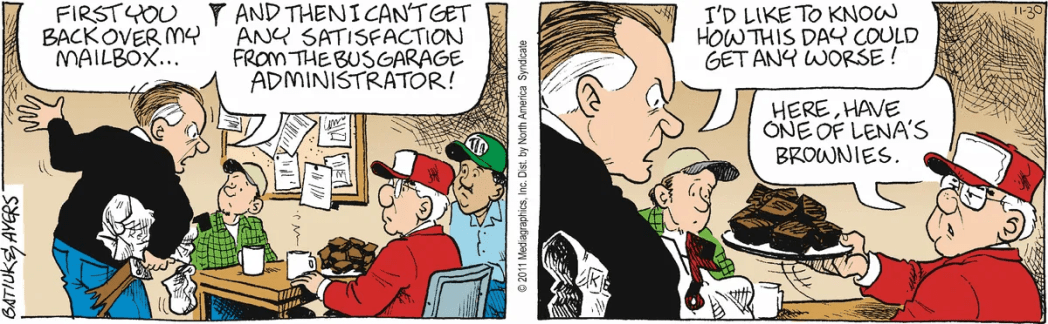
And yet, these two worlds would occasionally intersect.


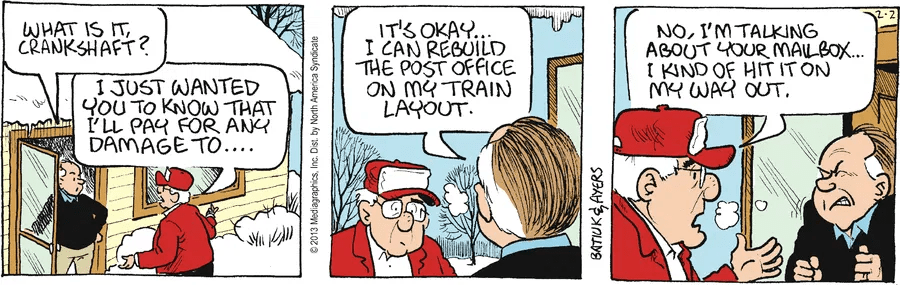
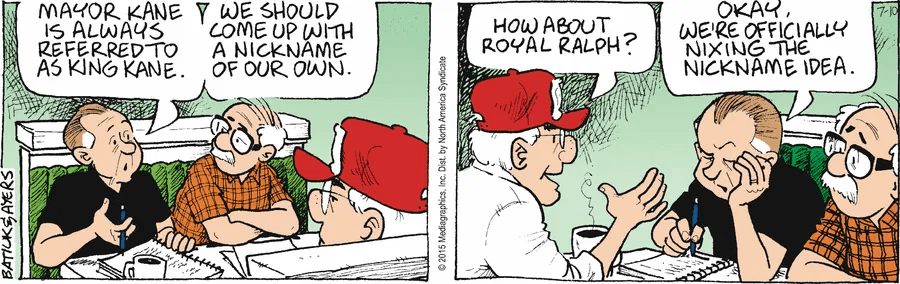
In 2015 Keesterman showed up quite a bit as he and Crankshaft worked together on Ralph Meckler’s campaign for mayor.
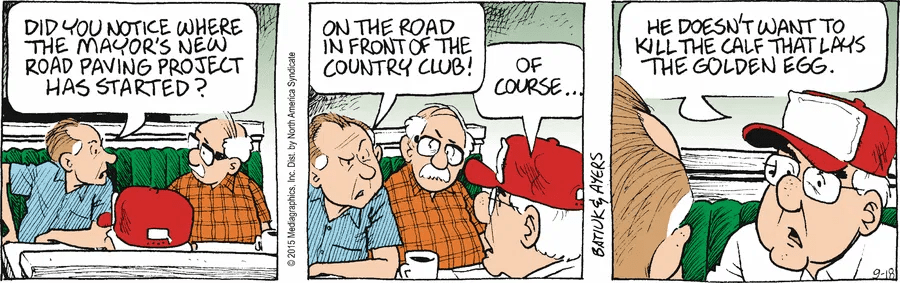
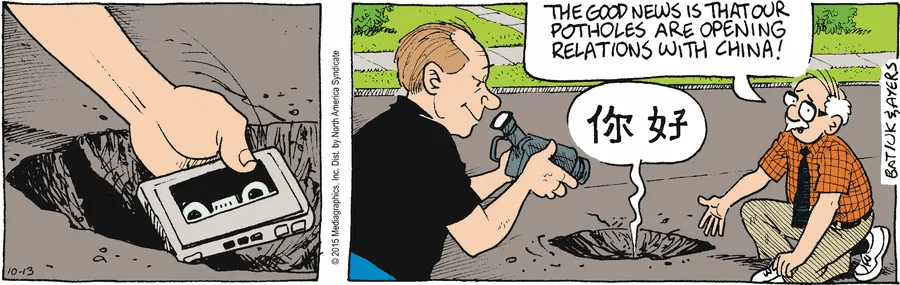
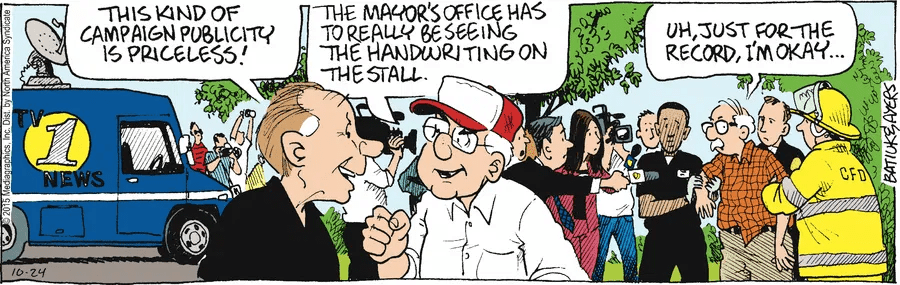
And yet, a year later, as commenter Joshua K recalled, Keesterman would consider suing Ed.
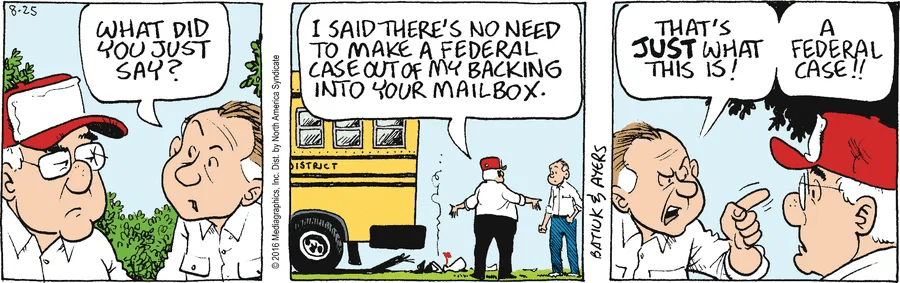
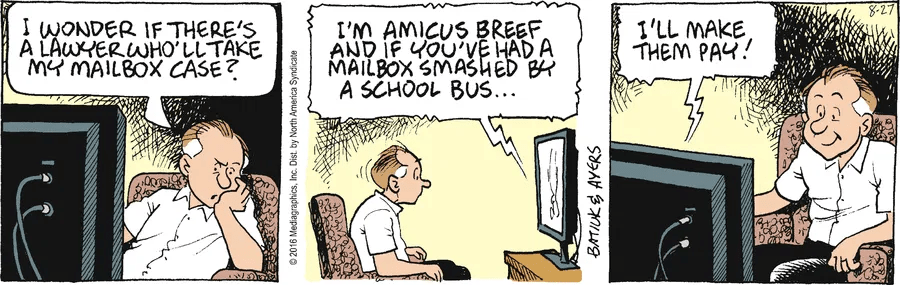
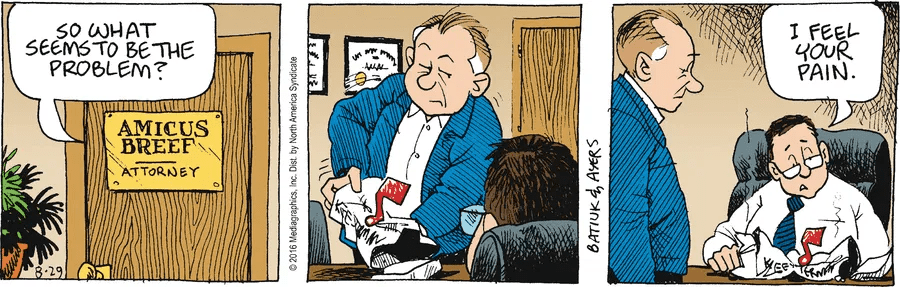

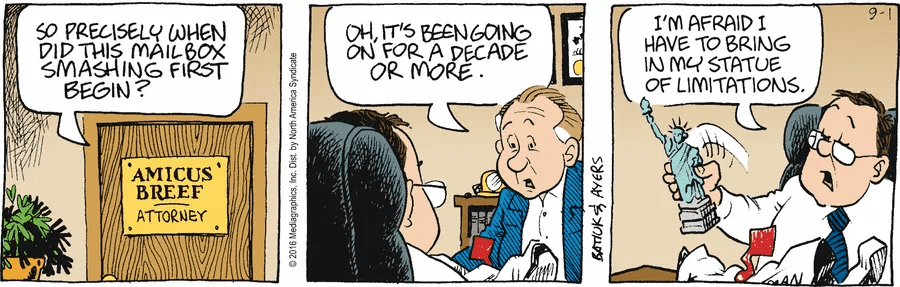

Judging by the expressive grimaces, scowls and frowns, Chuck Ayers seemed to love drawing Keesterman. Appropriately a Keesterman mailbox week was Ayers final week on Crankshaft.
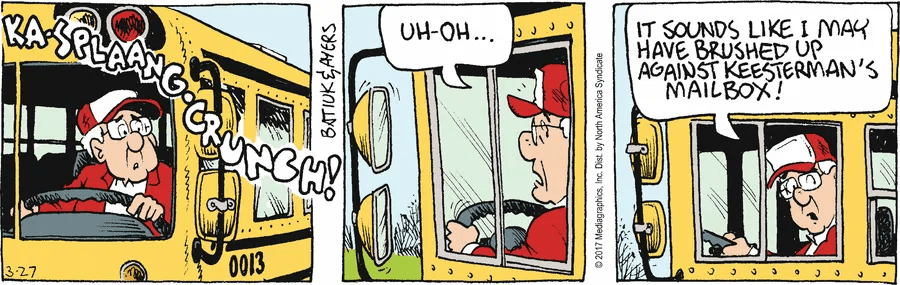

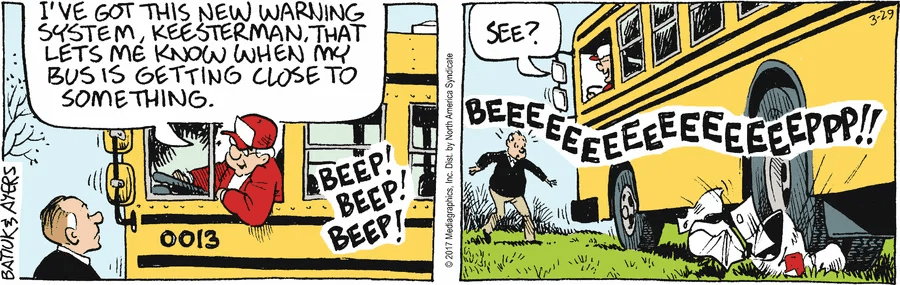

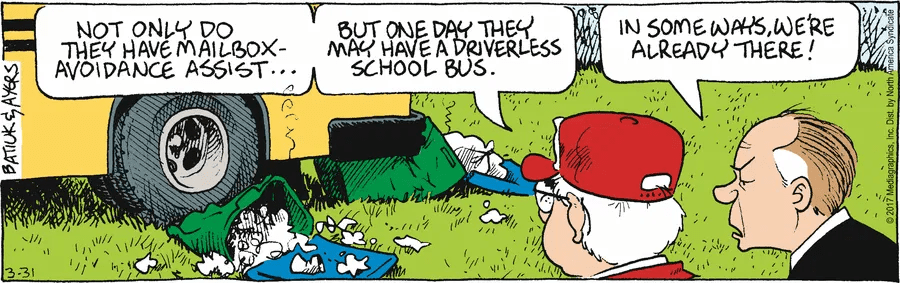

Mailbox arcs continued into the Davis era, but with the gradual de-assholification of Cranky, we eventually get a kinder, softer, mailbox flattening.
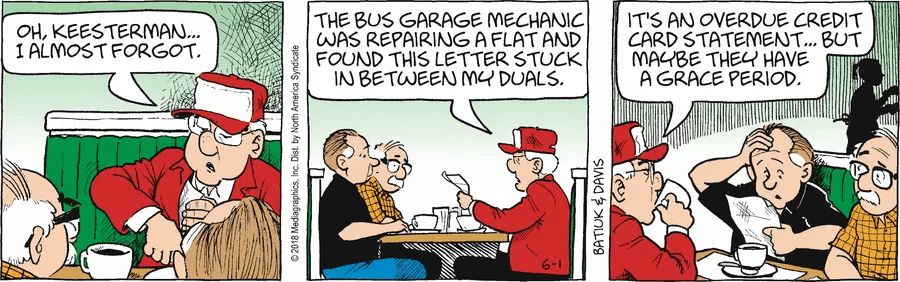
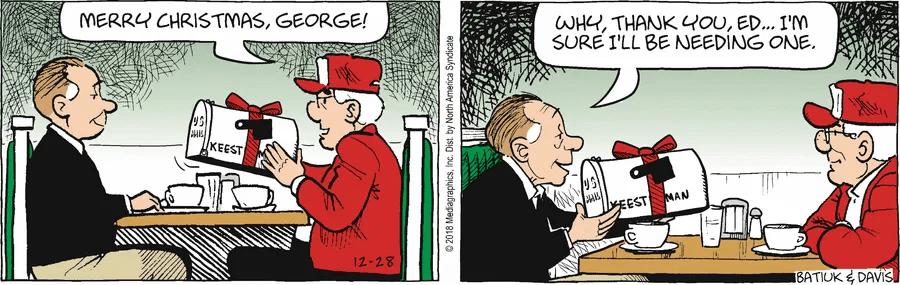
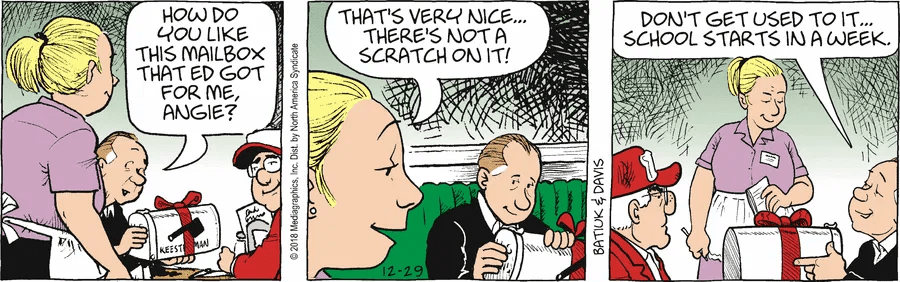
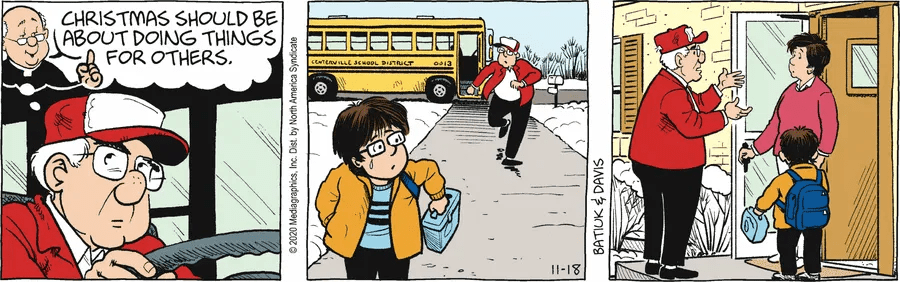
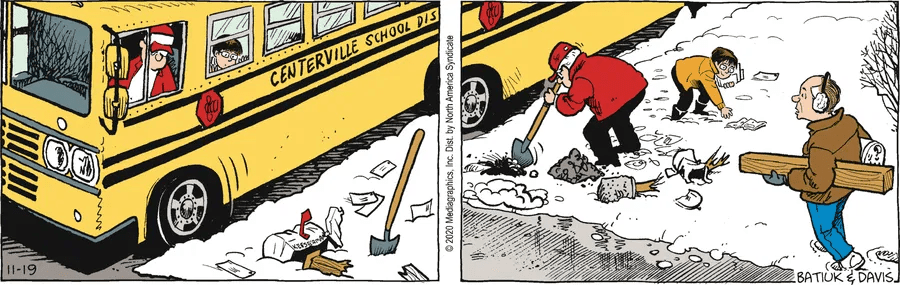

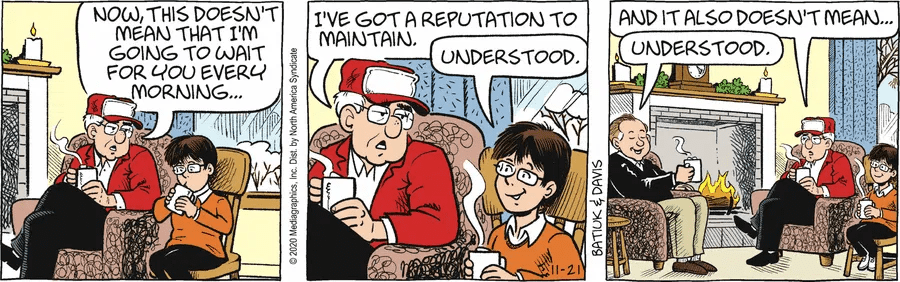
Why are Ed and George friends? The out of universe explanation I came up with is that Batiuk realized around the late Aughts that a crew of old guys eating out, as they do, would make an easy tableau for endless jokes. But it just being Ralph and Ed was missing a certain acid and bite. There’s no other named male characters of the same age except George.
I guess he could have added Andy Clark, but Andy Clark was originally supposed to be a decade or so younger than Cranky. He’d already decided that Ralph and George and Ed had all grown up in Centerview in the same age bracket. So, for an in universe explanation, as other men age and die around them, they have gravitated toward each other despite everything else.
Is it realistic that the gravity of that familiarity overcomes decades and decades of property destruction? That’s for the individual reader to decide.

But as for me, I don’t hate the mailbox gag.
 Son of Stuck Funky
The nearest parallel that I can find is the British sitcom Last Of The Summer Wine. It too has a meek guy like Ralph hanging out with best friends who hate each other.
Thanks for posting this. I had remembered that Keesterman’s attempt to sue Crankshaft had failed but I had forgotten the details.
The idea that Crankshaft would repeatedly destroy the same mailbox is an okay idea for a running gag.
However, it doesn’t make sense to me that (a) Crankshaft would apparently target one of his best friends for repeated mailbox destruction, or that (b) Keesterman would remain friends with Crankshaft while he — apparently intentionally — destroys his mailboxes repeatedly.
It would have made more sense for Ed’s mailbox destruction to be targeted at someone in town whom Ed didn’t like and who was much nastier than Ed, so that readers would sympathize with Ed rather than the mailbox owner.
But Batiuk doesn’t think that way. Batiuk thinks in terms of Dagwood colliding with a mailman.
it doesn’t make sense to me that (a) Crankshaft would apparently target one of his best friends for repeated mailbox destruction, or that (b) Keesterman would remain friends with Crankshaft while he — apparently intentionally — destroys his mailboxes repeatedly.
This. I was shocked to learn Keesterman was one of Crankshaft’s friends, considering how overtly hostile and malicious they are to each other. You can have characters who are frenemies, but it needs a lot more exploration than this. Once again, Tom Batiuk just dumps a complex, self-contradictory relationship in our laps, without giving us any clues whatsoever.
I think the idea of trying to soften up Ed is a big part of why I just can’t muster up the energy to be interested in Crankshaft. I liked him well enough pre-spinoff where he was just the crotchety old dickhead. That’s what made him funny and trying to soften that just doesn’t work for me because at that point it’s taking what made the character actually funny and neutering it to make him more palatable as a lead character. But the end result, whenever I read even the older Crankshaft stuff that’s posted here, is a sort of worst of both worlds for me. He’s not mean enough to where his behavior is actually be funny yet because he’s also an old crank it just means the attempts to humanize him and make him more rounded don’t work IMO.
I guess it also doesn’t help that I just don’t have even the minimal connection to Crankshaft that I had to Funky (which was reading some of the snark for a bit on places like Comics Curmudgeon and Something Awful around the time of the Lisa’s cancer story which mght have been even before the original Stuck Funky) prior to my reading it. Maybe if I had more of a connection I’d be a little more inclined to how Ed is portrayed and thus the strip? Or maybe it’s because I’m just not as into gag strips (and I don’t find what I’ve seen of Crankshaft to be as funny as the actually amusing Act I stuff to make up for it). Or perhaps I’m just colored by how much I disliked the creeping Crankshaft encroachment in the later years of Act III to the point where the strip ended essentially advertising its spinoff.
To me, though, it just comes off as a banal and limp spinoff of an already banal comic; less Frasier to Cheers and more King of Queens to Everybody Loves Raymond.
I think Batiuk’s desire to “soften” Crankshaft is another example of what I mentioned below: that he mimics what he sees without really understanding it.
Yes, Pet The Dog moments can be done well. I would even say that the story where Crankshaft helped the Rough Riders go to college was one. Ed was illiterate, thinks he lost the greatest opportunity in his life because of it, and doesn’t want anyone else to go through that.
What we usually get instead is random moments of kindness, like Ed buying Keesterman a new mailbox. This feels less like petting the dog and more like some kind of psychological torture. The bully lovingly replaces the victim’s destroyed item, just so he can destroy it again. Which is exactly what eventually happened! And they both joked about it!
In the early days of Crankshaft, I don’t think having Keesterman nastier than Ed would have worked as well. Most of Crankshaft’s victims operate under the “My Cabbages!” guy logic from The Last Airbender, where the victim is morally neutral, neither malicious nor too pathetic. That way we feel a strange mix of dark laughter, schadenfreude, and sympathy.
If you’re going to create a character like Ed Crankshaft, his victims need to be morally neutral butt-monkeys with little audience investment, like you said. Or they need to be complete jackasses that make your jackass seem like the good guy by comparison. Bugs Bunny, Basil Fawlty, and Rick Sanchez get away with the shit they do, because they’re bringing righteous justice on evil characters who deserve it. Who are usually much bigger and badder than them. Keesterman is neither of these. He and Ed are friends who regularly have breakfast together, but Ed routinely smashes his property? How does that workl?
You can have characters who are frenemies, but it needs to be a LOT more fleshed out. Keesterman’s not The Friend Nobody Likes, because no one else has any animosity towards Keesterman (or towards Crankshaft). They’re not Vitriolic Best Buds, because their conflict is limited to mailbox incidents. There is nothing forcing them to have a friendnship; they’re not coworkers or anything like that. There’s nothing that bonds them, unless you want to argue that smashed mailboxes are that thing. The OP hints at a Bully Turned Buddy relationship, but this is never explained, nor is there any reason Keesterman should have forgiven Crankshaft at any point in his life. (And we all knows what Tom Batiuk thinks about bullies… when they’re not him.)
Think about this for a second: Bull bullied Les all of high school, became a friend and tried to atone as an adult, and Les still pisses on his grave at his own funeral. Bull’s father bullied Ed into missing a major league opportunity, which Ed has lamented all his life. Keesterman is bullied by Crankshaft as a child, and now… they’re friends? Even though Ed is more or less STILL bullying him?
Today’s Crankfuckery
Day 4 of The (Literal) Fall of George Keesterman
(suddenly, Homelander shows up and lasers George Keesterman’s mailbox in half and then flies away)
George Keesterman: I just repaired that two days ago, asshole!
(Homelander then turns around, flies back towards George’s direction, grabs him by the neck and is 1 second away from killing him when Superman grabs him and throws him onto Keesterman’s driveway)
Does anyone else think Panel 2 “shoot from the lip” is much better punchline than Panel 3 “nearly joking”? I certainly do.
*Still a Few Bugs in the System* is the title of the first *Doonesbury* collection.
It’s been reissued with other titles, so maybe Jeff Murdoch will one day tell us that even revolutionaries like chocolate chip cookies.
Or Harry Dinkle will run afoul of a pupil who’s proud to be just a French major from theBronx.
1/16: Ed described George the way Pam describes him. Mirth ensues.
My opinion of Keesterman has improved dramatically now that I know he very nearly strangled Ed to death.
Sentences like this above are the reason this site must continue to exist. I agree that the mailbox bit is a solid running gag. Interesting to see how it’s rhyme shows up in the Wisteria Ballroom fire strip… Keesterman only drops his cigar because an intoxicated Ed (our hero…) nearly backs straight into him.
I’m guessing this story is somewhere in the gap between the early 90s and 2003, but I recall it being a pretty fun way to play with the mailbox gag. Keesterman gets the city or the school district to forbid Ed from using his driveway to back up and turn around, which results in a monkey’s paw cascade of negative effects (stuff like the downtown hardware store going out of business because George had stopped buying mailboxes and posts). By the end of it, Keesterman agrees to let ‘Shaft back up in his driveway again.
Posted this on the last entry, but I guess this one went up while I was writing it…
https://tombatiuk.com/komix-thoughts/match-to-flame-230-2/
New “Match to Flame”! And… well, let’s just say the most surprising thing is that Batiuk admits his glaring weaknesses, except he doesn’t acknowledge them as such…
Yep. Don’t give the audience what they want, give them your own inane interests and make them seem as boring as possible. It’s called writing!
Hm, pretty sure “subtlety” isn’t a synonym for “incomprehensibility”, nor “complexity” for “inconsistency”.
(He also talks about Hal Foster and Prince Valiant, yet doesn’t mention anything about dropping a huge Cleveland Steamer on his grave.)
(Figured some of you might appreciate this look inside the mind of Tom Batiuk. Such as it is.)
Like a lot of hack amateurs, Tom Batiuk loves telling you how subtle he is. “The audience doesn’t understand me, therefore I must be over their heads.” He’s trying to turn his incoherence into a virtue. Which is the writing equivalent of telling people you have Asberger’s. “I must have Asperger’s, therefore I’m super-smart and don’t have to adhere to social norms.”
We don’t understand Tom Batiuk’s writing because it makes no sense, because he never clarifies anything, and because his characters’ actions and motivations defy human behavior.
Which is why Lynn Johnston is less painful. We understand exactly what she’s trying to do. We just don’t like it much.
I wonder what the “difficult” story he’s talking about is? Given that the story he’s telling is from the book that covers 2014-2016 and he says that Funky had been around for 40+ years, I’d assume this anecdote happened in 2013 so I’m going to guess that this is in reference to Frankie III: Bio-Dad’s Revenge.
And I’m always down for a new Match to Flame because while they’re often inane, if you look hard enough eventually they do offer valuable insight into Batty’s mind. It’s just buried within the need to take 100 words to say what 1/5 of that will and rambling digressions about other stuff that doesn’t really serve any point. I guess we’ll see what the broader point is once he’s finished copy-pasting the rest of the book intro but this entry feels like one of the more revelatory ones. I’d put it right up there with the Volume 1 one where he mentions that the moment that changed his life as a kid was seeing the cover — and only the cover — of Hopalong Cassidy #122 (a story put into Tony’s mouth in Act II) and the awe that it filled him with as he wondered what the story was.
Essentially, it reads as if he’s confirming what we all thought: that he had some kind of a plan up through roughly part of 2013 and once he exhausted it he got lazy and fell back into just being self-indulgent leading the wheel spinning boredom of the mid-2010s up through the end. He basically stopped putting in real effort in order to spend the final eight years using Funky Winkerbean as wish fulfillment, living vicariously through his characters in order to do in the strip what wasn’t able to do IRL.
He bemoaned in earlier entires about how various adaptations over the years never bore fruit so Les gets to see Lisa’s Story not only be a success but get the multimedia adaptations denied to Tom Batiuk. He couldn’t get a job working in “real” comics so instead Mopey and Dopey get to do it and form their own publishing company where they get to work with Stan Lee and Jack Kirby who have made up and become friends again. His Adam Strange/Flash Gordon/Buck Rogers ripoff he created as a kid gets to be a pop culture icon (which also obviously stands in for his other work too).
It’ll be interesting to see how he tries to spin at as actually being a good thing (we already have “subtlety and complexity”) but that he’s even admitting to it in the first place is the more interesting part.
It says a lot about Tom Batiuk that he can say he writes about “difficult” topics, and we don’t even know what story/stories he’s referring to.
It says even more that Funky Winkerbean doesn’t have a periphery fanbase of comic book enthusiasts, just like he had (and thinks he still has) a periphery fanbase among band directors. But even comic book enthusiasts want nothing to do with his self-indulgent, meandering, Mary Sue stories. Because Tom Batiuk’s interest in comic books beings and ends with exploring ways comic books can fulfill his childhood fantasies. Fantasies he should have outgrown long ago. Like “the bullpen.”
I’ve long argued that Tom Batiuk is neurodivergent. He seems incapable of understanding that his interests are not the same as his readership’s interests, and that his interests are extremely narrow. His attempts to write about actual human emotions seem like mimicry. He has a vague idea about how you’re supposed to act, but he doesn’t understand the real mechanisms at work. He gets the details of a funeral right, but then he has Les use the opportunity to trash Bull, which no one would tolerate. Especially in football-centric Ohio, and the deceased is a beloved football coach/former NFL player/only good athlete in town history. Batiuk also seems to struggle with scope, like when Summer went on this long tour of places that weren’t that important to FW, or were so ancient nobody recognized them.
It’s almost a mercy that Tom Batiuk is as delusional about his own talents as he is, because it would be awful if he truly understood.
Well said, Narshe and BJr6K. I particularly hated Summer’s tour of real-life places from Puff Batty’s life, thinly disguised — places that aren’t important to faithful FW readers, all 23 of them, OR even to real-life Akronians.
Come with me, fellow SoSFers, on a grand tour of my hometown, NYC! First we’ll stop at the nondescript apartment building I grew up in. It’s on a nondescript block. Then we’ll stop at the nondescript spot where I went to school. Not to mention the nondescript building I had my first job at! It’s been torn down and replaced by a hotel. Wait till you see where my favorite coffee shop used to be! WOW!!! Yep, don’t mean to brag, but it’s a pulse-pounding thrill ride, all right!
What’s that you say? You want to see Times Square, the Empire State Building, the Metropolitan Museum? How utterly DULL. Why on EARTH would you want to see that tiresome crap when you could visit the Site of My First Apartment? It was a fifth-floor walkup. ABSOLUTELY RIVETING. You’ll be on the edge of your seat! All this and more, from The Drake of Life NYC Tours!
I don’t hate the concept of Summer’s walking tour but the problem really is that, like a lot of BatYam’s stories, the execution was way off. Walking past the apartment where the Fairgoods and Pm and Jfff lived in when the Murdochs saved Lisa from Frankie? Sure, that’s fine, it’s something related to Lisa and thus relevant to Summer. Walking past WHS? Obviously, sure. Even the diving board, again that was relevant to her dad and you can (somehow) get a good view of the city so I’ll allow it.
But what relevance do Dinkle’s house, the Lighthouse, and Ann and Fred’s first apartment have to Summer? Why not walk past Montoni’s to see it closed up, the park where they’ve held so many of those Lisa’s Legacy runs? Why not give her some thoughts so she’s actually reflecting on things? And why shove it all into only a week as a coda to the TimeMop story? It’s so damn stupid!
The entire final six months should have been dedicated to this kind of stuff and Summer’s reminiscing about the changes in her hometown as her and her friends have truly become adults in the wake of Cory’s wedding. Give the readers (through Summer and other characters) time to really reflect on the strip and its history and the way that things have changed and all that’s happened. No TimeMop, no Atomik Komix crap, no St. Spires and Crankshaft shilling, no stupid hypothetical future starring Summer and Maddie’s IVF daughter and her granddaughter to shill Lisa’s Story.
The one time it would make sense to be a little self-indulgent and he can’t even do that right.
Drake,
I just felt like Captain Picard in the Next Generation “The Inner Light” Season 5, Episode 25.
Thank you for the tour of your life. Not only do I feel I know you, but have partnered your life with you. Job well done. You are a wordsmith.
Going by that 1992 collection cover I see that the Batiuk Tuxedo, composed of a long-sleeved collared shirt under a plain sweater with slacks combo that is apparently the standard uniform for all male residents of Westview and Centerville once they enter their 30s, might just be the Funkyverse’s most enduring concept.
It’s the Woody Allen special.
At least when people call him out on telegraphing a punch, he has the decency to be a smug asshole about it. He doesn’t blubber about fungus people like Lynn Johnston.
Today’s (Very Late) Crankfuckery
Day 5 of The (Literal) Fall of George Keesterman
(sound of crickets)
We have Ed being the lesser grump.
I’m digging the work of the new guest artist, Jason Margos, in Gil Thorp. I loved it when that coach popped a basketball between his hands, but today’s strip was pure comic strip gold. PASS! JUMP! SWISH!
Holy crap, Gil Thorp looks more like Mark Trail than Mark Trail!
1/17: Just as Larabee was Maxwell Smart’s Maxwell Smart, Keesterman is Ed’s Crankshaft.
The Chief of CONTROL and Larabee are trapped in a time-controlled vault. Before it opens, they’ll run out of air. Chief: “What are doing?!” Larabee holding a coin: “I’m tunneling through the door!” Chief: “With a QUARTER?! That’ll take forever!” Larabee, after a pause: “You think maybe I should use a fifty-cent piece?”
Max and 99 are outside with a technician who’s using a drill giving them an airhole that will keep them alive until the timer unlocks. Suddenly, the tech walks away in disgust right after he cut through. Max asks “What happened?!” Tech: “Some idiot just plugged the airhole with a quarter!”
Sterling Archer: He died doing what he loved: being a Darwin Award.
ComicBookHarriet,
Thank you for the 1992 cover.
My interest in Crankshaft and all things
Tom Batiuk-ian tends to focus on the art. All of you do a standup job on his prose or its lack there of. There is nothing I can add that the rest of you haven’t already covered better. Yes. I am looking at you, Anonymous Sparrow.
But look at that 1992 cover. That rendition of Ed Crankshaft is just a perfect curmudgeon specimen. Why did TB shift to today’s short, bulby caricature?
The original is classic. This modern, today’s rendition looks lazy without any character. It strikes me as similar to Steve Rogers transitioning from Captain America to Nomad. Yuck!
On another note, most of us follow Mary Worth. Karen Moy has the best introductions to her arcs. Then writes great middle parts of the stories. It just makes me crave: More! Moy! More!
But then she jumps uncreatively to the sad, insipid conclusions. Examples: Wilbur’s death at sea, Wilbur’s crazy girlfriend, and Ian’s jealousy towards a parrot. Horrible! Horrible! At least TB has the consideration to skip the fascinating intros and wonderful middle parts to his stories and just jumps headlong into the boring, nearly unreadable conclusions. Well done Tom Batiuk. Well done.
On a much happier note, our beloved Be Ware of Eve Hill has her birthday today! ❣️🎁🎉🎂
Enjoy your day, dear Eve!
Thanks for the birthday wishes, SP. 🤟
You nailed TB’s thankfully inimitable writing style. He insists, “It’s called writing” but he has the skill of an 8th grader.
Be Ware of Eve Hill,
I hope you are enjoying your birthday week.💝
I do not understand why TB and Ms. Moy do not understand that an arc has to have a payoff that relieves the tension in a satisfying way.
They fail to do so, and I imagine that drives away readers. “It’s called writing.”
My wife says I act like an 8th grader. I hope I have better writing skills than TB.
Yes! You are beloved!🌺💐🌹(You just got flowers for your birthday!
Today’s Crankfuckery
Day 6 of The (Literal) Fall of George Keesterman
(George takes a peek outside his window and notices Homelander and Superman still fighting when a bald man in a mechanical suit shows up and punches Homelander so hard that he explodes)
Lex Luthor: I have to do EVERYTHING myself! THIS ENDS NOW, SUPERMAN! I’LL CHASE YOU TO THE ENDS OF THE FUCKING EARTH TO KILL YOU!
(George rushes to close the blinds)
(Happy birthday, Be Ware of Eve Hill!)
Thanks for the birthday wishes, csroberto2854. 🤟
I guess we’ll never know if Keesterman’s ankle was broken.
Keesterman should treat his ankle to some wishful drinking.
1/18: When dad jokes are for the birds, Ed will be there.
Today’s Crankfuckery
(Crankshaft walks out the door and is then eaten alive by a swarm of birds)
Jan 19: OH, COME ON!
And so the ego-stroking self-insert interview that began in August of 2024–not last Summer, mind you, but the year before that!–is still going on. Can’t we find some past Nobel Peace Prize winner willing to give their medal to Batiuk so that his neglected, award-deprived inner child will finally be sated?
It’s not just how self indulgent and long this is, it’s showing us how stupid this egomaniac is that bothers me. Who’s supposed to be stopping him escapes me but every career goal has to get past a barrier of asking if he’s allowed to do anything.
Talking about his history would be fine if his life had been interesting but from everything that’s been revealed it’s just been horribly pedestrian and boring. If he’d created an amazing work of art then I could see that too but he created a C-level comic strip that topped out at one character being kind of popular among a niche group of people 40 years ago and is mostly remembered by another small niche of people who mostly want to make fun of it or pick it apart.
I mean crap like this is what he has a blog for except he only uses the blog to post pictures of leaves and reprint intros from his book collections where he doesn’t go in depth enough in his anecdotes to make the stories he’s relaying interesting.
And of all the Funky Winkerbean characters to carry over, why Batton? Funky’s trainer somehow made the leap so give me some stories of her smugly screwing with annoying old men. At least she’ll be nice to look at.
“And of all the Funky Winkerbean characters to carry over, why Batton?” Well, that’s an easy question. Because Tom Batiuk needs the world to understand how he expects to be interviewed! The multi-session interview at Montoni’s was just the beginning! After that, he expects you to get in his car, while he takes you on a tour of every uninteresting place in his past, and every uninterersting thing that happened there. You can’t properly understand 5 O’Clock High until you’ve seen the imperious Rexall!
That’s all this is. This is Tom Batiuk announing the level of attention he expects.
What is lost on the man is that he’s revealed how dense and out of touch he is. It’s not an act of betrayal to stay in a decent hotel but Daddy’s Little Stooge doesn’t come close to understanding that.
Another annoying thing is his insistence on not understanding what covers are for.
He has the hardest time understanding why people do not things they do because he’s kind of a dumb kid still.
Next week will be worse, because the OMEA convention opens!
Why can’t it be both? “And this convention is where I found my most loyal readers for 5 O’Clock High! They love that wacky band director!”
Today’s Crankfuckery
Day 1 of The Interview from HFIL
NO NO NO WHY BATTON THOMAS AND SKIP RAWLINGS WHY DID THE FOCUS SHIFT FROM KEESTERMAN AND ED TO THE INTERVIEW FROM HFIL
You must still be on Stage 2, Anger. Most of us have moved on to Acceptance, or at least Depression.
Yep, again the tour of nondescript places at which boring events happened.
One of Puff Batty’s worst tendencies is what I think of as the “medium shot.” Crappy directors tend to focus on medium shots, while good directors skillfully intersperse close-ups, long shots, tracking shots, panning shots, etc.
In comics, this means consistently giving us just the boringest possible level of detail.
A “close-up” would zoom right in on his childhood the way Watterson or Barry or Schulz might, letting us see through a child’s eye, hitting us by pulling on our own long-buried childhood emotions.
A “long shot” might mean zooming way out, talking about what Akron was like in the 50s, what his school experience was like, quotidian snapshots of that era, so that we can experience that time and place through his work.
As it is, he shows us a deadly dull “medium shot” look at a cookie-cutter house that means something to him, and thinks that magically it’ll mean something to us.
It doesn’t. That’s where artistry and skill are supposed to intervene to pull us in emotionally. But they don’t, and so we’re left with a random boring house, totally emotionally disconnected to a boring story.
That’s a good way of putting it. Everything in the Funkyverse is “shot” from too far away to be personal, but also shot too close to be universal.
Lisa’s Story gives us neither an up-close look of cancer affecting one family, nor a broader view of fighting cancer in general. It pretends to be a personal story, but it’s almost designed to keep you at arms length from the two main characters. It is the story of two people who made baffling and self-destructive choices, for reasons that are too personal to share with the reader. All it does at make you ask what the point of the story was.
Another defect is his poor timing and not so good understanding of the stakes of a story. I remember thinking up ways Ed giving Winnipeg’s coach an idea could actually mean something. All he wanted to do is give Ed the FIFA Peace Prize.
I wonder if that comparison ever occurred to Tom Batiuk. Les didn’t lobby for the Oscar award, but he sure as hell thought he deserved it. And showed off the trophy like it was actually his. Sounds like a real person we all know.
At this point, I wouldn’t be surprised if Batiuk thinks everyone involved must be Funky Winkerbean fans who took inspiration from him. (I mean, if he still hasn’t figured out that The Simpsons reference wasn’t complimentary…)
He would have to understand that the campy sixties Batman wasn’t put on the air to bully him.
In an interview with Thomas Dollard, he asked Batiuk “How does it feel knowing that Funky Winkerbean is Marge Simpson’s favorite newspaper strip?” Which is a question Batiuk obviously wrote himself, because it starts with a false assumption. (This never happens in the episode.) Batiuk’s response was to gush about what a great “shout-out” it was. Sure, buddy, if you think this year’s South Park is making shoutouts to the Trump administration. I wrote a blog post about it here.
He doesn’t have the least idea at whose expense a joke is. The poor dumb cluck still thinks the campy sixties Batman was designed to bully kids like he was.
He would have to wonder what people think of him or realize that he looks a certain way to others.
If you’re not familiar with the movie “United Passions”, look it up, particularly the public’s reaction to it. It really puts the FIFA Peace Prize into perspective.
Oh, I’m familiar with “United Passions.” During its one-week run at a local Philly metro multiplex I went to a Tuesday evening show just to say I was there. I was in fact the only person in the theater.
1/20: And here we go again with the mistaken belief that naming the parent strip Funky Winkerbean is what’s in the way of his success.
I suspect he’s going to talk about the name all week. Nothing at all about any famous strips “Batton” did, his thought process, what his own life was like during these times, what he learned, or anything at all you might expect to see in a retrospective look at a creator’s own life.
“Five O’Clock High” is basically the comic book cover he wanted for his life’s work, and that mean old syndicate wouldn’t let him use it. And he will NEVER let it go. Even though Funky Winkerbean turned out to be a pretty good name for the Internet age, because of its uniqueness. And it is/was the name of a main character, which Batiuk never felt the need to change or explain. (Even though this would have been easy to make Funky a nickname, and give him an embarrassing first name. Apparently Batiuk didn’t hate it THAT much.)
Once again, Tom Batiuk’s neurodivergent obsession with book publishing formalities comes to the forefront. It’s the only thing he ever talks about, and the only thing he thinks anyone ever wants to hear about. And Skip will just sit there nodding and smirking, as if this were the greatest monologue in human history.
What he didn’t care or think to understand is that the syndicate had to deal with a powerful figure angered by a non-indicative name: Charles Schulz. After him betters asked what kind of a name Peanuts was, naming a strip after a prominent character became SOP.
And yet, arguably the most important, beloved, and enduring pop group in history had the absolutely most idiotic name. They were a beat group, geddit? And they liked Buddy Holly and the Crickets, geddit? LOL, ROTFL, ROTFLOL, so they were called The Beatles, geddit? No one ever thinks any more about how stupid that name is, because it belongs to such a brilliant entity that it became beloved in itself.
Saul Bass, one of the greatest logo designers, defended his abstract logos (like the AT&T ‘Death Star’) by saying that the logo need not describe the company; the company would define the logo in time.
Nobody ever said, “I like Charlie Brown and Linus and Snoopy, but I can’t read that strip because of the name.” As Bass would have predicted, the strip became beloved and the name came to represent that beloved strip.
TL;DR: The name of the strip was never the problem, Batty.
I don’t think there’s any reason to think that “Funky Winkerbean” was held back by its odd title.
There’s another comic strip that went into syndication just a few years before FW. This other comic strip dealt with serious issues ranging from Watergate to the Iraq War. It was adapted into a Broadway musical and an animated TV special that was nominated for an Oscar (yes, an Oscar, even though it was a TV special). The cartoonist has not only won a Reuben Award — he won a Pulitzer Prize, too. The strip may not have made money like “Peanuts” or “Garfield” did, but it had as much prestige as any other strip to run in the last 60 years.
And that comic strip was named after its oddly named main character, too: “Doonesbury.”
There is absolutely zero reason to think Funky Winkerbean was negatively affected by its title in any way. That Batiuk thinks it was stems from two things. One: his complete inability to consider that the failure of anything he does might be his own fault.. And two: his obsession with comic book covers. He assigns far too much importance to the “cover” of something, as if its outer presentation is more important than its content and quality. FW could have been called Three O’Clock High or Westview or School Days or Martian Upholstery and it wouldn’t have made much difference.
He doesn’t really understand what they’re for. I was ten or so when I figured out that their purpose was to attract attention by misrepresentation. He never will.
I know that Tom Batiuk was a teacher before he had his syndicated comic strip. Wasn’t Batton Thomas a teacher before he had his strip, too?
The reason I ask is that if Skip knew Batton was a teacher, he might not have asked where Batton came up with the idea about doing a comic strip set in high school. It’s not like Batton was a teacher and decided to do a comic strip about a doctor like “Rex Morgan” or a detective like “Dick Tracy.”
Yes, there was some strip a year ago or so, still within this interview context, that shown Batton being in a classroom before making his LaGrange trip to New York.
Re: January 20 2026 Crankshaft
“So you just sat out here watching the students leave the high school every day at 3:00?”
“That’s the thing about these high school girls: the older I get, they stay the same age. All right, all right, all right.”
“Yeah, I’m turning these interview tapes over to SVU…”
(Also, Batton/Tom should probably consider not explaining that he got his ideas through a “brilliant stroke”. It’s just too easy…)
A week or so ago, Bjr6K posited a theory that the syndicate lowered the boom on TB, insisting that Crankshaft drop (or at least downplay) the leftover FW characters, and return the focus of the strip to the antics of Ed Crankshaft.
For this theory to be tenable, we would need to accept that:
a) the syndicate bothers to read the feature
b) the syndicate has any interest whatsoever in what the feature actually does, as long as it continues to run in a bunch of papers and turn a profit.
Obviously, this week’s series of strips is severely testing that theory.
New theory: TB continues to write about whatever addled thoughts pop into his increasingly creaky brain. We can only assume that his decaying neural pathways are now barely able to accommodate an ever-shrinking number of pet characters and obsessions. Hence, what we see in the strip, with some FW characters being literally forgotten about.
Of course the syndicate is making money, so the syndicate doesn’t care. (cf: Apartment 3-G.)
The fact that Batton Thomas continues to exist in Crankshaft after the “Grandpa Wrinkles” snit pretty much blows my theory out of the water. The publisher might have told him to knock it off, but he doesn’t care. “It makes money, so nobody cares what he puts into it” is probably much closer to the truth.
Today’s Crankfuckery
Day 2 of The Interview from HFIL, 2026 Edition
(Skip falls asleep due to how much Batton is talking)
1/21: Most people don’t care why he gave them their names.
“I put real people in my comic strip all the time! Mike O’Shea, Marc Evanier, Linus Van Pelt, Batman, Superman, The Flash, my roommate from 1972, you name it! Intellectual property and name/image/likeness laws don’t apply to me!”
They should.
1/21: People don’t actually care if mildly distorted versions of themselves appear in Store Brand Archie.
Tom Batiuk really should. This “Batton Thomas” character really makes Batiuk look like a talentless hack.
So is he really a quarter inch away from being a talentless hack, or a quarter inch past being a talentless hack?
Instead of someone whose brain is eroding.
I will literally forgive every Batton appearance if his final one is him leaving the interview with Skip and as he crosses by the alley next to Montoni’s a hand juts out. It’s holding a gun and while we don’t see who’s holding it, we are left with two simple words before everything cuts to black.
“Where’s father?”
There’s a new Match To Lame on tombatiuk.com. It’s an inside look at his writing process, and it’s about as coherent as you’d think. A sample:
in previous introductions to these collections, I’ve discussed the writing in terms of how it changed from gags to sitcoms to a more cinematic storytelling approach, and how that opened the work up to approaching more complex subjects and edge work.
No, you just announced how “cinematic storytelling” you thought your work was, and didn’t give any examples.
the night in that back bedroom when I came up with Harry L. Dinkle, the World’s Greatest Band Director, and wonder what my career might have been like if I’d skipped that night and never come up with the strip’s first truly iconic character.
I shudder to think of how many “truly iconic characters” this man thinks he’s created.
Iconic and well-loved characters like Batton Thomas, John Howard, Pete Robert-Reynolds, Cliff Anger, Phil Holt, Darin Fairgood and Les Moore. I can see Batty’s inner child dancing like Rich Evans in the corner shouting “Malcom, Bernie! Malcolm, Bernie!”
Well, an icon is merely a representative symbol for something else. So yes, Tom could have created many iconic characters. The real debate, which goes on here daily, is what the characters are actually icons of…
Today’s Crankfuckery
Day 3 of The Interview from HFIL, 2026 Edition
Batton: Skip, I don’t think that they even cared that I based my characters off of them.