Most works that are infamous for being bad – The Room, The Eye of Argon, Big Rigs Over The Road Racing, The Star Wars Holiday Special, Crown Royal – are bad in ways that are easy to explain, and apparent to anyone who consumes them.
Funky Winkerbean was an awful comic strip, but in ways that are difficult to quantify.
My usual go-to resource for this kind of analysis is TVTropes. A trope is a “narrative device or convention used in storytelling or production of a creative work.” TVTropes catalogues them all, and catalogues works in all media by the tropes they use. Most importantly, it gives us a language we can use to talk about what’s good or bad about creative works. It’s one of the best things the hive mind of the Internet has ever come up with. If you’re not already a reader, go check it out, but be warned that TVTropes Will Ruin Your Life.
I view tropes as the atoms of storytelling. Every object in your home, at its most fundamental level, is made up of atoms. Water is two hydrogen atoms, one oxygen atom. Salt is sodium and chlorine. If you look up your favorite book/movie/TV show/record/comic strip/video game/Bible story/anime/whatever on TVTropes, you’ll get a list of the tropes it’s made of. It’s a way of breaking down your favorite story into its most basic elements, and discussing what does well or badly.
Tom Batiuk’s writing is so bad that it defies this model.
Don’t get me wrong: there’s a lot about Funky Winkerbean that can be defined in terms of tropes, and how they are misused. Here’s a good example:
The Last DJ: Les Moore is apparently the only person in the entire world who does anything for the sake of artistic expression. Everybody else is creating twaddle for money-grubbing weasels. Taken to absurd lengths in the Lust For Lisa storyline, where Les’s film script is rejected by the only-in-it-for-the-money studios for, in their dismissive words, being “a beautiful work of art.”
https://tvtropes.org/pmwiki/pmwiki.php/ComicStrip/FunkyWinkerbean
Batiuk is trying to make Les into a character archetype that poorly suits him. The general description of The Last DJ includes words like “integrity”, “skilled”, “admired”, “mentor”, and having bosses to answer to. None of which applies to Les. The story is always telling you how talented and popular Les is, but you never see it. Instead, we get stuff like this:
This isn’t the spiritual cousin of Dumbledore, Qui-Gon Jinn, Sam Vimes, Dr. House, Johnny Fever, and the hero of a Tom Petty song. This is Brian Griffin at his worst.
Which is why the TVTropes model doesn’t work with Funky Winkerbean. There are tropes that clearly apply to Les, like Know-Nothing Know It All, Apathetic Teacher, The Mourning After, and Hostility On The Set (Les being the cause of it, while acting like the victim of it). But Funky Winkerbean doesn’t really use these tropes, because the story never acknowledges it. Les is never portrayed in the story as the rude, thin-skinned, indifferent, lazy, elitist ball of Dunning-Kruger syndrome he is. Not even once.
So we need a new framework to properly catalogue Tom Batiuk’s crimes against storytelling. We need a new term to describe that thing Tom Batiuk does that he calls storytelling. We need some… T.B. Tropes.
And here’s the first one:
Story Asserting
Show, Don’t Tell is one of the most basic principles of narrative. Most of the time, it’s more effective to demonstrate a fact, rather than use dialog or exposition to state that it is so. Have the character do something awesome, rather than just telling us they’re awesome.
But Funky Winkerbean takes this to a new level. Tom Batiuk’s writing doesn’t merely tell instead of showing. It tells you and shows you two completely different things. The noble, talented, Byronic hero Les Moore the story describes isn’t the same jerkass Les Moore the readers see every day. But this discrepancy isn’t a Red Herring, it’s not a Bait-And-Switch Character Intro, it’s not an out of character moment, or there for any other storytelling reason. There are two completely different Leses.
Tom Batiuk doesn’t tell stories. He asserts them. Storytelling is a process of using art, language, narrative techniques, and other tools to convey the elements of a story. Batiuk just asserts what the story is rather than actually telling it. In this case, the asserted story is “Les is a talented, deeply devoted widower who is concerned that Hollywood will misrepresent the life of his tragically deceased wife.” The characters go about advancing that story, as if a word of it were true.
Les’ writing skill is an Informed Ability; what we see of it isn’t pretty. His devotion to Lisa stopped being positive a decade ago; it’s now closer to mental illness. Hollywood did nothing but bend over backwards to meet Les’ never-stated ideas of what “telling Lisa’s story correctly” entailed. Her reputation hasn’t been in any danger since the Lust For Lisa incident in 2014, and even that was a ridiculous strawman. And Les’ decision to unilaterally cancel that movie should have permanently ended any Hollywood interest in his book anyway. To say nothing of the actual circumstances of Lisa’s death, which were arguably something less than “tragic.”
There are five different ways Tom Batiuk asserts stories rather than telling them:
- When the characters act towards the story’s desired end, contrary to how a believable human character would. Described above.
- Tom Batiuk’s media and blog proclamations. Here’s a perfect example, from the Sports Illustrated coverage of the CTE arc:
Bushka’s story will come to an end this fall, culminating in a wordless five-panel strip in which he takes his own life after being denied disability. “It’s that sort of dichotomy,” Batiuk says.
https://tombatiuk.com/media-and-events/football-comic-tragedy/
So that’s why Bull killed himself! Because he was denied disability! That’s helpful to know, because the story never tells you this. Or mentions it even once. Money was a minor, confusing plot point. The story was mainly about Buck Bedlow’s failed courting of Linda, Linda’s wacky support group, and of course, a full week opening an envelope. An envelope whose importance was never conveyed to the audience, but whose “NFL” logo was lovingly focused on as if it were the clue in a Dora The Explorer episode. With no explanation beyond that, the story then became about Les, as all stories do.
I realize that when someone commits suicide, the friends and loved ones don’t always know why. But in the case of Bull Bushka, no one even cared. Not one “Why?” was asked. The police went right to work covering up Bull’s suicide, even though wearing a helmet in a crash is the action of someone who’s trying not to die. Because:
3. All characters are Infallible Narrators. Every character knows where Tom Batiuk wants the story to go, and does their part to advance the story there. Even when those steps are completely illogical and out of character. Here’s an infamous example:

The overly passive Les confronts an unknown driver in a road rage incident. But it turns out to be his friend Mason Jarre, secretly following him around Westview because method acting. For the only time in his life, Les Moore confronts a problem, because it’s safe for him to do so. And no character comments on this. Nobody asks “Gee Les, where was all this energy when you could have sued that hospital?”
The CTE story also ties into the fourth way Tom Batiuk asserts stories:
4. The obscure flashback. Batiuk asserts stories by making them follow-ups to obscure past comic strips, rather than flowing naturally from events. Just by accident, Billy The Skink’s October 1 post mentioned this strip from six months before:

There’s no way anybody had this in their mind when they were following the CTE arc. But Tom Batiuk asserted that this conversation was important to the story. And he treated it as so self-evident to the story that it didn’t even need to be said. Flashbacks and continuity should be about things that are important to the audience. In the Funkyverse, they’re random moments pulled from the archives by the author and imbued with more importance than they actually had.
The CTE story had a second example of this. It referenced a one-week arc in the early 1980s where Les tried out for the football team. This, and a cancelled check to the Lisa’s Legacy foundation, were cited as proof of Bull’s friendship. This completely ignored the fact that Les and Bull had been adult friends for decades, and Bull had done a lot to atone for his high school behavior. It’s as if the story couldn’t give Bull any credit for his actual good deeds, asserting that their friendship was a ridiculous bit of trivia.
5. By making the story a constant restatement of the premise. If you don’t follow Crankshaft, here’s what you missed the last two weeks:

I used to help my daughter chase Crankshaft’s school bus. I used to help my daughter chase Crankshaft’s school bus. I used to help my daughter chase Crankshaft’s school bus. Over and over and over again. At no point do we see this actually happen! Not in the current day, and not in a flashback. The story talks in circles about itself without ever actually existing. The characters tell us what happened off-panel, with more backstory than The Lord of the Rings.
Once again, the story being asserted contradicts the story being told. They keep talking about chasing the school bus and never catching it. That she did catch it was a punchline two weeks in the buildup. But in the strip we saw Crankshaft stop, pick the child up, and have a polite conversation with her and the grandmother. On two consecutive days. The real story contradicts the asserted story.


The TV tropes site was the thing that originally led me to Son of Stuck Funky. It was the “Lisa phones in a bomb thread from beyond the grave to save Les from a plane crash” arc that pushed me over the edge into the rabbit hole. There was something almost poetic in the way that TB mishandled conventions and ignored logic and consistency, and I was glad to find a group of people who were as astonished as me at what was happening.
Regarding the Crankshaft strips of the past few weeks, the artwork has been strange. The style with which the Grandmother is depicted is identical to the style with which characters in Curtis are depicted. Is there a different artist? The names in the byline seem to be the same (Batiuk & Davis).
There is a sort of fix for this. Everyone is an unreliable narrator who does not realize that what they think is happening is not what is actually happening. We could call it winkerbeaning.
Another great analysis BJ! I’ve learned so much about writing and how to analyze a story from you…thanks!
What really gets me about Batty is how hypocritical he is. He loves to take on big Hollywood, big publishers, comics publishers, etc, for being greedy, yet Batty is the definition of greed in that he wants more than he is willing to give.
He preaches tolerance and respect for differences, but then strikes like a rattlesnake when someone holds a different view. Disagree with how he tells a story? He yells “it’s called writing” and stomps off in a huff.
And yes TvTropes has ruined my life, or maybe not, that sounds like a trope too!
It appears to me that there’s not just one entry that applies. There is a whole spectrum of informed attributes: informed ability, informed kindness, informed flaw, informed loner, informed wrongness……
Informed Writing. Informed Comedy. Informed Realism. Informed Tragedy. Informed Characters.
There’s also the COMPLETE lack of self-awareness on Batiuk’s part, that leads to further hypocrisy on his part. He complains about faults in OTHER people’s works while being utterly oblivious to the fact that he’s just as guilty (if not more so) of the things he’s complaining about. It’s worth quoting his latest Flash Fridays blog post again because it’s just SO applicable to Batiuk.
Let’s face it, it was pretty obvious no one was putting any editorial oversight in the final months (years?) of Funky. No one was there to say “Tom, what are you even trying to say here? Are you sure this is the best way to proceed? Did you really mean to say that the answer to racial profiling is to shrug your shoulders and say ‘eh, whattya gonna do?’ Did… did you give a child a toy made out of the gun that murdered his grandfather? WHY WOULD YOU DO THAT. Hold up… time traveling janitor? Tom, are you off your meds again?”
“It’s called writing!”
Really, just the 2023 Crankshaft strips are exactly that “series of incidents”. Even a two-week story arc can’t manage a “cohesively told story”; we get to see all of Granny Johnson’s schemes to get Cindy onto the bus after we spent almost an entire week of Ed talking to Granny when he stopped the bus for Cindy. When you start the arc by contradicting its premise, you’ve clearly failed at telling your story cohesively.
Really, we could probably sit here and name potential storylines that Batiuk introduced and promptly forgot about and it’d be longer than this post already is.
The entire thing is filled with complaints that can (and have) been said about Batiuk’s work, yet he seems blissfully unaware of his own faults as a writer. It’s really fascinating. (But, of course, he simply speaks the truth, whereas his own critics are merely beady-eyed nitpickers…)
He truly is a unique and largely unreadable flavour of awful.
Eventually, someone with cancellation power noticed how Apartment 3-G had devolved into repetitive, directionless, addled incomprehensibility. When will Batiuk’s day of reckoning come?
We’re probably looking at a preemptive strike. Rather than have someone come along and do better with John Darling than he ever could, Batiuk ‘rescued’ the character by killing him. Thus next year’s Byrnings.
The story with A 3G was kind of sad from what I read. Apparently they had been looking to replace the artist for a while as he was getting on in years, but no one ever managed to find one and he was working through clearly-degrading abilities right up to the end. Writing didn’t have quite the same issue though so can’t judge much on that.
I’d argue that the A3G writing very much suffered from the same issue. Yes, the art definitely degraded badly. But the maddeningly repetitive and hopelessly unstructured, unfocused, and unending ‘story’ — full of narrative dead-ends, dream-like illogic, pointless digressions, and narrative inertia — made it quite clear the artist was illustrating material written by a mind in serious decline. Mary Worth was a model of fresh concepts and tight, concise plotting in comparison. (And indeed, writer Margaret Shulock was later revealed to have been suffering from Alzheimer’s.)
Margaret Shulock was at one time the Tuesday Chick on Six Chix.
The work of the current Tuesday Chick, Bianca Xunise, is an abomination and an indignity against women cartoonists everywhere.
I meant to say:
Margaret Shulock was at one time the Tuesday Chick on Six Chix. She was one of the better “chicks”.
Are the present Tuesday and Thursday Chicks having a contest to see how crappy they can make strip before Comics Kingdom management intervenes? The loser buys the winner a year of boxed wine?
Tuesday Chick: On my day, I’m drawing myself in my strip wearing a pumpkin on my head. It also works because I can’t draw noses. My character is always depressed because she hates her life.
Thursday Chick: Hold my wine glass. I’m drawing my panels with my foot and taking story suggestions from the kids at my local daycare.
Xunise is not only not funny, she’s doggedly, relentlessly not funny. She makes Tom Batiuk look like Steve Martin.
Six Chix – Tuesday 09/26/2023
… and there we go with the pumpkin on the head shtick. No writing skills of any kind. Tuesday Chick is nothing if not predictable. How long will it last this time? April?
I think Batiuk’s day of reckoning already came. That’s why he already has “the burnings” cued up for next year in Crankshaft. Because he’s been told it won’t be back for 2025.
By the way, I’ll wager real money “the burnings” will be a standard Ed grilling mishap that “spreads out of control” with zero explanation. With no discussion or even acknowledgement of the political factors that drive book burning. Or even seeing the grilling mishap. They’ll all just sit around the bus depot or Dale Evans and talk about that crazy thing that happened last week. This will wordlessly transition to the bleak post-apocalyptic world we saw. It’ll be the Act III time skip all over again.
Tom Batiuk’s stories have no middle. They’re all exposition and denouement.
This. THIS is a perfect and concise way to sum up TB’s writing. I don’t know if it could be said any better.
Great entry, and thank you for tying the recent CS strips in with everything else. I’ve been observing the gocomics comments and the disconnect between what the strip says and shows is mentioned there, and nobody can explain it any further.
If I may suggest another TB Trope – “Just Don’t Say No”. The TVTropes page attributes “Failure Is The Only Option” and then, following that page, lists “Stupidity Is The Only Option” as being a trope only found in video games. Maybe these strips are an example where Stupidity Is The Only Option is fully manifest in this medium.
Regardless, the point remains as it has been said very many times. There are an exceeding number of arcs and plot points and dialogue statements that wouldn’t happen if the designated victim simply would just have said “no” to what was about to happen.
I like that, but I want to put in a bigger scope. I hope I can use “Just Don’t Say No” as a sub-trope.
TVTropes has Can’t Spit It Out which is kind of similar. That’s for cases where a character can’t say a fact that would resolve the entire story, like The 40-Year Old Virgin. Here, it’s just bad writing.
I can’t think of a better example of “Can’t Spit It Out” than Crazy Harry going back in time and starting to tell Lisa to get regular mammograms, but then getting grabbed by the arm and led away. Somehow grabbing his arm made him unable to continue shouting to Lisa? He couldn’t even get one more word out? He couldn’t even try? Not even knowing that it would save Lisa’s life?
Hmm.
I’d ask “Where’s Time-Mop when you need him,” but it’s clear that Holy Mother Lisa had to die to fulfill The Prophesy.
Every so often I think briefly about the absurdity of TB making Lisa a Christ-figure whose coming and subsequent death remade the entire world. I was reading it while it unfolded, and I still can’t believe it.
Insane.
There’s a big difference, though. The 40-Year Old Virgin spent a lot of time showing why Steve Carrell’s character couldn’t spit it out. He had all kinds of sexual hangups, his friends had made him think his virginity was something to be embarrassed about, and he was afraid he’d lose his relationship with Katharine Keener. To use another improv word: it’s justified.
Harry couldn’t spit it out because that’s the story Tom Batiuk wanted to tell. Oh, poor Lisa missed yet another chance to not die of cancer. Even though knowing mammograms exist wouldn’t have saved her anyway, because it was a hospital error. He really needed to be more specific.
Sorry to go off-topic, but some big news–Crankshaft may be coming to a newspaper near you! The Gannett newspapers (more than 30 nationwide–not including USA Today), are revamping their comic pages starting October 2. Depending on space available, and what is currently being carried, the Shaft will be among those added to all of the newspapers. Here is the description from our local paper:
“For the…. daily comics page, we are adding Family Circus, Dennis the Menace, Garfield, Peanuts, Ziggy, Marmaduke, Non Sequitir, Crankshaft, Baldo and Born Loser. We are discontinuing Carpe Diem, Doonesbury, Frazz, Heart of the City, Hi + Lois, Mother Goose and Grimm, Rhymes With Orange, Rose is Rose and Wallace the Brave.
For the…Sunday comics page, we are adding Dennis the Menace, Non Sequitir, Crankshaft, Luann, Baldo, Close to Home, Mother Goose and Grimm, Mutts and Curtis. We are discontinuing Carpe Diem, Doonesbury, Gasoline Alley, Phantom, Prince Valiant, Shrimp & Grits and Wallace the Brave.
I am somewhat ambivalent about most of what is leaving and what is being added. The dropped comics can be accessed online. Our paper has had little change in the comics for the last 7-8 years. Like everyone, it dropped Dilbert. Interestingly, the local editor dropped Non Sequiter a couple of years ago when Wiley snuck “Fxxx Trump” into one of the margins. Looks like he’s now been overruled.
It is an interesting statement about the state of newspapers. The local editor claims the changes were the result of surveys. But, unlike previous similar changes the surveys must have been national, not local.
Now, back to our regular programs (is that a trope or a cliche?)
Discontinuing Wallace the Brave? Those monsters!
Yeah, if I had to choose only one comic strip featuring a precocious youngster growing up in New England… it’s not gonna be Non Sequitur. And that has nothing to do with Miller’s politics and everything to do with Wallace being consistently better than anything I’ve read in (the still-enjoyable) Non Sequitur in at least a decade.
I had a conversation a while back with CBH (I think) Re Wallace the Brave. To me it’s at the level of Rose is Rose or Carpe Diem. I must be missing something
Totally agree about Wallace the Brave.
Rhymes With Orange is one of the best comic strips on the Comics Kingdom. Nobody snarks on RWO.
BTW, can somebody please explain to me how Crankshaft has more followers on GoComics than Mother Goose and Grimm? Both titles moved to GoComics on the same day, 01/01/2023.
So they are removing “MG&G” on weekdays but adding it on Sundays? An almost Batiuk-worthy level of consistency.
Irony is that Mother Goose has been in our daily but not Sunday. So, they are reversing it
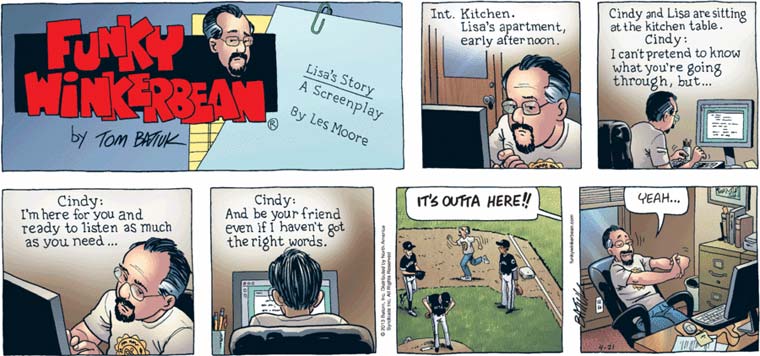
Int. Tom’s lobe.
CINDY: I speak Words that would get laughed out of a 2000 Hallmark Channel Movie.
Les: IT’S OUTTA HERE! Yeah, that was one GOOD masturbation! (throws hands in air, then wipes them off with the multiple Chik-F-Ila’s napkins he has handy; throws them next to monitor)
Tom: “YEAH! My supernormal fantasy knocked off the pitcher’s head with my manly essence! I LOVE YOU, ME”
Tom Batiuk writes for Tom Batiuk, and in his mind, all his readers are also Tom Batiuk. So naturally they don’t need to be filled in on important story matters because they already know them.
Good observation. It’s that “no theory of mind” thing again. He can’t distinguish between the story he thinks he wrote, and the story he’s actually told in his strips. In his mind, that envelope scene was super obvious. I’m sure the current Crankshaft arc will be someday be described as a hilarious action scene, when all the characters have done is stand around and talk about it.
My theory on these bizarre weeks where several days are spent on the same mundane action:
It’s an attempt to build suspense cinematically, à la Hitchcock. One of the tricks Hitch was known for was long, suspenseful shots of a mundane-seeming object that the audience knows is actually very dangerous or important. In a film, and in Hitchcock’s hands, this could build almost unbearable suspense. In a daily comic strip, it just doesn’t work.
Especially when you haven’t clearly established what the object is and what the stakes are for everyone involved. Especially when there is no conflict.
You can build suspense narratively in a comic strip, but not in a cinematic way with long, held nearly static “shots” that last all week. Because comic strips are not films, you see. And Tom Batiuk is no Alfred Hitchcock.
I set myself a mental exercise to see whether the delivery of the letter could have been done suspensefully. Here’s what I came up with:
Linda and Buck (or whoever) are sitting at the kitchen table discussing how important it is that Bull gets his disability. For several days, they talk about the possible horrible implications of being turned down, and Linda says she’s hopeful but extremely stressed waiting for news.
The last panel of each day has dialog balloons about the high stakes, but the art shows the letter getting closer each successive day. Mail truck comes down the block… mailman puts mail in mailbox… mailbox flag is up… Bull picks up mail and puts it somewhere where it can be in the foreground as we see Buck and Linda talking in the background.
Of course, the greater question is: Why did the letter opening need to be suspenseful in the first place? But I’m afraid that’s beyond my ability to answer.
The best way to tell Tom Batiuk’s stories is to gather them into a pile and silently brush them into the trash can.
Linda and Buck (or whoever) are sitting at the kitchen table discussing how important it is that Bull gets his disability.
Eureka!
That’s it!
That’s the biggest failure point of the Funkyverse, right there. You’ve discovered the thermal exhaust port of Tom Batiuk’s career.
The characters in Funky Winkerbean simply never talk to each other about what’s going on in the story. Tom Batiuk completely misses the point of exposition. He has a stated aversion to fourth-wall breaking. But he also seems to reject the idea that the audience should observe meaningful conversations between the characters. Or, this being a comic strip, the characters’ inner thoughts.
In Star Wars, how many times do the characters say “Death Star” or “Empire” to each other? How many times does Woody say the word “Andy” to Buzz Lightyear and the other toys? Pick any good movie and think about how often the characters have conversations whose purpose is to tell the audience the plot. Batiuk just doesn’t get this.
This explains his hypocrisy. He knows what angers him but hasn’t the blindest notion of what might annoy someone else.
Brilliant work, BJr6K. This is the manifesto we’ve been needing all along. “TB Tropes” — that’s pure genius. You laid it out, plain and simple, for all to see.
TV Tropes could really use a spinoff site or separate section, exclusively for tropes that are always shitty. The oeuvre of Thomas Batiuk could be a good place to start.
For example, a trope I didn’t find at TV Tropes: “It’s Called Writing.” Used when an author or creator justifies egregious logistical or continuity flaws by invoking writer’s privilege. “I am the creator, and this is my creation, so it is de facto impossible for any of it to be wrong.”
Another one: “Reversion to the Main (Character).” It’s the opposite of Flanderization. Instead of character traits becoming more and more exaggerated, they become smoothed out and more like the author’s favorite character (likely an author avatar). Eventually, every character’s opinions and beliefs and hobbyhorses will merge into absolute sameness, ensuring that no conflict or drama can take place.
Which brings me to this one, which is actually in TV Tropes:
Thanks, BJR6K. I needed this.
I had a recent period of reflection where I questioned whether or not we were being too harsh on TB. This “crisis of faith” came about after reading the old Crankshaft comic strips on CBH’s blog “Keeping up with The Johnsons” and realizing that I wasn’t as offended as some of the other readers. It made me wonder if we had become so cynical that we automatically disliked everything TB does.
*SMACK* Snap out of it!
After reading your blog, I’m convinced TB deserves everything we say about him. Batiuk’s writing is truly in a class of its own. Terrible, retched stuff.
The ongoing Grandma Johnson arc in Crankshaft is troubling. There’s no cohesive storyline from day to day. It’s like somewhat related
comicstrips printed in random order, but worse. It’s another decent premise ruined by TB’s craptacular writing. How is any Crankshaft “fan” not confounded by this mess?If anything, we’re fair to TB. We give him Kudos when he creates something “that isn’t bad.”
Mr. bwoeh is a fan of Family Guy too. Our favorite episode is the one where Brian wants Quagmire to like him. Brian wants to know, “How can you not like me?” Quagmire’s response is classic.
After watching Quagmire’s speech, Mr. bwoeh applauded the TV.
If only a Funky Winkerbean character went off on Les that way. I would have paid for the framed strip. Perhaps even wallpapering my office with that strip.
I still believe the Comics Kingdom Store missed an opportunity by not creating a stress doll based on Les Moore, with detachable limbs and a head made of durable material that can withstand being punted and punched.
That’s an all-time great The Reason You Suck Speech. It’s effective because every word Quagmire says is true. A lot of it references Brian’s behavior in past episodes. Seth MacFarlane has said he relates to Brian, so you have to give him credit for letting himself have it like that. And, for recognizing his pet character’s flaws.
It’s honest self-deprecation, which you never get from Tom Batiuk. Not only does he incapable of seeing his own flaws, he can’t even let anyone criticize the fictional versions of himself. Funky or Cayla would never tell Les he needs to let go of Lisa and grow the hell up. And that’s just the beginning of what that man needs to hear.
Wasn’t it this time a year ago that the …”THE” happened?
I’m no scholar. But here, for your annoyance, are 2 of my CS comments on the subject.
9/25: “But—he’s just staring at his nose!” “Lena, you’d grieve too, if that thing was rotting off your face!” Lena: “CRANK! You went out of your way to make my life miserable, literally for DECADES! Now it’s your turn! HOW DOES IT FEEL, ROTNOSE?!” (gets in closer, closer, then hisses through clenched teeth) “Do you know what happens to you on 12/31/2024, CRUDSHAFT? AH-HAHAHA!!”
9/26:
“WOOOooooOO! I’m the Ghost of This Time A Year Ago Exactly, when TIMEMOP came to wish away the FUNKY–winking it away FOREVER!” Crank: “Why should I care?!” Casper: “WOOooO! Because the syndicate has DOOoooOOMed this strip too! Err, I mean, TOOooOO!!” Crank: “Yeah, SURE.” Casper checks watch: “The SYNDICATE says that Christmas has come early this year! And 12/31 even earlier!” Crank: “Oh, wait. I ate all my grandson’s weird gummy bears, and…You’re just a bit of undigested beef!” Casper: “Dude, dude–it’s called ‘foreshadowing’. This strip couldn’t be more TOAST unless–YOUR GRANDSON SPREAD AVOCADO ON IT!”
Tom claims he knew a year in advance when FW would end. Did you believe him then? Would you believe it now, when he says it about CS ending “next” year?
Lord have mercy. Today’s Crankshaft features the ghost of Pop Clutch. And some clumsy, repetitious naming of what should be apparent.
P1: Crankshaft sees the ghost of Pop Clutch. “Pop Clutch, is that you?
P2: “I’m the ghost of Pop Clutch!”
P3: Crankshaft says, “Isn’t it a little early for the Scrooge ‘Christmas Carol’ homage?”
Wow. Crankshaft could have said in P1, “Pop Clutch? But you’ve been dead 20 years!” and we would have figured out that the hazy grey figure was a ghost. But whatever.
Two questions arise. First, is Pop Clutch one of those ghosts of a living person, like Phil Holt, or of a dead person, like Dead St Lisa?
Second, what? The Scrooge “Christmas Carol” homage? Is there one every year and I missed it?
And why would anyone call it “Scrooge ‘Christmas Carol'”? What a bizarre, typically Batiukian way to refer to Dickens’ novella. We all know the protagonist of the story, especially the old folks who read this comic. If you don’t know that, you’re certainly not gonna know the word “homage,” which really shouldn’t be in Crankshaft’s vocabulary.
We’re already off to a dreary start with … whatever the hell this is.
“Pop Clutch? But you’ve been dead 20 years!”
And he’s still younger than Ed Crankshaft.
Like Joe Hill, he never died.
I think I need to hear Phil Ochs’s “Joe Hill” song before I call it a day.
Fittingly, it’s on his *Tape from California* album, and on its successor, *Rehearsals for Retirement* (honest!), Ochs has a song called “The World Began in Eden and Ended in Los Angeles.” (O Mason! O Jarre! O Cindy! O Summers!)
Can’t imagine Crankshaft knowing Phil Ochs, but he’s old enough to have heard Woody Guthrie material when it was new.
Take it away, Phil:
Sure once I was young and impulsive
I wore every conceivable pin
Even went to the socialist meetings
Learned all the old union hymns
Ah, but I’ve grown older and wiser
And that’s why I’m turning you in
So love me, love me
Love me, I’m a liberal
Like Milton for Wordsworth’s England in 1802, we hath need for Ochs in 2023.
And we all know what’s going to happen next: Crankshaft and Pop Clutch are going to stand around saying “Mrs. Johnson caught my school bus” over and over again. It’s all the strip has done for three weeks.
Did Batiuk create a whole new character for this purpose? ‘Pop Clutch’ isn’t an existing character I know of. It certainly fits his tendency toward stupid punny names.
I hope one of our archivists will step in to answer that, but I know I’ve seen the name “Pop Clutch” before in the strip. I don’t think I’ve seen the character, though, just references to him.
It’s probably TB’s best punny name, too, which is more evidence that it was thought up years ago. Compare to more recent dross like “Amicus Breef.”
I still have a soft spot for “Bedside Manor.”
Mr Banana My Sir, what a brilliant essay, thank you. You touch on what I have come to see as Batiuk’s allusive and elusive narrative style, where he’s been bitten by the bug that says “let the reader fill in the blanks.” The greatest writers are able to evoke like this, but never as a constant, never as a narrative tic. As a defense against charges of laziness Tom might say he’s complimenting the reader, but when the history is all wonky and recursive like it is, we precious few are left with disappointed head-scratching.
he’s been bitten by the bug that says “let the reader fill in the blanks.”
He doesn’t “let” the reader fill in the blanks. He expects the reader to fill in the blanks, but you have to do it correctly. He’s a teacher giving you a pop quiz. “Dear Bull Bushka: The NFL regrets to inform you…” the correct answer was “you are denied disability.” Any other answer, or any other explanation for Bull’s suicide, is wrong.
“As a defense against charges of laziness Tom might say he’s complimenting the reader”
But then he’ll turn around and call them “beady-eyed nitpickers” and dismiss anything they say with “It’s called writing” if they don’t recognize his own genius, so, y’know.
The first rule is: Tom Batiuk is always right.
The second rule is: Tom Batiuk is never wrong.
As opposed to the Ramones’s “Commando”:
First rule is
The laws of Germany
Second rule is
Be nice to mommy
Third rule is
Don’t talk to commies
Fourth rule is
Eat kosher salamis
Grabs a pipe, a comfortable sweater with patches on the elbows, and nestles into a comfy chair.
Ah, yes, reminds me of a time, 1979. My freshman year of college. I had three roommates. One of whom was a big fan of the Ramones and punk rock in general. She had an incredible stereo system. ‘Commando’ by the Ramones was one of the songs I remember best. Especially the chorus. We always loved the way Joey Ramone emphasized “IS!”
First rule… IS! 😂
Even the dormmates who didn’t know the words shouted the “IS!” lyric. *sigh* Good times.
BWOEH:
Delighted to have given you a chance to summon up memories of things past.
Strangely though I am sitting here in Queens, no one from the magazines wants to take any pictures of me gulping down Thorazine(s).
My family must not be happy enough.
Batiuk has mentioned his fondness for Isaac Asimov’s work several times. Has he ever mentioned Ray Bradbury? I’m in the midst of *The October Country* and checking up on how many adaptations of his stories EC did (four of my favorites: “Touch and Go” {“The Fruit at the Bottom of the Bowl”} from Johnny Craig, “The Small Assassin” from George Evans, “The Lake” from Joe Orlando and “The October Game” from Jack Kamen) and feeling curious.
Some idiot will always turn on the lights or turn out the lights.
@Anonymous Sparrow
I don’t recall Batiuk ever mentioning Ray Bradbury. For what it’s worth a search of his blog produced no results for “Bradbury”.
Aside from Asimov, Batiuk has mentioned Robert Heinlein, Alfred Bester, and Daniel Keyes.
Thank you for clearing that up for me.
Asimov, Bester and Heinlein were all very prolific (the first especially!), yet we know Keyes basically for *Flowers for Algernon.*
Perhaps Batiuk mentioned him because, like Bester, he has some solid comic-book credentials, both for Atlas (Marvel to be) and for EC.
Call no doctor unless you’re dead, and then only Dr. Amy “Little Girl” Johnson…
OH and I forgot to ask … has anyone else had MS Paint disappear from their Windows computer or device? I had heard some time back that it would vanish, but I didn’t think it might have been on a Windows update (I’m on 10).
I still have “Paint” on my work laptop. Windows 10 Professional.
Is this it?
Perhaps my laptop hasn’t run the latest Microsoft “updates” yet.
My coworker says Microsoft has been trying to get rid of the MS Paint app for several years.
And as the current Crankshaft demands, we must now all ponder our mortality, and Tom’s vision of the afterlife.
And what is it?
Phil Holt, famous dead comics guy, is now dead.
*poof* “Gee whiz! I seem to be dead and in Heaven! Who’d’a thought smoking 10 cigars and drinking a quart of whiskey every day could kill a 100 year old!”
A shrieking horde of beautiful lady angel girls, all blonde and pretty vacant, stampeded up. “FINALLY, it’s a CARTOONIST!” they squealed.
One angel wafted from on high, her radiance shimmering like unicorn farts. This One Is Perfect, as she has been named by her acolytes, touched upon the cloud and said “HI! I’m Lisa!”
“I’m Phil Holt! Dead Phil Holt!”
The Goddess but chuckled. “Oh, ‘Phil Holt’? Were they sold out of ‘John Smith’ at the alibi store?”
The other angels, who were like super hot, all laughed. One yelled “Know what she calls you up here, Phil? FUCK FACE!” The rest dissolved in laughter, some actually rolling on the floor while doing this.
Saint Lisa spun to her acolytes, her face twisted in anger. “I…DID…NOT–”
“–Call him that, call him that!” the angels stammered nervously.
“This is great, Lisa, but can I get a tour and a complimentary Danish?”
“What would you like to see first? Usually, it’s the bathrooms.”
The angels enthusiastically chattered “The bathrooms, the bathrooms! Oh, they’re so good!” Lisa glared. They bowed and whispered “Cartoonist…Comic Book…” as they backed away in awe.
Phil shook his head. It made a rattling sound.
“Nah. I wanna go to Earth and perv on people.”
Lisa said “And so you shall!” *poof*
Dead Phil Holt, who lived forever because of his love of Flash comics and staring at live people, especially the ladies amirite, said “Whoa boy! Sure glad I can just be alone with my lube and–Christ! Who are you, Slouchy?”
“I’m the Ghost of Pop Clutch. I have been condemned for all Eternity for being a bus driver. Well, okay, and maybe a bit just because of the repeated vehicular manslaughter of children. The Afterlife, they’re so judgy here.”
“Yeah, buddy, maybe get yourself a Posture Pal–”
“Not ‘Buddy’! THE GHOST OF POP CLUTCH!”
“You’re gonna say that every time we meet, aren’t you?”
“I, the GHOST of POP CLUTCH, shall never say that! So speaks–THE GHOST OF–”
“GAH! I’m going to be alive again!” *poof*
(Atomik Komix Bullpen) “PHIL HOLT IS ALIVE!”
“Yeah, I faked my death because of the very believable reason of–”
(SCREEN GOES TO STATIC)
Mopey Pete: “Well, now it all makes perfect sense!”
I just received my copy of “the Superhero’s Journey” by Patrick McDonnell the Mutts guy. It is a mixture of Marvel art and his own style. He credits every artist. All dialogue from Marvel is by Stan Lee. It is a labor of love and appreciation for the inspiration provided by Lee, Ditko, Kirby, and others while Patrick was growing up. It has exposition, continuity, and action. It is a graphic novel so the pages make sense from start to finish. It has a beginning, middle, and end. It actually has a STORY! not just a cover.
Patrick was an actual member of the M. M. M. S. The Merry Marvel Marching Society. I also sent in my dollar and had my name published in a Tales to Astonish starring the incredible Hulk. He was my favorite character, so that was neat.