I want to take off my snarker hat for a moment, and talk seriously about the future of Crankshaft.
We thought the past week would be yet another week of Skip Rawlings’ endless, pointless, onanistic interview with Batton Thomas. It turned out to be something much worse.
After what we saw this week – Tom Batiuk using the title character of Crankshaft as a tool to bash readers who want to see more of Crankshaft in the strip, and additionally as a strawman for Tom Batiuk’s tired “comic strips have to be funny” canard – there is one inescapable conclusion:
It’s time for Ed Crankshaft to die.
And I don’t mean that maliciously. I mean it in the way that a long-suffering family pet, who can’t be cured or even helped, needs to die. It’s a gut-wrenching decision to have a pet put down, but sometimes it’s the merciful thing to do.
Because the way Ed Crankshaft was used this week is appalling. How much do you have to hate your own creation, and all of its followers, to use that creation to mock their desire for more of it? I haven’t seen a production insult its audience this much since 1968.
And this isn’t the first time Batiuk has acted like this. He killed off John Darling so the syndicate could no longer use the character (even though no one would ever want to). He’s bitter about the name Funky Winkerbean, because he thinks it held the strip back; the character Funky Winkerbean got pushed into the background. When Funky did appear, his arcs tended to center on his misfortunes: alcoholism, obesity, ego, incompetence, bad luck. And now Batiuk is bitter that readers want to see Crankshaft in Crankshaft, so he used the character to mock them. Notice a pattern?
The worst part of it is: these are his genuine fans. “Where’s Crankshaft?” isn’t something this blog thought up. It’s a common sentiment in online comment areas, from people who presumably enjoy the comic strip as Batiuk intended. They prefer Ed’s antics to the self-indulgent meandering slop Batiuk has been filling it with since Funky Winkerbean ended.
These are the people Batiuk should be trying to please. Or at least, listen to. “Where’s Crankshaft?” is essentially positive feedback. It affirms his decision all those years ago to give Crankshaft his own world. People seem to enjoy the cranky old bus driver and his antics.
Personally, I have no strong feelings about Ed Crankshaft. I don’t like or dislike him more than any other character. He’s a selfish, egotistical, malicious, unemployable jackass, but so are most male characters in the Funkyverse. But I do think Crankshaft deserves some dignity. He does not deserve to be used as a punching bag by an arrogant creator trying to make a point.
There are several reasons why the death of Ed Crankshaft would be beneficial to Crankshaft as a whole:
- It’s way, way overdue. Ed Crankshaft is at least 106 years old. I base that on the fact that he played for the 1940 Toledo Mud Hens, and the youngest member of that team was born in February 1919. It’s also consistent with other mileposts of his life. He fought in World War II. He was an advocate for black baseball players in the early days of integration, which would have been the late 1940s. He played professional baseball in Cuba, which ended halfway through the 1960 season. His daughter Pam was a student at Kent State in 1970, making her birth year about 1950, at which time Ed was in his early 30s.
I know there are some individual strips that contradict that chronology. Like when Crankshaft claimed to admire Vic Power and Rocky Colavito growing up. But I think those were all caused by Timemop. If Tom Batiuk can use a time-traveling janitor to fix all his continuity errors, I can use a time-traveling janitor to break them again. Nudge!
If Batiuk truly believes his comic strips are the only ones where characters age realistically, it’s time to let nature take its course.
- It would attract attention to the strip. Tom Batiuk loves media attention, and he loves killing off his own characters to get it. This would be another opportunity to do that. Alert the New York Times.
- It would require no new writing or artwork. We already know Ed’s future, because it’s been shown in the strip. During the “Funky Winkerbean is ten years in the future from Crankshaft” era (2007-2022), Ed was depicted in FW as a decrepit husk.
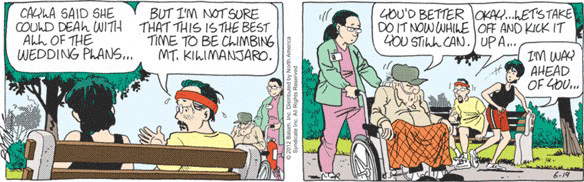

We also know where he’s going to die: at a baseball game. So no new story needs to be written. Existing art can be repurposed or recreated. Which is a common practice in Batiuk’s work nowadays.
- It would be a nice Continuity Nod. The Funkyverse loves revisiting its own stories, and this would do that.
- It would be a satisfying end. It would bid farewell to the character in a way that lets readers and other characters say their goodbyes to the cranky old bus driver. In other words, it would be the opposite of what happened in Star Trek: Generations.
- It would signal the strip’s change in direction. Have you ever seen (or been part of) a couple that really needs to break up, but they won’t pull the trigger on it? They just hang around together, hoping things will get better? Ed Crankshaft’s continued presence in Crankshaft feels like that.
Batiuk clearly wants to turn the strip into Funky Winkerbean Act IV, full of comic books and writing awards and Dinkle and Montoni’s and the Winnipeg Blue Bombers and interviews of himself and cheap award-baiting. And Ed Crankshaft is in the way of all that.
If I’m right that Batiuk is bitter about being pressured to include Ed in the proceedings, the best thing he could do for his readers and himself is retire the character permanently. It would end the “Where’s Crankshaft” questions, because readers would know he isn’t coming back. (Though death can be a dubious thing in the Funkyverse.)
- It would let Tom Batiuk do what he claims he wants to do. Batiuk constantly complains about having to be a gag-a-day writer. If Ed Crankshaft isn’t around anymore, there’s a lot less need for gag strips in Crankshaft. It removes a writing crutch Batiuk has leaned on for far too long. And it calls his bluff. You want to write serious drama, not gags? Fine. Get rid of the main character you have to write gags for.
Of course, he’d also need to get rid of Dinkle. But that would only take one panel:
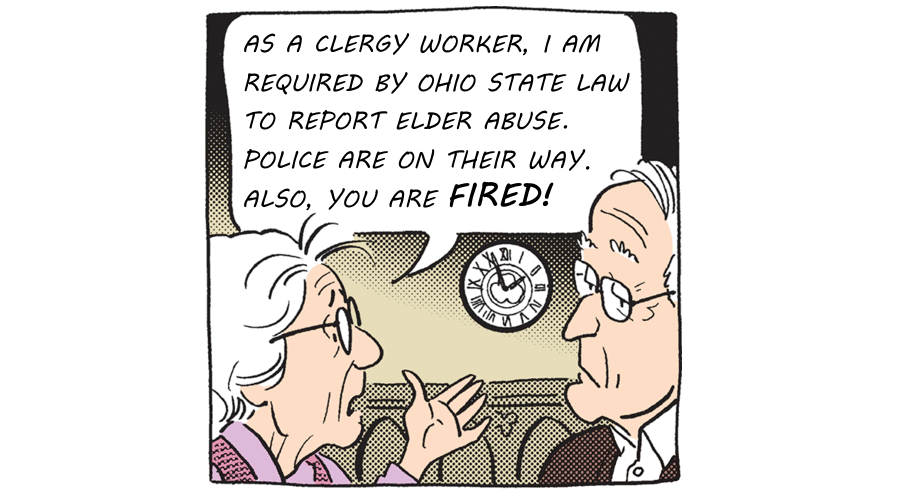
And if Tom Batiuk doesn’t want to kill off Crankshaft or Dinkle, I’ve got another character he can get rid of:


 Son of Stuck Funky
The other characters would all be manifestly better off without this old jerk messing up their lives too.
10/5: Not only does the strip suffer from his stupid habit of writing a year in advance like his inept big shot idol John Byrne, we have to contend with his pretentious dialog that makes Elly “I come across as an inept alien infiltrator” Patterson sound normal.
And the game is always the same. He doesn’t understand that if they don’t immediately love and uncritically support whatever he wants to do, they aren’t bullying him because they hate him. To do so would mean not be the unsettling little boy who looks like he’s going to die of grief if a funny book is late.
I actually feel sorry for TB because this problem is self-inflicted and he refuses to see it. He doesn’t want to acknowledge that there are fans of Crankshaft who don’t/didn’t want the Crankshaft strip turned into Funky Winkerbean 2.0. Everyone saw what he did to the Funky Winkerbean characters over its 50 year run and they don’t want it to happen to Crankshaft. That’s not too much to ask, but to TB every criticism is a sword in his back from an ungrateful fandom.
That is a great description, and much more succinct than what I write. I think it goes beyond being unable to take criticism; I think he’s offended that anyone dares have an opinion other than his own. He considers it a personal attack, and responds by insulting the critic. And strawmanning their argument into the only mode of thinking he can understand: “it’s an arbitrary rule people make me follow for some reason.”
I don’t think his mind ever actually gets to the criticism. Much less the notion that “where’s Crankshaft?” is a subtle expression of the real problem, which is that fans don’t like the new direction of the strip. I wish Batiuk would be the mob boss he runs the Funkyverse like, and take out a few henchmen (characters) who have outlived their usefulness. Harry Dinkle and Ed Crankshaft, I’m looking at you.
He used to cower behind a sock puppet and whine about how he was being bullied because other people didn’t agree with him. The hostility marches hand in hand with being a gloomy simpleton.
From my reading through it right now (I just got to “Drunky Drinkerbean collapsing on the sidewalk”), I just get the impression that Batty never got over the small bit of praise he got for Lisa’s pregnancy. It seems like he’d obviously grown bored of gags and high school by the early part of the 1980s which is why the focus of the strip shifts more and more to the teachers throughout that decade while the students, with the exceptions of Les and Cindy, fade into the background. And with Les, his sad sack nature begins to be treated with more seriousness and sympathy while Cindy seems to mostly exist to allow Batty to rail on what he sees as the shallow youth culture (especially teen girls) of the time.
So wanting to try and change things up and wanting to try and flex a creative muscle or take a risk? I can completely understand that. He tried something with Lisa, it got some positive attention, and so he thought “Hey, maybe I can do this.” The problem is that no, he really couldn’t. In fact, that story contains pretty much the same issues that plague him later on. The entire thing just comes out of nowhere. Les wants breaks up with her because she’s smothering and controlling but then he’s suddenly pining for her again for no real reason just to set up that she got impregnated by Big Walnut Tech’s BMOC. I don’t quite get why either Les or Frankie want her. Is a walking slug with glasses and a mop on her head that irresistible?
We never see what happens, we’re simply told after the fact… which is later retconned to date rape. Because at that point Lisa had become The Divine Lisa and was thus infallible and couldn’t have allowed herself to be taken in by a handsome football player (not like that idiot loser Susan Smith who she is way better than). And that’s basically a problem once Act II hits. Things happen to characters inbetween their appearances or inbetween time gaps and we’re either filled in after the fact or given no explanation at all. Because for Batty, the details what’s important is the shock value of the change and not so much the details that go into how it came about or the internal psychology of the characters that caused them to reach that point or how they feel in the moment. What’s important is that Lisa is pregnant and she’s going to have a kid any day now even though the timeline doesn’t make sense (to have it in December it would have meant Darin was conceived before she’d ever left Westview High which is explicitly not the case) and the actual details of how are unimportant. Details, in fact, are acceptable mutatable in the Funkyverse if the details as they exist get in the way of Batiuk’s genius stories.
Then Lisa has the kid, it’s immediately adopted by the Fairgoods, and off she flies never to show up again for the rest of Act I. Which seems to be another hallmark of TB’s stories. They happen, then that’s it. The fallout and how the characters react to what’s happened? Unimportant. Lisa gets blown up in a post office bombing and once the story is done and Tony turns off the Rush Limbaugh, she’s back to normal as if nothing ever happened. Because the shock of Lisa getting blown up was what was important, just like the shock of Lisa being pregnant was what was important, just like the shock of Wally and Becky’s driving off a cliff was what was important, just like the shock of Susan trying to kill herself was what was important, just like…
TB got praise for the pregnancy and seemed to take it that the shocking act was enough and so kept chasing that dragon without really understanding what it was that made stories like that work (in a general sense, because Lisa’s pregnancy was not a good story). But when people were understandably turned off by the crass manner it was always done in, the cheapness of it, the fact the stories and consequences and characters aren’t really explored, well it rankled him. Because people liked the Lisa pregnancy, damn it, so why not Lisa getting blown up? Why not Wally’s PTSD? He didn’t really seem to get that Lisa’s pregnancy got attention because the Reagan years were a more saccharine time and the funnies had long been relegated to mostly bland and inoffensive comedy so seeing teen pregnancy in a newspaper comic strip in the more conservative and “moral” environment of 1986 undoubtedly would have ruffled a few feathers. In the more cynical Gen X days of the ’90s or the even more cynical millennial driven 2000s and 2010s where people had come of age on envelope pushing shows, movies, music and internet humor? Not so much. What was shocking 10 or 20 or 30 years earlier was quaint and even laughable and TB never seemed to have understood, or still seems to understand, that.
Now being about halfway done with the ’98 class, I get the distinct impression that Ally and Chien were inspired by Daria and Jane (as Daria had started in 1997). Chien is especially blatant about this: the artsy pretentious vaguely goth bohemian snarker with bobbed black hair? It’s so obvious. I bring it up because Daria was a Beavis and Butthead spinoff but unlike Mike Judge, TB is seemingly unable to really ride with the zeitgeist of the times and update his work as appropriate while never losing the spirit of it. He’s forever stuck in the mid-1980s where the simple act of showing a teen pregnancy or commenting on a moral panic would have gotten people talking not realizing that the well ran dry a long, long time ago.
I think you’re spot on with all of that. And all the stories that come of nowhere and then end abruptly will continue, but much more so.
Beavis and Butt-head is surprisingly timeless. Music videos haven’t been a thing in ages, so he updated their new snarking segments to be about YouTube videos and reality TV. The show has come back two or three times now, and there are good shows from all four iterations. Unlike Futurama, which just needs to stay retired at this point. And somebody please pull the plug on Family Guy!
Batiuk is, I think, somewhat interesting because there’s an obvious need to want to be seen as more than just a guy writing goofy gags about high school. Even early on in Act I you’d get the occasional bit of Funky gazing at the sky and philosophizing or more pointed (presumably inspired by Doonesbury) political commentary. The frustrating thing is that when he’d allow the social commentary to exist as a joke, it could work. I think he did have a talent for that and it’s what he should have focused on developing.
But he seems to have always wanted to be taken more seriously as a writer and wanted to do work that he felt held more weight. When I read through Act I and early Act II, one of the things that stood out to me was when musicians would come up. Batiuk seemed dismissive of the likes Michael Jackson and I’d say even some of the general boomer rock icons like the Rolling Stones. But I get the impression he had an admiration for the Woodstock generation of folk musicians and their offspring who made Music That Mattered and you know who seemed to stand head and shoulders in his idolization of them? Springsteen.
I think that was Batiuk’s aim as he moved into his 30s: to be to comic strips what Bruce Springsteen was to music and Bruce Springsteen is a serious guy who makes serious music which meant Batiuk couldn’t be content making gags and jokes, he needed real stories that said something about society and the human condition just like the Boss’s music. It’s just that he both overestimated his abilities and didn’t want to put the time in to actually sit and think about his stories. Simply making them was enough, he thought, to get him attention and plaudits.
There’s one strip that stands out to me. It’s the 11/8/98 one where the students are watching Romeo and Juliet and Les at first is happy that they’re into it… until one student implores Romeo not to drink the poison and another says Juliet will wake up. Then Les glumly says he’s gone if his writing career takes off; he’s unhappy because the students are not enjoying the play “correctly”. They’re not appreciating it as high art but in the way they’d watch a movie or TV show and this, as far as Les (and Batty) is concerned is wrong and stupid. I think it’s a strip that sums Batiuk up perfectly: he’s a pseud who’s not as smart or sophisticated as he believes he is while also snobbishly looking down on others who are less refined. He’s the Bruce Springsteen of the Funnies, damn it, and these people need to appreciate that. You want laughs, go read about Charlie Brown trying to kick that football for the thousandth time. If you’re (god forbid) someone who actually enjoys Crankshaft and wants Crankshaft in a comic called Crankshaft doing Crankshaft things, well that’s too bad because Batiuk is producing something more worthwhile and you can either get on board or get out.
That’s a good analogy. I can see Batiuk being into Springsteen, or someone like Tom Petty or John Mellencamp: mainstream and commercial as hell, but regional in nature, and never forget where they came from. But Jim Davis and Bill Watterson were that guy for the comics and the midwest. Garry Trudeau and Berke Breathed had some of this quality as well. There are several better Springsteens in the comics world than Batiuk. He wouldn’t even make the E Street Band.
And also, he doesn’t have Springsteen’s humility.
Batiuk isn’t even Southside Johnny. Or John Cafferty.
He’d maybe be Michael Stanley, if Michael Stanley had suddenly decided after about 1992 to transition from “Ohio-area-hero heartland rock guy” to “atonal math-rock artiste whose compositions are all in 5/4 and 19/7” because that’s more serious and worthy of awards.
So Michael Stanley, if Michael Stanley thought he was the band Rush, despite not having any of Rush’s skill set? Sounds about right.
In hindsight, BatYam probably could have shoehorned Ed Crankshaft into FW more easily than shoehorning various FW characters into “Crankshaft”. He was already part of old FW lore, and he could have had him pop up every once in a while, instead of coming up with totally absurd contrivances to ram Pete, Batton, and Dinkle into CS. His regular CS readers (both of them) are probably totally baffled every time these FW refugees show up for dubious reasons. But, as always, who the hell knows what he’s thinking, or even if he’s thinking at all?
It was a defensible decision in 1987. Act I wasn’t even over yet, and Crankshaft was a breakout character. But by now, Crankshaft is narratively spent. There’s nothing else to do with the character. Especially if you’re going to pretend the character’s age matters, which Tom Batiuk very much does. I meant to mention this in my list of reasons.
So much of the man’s backstory is implausible but Batiuk wants buy in from us.
Especially in what is supposed to be a realistic world. Nobody would tolerate Crankshaft or Dinkle’s behavior. Any employer would fire them the second it came to light. Police would probably be involved. That’s another way Batiuk wants everything both ways: he demands to be taken seriously, while writing stories that only work in a non-serious world.
When it’s pointed out that he can’t have his cake and eat it, Mommy Issues whines about being bullied.
Today’s Crankshaft
Is there a lore reason for why Crankshaft is obsessed with leaves falling from the tree? Is he stupid?
“Leaf–I am Inigo Crankshafta. An acorn once killed my father. Prepare to die!”
(Inigo is kilt by the squirrels from “Mutts”)
This strip’s premise is earnestly one of those things that do make me think on the current state of affairs (even observed it today, though with thoughts of how the leaves were finally changing), but I’ll snark as effort that Crank going broken-record mode about it is eye-rolling and that it’s another Trademark-Funkyverse-Smirk ™ ending on everyone’s part is incredibly groan worthy.
10/6; It’s the stopped clock moments like this that make people come back.
So after last week’s performance, he’s just going to give them some Crankshaft? Why not, it makes as much sense as any other direction this strip takes.
If he isn’t doing gag a day stuff, he doesn’t know what he’s doing.
Yeah, and it’s time the world called his bluff on that. He thinks gag writing is beneath him, but it’s the only thing he actually knows how to do.
As is evidenced by his not understanding why extended arcs flop.
Today’s Crankshaft
Now we’ve shifted from Strawman Crankshaft at Montonis to the diner with Keesterman, Ralph Meckler and Crankshit himself
10/7: Mutually assured stupidity where mangled English meets not understanding it.
Today’s Crankshaft
I don’t get the punchline for today’s strip
It’s attempted wordplay on “mosquito” / “mesquite … oh!”. A veritable knee-slapper, no? Then the waitress, believing Crankshaft is incorrectly correcting her, tries to explain that the word mesquite has no O! <holds for laughs>
Might have helped if the lettering in the last panel didn’t make it look like the waitress is saying “…there’s no D.”
Might have helped even more if Batiuk had just crumpled up the paper and started all over with something else. But we all know that ain’t gonna happen.
It’s the waitress not realizing Ed understood her. People either being baffled by or correcting him was an old standby.
I envy you.