If This Is True, What Else Is True?

I often speak about improv, and this is a question they teach performers to ask themselves in a scene. Especially in long-form, where actors need to construct a long scene, rather than the short games we’ve all seen on Whose Line Is It Anyway.

I think the most potent example of this concept is Monty Python’s famous “Argument Clinic” scene.

Continue reading “If This Is True, What Else Is True?”

I’m Pac-Man

One of the other games on my arcade machine is Pac-Land. It’s a platforming game, starring the little yellow guy running and jumping and solving puzzles and doing other things that Mario is much better at. It’s a rare case where one screenshot will tell you everything that’s wrong with the game:

You see that red arrow that’s telling me to move to the right? Umm, excuse me, video game, I’m Pac-Man. Eating blue ghosts is what I do. Don’t tell me that arrow is pointing to something more important. Especially after these guys were just using their children as bombs:

Look how guilty the ghosts look. The red one is like “well, little Quinky is dead. But I guess that’s the price we have to pay. War is hell.”

As we discussed in the prior thread, Pac-Man doesn’t have much of a personality. So games like this need an Excuse Plot just to give him something to do. In this game, he’s got to rescue a fairy, or something like that. There’s 8 levels, and on Level 3 there are springboards Pac-Man has to use correctly to make a long jump over water. I can’t figure out how to do it, nor do I care enough to look it up on the Internet. Pac-Mania, an isometric version of the original game, is a much better application of the late 1980s’ improved processing power. It’s still worth a play occasionally. This, not so much.

But the second screenshot is where Pac-Land crosses the line from misguided into downright disconcerting. If you followed the Pac-Man expanded universe – and if you’re playing Pac-Land at an arcade in 1984, you absolutely did – then you know that Jr. Pac-Man is about the offspring of the the Pac-couple. And also of the ghosts. So we know they can reproduce, and that game’s main plot is a story of forbidden love. So why did this game repurposing these characters as munitions? Why couldn’t the ghosts just drop bombs on Pac-Man? They’re already in World War I vehicles, so just give them World War I weapons. It wouldn’t make any less sense.

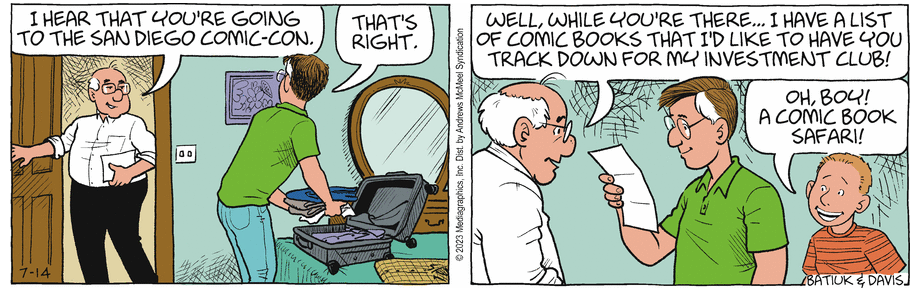
This is also a huge problem in the Funkyverse, and one we saw repeat in the Comic-Con arc. On July 14, we got this moment:

Which they never got around to. Ten days later, on a Monday, we get this:

And right on cue:

It turns out we didn’t all know where this was going! The whole week was about NFTs, a topic perfectly outdated enough to fit Tom Batiuk’s 11-month lead time. Why the hell did he spend two strips setting up an comic book investment story, only to ignore it? The storytelling priorities of this world are just baffling. It’s bad enough that Batiuk makes everything about comic books; why does he also set up comic book stories and then not tell them? What purpose did those strips serve?

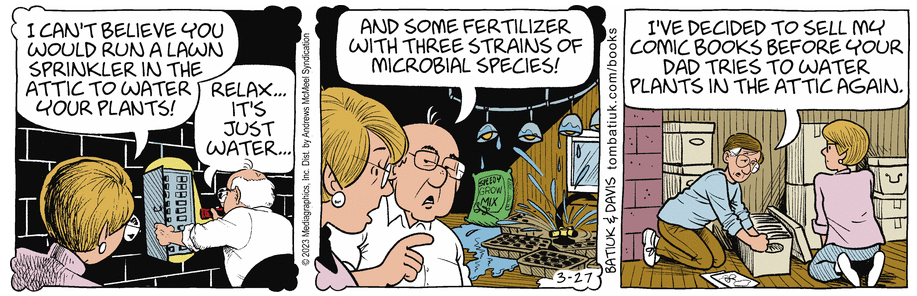
We established in the previous article that Jeff was compelled to sell his comic books by Crankshaft’s destructive behavior. Oddly, this still is the most pushback Ed’s ever gotten for his behavior, But, let’s look at what he did set up:

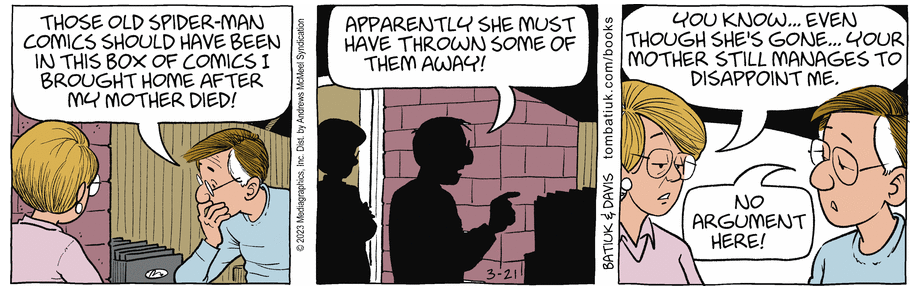
This story has nothing do with Jeff’s mommy issues, but look who gets blamed. Again. Batiuk is constantly re-telling this story, even though he had a whole other story cued up.

And he planned this four months in advance:

You know, Jeff, if you just now noticed your comic books are missing, maybe they weren’t that important to you. Maybe you’re not remembering correctly. Maybe it wasn’t the fault of your mother, who’s been dead for years now. Does your mom throw away your comic books from the afterlife? Is she related to Lisa? Sheesh, Jeff, get some help.

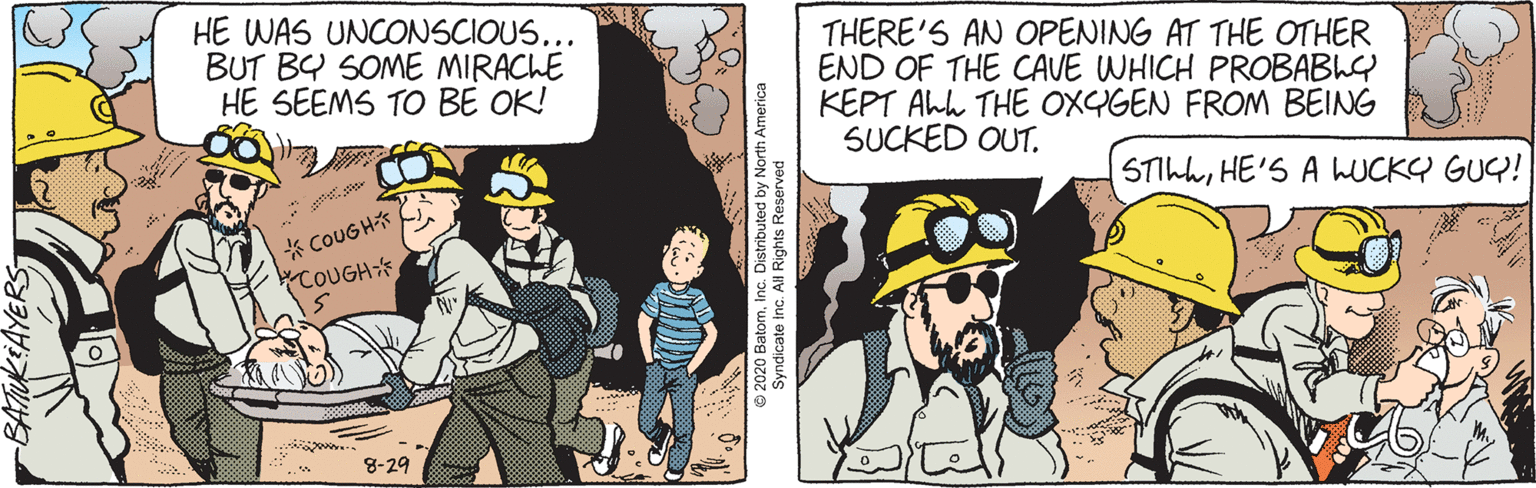
And now for something Jeff should be anxious about: the last time he went on one of these trips, he narrowly escaped burning to death.

But it’s never mentioned. These people dwell on incidents from high school and their childhood, but don’t remember the last time they went to California four years ago. On a trip where the whole Los Angeles metro area burned too.

Here are some other forgotten story points that were touched on this week:

Where is Pete and Mindy’s relationship? The engagement tiger incident was August 2019. We’ve had no update since then. They haven’t grown any closer, further apart, upgraded the ring, scheduled a date, or even told anyone other than the comatose Ed Crankshaft. But Funky Winkerbean had about 25 more weeks of comic book stories before it ended. And it spent three weeks marrying ninth-tier characters Cory and Rocky, because that loose end had to be tied, I guess. Again, just mind-boggling priorities.

Why is Mindy just now learning who Pete is? She expresses annoyance at Pete “damseling” her, because Tom Batiuk loves naming things that already have names. Even if this is before the engagement, their relationship must be pretty advanced, since they’re on a trip together and he invited her father. Comic Book Guy was being a lech, and Pete wasn’t out of line telling him to back off. If anything, it’s a big step up from his usual indifference.

Why are they cosplaying as siblings? As best as I understand it, they’re supposed to be Scarlet Witch and Quicksilver, who are fraternal twins. It’s a bit squicky. And it’s not the first time. Remember Les and Lisa’s Batman and Robin costumes? For their wedding? Ewww.

Why does Atomik Komix have no presence at Comic-Con? They’re supposed to be a big, important publisher in this world. But every year, they just go as fans. And nobody ever questions this. Les Moore and Lillian McKenzie can’t walk down a street without having to do a book signing for a throng of groupies. Why don’t these comic book makers, who are constantly presented as rock stars in this world, get that treatment?

Karma Chameleon

In the first installment of this series, I talked about the problems with the Inner Child character, but I didn’t mention the biggest one. It deserves its own deep dive, because it represents another major problem in Tom Batiuk’s writing: misguided characterization.

But first, I’d like to talk some more about my arcade machine. Harriet’s stories about her cows inspired me to ramble a little about one of my interests. And, because I want to make it clear I’m not anti-nostalgia. I’m not such a hater that I can’t enjoy watching someone else delve into their childhood passion. But as we’ll see in this series, Tom Batiuk pushes this privilege way too far.

Everybody in 2023 still knows Pac-Man, but I wonder how much people really know about it. Its pop culture weight was so massive, it’s hard to measure by modern standards. It just hovered over everything.

Like a lot of people in 1980, I had Pac-Man Fever, from Akron’s own Buckner & Garcia. It was the first pop record I ever owned. The album had seven other songs, which were all about arcade games too. “Do The Donkey Kong” is probably the best one. I also had my mom make me a Blinky costume for Halloween one year. It was a red cloth draped over some hoop-skirt thing to give it the right shape, and the big eyes were made out of white and black felt circles. I also had the board game, cereal, school notebooks, Saturday morning cartoon, and all that dumb stuff. I was 8, and this is exactly what you do when you’re 8.

But the game itself is kind of an urban legend, despite it still being widely available. Pac-Man suffers badly in comparison to the much better Ms. Pac-Man. This sequel introduced four different mazes, moving fruits instead of stationary ones, and better enemy logic. And the available versions of Pac-Man are often variations on the original, from the giant simultaneous-player arcade machine to the playable Google doodle.

About that enemy logic: the way to beat Pac-Man in 1980 was to memorize patterns for each level. Even when most people barely knew what a computer was, the public figured out that the enemies moved in predictable ways. There were all kinds of books you could buy with diagrams of how to go through each maze. Some of them even had stunts. Clearly people put a lot of effort into it.

I was never a pattern guy, so I gravitated to games where that wasn’t the way to win, like Centipede, Berzerk, Frogger, Missile Command, and Harry and Donna’s favorite Defender. I did the pattern-memorization thing during my earlier Rubik’s Cube phase (another thing people don’t realize how huge it was), and I wasn’t excited to memorize patterns again. When the Nintendo Entertainment System came around, I wasn’t that enthused, because a lot of its games seemed to depend on memorization too.

Is Pac-Man still fun to play? Absolutely. As you hopefully didn’t notice from my prior screenshot, my scores are not high. And it doesn’t hold my interest for repeated playings. But it’s always fun to take for a spin, and fun is what it’s all about. It pleases my inner child.

Unlike Jeff’s Inner Child, who shouldn’t be in this story at all. Because this story isn’t about Jeff’s childhood at all. Jeff’s most recent incident having to do with comic books involved Ed Crankshaft:

This raises an immediate question: why isn’t Crankshaft the villain of this story? He has committed the second-most important misdeed in the Funkyverse criminal code: Deprivation Of Comic Books. It’s ahead of Liking The Internet, but behind Offending Les Moore’s Precious Precious Feelings About His Dead Wife Because He’s Such A Sensitive Artist.

Ed Crankshaft is a combination of character types never seen anywhere else in fiction. On one hand, he’s a type we all know: the Unsympathetic Comedy Protagonist. Many famous TV characters are this type: Archie Bunker, Basil Fawlty, Al Bundy, Sheldon Cooper, Michael Scott, Barney Stinson, Peter Griffin, Eric Cartman, Rick Sanchez. And after Seinfeld, it became common for the entire cast to be this. It’s Always Sunny in Philadelphia is one of many examples.

But Ed Crankshaft is also a Karma Houdini. He’s frequently shown dangling from roofs, having to be rescued from fires, and doing massive damage to other people’s property. All for no reason other than his own malicious, reckless idiocy. And no matter what he does, nothing bad ever happens to him. The story carefully cuts around any moment where someone might suggest he did anything wrong.

These two character types don’t go together. We want to see the Unsympathetic Comedy Protagonist get what he deserves, at least sometimes. Even if we like the character, it’s still satisfying to see obnoxious behavior get punished. And in the Funkyverse, it never is.

We never see any repercussions for Crankshaft. Or Dinkle, when he’s slave-driving a bunch of elderly church volunteers to feed his own ego, or treating his wife like a blow-up doll. Or Funky, when he pointlessly abuses some seminar presenter or hijacks a doctor’s office and a room full of recovering alcoholics to workshop his lame comedy material. Or Mort, when he sexually harasses Lillian. Or Phil Holt, when he fakes his own death. Or Melinda, when she bullies her daughter into a serious injury. And that’s just from the final two years!

I didn’t even mention the worst offenders: Les Moore and Pete Whateverhisname is. These characters also have a third problem: Tom Batiuk doesn’t realize they’re unsympathetic. That’s a whole other deep dive.

The Unsympathetic Protagonist also being the Karma Houdini is a regular feature of the Funkyverse. And it’s why these characters and this world are so unlikeable.

In our next installment, we examine how Tom Batiuk retcons his own story to make it about what he wants it to be about, instead of what he wrote the first time.

I’d Like To Find Your Inner Child And Kick Its Inner Ass

The last two weeks of Crankshaft have been about their annual trip to Comic-Con. It has been an exploding clown car of all Tom Batiuk’s worst qualities as a writer. I think it’s worth analyzing as a window into how far gone Funky Winkerbean was by its end. All of the mistakes in this story grew from Funky Winkerbean, or were just as commonly made there.

The story is about Pete and Mindy taking her father Jeff to Comic-Con. Because it’s July, and Tom Batiuk must do a Comic-Con arc. It’s the second-most important event on the Funkyverse liturgical calendar. It’s ahead of Ohio Music Educator’s Association Week in February, but behind the ongoing Millennium Of Lisa.

This will be a multi-part series. But today, I want to focus on that obnoxious inner child character.

Inner Child’s most famous appearance in Funky Winkerbean was during the during the Lisa’s Story/wildfire/Bronson Canyon/Phantom Empire/climate damage/setting up Les’ Oscar arc:

Bronson Canyon was of importance to something from Tom Batiuk Jeff’s childhood, so it makes sense for Inner Child to appear as adult Jeff is discovering it. As adults, we sometimes get opportunities that appeal to our younger selves, and remind us of that time in our lives. For example, I just bought this thing:

I was born in summer 1972, which is the perfect window for arcade games to be my childhood passion. I was hit by puberty and The Video Game Crash Of 1983 in the same week. When I saw I could buy this magnificent device at the furniture store, my inner child came out too. So this comic strip captures a real feeling, and one I can relate to.

Inner Child’s first appearance in the current story, on July 12, is similar to this. The problem is that Inner Child keeps showing up, in ways that make no sense: doing favors for their father, losing their luggage, enforcing terminology, and carrying stuff. Twice. How do you even lift, bro?

And what aspect of getting on a plane, going to a comic book convention, and using an app to locate your luggage brings out your inner child? None of those things were widely available during Jeff’s childhood, so they can’t be stoking his memories. There’s no reason for Inner Child to be in these moments. And he’s absent from moments where he should be, where adult Jeff laments his past. (Which has the side effect of confirming that no “Inner Child must be in every strip” rule is in play.)

Another big problem is that there’s no indication of this character’s nature. This wasn’t a problem in Bronson Canyon, because there were no other people around. But now he looks like a real child, standing around an airport, talking to a grown man about his underwear. Chris Hansen needs to get involved.

Why doesn’t Batiuk make Inner Child transparent, to portray that he is a non-corporeal being? Oh, wait, he did do that:

…in 2016. I guess this was enough to make the point.

Transparency to represent dead, imaginary, or otherwise non-corporeal beings is a common visual trope in comics. In the Funkyverse, it somehow makes things even more confusing. More recently, Batiuk has also used the transparency trope on people who weren’t dead. Tony Montoni appeared in the strip just before its end, but was transparent the winter before, as if he had died off-panel. There was also this:

Neither of these transparent characters is actually dead. Phil Holt was revealed to be faking his death, and Dead Lisa has shown up in the strip so many times she should be called Undead Lisa.

But there’s another problem: the Funkyverse is full of blond boys of indeterminate age, mainly Skyler and Mitch. They’re both about 5, with gusts up to 12. On other comic strip forums, people (inlcuding our own J.J. O’Malley) had to explain who this character was. Because Lord knows the story didn’t.

So Inner Child’s appearances had visual cues, no written exposition, and didn’t make any sense in the story. Other than that, he’s fine, I guess.

Lisa, You’re No Jack Kennedy

Happy Memorial Day! Banana Jr. 6000 here again. I really don’t want to make Komix Korner posts a regular feature here, but Tom Batiuk has just dumped two more ridiculous declarations about Lisa that warrant a response.

I took Lisa’s story in to (editor Jay Kennedy) and King (Feature Syndicate), and the same measures that we had used to support my work in the past were undertaken without a hiccup. Okay, there was a hiccup.

Ugh. Batiuk loves his pointless stream-of-consciousness. This babble defeats the story. It reveals the previous 25 words to be a waste of the reader’s time. Just write “I submitted Lisa’s story to King, but there was a problem.” Sheesh.

Continue reading “Lisa, You’re No Jack Kennedy”