Karma Chameleon

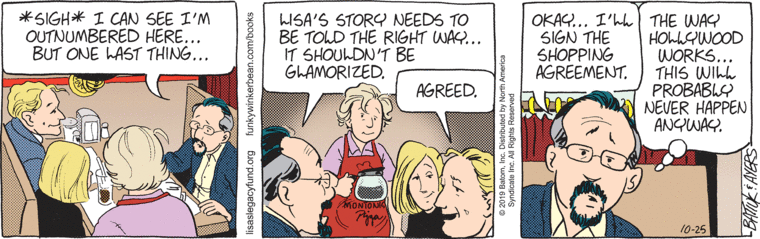
In the first installment of this series, I talked about the problems with the Inner Child character, but I didn’t mention the biggest one. It deserves its own deep dive, because it represents another major problem in Tom Batiuk’s writing: misguided characterization.

But first, I’d like to talk some more about my arcade machine. Harriet’s stories about her cows inspired me to ramble a little about one of my interests. And, because I want to make it clear I’m not anti-nostalgia. I’m not such a hater that I can’t enjoy watching someone else delve into their childhood passion. But as we’ll see in this series, Tom Batiuk pushes this privilege way too far.

Everybody in 2023 still knows Pac-Man, but I wonder how much people really know about it. Its pop culture weight was so massive, it’s hard to measure by modern standards. It just hovered over everything.

Like a lot of people in 1980, I had Pac-Man Fever, from Akron’s own Buckner & Garcia. It was the first pop record I ever owned. The album had seven other songs, which were all about arcade games too. “Do The Donkey Kong” is probably the best one. I also had my mom make me a Blinky costume for Halloween one year. It was a red cloth draped over some hoop-skirt thing to give it the right shape, and the big eyes were made out of white and black felt circles. I also had the board game, cereal, school notebooks, Saturday morning cartoon, and all that dumb stuff. I was 8, and this is exactly what you do when you’re 8.

But the game itself is kind of an urban legend, despite it still being widely available. Pac-Man suffers badly in comparison to the much better Ms. Pac-Man. This sequel introduced four different mazes, moving fruits instead of stationary ones, and better enemy logic. And the available versions of Pac-Man are often variations on the original, from the giant simultaneous-player arcade machine to the playable Google doodle.

About that enemy logic: the way to beat Pac-Man in 1980 was to memorize patterns for each level. Even when most people barely knew what a computer was, the public figured out that the enemies moved in predictable ways. There were all kinds of books you could buy with diagrams of how to go through each maze. Some of them even had stunts. Clearly people put a lot of effort into it.

I was never a pattern guy, so I gravitated to games where that wasn’t the way to win, like Centipede, Berzerk, Frogger, Missile Command, and Harry and Donna’s favorite Defender. I did the pattern-memorization thing during my earlier Rubik’s Cube phase (another thing people don’t realize how huge it was), and I wasn’t excited to memorize patterns again. When the Nintendo Entertainment System came around, I wasn’t that enthused, because a lot of its games seemed to depend on memorization too.

Is Pac-Man still fun to play? Absolutely. As you hopefully didn’t notice from my prior screenshot, my scores are not high. And it doesn’t hold my interest for repeated playings. But it’s always fun to take for a spin, and fun is what it’s all about. It pleases my inner child.

Unlike Jeff’s Inner Child, who shouldn’t be in this story at all. Because this story isn’t about Jeff’s childhood at all. Jeff’s most recent incident having to do with comic books involved Ed Crankshaft:
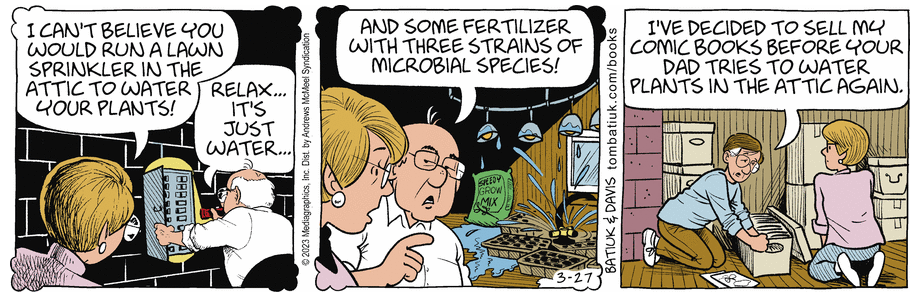
This raises an immediate question: why isn’t Crankshaft the villain of this story? He has committed the second-most important misdeed in the Funkyverse criminal code: Deprivation Of Comic Books. It’s ahead of Liking The Internet, but behind Offending Les Moore’s Precious Precious Feelings About His Dead Wife Because He’s Such A Sensitive Artist.

Ed Crankshaft is a combination of character types never seen anywhere else in fiction. On one hand, he’s a type we all know: the Unsympathetic Comedy Protagonist. Many famous TV characters are this type: Archie Bunker, Basil Fawlty, Al Bundy, Sheldon Cooper, Michael Scott, Barney Stinson, Peter Griffin, Eric Cartman, Rick Sanchez. And after Seinfeld, it became common for the entire cast to be this. It’s Always Sunny in Philadelphia is one of many examples.

But Ed Crankshaft is also a Karma Houdini. He’s frequently shown dangling from roofs, having to be rescued from fires, and doing massive damage to other people’s property. All for no reason other than his own malicious, reckless idiocy. And no matter what he does, nothing bad ever happens to him. The story carefully cuts around any moment where someone might suggest he did anything wrong.

These two character types don’t go together. We want to see the Unsympathetic Comedy Protagonist get what he deserves, at least sometimes. Even if we like the character, it’s still satisfying to see obnoxious behavior get punished. And in the Funkyverse, it never is.

We never see any repercussions for Crankshaft. Or Dinkle, when he’s slave-driving a bunch of elderly church volunteers to feed his own ego, or treating his wife like a blow-up doll. Or Funky, when he pointlessly abuses some seminar presenter or hijacks a doctor’s office and a room full of recovering alcoholics to workshop his lame comedy material. Or Mort, when he sexually harasses Lillian. Or Phil Holt, when he fakes his own death. Or Melinda, when she bullies her daughter into a serious injury. And that’s just from the final two years!

I didn’t even mention the worst offenders: Les Moore and Pete Whateverhisname is. These characters also have a third problem: Tom Batiuk doesn’t realize they’re unsympathetic. That’s a whole other deep dive.

The Unsympathetic Protagonist also being the Karma Houdini is a regular feature of the Funkyverse. And it’s why these characters and this world are so unlikeable.

In our next installment, we examine how Tom Batiuk retcons his own story to make it about what he wants it to be about, instead of what he wrote the first time.

I’d Like To Find Your Inner Child And Kick Its Inner Ass

The last two weeks of Crankshaft have been about their annual trip to Comic-Con. It has been an exploding clown car of all Tom Batiuk’s worst qualities as a writer. I think it’s worth analyzing as a window into how far gone Funky Winkerbean was by its end. All of the mistakes in this story grew from Funky Winkerbean, or were just as commonly made there.

The story is about Pete and Mindy taking her father Jeff to Comic-Con. Because it’s July, and Tom Batiuk must do a Comic-Con arc. It’s the second-most important event on the Funkyverse liturgical calendar. It’s ahead of Ohio Music Educator’s Association Week in February, but behind the ongoing Millennium Of Lisa.

This will be a multi-part series. But today, I want to focus on that obnoxious inner child character.

Inner Child’s most famous appearance in Funky Winkerbean was during the during the Lisa’s Story/wildfire/Bronson Canyon/Phantom Empire/climate damage/setting up Les’ Oscar arc:

Bronson Canyon was of importance to something from Tom Batiuk Jeff’s childhood, so it makes sense for Inner Child to appear as adult Jeff is discovering it. As adults, we sometimes get opportunities that appeal to our younger selves, and remind us of that time in our lives. For example, I just bought this thing:

I was born in summer 1972, which is the perfect window for arcade games to be my childhood passion. I was hit by puberty and The Video Game Crash Of 1983 in the same week. When I saw I could buy this magnificent device at the furniture store, my inner child came out too. So this comic strip captures a real feeling, and one I can relate to.

Inner Child’s first appearance in the current story, on July 12, is similar to this. The problem is that Inner Child keeps showing up, in ways that make no sense: doing favors for their father, losing their luggage, enforcing terminology, and carrying stuff. Twice. How do you even lift, bro?

And what aspect of getting on a plane, going to a comic book convention, and using an app to locate your luggage brings out your inner child? None of those things were widely available during Jeff’s childhood, so they can’t be stoking his memories. There’s no reason for Inner Child to be in these moments. And he’s absent from moments where he should be, where adult Jeff laments his past. (Which has the side effect of confirming that no “Inner Child must be in every strip” rule is in play.)

Another big problem is that there’s no indication of this character’s nature. This wasn’t a problem in Bronson Canyon, because there were no other people around. But now he looks like a real child, standing around an airport, talking to a grown man about his underwear. Chris Hansen needs to get involved.

Why doesn’t Batiuk make Inner Child transparent, to portray that he is a non-corporeal being? Oh, wait, he did do that:

…in 2016. I guess this was enough to make the point.

Transparency to represent dead, imaginary, or otherwise non-corporeal beings is a common visual trope in comics. In the Funkyverse, it somehow makes things even more confusing. More recently, Batiuk has also used the transparency trope on people who weren’t dead. Tony Montoni appeared in the strip just before its end, but was transparent the winter before, as if he had died off-panel. There was also this:

Neither of these transparent characters is actually dead. Phil Holt was revealed to be faking his death, and Dead Lisa has shown up in the strip so many times she should be called Undead Lisa.

But there’s another problem: the Funkyverse is full of blond boys of indeterminate age, mainly Skyler and Mitch. They’re both about 5, with gusts up to 12. On other comic strip forums, people (inlcuding our own J.J. O’Malley) had to explain who this character was. Because Lord knows the story didn’t.

So Inner Child’s appearances had visual cues, no written exposition, and didn’t make any sense in the story. Other than that, he’s fine, I guess.

Lisa, You’re No Jack Kennedy

Happy Memorial Day! Banana Jr. 6000 here again. I really don’t want to make Komix Korner posts a regular feature here, but Tom Batiuk has just dumped two more ridiculous declarations about Lisa that warrant a response.

I took Lisa’s story in to (editor Jay Kennedy) and King (Feature Syndicate), and the same measures that we had used to support my work in the past were undertaken without a hiccup. Okay, there was a hiccup.

Ugh. Batiuk loves his pointless stream-of-consciousness. This babble defeats the story. It reveals the previous 25 words to be a waste of the reader’s time. Just write “I submitted Lisa’s story to King, but there was a problem.” Sheesh.

Continue reading “Lisa, You’re No Jack Kennedy”

Masky McDeath: Origins

Hi folks! Your potassium-rich guide to the Funkyverse is back again for another post.

Unlike my colleague Comic Book Harriet. I’m not the “deep dive” type. There are a few Funkyverse stories I want to dig into, as we continue to write new posts for you all to enjoy and discuss. But for the most part, I will have standalone posts to make. This is another one.

I’m a regular reader of “Komix Thoughts”, Tom Batiuk’s very fittingly-named blog. Even though they’re mostly just excerpts from already-published Funky compilations that nobody but the most devoted non-ironic fan has ever seen. This week, it dropped a doozy:

The last remaining hurdle for me was how I was going to depict Lisa’s death. The answer came at a concert. I had been working pretty intensively, so my wife Cathy and I took a break to go hear Apollo’s Fire, a baroque ensemble, at Oberlin College. Near the end of the performance, three dancers came on dressed as harlequins and wearing white-full-faced masks, and I suddenly saw my ending. Using a bit of magical realism, Death would come for Lisa in an otherwise empty white space, wearing a white mask and a tuxedo. Using that conceit, I could now address and depict death directly. I was almost finished.

“Match To Flame 198”

Yes, he means Masky McDeath. And yes, he is dead serious.

At the climax of Lisa’s tedious, decade-long death, Batiuk decided “some dude with a deeply cheesy tails/Phantom of the Opera get-up” would lend the proper gravitas to the proceedings. To put it mildly, this character’s appearance undermined whatever emotional weight Lisa’s death was supposed to have. It was a textbook example of Narm: something that’s supposed to be dramatic, but is so poorly executed it’s unintentionally funny.

The character was a laughingstock, even to people who were inclined to like the strip, and became a symbol of the strip’s ineptitude – to anyone who still cared in 2007. And yet, here is Tom Batiuk in May 2023, making a serious blog post about the thought process that led up to it.

It reminds me of Jar Jar Binks.

I bought a DVD of The Phantom Menace as soon it was released. It contained the usual “making of” features. They’re interesting in that they were made before the world had a chance to be repulsed by Jar Jar. George Lucas really believed in this character, and wanted it to work. He was going to make a cartoon character come to life, and feel like a real character who belonged in a scene with human actors like Liam Neeson. He talked about what CGI technology could do now, how Ahmed Best could act with his entire body, that the character was going to achieve a level of comedy not seen before in a Star Wars movie; and things like that.

It. Just. Didn’t. Work.

We don’t need to rehash why. But it’s instructive to keep in mind that the great George Lucas genuinely thought it would, and put a lot of effort into it. It’s honestly a little sad to watch now. Say what you will about Lucas and the Star Wars universe now, but at least nobody’s making these claims any more. Jar Jar was a misstep that was swept under the rug, and not talked about any longer than it had to be.

That’s what Tom Batiuk can never do: admit that anything he ever did was wrong. It goes against the whole headcanon he’s built for How To Enjoy Funky Winkerbean Correctly. My last post was about Batiuk’s need to control the narrative at all times: this is a fantastic example of that. He doesn’t even defend the character; he just pretends no one ever attacked it. Kind of the opposite of what he does with Les, who’s always “protecting Lisa” from things that don’t exist, but is too spineless to act in her interest when it actually would have helped.

And, as is common is his blog posts, Batiuk’s middlebrow elitism is on display. “When I was overworked from deciding how to end my comic strip after eight years, my wife and I went to see the baroque ensemble, at Oberlin College.” I live in a city with an opera company and I have a range of cultural interests; I just don’t feel the need to bring them into unrelated conversations. Tom Batiuk is this woman, except he’s never been anywhere other than New York, Los Angeles, and Cleveland:

The other thing I love about this story is how impressed Batiuk is with himself for thinking he invented the most basic storytelling techniques. “Magical realism”? The personification of death isn’t a new idea. His other “Match to Flame” posts are all like this. “I know! I’ll have a time-traveling janitor deus ex machina our entire 50-year run into a galactic plot to make sure Les gets laid! That’s an elegant solution!”

But that’s a post for another day.

Tom Batiuk Comments On Funky Winkerbean’s Appearance On The Simpsons

Hello! This is your friend Banana Jr. 6000 stopping in to make a guest post. Inspired by Comic Book Harriet’s efforts to have a new post up regularly, I’ll make a post whenever I think there’s something worth talking about.

Regular poster Be Ware Of Eve Hill shared this interview with Tom Batiuk himself, early this year just after the strip ended. I was going to transcribe the whole thing, but it was so boring I gave up on in it. The most interesting thing is the interviewer and subject looking like twins:

The interviewer is Terence Dollard of the University of North Carolina at Pembroke. He hosts Comic Culture, a regular interview show that sits down with cartoonists. Another recent show was with Henry Barajas, the new writer of Gil Thorp. So there’s a lot of good stuff for regular fans of newspaper comics. Which we all are, to be sure. Here’s a typical exchange with Batiuk (starting at 19:14):

DOLLARD: You’ve done a lot of interesting stories that wouldn’t normally be in what we could consider the funny pages. So when you’re handling something like CTE or DWI, how do you balance between what the reader might want to see first thing in the morning with their coffee, and you as an artist wanting to tell a compelling story?

Could it be any more obvious that Tom Batiuk wrote this question for himself to answer? In a 21-second sound bite, look how many of Batiuk’s conceits this indulges:

  • Calling his own stories “interesting,” and then “compelling,” in case you didn’t catch it the first time
  • “Funny pages are not for serious stories,” and then saying this a different way, in case you didn’t catch it the first time
  • Referencing major Funky Winkerbean arcs
  • Calling him an “artist”

The Stan Lee foreword recently shared by poster Andrew does the same thing. It batters the reader with bland, unnecessary praise. “Deliciously different”, “brilliant strip”, “perfect artwork”, “deceptively simple”, “cleverly conceived”, “titanically talented”, “awesome authenticity”, “extraordinary economy of line” – all in the first three paragraphs. There are nine total, and the rest are the same. Did Stan Lee really talk like this? Some people are effusive by nature, but Lee didn’t strike me that way. Dick Vitale would tell him to dial it back.

Anyway, let’s get to Tom’s answer:

BATIUK: Well, I just – basically went ahead and did it. I think my biggest – my readers – learn to trust what I do. And that I’ll handle situations like that in a good way and a thoughtful way. And so they come along for the ride. And in each step I would take my readers, I’d move them over a few inches, and say “let’s go over here and do this” and they’d all come over. And then a little while later, “now that we’re here, let’s go over here” and then I’d take them a little further. I think the Funky readers have come to expect that, so it’s less jarring in the morning for them, I think, they know where I’m going. I think they kind of almost expect that.

A typical Batiuk answer, because it uses a lot of words to say absolutely nothing. It’s an answer you’d get from an elected official, carefully crafted to sound important while not revealing any actual information. He’s actually kind of good at deflecting, except for how much he stammers his way through it. Dollard’s got nothing to work with here. What follow-up question would you ask?

But that’s not the exchange I came here to talk about. Dollard asks him about a joke The Simpsons made at Funky Winkerbean’s expense. Here’s a clip of the incident:

The episode name is “Homer Vs. Dignity.” Homer has squandered his family’s income, leaving them in dire financial straits once again. He seeks a raise from Mr. Burns, who pays him to throw pudding at Lenny instead. This amuses Mr. Burns, who hires Homer to do more and more humiliating tasks. One of which was the infamous “raped by a panda” incident, that made this one of the show’s most despised episodes. Lisa (who else?) convinces her father that earning money isn’t worth throwing away your dignity. He gives his earnings to charity, who appoint him to be Santa Claus in a parade, restoring the Simpsons’ dignity for the moment.

Funky Winkerbean isn’t relevant to the main story. It’s part of a side joke about how lame the licensed characters in parades tend to be. Here’s the transcript:

BART: “Rusty The Clown”? Springfield gets the lamest balloons.

MARGE: Are you kidding? There’s Funky Winkerbean! Over here, Funky! Oh look, it’s a Noid! Avoid the Noid! He ruins pizzas!

Local news anchor Kent Brockman and guest star Leeza Gibbons talk about another lame entry, an animatronic gingerbread desk set. The plot then switches back to the main story.

So what did Batiuk have to say about this? Let’s see the question first (starts at 24:27).

DOLLARD: How does it feel knowing that Funky Winkerbean is Marge Simpson’s favorite newspaper strip?

This is why I’m convinced Tom Batiuk writes all his own interview questions. Because what Dollard says does not happen in this scene. Marge never said that, or anything that implied it. She’s just aware Funky Winkerbean exists, at a moment she’s fishing about for something to placate Bart. Funky Winkerbean came between a blatant ripoff of an in-universe celebrity, and an out-of-date Domino’s Pizza campaign that tried to annoy America into accepting it as a legitimate animated character. It’s pretty obvious what the joke is. And if it’s not, Bart tells you!

BART: Springfield gets the lamest balloons.

Dollard asked a leading question and a loaded question at the same time. It’s based on a false assumption, and it’s designed to prompt the answer Batiuk wants to give. Which is:

BATIUK: (laughs) I think it’s pretty cool. I think that was just an absolutely fun thing to see pop up in The Simpsons. And getting a shout-out from something you enjoy, it’s always fun. So yeah, that was fun.

A “shout out?” It was making fun of you! It did everything but look at the camera and say “Funky Winkerbean sucks!” That’s more of a South Park approach, but I digress. A shout out implies some level of affection. This mention clearly has none. It just used the strip as a prop for the joke it wanted to make, which was about lame cartoon characters. And again, the question was based on the false premise that Marge is a fan of the comic strip.

By the way, earlier in the episode, this happened:

We’re supposed to believe Mr. Silver Age Comic Books Changed My Life kept watching after this? The panda rape seems minor in comparison.

If you read any interview with Batiuk, they’re all like this. His interviews are more stage-managed than a North Korean military parade. Every question prompts one of his preferred talking points: people don’t want serious stories in the comics; I did things in the comics that had never been done before; and how culturally important Lisa’s Story is. None of which is even true. But every interviewer, from different media sources and different parts of the country, asks them every time. Nobody ever asks anything contrary to what Batiuk wants to portray, or even the most basic open-ended questions about unexpected fan reactions. I wonder how Dollard felt about having to ask a question that requires him to have completely missed the point of a 20-year-old TV episode. Yes, that’s how long ago this joke was made.

I know we’re all a bunch of haters, but there’s a lot of room for interested parties to ask Tom Batiuk uncomfortable questions about his creations, without being disrespectful. Here’s a good example. Or even this. But no deviating from Batiuk’s party line is allowed. And it’s amazingly how willing supposedly professional journalists are to go along with it.