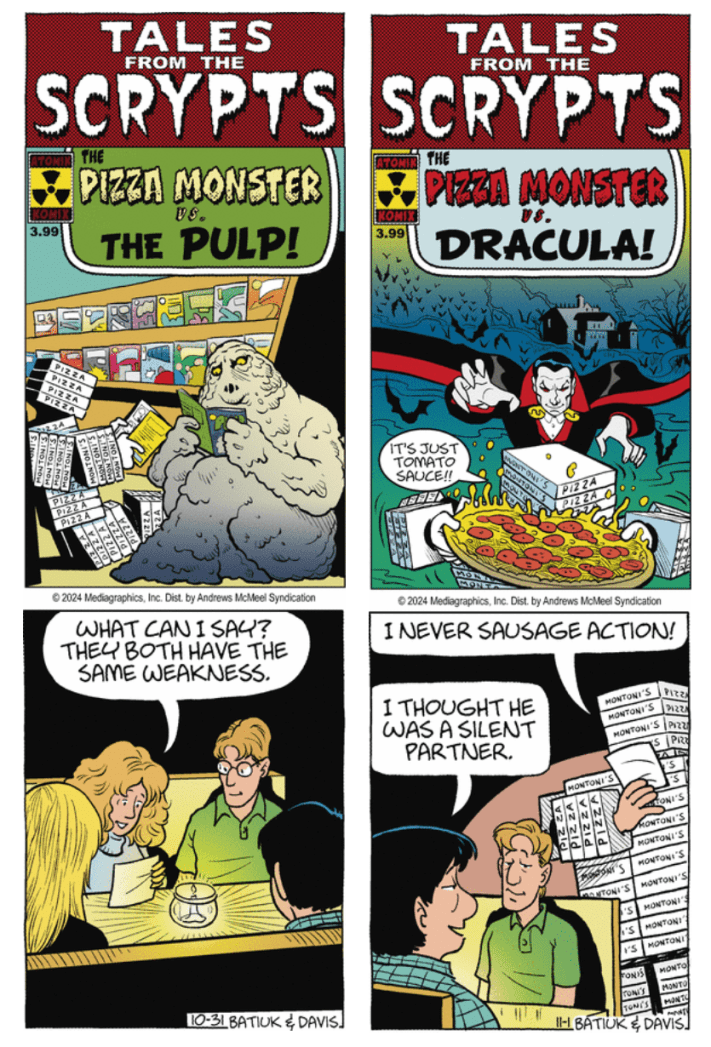
After the Burnings piddled out, Tom Batiuk spent two full weeks on comic book covers. Pointless, derivative, unimaginative, actionless, talky, over-expositioned, self-indulgent, still-auditioning-for-Marvel-and-DC-at-age-76 comic book covers. It was so bad I struggled to write anything about it. Then on Sunday, I asked myself a question I never thought I would: why’d he stop?
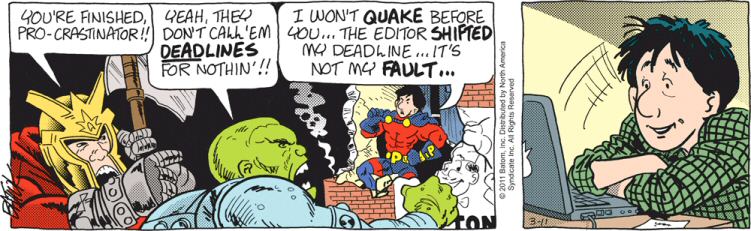
The November 3 Crankshaft strip is perfectly suited to be a comic book cover. It’s already turned sideways. It’s already framed like a comic book cover; there’s empty space at the top where the Atomik Komix livery and price tag would go. There’s more action in this drawing than anything we saw during Pizza Box Monster week. So why isn’t it one?
It could have been a nice little self-callback. It’s hard to remember now, but comic book covers and comic book art in Funky Winkerbean used to be a way of framing the actual story arc. Not-Yet-Dead Lisa would imagine herself as a cancer-fighting superhero. The obstacles in a character’s world would manifest themselves as comic book-style villains, and so on. It had its charms.
Or at least, it had a point. It complemented the narrative instead of replacing the narrative with something that wasn’t narrative. Sometimes it was just in service of a “collecting comic books” story, but that was still in-bounds. It wasn’t just to flesh out Batiuk’s imaginary comic book continuity he never does anything with. Or indulge his fantasy of what he wishes he’d been doing for the last 50 years.
This Crankshaft strip is perfect for that treatment. It’s about urging people to vote, a common theme when an election is imminent. But it could have been so much better, if Batiuk had just leaned into what he’s been forcing onto us for the last two weeks. Put Ed in a America-themed costume. Call him Super-Citizen or something. With the power to change mighty governments in a single vote! Instead of Meckler lamely saying “we’re trying to encourage younger voters”, Ed could have compelled them to join his superhero team! This would have made a garden-variety voting story a little bit fun.
Which is what’s missing from all this. For all the time Tom Batiuk spends in Comic Book Cover Land, it’s just. Not. Fun. Not even to him! The comic book covers aren’t funny. Or interesting. Or skillfully drawn. or passionate. Or frame the story a different way. Or set up anything that gets explored later. Or serve as a entertaining spectacle in themselves. They feel obligatory.
This is like the song “She Keeps Me Up”. It’s an overproduced disco rock song from the humorless band Nickelback, played with complete earnestness. This should be hilarious, but it’s not. And it’s not because the song is bad. It’s fine for what it is. But watch the 70s-style music videos for “Are You Gonna Go My Way” or “I Believe In A Thing Called Love” or “Ooh La La” by Goldfrapp, and you’ll see the problem. Those people are enjoying themselves! They clearly love this type of music, and know how to create it. They have a sense of a humor. They put some thought into merging the disco sound into their usual songwriting.
As much as Tom Batiuk professes to love comic book covers, he draws them like it’s a contractual obligation.


 Son of Stuck Funky