Happy 107th Birthday, Ed Crankshaft!

We interrupt the Crankshaft awards to bring you a breaking story in Major League Baseball!

Bill Mazeroski died this weekend. Mazeroski is a Baseball Hall of Fame member, who hit one of the most famous home runs in baseball history. It was the first ever World Series-winning home run. This has only been done one other time, by Joe Carter in 1993.

Why are we talking about baseball necrology? Because former Major League Baseball player Johnny Lucadello was born on February 22, 1919. Lucadello was also the youngest player on the 1940 Toledo Mud Hens, the real-life baseball team which Ed Crankshaft canonically also played for. (Ed also has a real-life retired jersey number.)

For that reason, I view today as Ed’s birthday, because it’s the latest possible day he could have been born. And I think Lillian McKenzie was in his high school class – because this is the Funkyverse – which makes her well over 100 as well.

Ed’s baseball career, with its early integration experiences, and winter ball in pre-revolution Cuba, fits this time frame. So does Lillian, Lucy, and Eugene being young adults whose lives were interrupted by World War II. So does Pam’s life, centered around the 1970 Kent State shootings. Ed would have been about 30 at her birth.

I want to stress that 107 is the youngest Ed Crankshaft could reasonably be in 2026. The average player in the 1940 American Association, and on the Mud Hens themselves, wasn’t 21 years old: he was 27. If Ed was 27 in 1940, he’d be 113 today. Which would almost make him the world’s oldest man. (Unless Walt Wallet from Gasoline Alley also counts.)

We can’t move Ed’s birthday much later than 1919, because then he’d be too young to be drafted into the military. What if we gave him Joe Nuxhall’s backstory (pitched briefly in the majors at age 15, making Ed’s birth year 1925)? Ed would be way too young to join the military legally, much less be drafted.

Which would have made Crankshaft extremely likely to reach the major leagues, no matter how illiterate he was. MLB teams in 1942-1945 were eager to employ players who weren’t subject to being drafted. And since some were already missing, the standards were lower. A player too young to be drafted, who was also good enough to pitch in AA (the top minor league level at the time), would have been given plenty of chances. Especially on a mediocre team, which the Detroit Tigers and Cleveland Indians (both implied to be the Mud Hens’ parent club at some point) and St. Louis Browns (now the Baltimore Orioles, who was Toledo’s real-life parent club in 1940) were.

The optimal birth year seems to be 1922. That would make Ed 20 in 1942, which is the youngest that would have been drafted that year. So maybe he’s only 104 now. Which would also make him extremely young for AA baseball, and by definition a phenom. But let’s solve one problem at a time here.

So how many inches from reality is Ed Crankshaft’s life?

Out of 35 players on the real-life 1940 Toledo Mud Hens, only two lived to see 2003! They were Jake Wade (1912-2006) and Harry Bailey (1918-2014). Six others made it to the 21st century: Armond Payton (1917-2000), Daniel Scudder (1916-2000), Tommy Criscola (1915-2001), Lucadello (died in 2001), Hal Spindel (1913-2002), and Robert Jones (1916-2002). A ninth player, Harry Kimberlin, died on December 31, 1999 at age 90. Kimberlin was the last former Major League Baseball player to die in the 20th century.

Bill Mazeroski’s famous home run was in 1960. He was born in 1936. He was 89 when he died this year. Ed Crankshaft is 15-20 years older than all of those standards. Look at the photos of Harry Kimberlin and João Marinho Neto in the above links. That is what a very old man looks like.

On top of that, Ed is absurdly active. He still works as a bus driver, bowls regularly, goes out to eat with friends, portrays Santa Claus, sings in a choir, gets into arguments with cartoonists, goes to the fair, has traveled to New York, Winnipeg and Columbus, performs frequent physical feats, and builds an AI-powered smart garden. Very few people on earth have the expertise to build an AI-powered smart garden. And few centenarians on earth have the ability to do any of the other things.

So, Ed, since you like gardening so much, why don’t you dig a 6′ x 3′ x 3′ rectangular hole in the ground? I’m sure we’ll find something useful to do with it. Oops, I mean “you’ll” find something useful to do with it. Happy birthday and many more!

We now return you to the Crankshaft awards!
Over Yonder

Voting for the 2025 Crankshaft Award is Still Open!

The Funkyverse has a new corporate sponsor: Yondr!

I previously called this kind of product placement “egola.” It’s like plugola or payola, except that you get paid in self-actualization instead of money. Usually, these are about Tom Batiuk’s weird fandoms (The Phantom Empire, Chad & Jeremy); events that met his ludicrous standards for treating him like a big shot (Ohioana Book Fair, Comic-Con); or both (Winnipeg Blue Bombers, “Montoni’s” pizza).

Yondr doesn’t appear to be any of those things.

Interestingly, Batiuk describes the product correctly. You define a phone-free zone, and instruct visitors to put their phones in the special pouches. The pouches can’t be unlocked until you leave the area, or use the “unlocking base.” You can still hold the phone, hear it, and see it well enough to know if the screen lights up. You can understand why certain institutions, like schools, would use such a thing.

But why would the famously anti-technology Tom Batiuk, fresh off a week of trashing the long-established standard of online payments, portray a technology product in a positive light? Especially one that hasn’t stroked his ego, as far as we know?

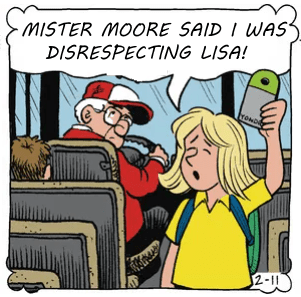
I think this image from Wednesday’s strip is the key:

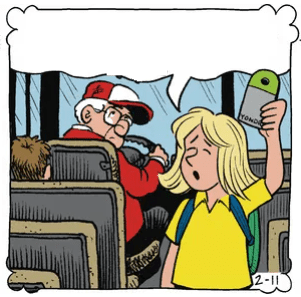
I hid the text, because it’s not important. Look at the child’s face. Compared to the usual faces in the Funkyverse, that child is very upset. This isn’t the devil-may-care smirk or the resigned acceptance we usually see. That is the face of someone in mourning. Even Ed Crankshaft is going above and beyond in this shot. He looks genuinely irritated at this behavior. And unless I’m way off base (which I often am), these are both new drawings.

Why would Tom Batiuk be excited about a product that lets parents take cell phones away from children? Does it maybe… relate to his life experience, somehow? Oh, yes, it does. And we all know how.

This is Tom Batiuk telling the world he’s still upset that his mother tried to take away his comic books. It practically screams “See? See what it’s like when mean grownups take your precious thing away? Let’s see how you enjoy living without your precious phones!” He gets to make that point again, and slam something that didn’t exist before 1991!

And another thing: Ed is totally the wrong character build a Yondr arc around. What Funkyverse character (1) has a job where it’s reasonable to ask children to put their phones away, and (2) demands to be the center of attention at all times? Come on, you know who it is!

The star of Yondr Week should have been Les Moore.

Batiuk pulled Les out of mothballs to make him the star of The Burnings, even though Les almost single-handedly caused the entire problem. So there’s no real obstacle to using him here. Having Les – or at least, a teacher – be the ringleader of the Yondr Enforcement Team makes much more sense than having bus drivers do it.

Using Les in this role would (1) fit his long-running characterization, and (2) poke a little fun at the character, something the Funkyverse desperately needs.

The Funkyverse is full of unsympathetic comedy protagonists, but it doesn’t use them properly. Characters like Les Moore and Ed Crankshaft need to get pushback every once in a while. A week about Yondr is a perfect opportunity to take Les down a peg. Not in an overly mean way, but in a way that tells readers “okay, I get it, this character is a little overbearing sometimes.” And other characters get to acknowledge it too.

But Tom Batiuk is so enamored with his interpretation of Lisa and Les as The Greatest Tragedy In Human History and Her Long-Suffering Heroic Disciple that he’s blind to things like this. But here’s what I’d do:

Monday Panel 1: Principal Nate: “The school board is mandating we use Yondr, which requires students to put their phones in these special pouches during class. We need volunteers to help us with the roll out.” Panel 2: Les, in a group of bored-looking teachers sitting in meeting room chairs, enthusiastically raises his hand. Panel 3: “Okay, I think we all saw that coming. Anybody else?”

Imagine if Les got to deliver the “we have our ways of finding out” line.

It’s not hard to imagine a situation where Les is a little too overzealous about enforcing the rules, or enforces them in selfish ways. And the kids call him out on it. Here’s what I would do with the above panel:

Now that’s a quarter inch from reality.

The Compleat Batton Thomas

Hi, folks! The Crankshaft Awards are still under construction, due to some nasty cold here in the upper Midwest. (My hometown was minus 6 degrees on Monday.)

So in the meantime, I want to document the entire Batton Thomas interview. Boring, I know, but I really don’t know how else to respond to it. I can’t use Batton to mock Tom Batiuk, because Batton already does a spectacular job of that without my help. And I think we’ve all wailed and gnashed our teeth in the comments about what an inane, boring, self-serving ego trip this all is. But it just keeps going.

I thought the best way to document it would be to put it all in one place, to illustrate how much nothing there is in what has now been nine weeks of strips.

August 5, 2024: Skip seeks Batton to do an interview, so he immediately heads to Komix Korner. Batton saunters in on cue. He quotes Dorothy Parker for some reason, probably to show off his writerliness.

August 19: Skip needs to do another interview for a “longer and more in-depth” piece. He asks “what sparked your interest in comics?” Of course, it’s comic books. Batton traveled to New York and failed to be hired by either DC or Marvel.

January 27 ,2025: Batton sucks at being an art teacher, so he badgers the local paper into letting him draw a cartoon. He meets with a syndicate, NEA, which gives him some advice on how to turn it into a comic strip.

March 17: Batton talks about what inspired him to become a cartoonist. Spoiler alert: it was comic books.

May 26: Batton comes up with the name for his proto-strip Rappin’ Around, and annoys Roger Bollen, the creator of Animal Crackers. Roger says “just because I visited the syndicates in New York doesn’t mean you have to.” Batton immediately announces his plan to do this, rejecting Bollen’s advice right to his face.

July 14: Skip visits Batton in his studio. Batton takes his second trip to New York, eats at Howard Johnson’s, and gets rejected by the syndicates. But he returns home to find an important-looking letter in the mail, despite having spoken to no one. After telling a friend about it, Batton realizes that he is now better than everyone else.

September 1: Skip asks “So what happened after Publishers-Hall offered you a contract for your own syndicated comic strip?” Batton mostly whined about how difficult it was.

September 29: Batton is sitting with Skip for yet another interview when he meets Jeff, his “dopplegänger from the comics shop.” (The umlaut was Batiuk’s.) Ed Crankshaft then rips into Batton over the diminished presence of “Grandpa Wrinkles” in the comic strip.

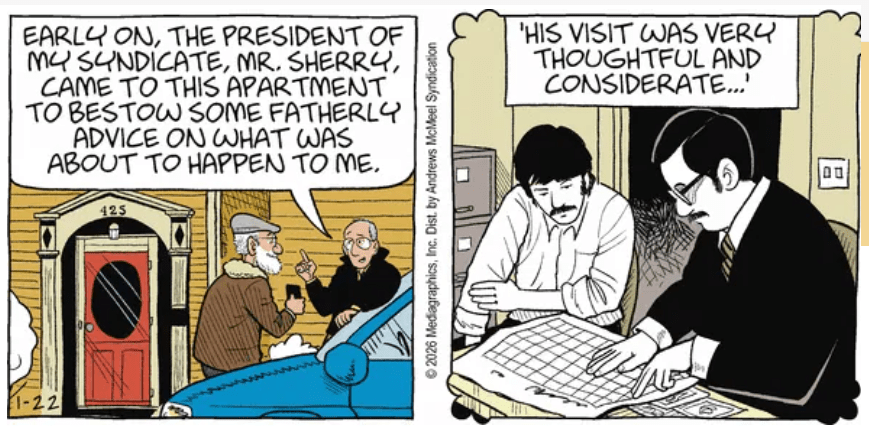
January 19, 2026: Batton and Skip visit Batton’s first apartment house, Elyria High School, and syndicate president Dick Sherry visits. Batton says Sherry’s was “thoughtful and considerate”, but “it felt like we weren’t on the same page” as Sherry looked at some new strips. This anecdote is never resolved, as Batton talks about the apartment house some more instead.

To be continued, no doubt…

UPDATE: February 23: The interview begins to run out of steam, even by its own very low standards. Batton drops several disjointed anecdotes that make him look even more petty and mean-spirited. Batton’s wife helps him color his comics; he took once someone else’s boxes from a shared storage area to use to pad his mailers; and whines that he doesn’t own his own characters. None of this is followed up.

Oh Sherry

This week in Crankshaft:

Hmm, that second panel looks familiar:

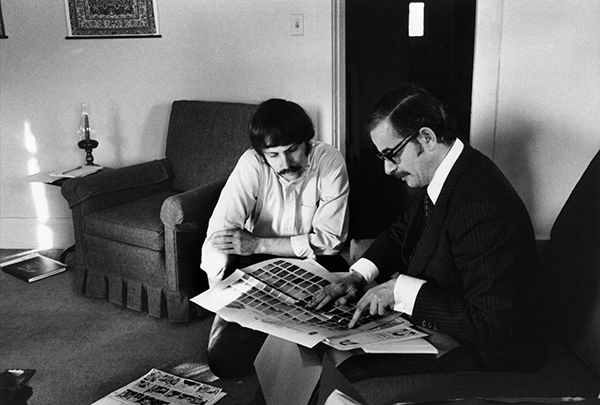
This is a photo I dug out of the image folder at the old funkywinkerbean.com in 2022. At the time, I didn’t know who this man was. The only thing I knew was that he was too young to be Hal Foster, who would have been about 80 years old. This came up during the “Hal Foster rips off Phil Holt’s work and publishes it in Prince Valiant” arc, during which Batton Thomas himself applied for the job. I wondered if Tom Batiuk had ever auditioned to draw Prince Valiant in real life, and if this photo was evidence of that. It’s not.

This week, an Anonymous poster on Comics Curmudgeon explained:

Dick Sherry was the president of PUBLISHERS-HALL SYNDICATE around the time Funky Winkerbean was picked up.

I’m glad for that explanation, because Lord knows Tom Batiuk didn’t provide one. And it seems to check out. Wikipedia says “some of the more notable strips syndicated by the company include Pogo, Dennis The Menace, Funky Winkerbean (snort).” So this company would have been Batiuk’s first publisher, and Sherry his employer’s president.

Apparently Batiuk liked Sherry, since Batton went out of his way to call his visit “thoughtful and considerate.” Why is that even noteworthy? A meeting with an employer, especially a one-time visit at the start of an agreed-upon work-from-home arrangement, is courteous by default. Considering the absurd level of consideration Tom Batiuk routinely expects, I wonder what Sherry did to earn this honor. Did he bring Luigi’s pizza and fresh comic books?

Information about Sherry is scanty. The only thing I could find was in an interview with comic book writer Rick Marschall. He says that Sherry was still in this job in 1977, and that he liked hiring international artists so he could take “trips around the world at the syndicate’s expense to have creative conferences with these cartoonists.”

One wonders why he bothered hiring a comic strip creator from Akron rather than Las Vegas or Orlando. Maybe he didn’t have enough clout within the company yet. Maybe that’s the entire reason Funky Winkerbean ever existed at all! Maybe Dick Sherry wanted to hire a cartoonist from Honolulu, but the company refused to reimburse the travel, so he had to take his vacation in Ohio instead. And 50+ years later, here we all are.

The Cardinal Really *Was* Lisa

So Tom Batiuk’s version of Calvin’s raccoon ran in the last full week of 2025. And it went like so many other stories do in the Funkyverse:

  1. Poor, innocent, helpless creature gets injured.
  2. One of the Funkyverse’s designated heroes notices.
  3. The designated hero makes a big show out of helping the poor, innocent creature.
  4. The designated hero provides little actual help to the poor, innocent creature, and may even subject it to further injury.
  5. The poor, innocent creature gets worse, for reasons that will not be blamed on the designated hero, even when they probably should be. (Optional: the poor, innocent creature may appear to get better for awhile first.)
  6. Poor, innocent creature dies, having suffered more than they probably needed to.
  7. Designated hero congratulates themselves while smirking. Never once do they ponder their own role in the death of the poor, innocent creature.
  8. Tom Batiuk starts checking his mail for Pulitzer nominations.

This isn’t just the cardinal story we just saw. It’s also Lisa’s story. In some ways, it’s Bull Bushka’s story, Becky’s story, and other pointless tragedies in the Funkyverse. And some of you picked up on this in the comments:

  • “The actual miracle will be surviving with a broken spine.”pj202718nbca

This is closer to the truth than you’d think. Most bird-window collisions result in the death of the bird, eventually if not immediately. Pam and Jeff made no attempt to ascertain the bird’s injuries, or take it to someone who could treat it. Though to be fair, most people wouldn’t know what to do when presented with injured wildlife. Which was part of the point of the Calvin and Hobbes raccoon story.

Calvin’s mom admits to Calvin that the raccoon looks badly injured. She also admits to Hobbes that she doesn’t really know how to help.. This concept was explored more in the story where Hobbes went missing after a break-in at the family’s home. But it’s nice to see it acknowledged here… because it’s something you’ll never, ever see in Funky Winkerbean. Characters like Jeff Murdoch and Les Moore are not allowed to acknowledge their own mistakes, must less admit them. Even when their mistakes are blatantly obvious to readers.

  • “I had predicted a ‘Christmas miracle’ with the bird getting miraculously better on Thursday. But it actually got better on Friday, albeit with the ‘Christmas miracle’ as the actual punchline.”Green Luthor

This speaks to a huge problem in Tom Batiuk’s writing, and that is: his attempts at humor, and even ordinary banter, undermine the seriousness of the situation. Pam and Jeff stored the injured cardinal in an oven warmer when any box would have worked, which made it look like they were planning to cook it. The partial first week of 2026 has been a celebration of football helmets, after a football helmet was the symbol of Bull Bushka’s stupid death and his even more stupid life. And we saw “costs an arm and a leg” jokes in CBH’s reposted Christmas story, thankfully out of earshot of Becky. Has Tom Batiuk never encountered the concept of “too soon“?

The raccoon story has jokes in it, but they’re not at the expense of the injured raccoon. Nor are they at the expense of Calvin’s emotional investment. But this happens quite a bit in the Funkyverse.

Bull Bushka’s CTE death arc started with Linda and Buck Bedlow cracking wise about Bull’s need to do laundry – a common symptom of his condition. Similarly, Mort Winkerbean’s dementia (before it was magically cured off-panel) was played for laughs in a Sunday strip where Funky observed him repeating himself.

Though this doesn’t happen in Lisa’s Story, nosireebob. Lisa’s death is the greatest tragedy in human history, and must be treated with complete seriousness at all times. Everyone in the Funkyverse must adhere to Les Moore’s inscrutable standards of “protecting Lisa.”

  • “I can’t shake the dread that something bad is gonna happen to the cardinal even if yesterday’s strip turned out to be a cop-out.”csroberto2854

He was right – the cardinal immediately bashed into the window again. Which was played for laughs. Which reinforces all of the above criticisms, and then some:

  1. Relying on ambiguous art to make a joke work. The artwork in the above strip suggests that the cardinal flew through the open window, and then immediately doubled back, as if wanting to return to the house. However, if we assume Rule of Funny is in effect, it’s arguable that the cardinal was just being drawn from the more comedic angle.
  2. Making the joke at the victim’s expense, again. Crankshaft hilariously says “Birds just don’t get glass!” Well, that’s exactly the problem, Ed; birds don’t perceive glass as an obstacle. If they see natural habitat on the other side, they will try to fly straight to it. This feels like mocking blind people for bumping into objects.

    Contrast: Richard Pryor. Richard’s Pryor comedy material was about poverty, racism, broken families, prostitution, gang violence, substance addiction, and other awful things. But he never once trivializes those things, or mocks anyone for being affected by them. That’s how you combine tragedy and comedy effectively: by not letting the comedy undermine the tragedy.
  3. The pervasive gloom of the Funkyverse. We initially see the cardinal recover, which threw off Green Luthor’s mental timeline for how the story would play out. But pj202718nbca turned out to be right: the recovery was a temporary respite, so Batiuk could prop up yet another tragic ending. Even though the tragic ending was going for a laugh this time.
  4. The pervasive indifference and incompetence of the Funkyverse. Which are hard to tell apart, really. Tom Batiuk wants to sell his world of noble, caring, small-town Ohio people. But their actions bely this at every turn. Pam and Jeff ultimately did nothing to help the bird. Ed laughed when it got injured again. Les had little interest in keeping Lisa alive, and great interest in leveraging her death into the writing career he thought was his birthright. Becky didn’t even care about losing her own arm.

    Maybe that’s why Tom Batiuk cured Mort Winkerbean and Harry Dinkle: nobody in Westview was capable of doing it. Or cared enough to try.