Outside the circumstances of her birth, life has been pretty simple for Summer. I mean true, she is a toddler so it can’t really be all that complicated for her but still, things have been going pretty well for the Moores and the residents of Westview in general minus the occasional hiccup. Sure, John got his hopes up that maybe the pretty one-armed pizza lady was going to give him the time of day only to have them cruelly dashed when that bastard Wally returned.
But Tom Batiuk is an artiste with a vision and soon the misery miasma will blanket Westview once more for he shall unleash upon it’s hatchet-faced denizens his masterpiece.
However at the start of 2005, things are going so good that after only their second date — which followed her being ghosted for most of the previous year — Funky and Holly get engaged! Wally and Lefty are as well so it’s going to be a double wedding at Montoni’s. This wedding stuff will take up well over half of the year and so for a lot of it Summer will only be making some token appearances. In fact it won’t be until February when Summer makes her first appearance of the year, starting to talk and being used to prank her Lego-headed father.
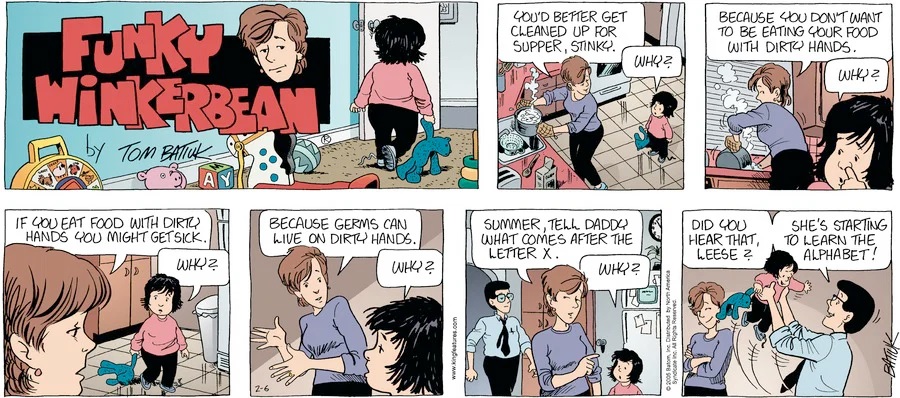
But February is also when we start getting the first hints that things will be taking a decidedly darker turn as Wally begins trying to deal with his PTSD and Roberta Blackburn appears out of nowhere to pester her daughter and son-in-law to be. But she’s also there looking for a gift for Becky’s cousin who just so happens to like comic books so Becky directs her moralizing mother down to Komix Korner where some Japanese works catch her attention and soon, the cops are taking John to the slammer. Presumably for having shit taste in manga.
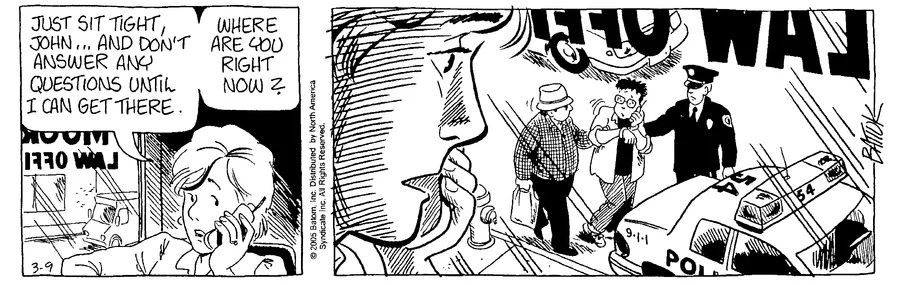
So Lisa’s got her big plot for the year, trying to uphold the sanctity of artistic expression and fight obscenity laws and you know… I really in a broad sense do agree with Batty on these types of issues whenever they do come up. After all, I live in the state that produced Jack Thompson and a lot of my formative and not-so-formative years involved hearing about his antics against music, video games and the like. But Batty makes it so damn hard when his arguments for them is delivered in a manner that tends to be overly self-assured in spite of their shallow insipidness. Like Les will go “These articles are important because free speech!” which… yeah? No shit. Or Lisa will stand in front of a jury and go “Comics… are art!” and yeah, of course they are.
But come on, Batty! This is an issue you seem passionate about so whenever you bring it up maybe show a little more fire than “[thing] is good, actually” and then leaving it at that.
With all of these events going on, it’s months before we see Summer again as she shows up during the Winkerbean double wedding in June.
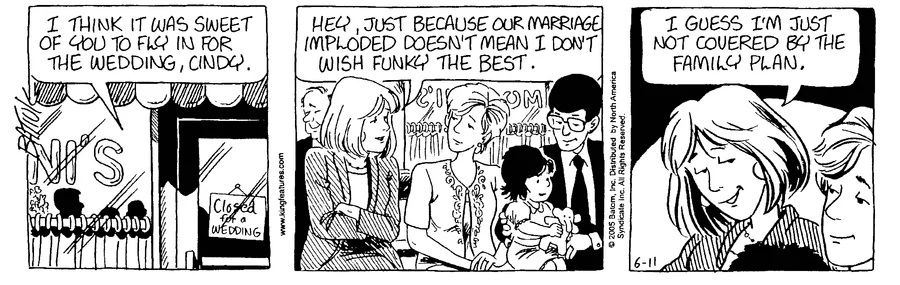
Which then causes her to have marriage on the brain.

But once again there’s no time in summer for Summer because it’s taken up by Wally and Becky’s honeymoon to beautiful Afghanistan. Which includes this rather bizarre strip just before Wally leaves.
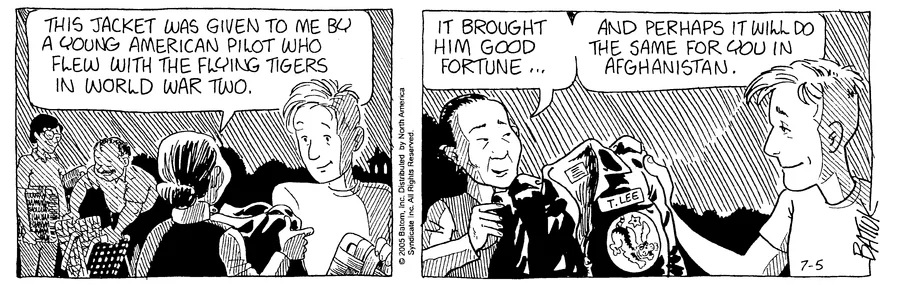
In a case of Batty just grabbing characters from other works, the implication is that La Choi San — the outdated cariature who doubles as the grandmother of Jade Dragon owner Liu Lin — is actually the Dragon Lady from Terry and the Pirates and is giving Terry’s flight jacket to Wally. It’s a jacket that Wally will wear all throughout the Afghanistan story that takes up a full two months of the strip’s focus, ending with he and Becky deciding to adopt Rana, the younger sister of the girl who rescued Wally during his original MIA phase but who was blown up along with the rest of her family by a car bomb.
Naturally, Lisa adds “adoption” to her plate of legal work to help them bring Rana over to the U.S. just as Becky’s taken the assistant band director job at the high school that was vacated when Kara became Big Walnut Tech’s band director.
Summer is still kind of there, hanging around during a multi-week story about Taj Moore-hal having bats in the attic… Batiuks, if you will hyuck hyuck.
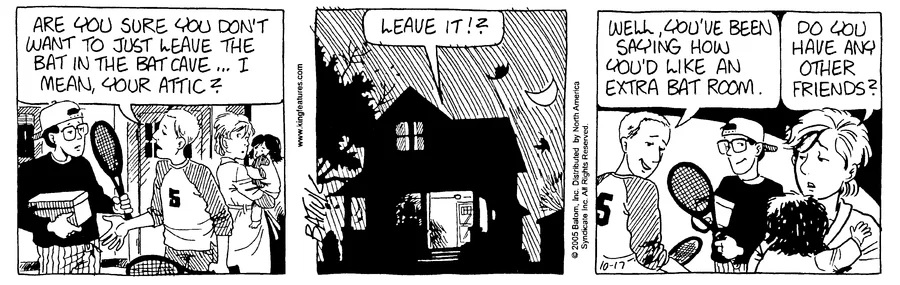
John’s trial occurs and Lisa has her big success with the rousing argument that John can’t be guilty of breaking obscenity laws because comics are art and also the “child” that was in the store when Roberta purchased the pornography — part of the reason John was being charged with breaking obscenity laws — was really an adult midget. It sort of feels like TB wasted months’ worth of time just to get to that punchline too.
The year winds down with some ligther fare like a pun worse than my bats in the attic one.
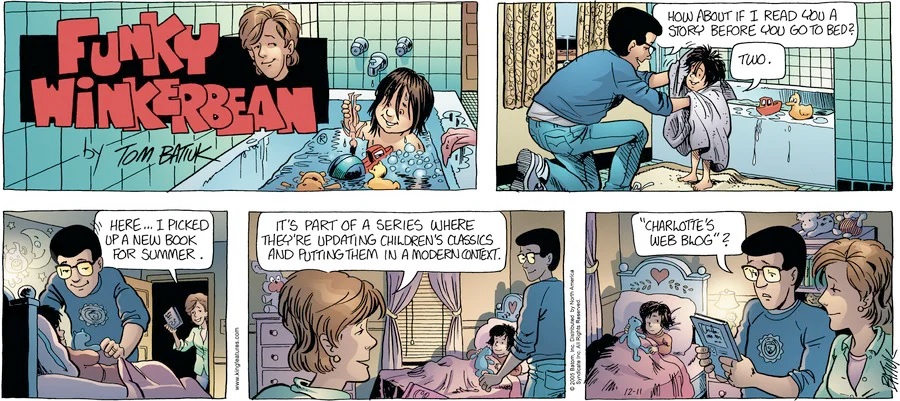
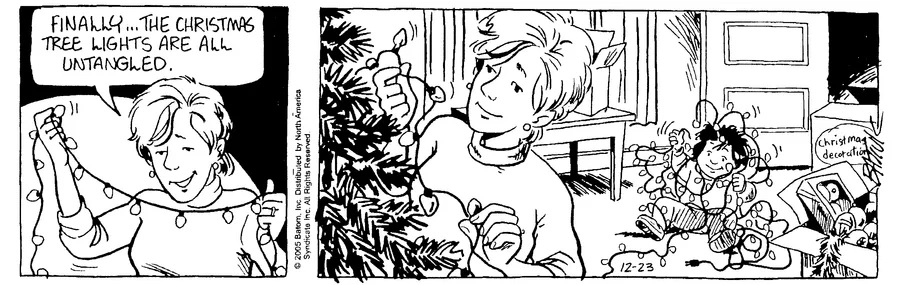
And some Christmas shenanigans.
But poor Summer opens up the next year having caught some kind of bug leading to a week of Les having to care for his sick child.
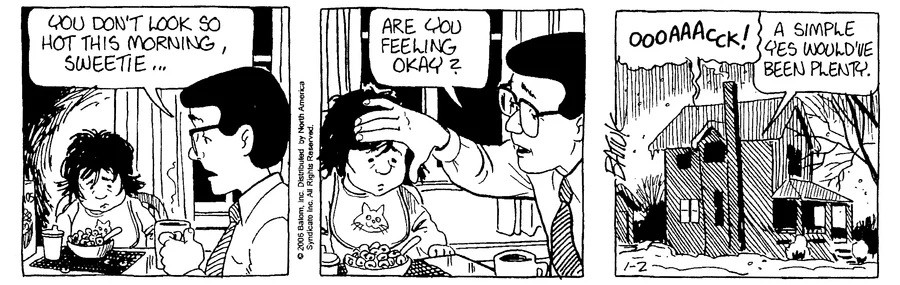
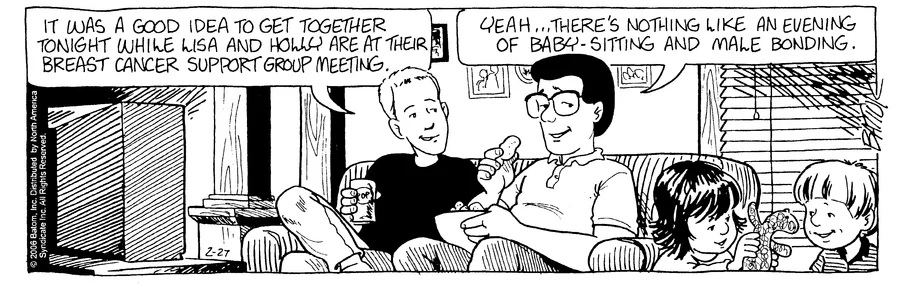
After heroically puking all over her father, she again takes a backseat to Lisa and Holly’s cancer support group as well as Becky learning she’s pregnant. We do get what I believe is the first appearance together of Summer and Cory though.
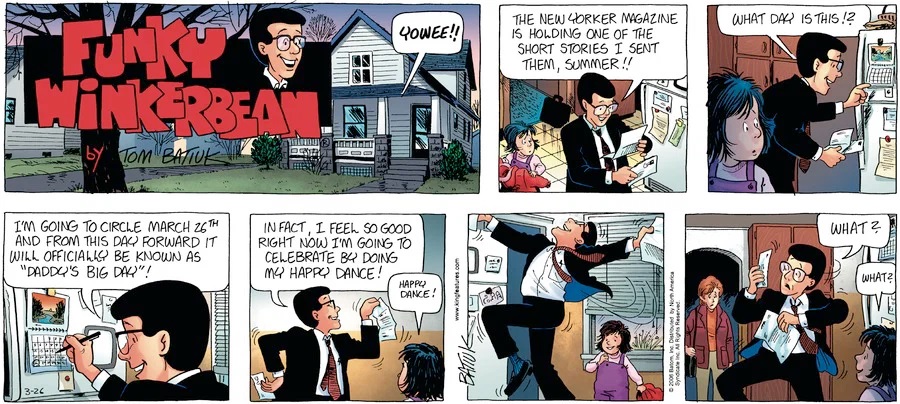
But it’s the calm before the storm. Things look as if they’re going well and Les is even going to have his story published in the New Yorker which means Summer, and we, get to watch him do a dumb little dance.
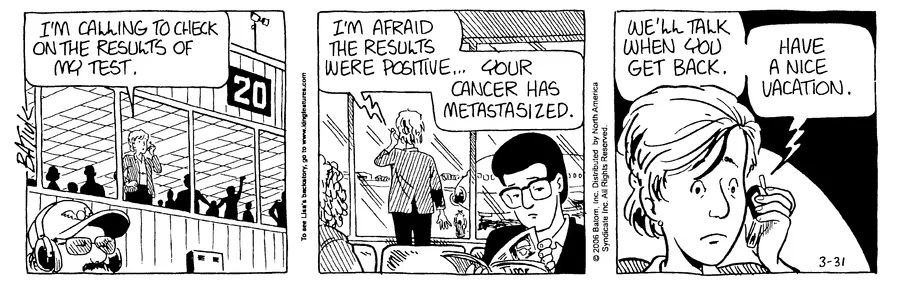
But as Lisa’s expression in the last panel indicates, something is wrong. She’d gone in to participate in some genetic testing but something came up and she gets the confirmation just as her and Les are heading out on a vacation to New York.
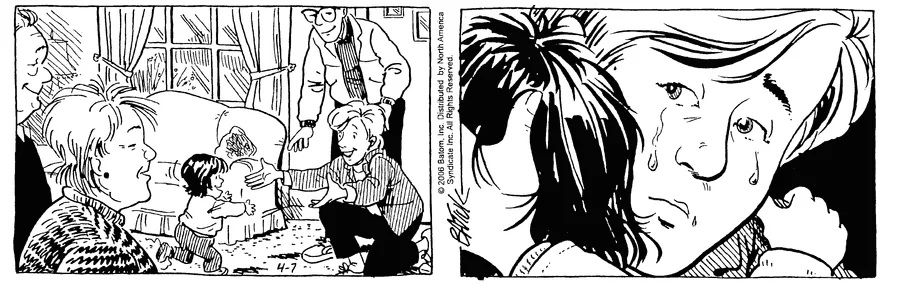
That’s right folks, it’s been twenty years since The Story That Changed Everything and with his creative fires fueled, Tom Batiuk has decided to give us The Story That Changed Everything II: The Lady with All the Cancers. Les and Lisa go on their vacation but of course the shadow of cancer looms over everything. When they get back, Lisa makes sure to give her daughter a hug and give the audience one of Funky Winkerbean‘s patented cursed close ups.
I would assume that deciding to bring back Lisa’s cancer is when Batty decided to do a second timeskip and it seems to have really put him in a mood because this is when we’re getting all the stuff that seemed to catch the attention of the broader internet in the mid-2000s, making people fascinated by how damn miserable this strip was. Because this is also the same timeframe where Wally gets dragged away from his family and back into active duty in Iraq which, spoilers, will not work out well for him. At all. This is right after construction on the street in front of Montoni’s forced the Jade Dragon to close as well.
But it’s not all bad, at least in-universe, because this is also the period where Darin and Jessica Darling, Whose Father John Darling Was Murdered, become an item when she’s impressed by some quick thinking he pulled to unforunately save Pete from getting his ass kicked by the Rough Riders from Crankshaft. And this is when Bull Bushka gets married to walking buzzkill Linda Lopez, who’d hooked up during summer break the previous year. It’s the kind of story you think we’d actually see but no, because Batty loves his shocking twists and so figured it was best to have everything happen offscreen so he could randomly spring it on the readers.
Why let a story get in the way of a good surprise?
A lot of the rest of 2006 goes back and forth between Lisa’s cancer — which includes repeated appearances by the worst doctor on Earth and a trip to the Grand Canyon — and the stuff with Darin and Jessica. Interspersed is also a goofy story about Montoni’s being profiled by the Food Network which culminates in some kind of Iron Chef style pizza cooking competition show.
Summer’s last significant appearance of 2006 and her first one since showing up in the background before Les and Lisa leave for Arizona isn’t until December.
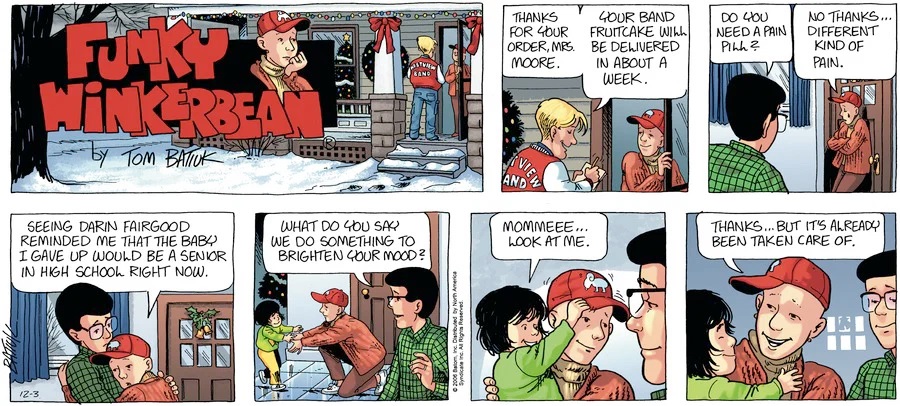
Batty was too busy with other things to deal with Summer. There’s Becky giving birth, John continuing to pine for her and setting up things that will have zero payoff by establishing Mooch’s relationship with Mindy Murdoch and Crazy Harry’s second kid, both of which will disappear shortly into Act III.
But 2007 starts off with a seeming bright spot for Lisa.
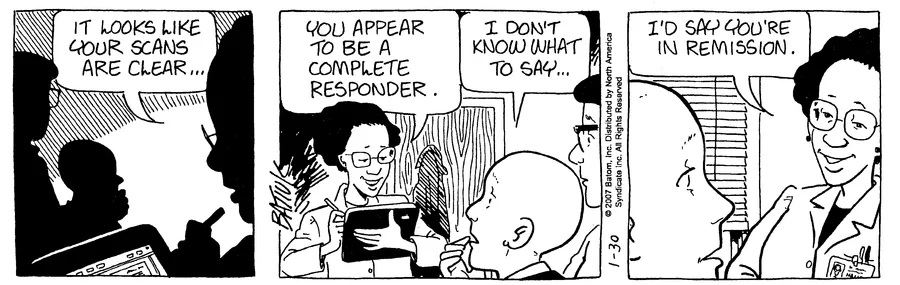
Joy of joys, Lisa’s results are looking good and she’s in remission which seems to be putting her in a much better mood as she can actually appreciate having a kid again. The one she actually has mind you, not the one she gave up and pines for.
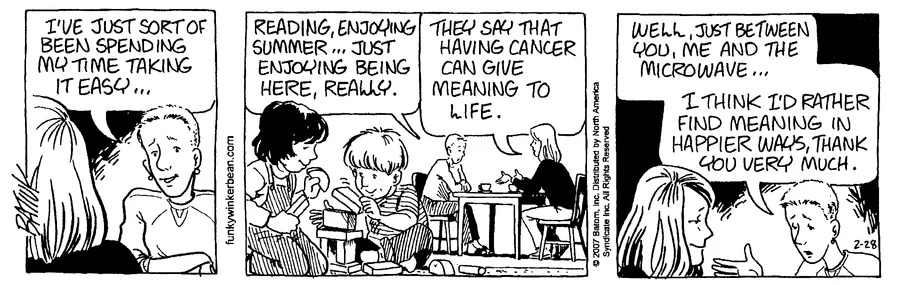
Unfortunately for Lisa we’re in the misery porn era of Funky Winkerbean so it’s not long before she learns that her doctor has in fact been utterly incompetent and that they’d mixed up her results with someone else’s.
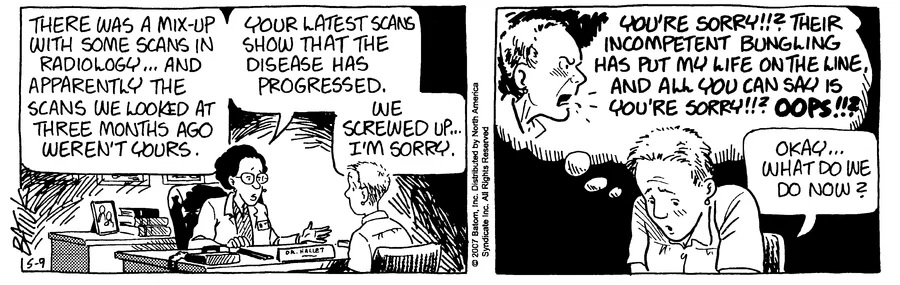
Now given all of this — that Lisa had gone off her chemo and other treatments for a few months because of their screw up, the fact that said screw up even happened at all — you’d expect the Moores to do something right? I would guess that they probably have a pretty clear case for a malpractice lawsuit. But nope, they just throw up their hands and say nothing can be done. There’s a constant thing whenever Lisa is brought up about what a strong fighter she was right up until the end but no, not really. She immediately gives up and just allows herself to rot away over the next few months.
Because as we all know, Lisa is destined to die and it’s in the summer when she gets the news, delivered to her by Dr. Screwup in the most tactful and courteous manner she can muster.

Now let me digress a bit here to ask, what was Batty’s intention with this character? Was it to portray someone who was ultimately a good and caring doctor who made a little whoopsie doodle because we all make mistakes? Or was she intended to be representative of the real or perceived cold indifference of the American healthcare system? I suspect something closer to the first one given that neither Les nor Lisa treat her with the scorn she rightly deserves for messing up in such a massive way.
And that response? “Months… but don’t ask me how many.” Double fuck Dr. Dipshit. It’s easy to want to criticize various characters for various reasons in Batiuk’s works but I don’t really think any of them are as bad as Dr. Hallet. It’s not just the incompetence but the callous flippancy with which she tells Lisa that she’s going die that makes her so unbelievably repugnant in a setting filled with repugnant jackasses. Les at Bull’s funeral comes close but really, she might be the absolute worst person in the history of the strip.
While this has been going on, the other major story running through the year has been Darin, at Jessica’s urging, searching for his birth mother. There were some starts and stops but eventually the information is released and he learns that Lisa is his bio-mom and decides to convey this via creepily watching Lisa and Summer play in front of Taj Moore-hal.

Maybe someone can tell me whether I’m right or not but I get this feeling that this is a go-to Batty likes to employ as part of his forced dramatics. The whole shot of someone staring at others from their car. I don’t think this is either the first or last time this type of thing occurs but maybe I’m wrong.
From here Darin basically plays real big brother to Summer who now has to face her dying mother though of course is still to young to fully grasp what’s happening.
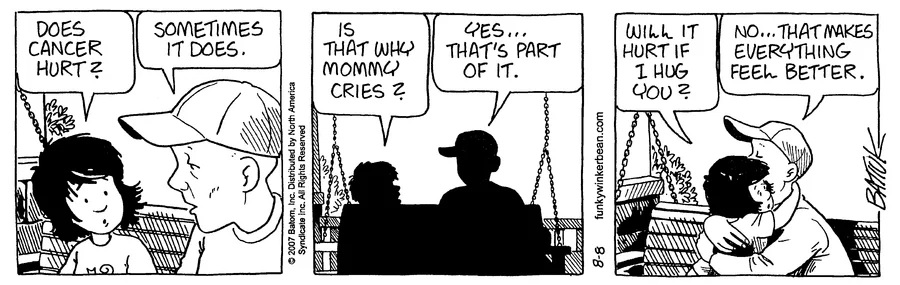
Shortly after this she enters kindergarten as well.
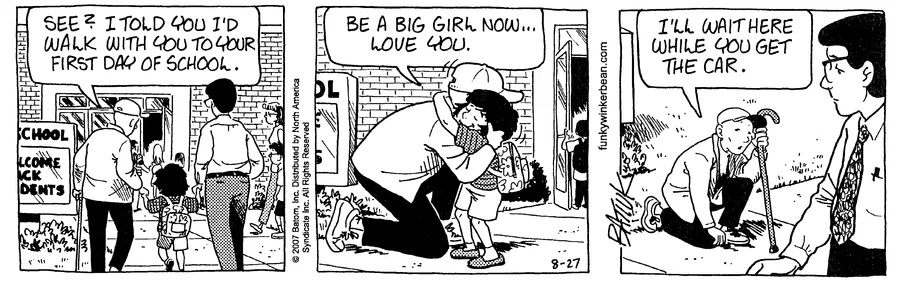
Lisa’s state is rapidly deteriorating and by September she’s hit the point where she can’t go up and down the stairs and so effectively enters hospice care in the living room.

Batty decides to get in one last minute instance of both closing off a plot thread and setting things up for Act III by having Bull and Linda pop by with the kid they’ve spent most of the year trying to adopt. At that point it’s pretty much the endgame for Lisa. Her parents show up one final time so her dad can apologize for not being there for her even though they’ve been around plenty the last few years.
Finally Masky McDeath appears to usher Lisa into the Great Phantom Zone Beyond and it’s over.
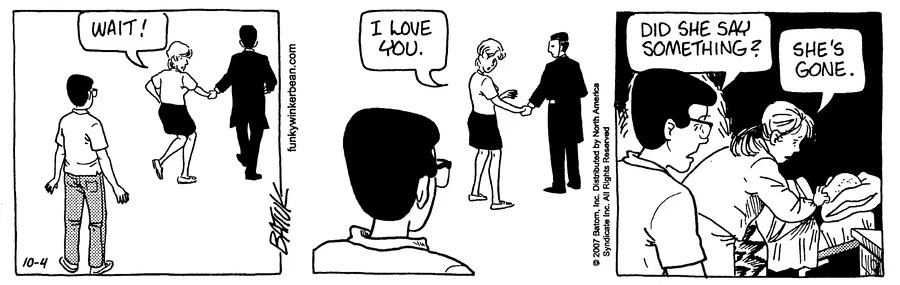
And we immediately smash cut to a goateed Les lying on a couch, speaking to a therapist as it flashes back to him dropping off Summer with the Winkerbeans while he heads to New York to spread Lisa’s ashes in Central Park.

Now Batty’s rationale for fast forwarding through and past everything was that he didn’t want to turn the comic into an extended grieving process but given what happens in Act III that’s obviously a load of crap.
The simple fact is that he wants to tell this grand ongoing narrative but is incapable of thinking of stories as existing beyond themselves. When the Flash beat Weather Wizard that was the end of it, it didn’t affect the next issue and it’s the same approach that Batty likes to take with his stories. Which is fine if you want to do a bunch of loosely connected but self-contained stories but that isn’t what he’s doing. We can see that in the currently ongoing Dinkle Pity Party in Crankshaft where 50+ years of Harry L. Dinkle, the World’s Greatest Band Director is brushed aside as a mere persona created by a man with daddy issues. All the haranguing, egotism, band turkeys… it was just an act to hide Dinkle’s insecurities. None of it was mentioned before this story and I would bet that once it’s over it’ll go in the same box and shoved into the same closet as all the other important stories and revelations like Danny Madison or Bull’s having protected Les from even worse bullying.
Or like Lisa’s death and the fallout from it. A story this big needs to dive into what happens afterwards, how the characters react, how Lisa’s passing affects them. But Batty is incapable of thinking about any of that and to him it’s not important anyway. Lisa dying was what was important and once her life ended so to did the story and it was time to move on to the next one. So the two weeks that TB allots for the story of Les’ NYC sojourn is all we get. This was his big masterpiece of a story and it’s treated with all the gravitas of the ending of a Silver Age comic book as that’s what his storytelling sensibilities are stuck in.
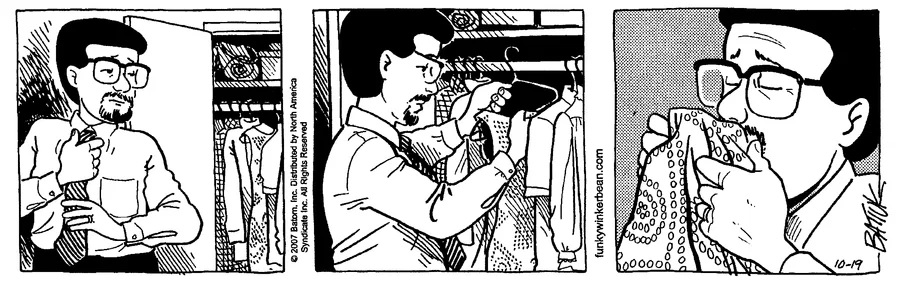
And back to the actual story, we get a little bit with Les returning to tuck Summer into bed and stare forlornly at his now empty bed.
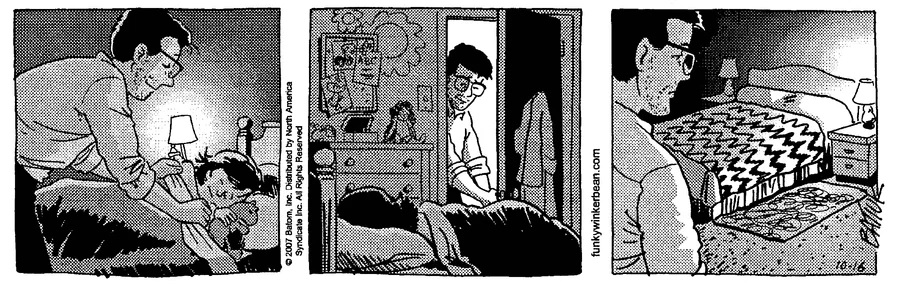
And, uh, sniff Lisa’s clothes like a giant creepy weirdo.
He finally sits Summer down to explain death to her and that Mommy isn’t coming home at which point we get one final Sunday that transitions to older versions of Les and Summer.
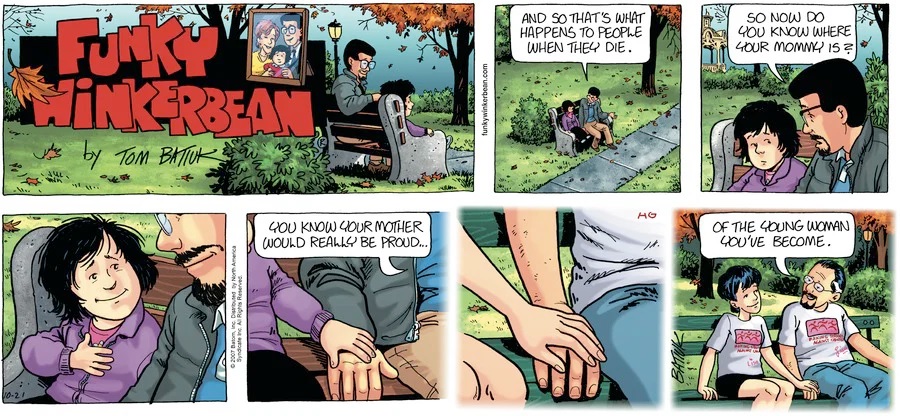
With that, Act II officially closes and we enter into Act III starring the middle-aged Les and the teenage Summer… for now, anyway. We’ve jumped ahead ten years but not really as infamously the timeline was instead shifted back by a decade because I guess TB is so lacking in imagination that he was unable to think of what life would look like in the far off year of 2017. Perhaps it would have had flying cars and ray guns and look like something out of an atomic age sci-fi comic book but maybe not. Best not to risk being wrong.
What will the future of Funky Winkerbean and Summer Moore look like from here? Next time we’ll gaze into tomorrow to look at the future-present of Westview and Batty’s attempts at making Summer into an actual character.


DSH getting arrested (just that part, not the ridiculous tilting at straw men in the trial that followed) remains my all time favorite Funky Winkerbean bit. That had to have been Ayers idea to follow Lisa asking “Where are you?” with DSH being hauled into Car 54, right? It’s too clever a reference for me to think otherwise.
Also, let us not forget how Lisa hijacked Holly’s Washington DC trip and wagged her finger at Representatives David Obey and Jerry Lewis for a strip or two. Not asking for federal funding for better lab tech training, though… One of late-Act II Lisa’s less becoming acts, I thought.
“I’m dying of learned helplessness and bonehead defeatism but you’re the suckers” had to be the second stupidest thing she ever said.
And let’s not forget why Doctor Lethal exists: to make sure that Summer discovers that comic-brain idiot white boy is humanity’s nation.
Lisa had every right to tear Doctor Stupid a new arsehole but that would make her the bully.
Dr. Stupid tells Summer from Westview, West Ohio: “Your parents are aliens! And while you’re in school, they shed their human skins and breathe dryer lint!”
Happy, happy. Joy, joy.
Too bad John Kricfalusi really *was* a sick little monkey. He made some great cartoons though.
My personal favorite is “In The Army.” The first time I saw it, I was with my college friend, who’d been in the army. He howled with laughter, which of course made me laugh too. According to him, it was a very accurate depiction of basic training and army life in general.
Still Gabby says–I was in the Army, and the gas chamber is a standard training exercise. My wife couldn’t believe I let it happen to me–like I had a choice.
But–true story. Many years later my wife and I were at a party, milling about outside. I suddenly smelt CS gas, which is what we were trained to know in the Army, and I was able to get her out of there.
He appears to have been a fly paper for other deviants. Case in point: Chris Savino was and is a real life Mineta from MHA.
7/9: Let’s give Larry a bullcrap Freudian excuse. There’s a Freudian excuse for everyone who ain’t Bull Bushka.
So today we learned that Dinkle’s daddy issues have daddy issues. Are we gonna work our way back to Adam and Eve, or what?
Probably.
Not even Bull Bushka was free of the Freudian excuse.
He’s the one getting a face full of it being no excuse because forgiveness ‘means’ Les should have been bullied.
Not that Batiuk ever showed Les doing anything with his father, of course. (For that matter, was his father ever even seen on-panel? I think there were some “word balloons coming from the house” strips, but… was the guy ever actually shown?)
How would Bull have seen Les doing things with his father? Did they live next door to him or anything like that?
I think Bull saw Les somewhat getting along with his father while he was walking around in the mall in Westview
And as rote as the Freudian shtick was with Bull… it was still plenty effective. It worked because Bull demonstrably changed his bad behavior prior to this reveal, so his reflection on his past behavior ringed true.
It can even work when the bad actor doesn’t change. It worked in All In The Family episode “Two’s a Crowd” where Archie and Mike accidentally lock themselves in a storeroom and then get drunk, for example… because the reveal that Archie’s prejudice reflected his fathers’ prejudice and was reinforced by the verbal abuse of his peers and the physical and mental abuse of his father is not just given to the audience, but to Mike as well. Maudlin as it is, the reveal is earned because Mike and Archie have a longstanding antagonistic relationship and Mike is given perspective on it, not just the audience.
We get nothing like either situation here with Dinkle. He’s shown no indication that he’s changing his ways or has need to make amends to anyone he’s wronged. He barely knows the folks he’s revealing all of this to (to our eye, at least… Lefty, or even Holly, would have been a more impactful audience for him).
And unlike with Archie Bunker, who may have been just as prejudiced as his own father but was demonstrably not an abusive spouse or parent, Dinkle’s megalomania by all appearances led to much much WORSE behavior with more widespread effects than whatever his own father did to influence it. Joseph Stalin’s father was an abusive alcoholic who eventually left the family during Joseph’s childhood, which is terribly sad and certainly informative… but it is very much NOT a redemption arc for the man.
To understand all is not to forgive all. Les neither understands nor forgives.
This fear of the question “and then what?” also explains his disdain for Marvel. Things don’t snap back nicely in real life so just dropping things after the end is bad writing.
The sad thing is, some of these individual strips are really, really good. The one where Lisa walks Summer to her first day of school, and then collapses on the sidewalk in fatigue once she’s out of view, is pretty heavy. It captures the reality of someone facing their own mortality, and not getting to watch their own child grow up. Even the cursed close-up is nice, because it’s got the right tone and art style for once.
But some strips show us exactly why Funky Winkerbean was so repugnant. “In my grief, my only concern was keeping my promise to Lisa.” You have a 6 year old daughter who is also grieving, you selfish fucking jackass. Any therapist who didn’t tear Les a new asshole for saying that is a worse doctor than the Dr. Stupid-Indifferent who got Lisa’s cancer wrong. And after that, Les’ inability to cook anything other than hot dogs and peas was supposed to be funny. Good Lord.
A grieving single parent’s top priority is not taking a scoop of ashes on vacation to do some ritual that means nothing to anyone but him. Batiuk loves that one, doesn’t he? Lillian delivering Eugene’s long-hidden letter, Les carting another scoop of Lisa’s ashes to Mount Kilimanjaro, and Dinkle’s sad little trumpet solo in the remains of the Akron Mystical Ballroom. And then they smugsmirk all over the place as if this accomplished anything.
I agree that some of those strips are excellent especially compared to the current storyline.
I know I’m probably going to get it for this, but compared to the misery porn of Act II, and the absolute sludge that was all of Act III…
I actually really do miss Lisa.
The entire dynamic, the art, the pacing, and, yes, even the writing in this strip was so much better before TB decided to slowly and torturously kill off his favorite pen-and-ink chew toy just for the accolades, secretly regret it (or the lack of awards), and then end up making it the strip’s MAIN FOCUS for the rest of its runtime!
No poster here ever “gets it” for sharing an opinion. Or anything, really, beyond the minimal forum rules. There is no orthodoxy to follow, or any proscribed opinions to offend. We even get a genuine fan every once in awhile. And we’re all pretty willing to give Batiuk credit when he’s earned it.
And I agree with you that at least Lisa was some kind of focus point. Like Wilbur Weston in Mary Worth or Bernice in Luann or CIApril in Judge Parker, at least it was a character worth hating, or just getting sick of.
Summer is always going to register as Someone Else’s Problem because Les is an oblivious selfish fucking dickchoad.
Narshe,
Les smelling Lisa’s clothes is accurate and quite sympathetic. The aromas left from loved ones onto clothing, triggers memories in a very powerful way. This might be the best that TB shows basic grieving.
Agreed. Especially considering Lisa had just died. In fact, my Saturday post will be about exactly this phenomenon.
The “Christmas” tree? OMG, that strip is old!
Batty got woke at some point and now refers to it as the Holiday tree. You know, the Holiday tree, under which the Holiday presents are placed to be opened on Holiday morning.
Batty dares not utter The C Word anymore, lest he offend . . . uh, someone I guess.
Allow me to take my pet peeve out for a little walk again.
They’re not Holiday trees. No one has ever put up and decorated in their house a Hannukah tree, or a Kwanzaa tree, or a New Year’s Day tree, or an MLK Day tree, or a Valentine’s Day tree, or a St. Patrick’s Day tree, or a Passover tree, or an Easter tree, or a Ramadan tree, or a Memorial Day tree, or a Flag Day tree, or an Independence Day tree, or a Labor Day tree, or a Veterans Day tree, or a Diwali tree, or a Thanksgiving tree, or for that matter an Arbor Day tree. They decorate Christmas trees, dammit!
Thank you for your indulgence.
(I mention this as something interesting, and not to be argumentative.)
My family has hosted several high school exchange students from “Post-Soviet” Central Asian republics, such as Kazakhstan and Turkmenistan. I was surprised to learn that, in those countries, there’s a tradition (left over from Soviet times) of what looks like a Christmas Tree, but is a New Year’s Tree, set up to celebrate the New Year. If my recollection is correct, the students were at least somewhat familiar with Christianity and Christmas, but seemed to have no idea that their concept of a New Year’s Tree was used for another holiday in other countries.
This said, when I hear “Holiday” used in that concept, I can’t help but wonder, “Which holiday?”
“concept”? I mean “context”.
I wouldn’t doubt “Holiday tree” to be a small thing adopted as a Batiukism (I have heard more ancedotes on “Vendos” being more common than thought), but what are some examples of that phrase being used? Legit don’t remember them, and with how we lean on the awkwardness of “climate damage” I’d figure that’d be a more common gag.
Also if he really was “woke” he wouldn’t have just left Roberta’s transitioned state as a one-n-done cameo as opposed to getting her own prestige arc. Or have Ayers draw her so unflattering.
Rolanda, not Roberta. Roberta is Becky’s mother, who somehow didn’t become the strawman busybody during The Burnings.
Of course, the whole point of “Rolanda” was for Batiuk to show off his “woke credentials” without actually, y’know, doing anything to demonstrate it. Like the “gay prom” story, where the two gay guys showed up long enough to draw Roberta’s ire, and then completely disappear from the story that was nominally supposed to be about them. (More important for Nate to give his support than to actually use the characters he was supporting.) (Guys didn’t even warrant being given names, that’s how unimportant they were to Batiuk’s demonstration of support.)
But Tom paid lip service to the cause, and that’s all that’s what’s really important.
Today’s Crankfuckery
Day 39 of In The Name of The Father
(ZZZZZZZZ)
Still Today’s Crankfuckery (happy 49th birthday to Rachel Winkerbean)
Ed: HAROLD, SHUT THE FUCK UP!
7/10: Crankshaft speaks and he’s doing someone else imitating him.
Well, Ed gets his first lines of dialogue since June 21 (look it up), and all he can muster is a compounding of “muddled aphorisms” that he immediately walks back? Give it up, Cranky. This arc wasn’t meant for you.
Who was it meant for? And can we find them, and stop them from doing whatever it is that keeps this thing going?
This arc was meant for Batiuk. His purpose is to explain someone who doesn’t need to be explained.
He’s hinting broadly at being a huge troll.
Oh, Lord, Puff Batty and his neverending battle with the strawman of “Comics aren’t art and they’re supposed to be funny, nyah nyah.”
Let’s look at the timeline, shall we?
1980: Art Spiegelman publishes the first installment of the serialized “Maus” in his alternative comics zine, “Raw.” “Maus” tells the harrowing story of Spiegelman’s father’s survival in Auschwitz.
1992: The anthologized “Maus” wins the Pulitzer Prize.
2005: Bravely Bold Sir Thomas wades into the fray all alone, bringing to a mocking, doubting world the stunning revelation that comics can too be art and they can so tell serious stories and they’re not always funny!
TB mistakes the tonal whiplash his readers were reacting to — from high school hijinx to young-adult drama to — lengthy, relentlessly grim, fatalistic plots about a young mother spinelessly resigned to dying of cancer? Spiegelman’s readers would have done the same if he’d abruptly pivoted from “Vladek starving in Auschwitz” to Hogan’s Heroes-style wacky, hilarious Nazis and zany tomfoolery.
BTW, thanks so much, Narshe, for your incredible efforts — the deep dives, the research, and the analysis. It gives us all so much to chew on in the absence of any meaty storylines in Crankshaft.
That would require him to understand people. Not happening.
Batty’s issue is that he got a little bit of praise for the original Lisa story, his syndicate worked to make it a teachable moment kind of deal and he got it in his head that he was able to do big dramatic works that meant something. His entire career for the last 40 years has been attempts at trying to recapture that high but never being able to do so to his frustration. Instead his attempts were mocked or dissected for the incompetency on their own and combined with the sudden jarring shifts. Not just from what it was in Act I to what it became but from week to week.
Like I mentioned here, you have Lisa’s cancer and Wally getting shipped to Iraq intercut with insipid stories about a pizza cooking competition or Tony trying to teach dining etiquette to the staff. And sure, you can have heavy and serious stuff broken up with lighter fare but it’s the way it’s done that’s the issue. Like the one week Les is looking in the dumpster for a check, then the next the post office is bombed and Lisa almost dies for a few weeks, then that story finishes and it smash cuts to a week of Dinkle buffoonery while the bombing remains unsolved and never brought up again while Lisa suffers no ill effects like PTSD. Almost like it never happened.
Nothing is eased or gracefully transitioned into. Just suddenly Lisa has cancer or is blown up in a post office explosion and it ends and that’s that, time for hijinks again. The serious stories aren’t treated with the gravity they need either in the telling or aftermath, there’s no true depth given to them and thus they come off as childish and insincere which is why Batty got mocked instead of praised and never got the recognition for his supposed daringness that he craved.
You can go back and read the Lisa pregnancy story and it contains all the same hallmarks that mar all the other prestige arcs he attempts; every single one. It starts with no build up, it goes on for a while but nothing really happens, the characters involved act the way they need to for the story to happen regardless of whether or not it makes sense with how they’ve been written before, and when it ends it’s immediately moved on from having made no real impact on anything until whenever Batty wants to call back to it in a poor attempt at giving his world the depth and history it lacks.
That’s why I keep coming back to a question he fears: “And then what?”
Narshe, you’ve hit on the key explanation of why Batty’s Act III writing just doesn’t land — “cargo-cult” plotting.
In other words, he’s noticed that other writers and creators get accolades when they write about certain topics, like cancer, transgender/gay topics, veterans with PTSD, Islamophobia, alcoholism, racism, etc. So rather than understand what actually drives the accolades, he focuses on the obvious, surface features: The topics.
And he thinks touching on them very lightly is sufficient — we didn’t even see the faces of the gay students at the prom, but he did a Gay Storyline, box ticked, badabing, done. We didn’t see anything about Rolanda’s struggle, or learn how he went from sexist lothario man in high school to sensitive woman at the reunion, but it doesn’t matter, because it’s not about the story, it’s about ticking the box: Did a Trans Storyline, box ticked, badabing.
We see this in his discussions of his favorite Flash comics. Just plot. Nothing about what anything means, nothing about how anything affects characters, nothing about why the creators might have chosen certain pllots and why they chose certain art, layouts, and dialogue. Nothing about what specifically he loves about a given issue or character or artist. Just “this happened, and this happened, and this happened, the end.”
Just like a dumb f****** kid……
That’s the thing that gets me too. He’s supposedly passionate about comic books (or other things) but when it comes time to talking about them you never get the impression that he cares beyond a surface level thing.
There’s a manga I like (whose translation has unfortunately been dead for a while) about ballet. I went into it with no knowledge at all of ballet but it’s very clear when you read it that the author loves ballet. So much time is spent on the nuts and bolts of learning things and the rigors of practice. You’ll have entire chapters centered around the idea of having to immerse yourself in things like European art history or folklore and such to properly understand the context that a certain ballet was created in to be able to properly perform them, doubly important for the Japanese characters who don’t have that connection to western culture or history.
It’s the type of enthusiasm for the subject matter that made me go “Okay, let me see what some of these dances are that are being performed” and through there, hey, I’ve been going to watch yearly ballet performances that come through my area for the last few years. It’s not something you’d ever get from reading TB’s works because the subject of comics are never really explored in a way that conveys to the reader his own love and appreciation for what he’s talking about. It’s just very banal and shallow statements.
On a (very) few occasions, Batiuk would put some commentary into his Flash write-ups, but even those were more telling than he realized. Like, he might call out some cliched trope being used, somehow unaware that he himself would use those exact same tropes. Only to much worse effect.
The superficiality of his “prestige” topics also reminds me of his Atomik Vomits “climate damage” comics. Where most of the covers didn’t seem to be about the alleged topic at all, and the one that was (The Subterrarium or whatever) was so nonsensical it’s not even clear if it was supposed to be FOR or AGAINST ecological disasters. (Is that a burning factory or oil refinery or something? Is the fire the “climate damage”, or is it destroying the source of “climate damage”, or what? Did Subterrier start the fire, or is he trying to stop it? Wouldn’t burning down a source of pollution cause MORE pollution? And why was the art so bad?)
And then Batiuk had one of the characters (Flash Forgothisname or Undead Phil, I think) complain that their “climate damage covers” weren’t really doing much. Not the comics, the covers. As if (as we’ve suspected), Atomik Vomits only produces covers, not actual comics, or they just put the “message” (such as it was… or wasn’t as the case may be) on the cover and the actual comic was completely unrelated.
Basically, in true Batiuk fashion, he paid lip service to the concept, but couldn’t be bothered to actually address the issue, but I’m sure he thought he deserved praise for doing the minimum.
This sort of nonsense hits hard because most people have had rough patches in their past but don’t turn into a band director themed supervillain.
Thank you for reminding me of Jerry Thomas (whom you’ll actually meet in Crisis on Infinite Earths #11), who sent in a scenario in which the JLA battled a musical malefactor named the Maestro, who imprisoned them in “The Cavern of Deadly Spheres”). Luckily, in reviewing the situation (hi, Fagin), the team realized how to defeat him.
The story appears in Justice League of America #16. DC reprinted it in Justice League of America #113.
Batiuk would approve of that,
You also reminded me of Van Johnson’s turn as the Minstrel on the 1966 “Batman” TV series. in “The Minstrel’s Shakedown” and “Barbecued Batman?”
Batiuk would not approve of that!
Hat tip to Joseph Nebus, who put a link to his blog post on this arc in the comments to the previous post on this blog. He mentions that there is actually an obvious Kinks song to accompany the arc, and it’s not “Death of a Clown,” it’s “Come Dancing.”
It’s got that elegiac quality TB loves so much, only Ray Davies can actually *do* elegy without sinking into the maudlin and clichéd. It’s literally about the destruction of a Palais, or dance hall, where big bands played.
But metaphorically, it’s about the death of Davies’ beloved older sister, who died of a heart attack literally while dancing at a Palais, when Davies was 13. In a twist that Batiuk could have written, she’d just given Davies his first guitar that day.
They put a parking lot on a piece of land
Where the supermarket used to stand
Before that, they put up a bowling alley
On the site that used to be the local Palais
That’s where the big bands used to come and play
My sister went there on a Saturday
Come dancing!
All her boyfriends used to come and call
Why not come dancing?
It’s only natural.
…..
The day they knocked down the Palais,
My sister stood and cried
The day they knocked down the Palais,
Part of my childhood died, just died.
Here’s a link to Joseph Nebus’ post:
https://nebushumor.wordpress.com/2026/07/11/why-is-everyone-angry-at-_crankshaft_-i-mean-about-the-harry-dinkles-father-story/
Note, too, that Davies gave his sister the happy ending she never got in real life.
“My sister’s married and she lives on an estate…”
Of course, Davies is an infinitely better artist than Batiuk,
He’s also a better person.
https://www.youtube.com/watch?v=xRUE0aAI5o8&list=RDxRUE0aAI5o8&start_radio=1
For those who have never seen or would like to revisit the video to Come Dancing, it’s attached here. This was produced in MTV’s heyday, when bands started budgeting for video production and creating some really fun clips. As I mentioned in a prior post, this song introduced my brother to The Kinks, and it’s a great one. The video is heartfelt, sweet, funny, and full of joy. The old ladies dancing with the mops still give me a smile! There’s not a maudlin moment in it, which would explain why TB chose something else.
Honestly, in British parlance, “living on an estate” could actually mean a lot of things, across the entire spectrum of socioeconomic status. (Literally, it could be anything from “large sprawling area of land with a mansion” to what we in the States would call “project housing”.) It means different things depending on where you sit on that socioeconomic ladder, and it’s not quite clear (to me, at least) which it’s supposed to be in the context of the lyrics.
On the other hand, unlike reality, the song doesn’t include AND THEN SHE DIED, so… at least she got a happier ending, if nothing else.
Aw, thanks kindly for the shout-out. I do want to say, though, I’m far from the first to observe that “Come Dancing” would fit the story so much better. Several commenters said it in comments before I wrote my slightly cranky posting, and I’ll beg off giving names because it’s late and I’m sleepy and WordPress’s search box is so exhausting. But I agree with them all because it is so freaking obviously the better fit it’s a wonder that Tom Batiuk could get this wrong.
The least bad explanation is when he sketched out the story he remembered there was some Kinks song about nostalgia and the loss of the cherished old things and made a note to use that, and then when it came time to writing the final script he noticed … oh, there’s kind of a lot of Kinks songs you can describe like that and he went with the best fit after he’d got through listening to Preservation Act II and decided this wasn’t an important enough point to keep doing research.
“Village Green” and “Do You Remember Walter?” from The Kinks Are the Village Green Preservation Society would also work well.
I’m struggling with David Foster Wallace’s Infinite Jest and you make me want to to be wondering where they all are now:
I hope that Arthur Seaton is alright
I hope that Charlie Bubbles had a very pleasant flight
And Jimmy Porter’s learned to laugh and smile
And Joe Lampton’s learned to live a life of style…
7/11: And again, the easily deciphered muddled aphorism totally stumps women.
I’m stumped by “closure”. I’m assuming that playing a battered trumpet on top of rubble indicates forgiveness, but since I still have no idea how Harry actually felt about his father then or now, I’m not sure what has been closed.
And we never will have any idea either.
With any luck, this story line is closed.
It’s like a video game fetch quest: take the arbitrary item to the arbitrary location, perform the arbitrary action, and the next cutscene will play.
At least in that case you get some kind of a reward. Maybe it’s a cool weapon or useful item, maybe it’s just some insignificant pocket change but it’s something. The only reward the reader’s left with after this tale truly told is wasted time.
Judging from the Sunday strip, his mind. Daddy is bestest because AND THEN HE DIED
At least he got the horn fixed, although I’ll be surprised if we ever see him play it again.
Well, I didn’t think he would. It’s going to stay there like a Bombers helmet because AND THEN HE DIED. He’s also never going to release Sunrise Over Kilimanjaro to the public because AND THEN HE DIED.
Of course, if Batiuk is acknowledging that the trumpet had to be fixed/restored, it raises the obvious question: how awful did that thing sound when Dinkle was playing it?
Like what would happen if Harmony Smurf was a jazz cat.
I’ve always hated the sloppy use of the term “closure.” In another life I worked on the A&E true crime series American Justice with Bill Kurtis. We had a strict rule – when I was Supervising Producer it was actually posted on the bulletin board in my office: “THERE IS NO ‘CLOSURE’ IN AMERICAN JUSTICE.” It was necessary because every single script draft would come in with some language about the killer’s (it was a 99% murder show) conviction “bringing some sense of closure to the XX family…” which was just a down and dirty way to get in a couple of sound bites from the family and wrap things up fast. We also had a list of “Words We Do Not Use In American Justice”; the only ones I remember were those that the narrator couldn’t pronounce correctly for some reason (I learned that every VO person has at least a couple that they just get wrong every time.) I won’t share them out of respect for the narrator but suffice it to say, they were unfortunately words that were very useful in crime stories.
Those people tore big holes in people’s lives that can’t be filled no matter what Dick Wolf might say. Closure is like sympathy: a word in a dictionary.
Both Yesterday and Today’s Crankfuckery
Days 40 and 41 of In The Name of The Father
(Ed and Lillian then beat the shit out of Dinkle)
I wish…
I chuckled at the sentence “I’m glad we went with Harry to that abandoned amusement park today.” Maybe not a panel of the year winner, but a worthy nominee perhaps?
At least nobody was being chased by a guy in a rubber mask messing with them.
In Batman comics, “abandoned amusement park” usually means “hideout for the Joker”. (I think Gotham has more abandoned amusement parks and deserted warehouses per square mile than any other place on Earth.)
A shoo-in for a nomination, though I suspect the noms will be top-heavy with panels from this arc. SOOO much clunky exposition word balloons.
7/12: Meanwhile, Eugene’s ashes are in the Laurentian Trench next to the Decepticons.
Great job, Narshe. Thank you for the deep dive. Without your efforts, I wouldn’t even remember this stuff. Has Les ever been a sympathetic character?
Sorry to be so late. It seems like I’m always playing catch up.