Tom Batiuk’s latest attempt at a prestige arc, which he pretentiously titled “Dinkle, I Am Your Father” or something like that, is over.
Well, it’s not officially over. But I’m calling it over as of Thursday, because that’s the best place for it to end. I’m sure Friday, Saturday and maybe Sunday will be full of Lillian smirking at us, and explaining how we’re supposed to interpret the ending. Which insults the reader, and undermines the point of leaving it ambiguous. But I’m done showing Tom Batiuk how to do his job.
This will also be the last leg of the strangest multi part post in SoSF history. Weather forecast: clear, smooth sailing. No trauma dumps or cluster f-bombs on the horizon. This post draws on elements of Destroy Everything You Touch, so read that if you haven’t already. Be warned: that post is also a M*A*S*H-level dive into my own psyche, tied into the two subplots of this tedious story. This post will continue that analysis, focusing on the Eugene and Lucy half of the story.
The problem is easy to explain. Eugene and Lucy is not a love story. Eugene and Lucy is a limerence story. Let’s start at the beginning:
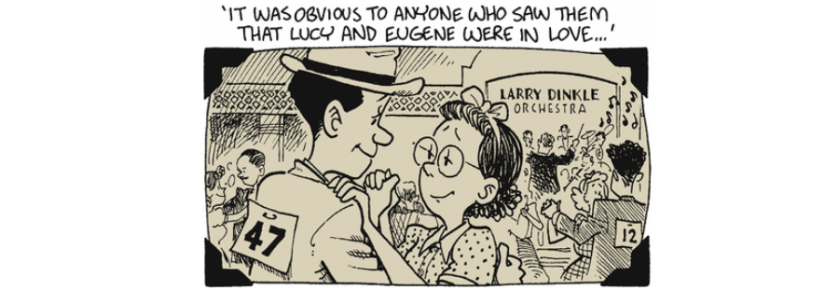
Was it, Lillian? Was it really? Who besides you was even looking at them? It’s a dance! People are looking at their own dance partners! Like they should be! Get over your Main Character Syndrome! (No theory of mind, a central problem in all of Tom Batiuk’s writing, rears its ugly head again.)
This is not love, this is limerence. Also known as “putting someone on a pedestal,” “in love with being in love,” “infatuation”, “obsessive love”, and similar things that are bus stops between “crush” and “creepy.” It’s when you’ve built a fantasy version of someone in your mind, independent of any actual information you have about the person. This is a great explanation:
Eugene and Lucy are a concept to each other. They’re both in love with the imaginary versions of each other they think will fulfill them. We don’t know anything about Eugene and Lucy, and they don’t know anything about each other, beyond one pleasant night at a pre-World War II dance, and an implied brief relationship. The story makes a lot of bold assertions about true love, but it provides zero evidence of that.
Most romantic relationships in the Funkyverse are actually limerence. They’re all arranged marriages between minor characters who don’t seem to have any reason to be together. This happens when your only source of how adult relationships work are comic books for 9-year-olds, and a marriage to your high school girlfriend.
John Howard and one-armed Becky are the most mismatched couple you could possibly create. She’s a disabled person with genuine talent, and is using it the best she can, hyper-motivated to prove she still has worth. He’s a lazy slob who only wants to spend all day in a comic book store, without ever contributing income to the family, or changing his T-shirt.
John and Becky, Bull and Linda, Mason and Cindy, Pam and Jeff, even Les and Lisa don’t even seem to like each other that much. (Exception: Funky and Holly genuinely do like each other, and have some sweet moments.)
I’ve long struggled with limerence, and it was a key reason many of my adult relationships fell apart. I took every relationship way too seriously, far more than my partner took it. Because I immediately turned any girl who gave me the time of day into a potential wife. I filled in any unknown data with what I wanted to be true. Limerence and low self-esteem is one hell of a cocktail.
The key is separating limerence from tangible qualities.
In Leaving Westview, I said:
In high school, I didn’t see anything but attractiveness and popularity as being important. I learned in adulthood that confidence, personality, positivity, values and common interests are far more important.
Let’s revisit Christine, my unrequited love from high school I introduced in Destroy Everything You Touch. (Inverted trope: I was her unrequited love.) She had personality, positivity, shared values and interests with me, and enough confidence to approach me when she otherwise didn’t have a flirty or forward nature.
This is not limerence. This isn’t me filling in the blanks with what I wanted her to be. These are genuine qualities I observed, based on many real interactions over a year or two. She was legitimately a very good potential partner, and would have been at any age. But in high school, I picked Ken O’Brien when Dan Marino was available. (Please note that Ken O’Brien was still a pretty good NFL quarterback, and two-time Pro Bowler. Susan, if you’re somehow reading this, I don’t regret picking you at all. You were awesome. My first kiss with you was one of the few romantic milestones in my life that actually went really well.)
Limerence can even make you idealize yourself! I caught myself comparing Christine’s 16-year-old self to my 54-year-old self, not my 17-year-old self. She was calm and easygoing, which I am now, but 17-year-old me very much was not. I was high-strung, and hadn’t learned how to manage my anger and frustration yet. Which might have been a serious obstacle in any real relationship with Christine. And I’ve had partners in my life who were attracted to me for qualities I definitely didn’t possess.
In the Funkyverse, limerence can apparently affect other people. Lillian seems to have swallowed the notion that Eugene and Lucy were some kind of destined couple that only didn’t get together because of her own selfish act. This is ridiculous.
If anything, Lillian should have been the one to tell her sister “oh come on, it was just one guy, get over it already.” Which is yet another way she should could have reversed her misdeed, but didn’t, even though she could have still covered up what she did. Lucy’s Story has a comprehensive list of the others.
It’s time for the lightning round! Today’s topic is Why This Story Sucks, Even By The Usual Low Standards Of The Funkyverse.
It’s too easy to move on. Despite my low romantic potential, I still preferred hoping for future opportunities in college over lamenting missed ones in high school. As any 18-year-old would.
Eugene never got a response to his letter, and interpreted that as a rejection of his marriage proposal. He served in the military until the end of World War II, and then came home. Imagine a returning soldier with a broken heart while V-J Day in Times Square is going on. No war veteran is going to be moping about the girl who said “no” years ago when they return home to a demographic abundance of females. Many of whom are throwing her panties at him, eager to start creating future baby boomers.
It should have been extremely easy for Eugene to forget Lucy and find a new girl. We’ll soon see why it wasn’t.
Something triggered my nostalgia. I haven’t been pining for Christine for 38 years. I never even thought of her for 37.95 of those years. Eugene has been in a consonant state of pining for Lucy since 1946, even though she died in 2009.
I don’t idealize the past. I realize that a relationship between Christine and I might not have worked out, for a million different reasons. Which would have been fine.
I spent most of my high school nights dreaming of random, unremarkable girls who caught my fancy at some point, but whom I never had the nerve to approach. They seemed unattainable to me. I daydreamed about how receptive they’d be to me, and how well-suited they’d be, even though I had no reason to think that. All while I ignored someone who actually was those things, and was trying to tell me she was interested. That’s what limerence does to you.
I recognize my own mistakes. Despite everything I wrote previously, I ultimately don’t blame anybody but myself. I could have started a relationship with Christine almost anytime I wanted to.
The failed relationship was a symptom of a much bigger emotional problem. This was obviously the case with me. My inner demons caused me to do an irrational, self-destructive thing to a desired relationship. We’ve often said that Eugene simply should have re-proposed to Lucy, or gotten a clarification of what her answer was. Why didn’t he?
Because Eugene was so afraid of rejection that he chose “no response means no” over Lucy actually telling him no. Why else would Eugene act like his “I’ll never bother you again” promise was more important to keep than his “I want to spend the rest of my life with you” promise? Which he didn’t keep anyway, because Eugene and Lucy had some kind of contact after that?
The four days of wordless, actionless panels imply that Eugene is moving into some kind of senior care facility, or hospice. And he’s ashamed of this. To be fair, dying at age 99 would be early compared to people like Lillian Mckenzie, Ed Crankshaft, and Mort Winkerbean. But I think there’s a much better explanation.
Eugene is moving into a mental institution.
Just like Lucy did.
And for the same reason Lucy did: because he was so in love with a concept that he let it destroy his entire life. And it also took Lillian down with it.
In a psychology class in college, I heard a story I’ll never forget. There was a psychologist who worked in a home of people having severe detachments from reality, to the extent that a woman would tell him she had a new baby every single day. The doctor said “even if I could push a button and cure her, I wouldn’t. She’s much happier where she is.”
So this is a bittersweet ending, which is an improvement from the just plain bitter we usually get. In the end, Eugene and Lucy got together, in a way. Unless this story is somehow still continuing. And if it is, then let me say with no irony whatsoever: bring on Batton Thomas!


BJ6k,
Bring on Batton Thomas????
Have you drank too deeply from the
limerence Kool-Aid??? Why are you showing unrequited love for Batton, of all people. My gosh, man! Put ComicBookHarriet on a pedestal. That’s a winning ticket. (I can easily see her as the Kate Winslet character.)
After only a day and a half of Batton, you would be crying out for more Larry Dinkle. After 2 full days of Batton, you would beg for Larry’s entire playlist.
Good grief! Come back to reality, son. Follow the light back to sanity and clean living.
Hurry, CBH! Send BJ6K soothing words and make him make a bigger pedestal. (Should CBH prove a bridge too far, I suggest Be Ware of Eve Hill! Mr. bwoeh only loads his pistols bimonthly.)
🤪😋😜🤩😎
After only a day and a half of Batton, you would be crying out for more Larry Dinkle.
And six weeks of Larry Dinkle made me cry out for more Batton. That’s the promise of the Funkyverse. Every story is so bad that it makes you cry out for whatever story isn’t on right now.
So true, but experience promises us there is never, ever any redemption in a Batton Thomas arc. In the same way, we never say “Les Moore” 3 times in a row.
🤩🤪😎
Believe me, I’m not looking for redemption – or any kind of plot – in a Batton Thomas arc. But it would be devoid of half-assed Pulitzer bait, which is what I would welcome after six weeks of this shit.
All of this is well said, but I’ll break out the dead horse on this week and state the other flaw of this week in particular is that Batiuk has forgotten how much Ayers elevated his strips with his subtle touches to illustrating scenes. Multiple days of Eugene and Lillian having a long-awaited important conversation without us privvy to hearing the details, and all “Dangerous” Davis can deliver is stock art reposting of the characters standing awkwardly and expression dull surprise at best. Wednesday was the deal-clincher where he had to (I can only assume) depict these two old people being frank and opening up about the love letter snafu and all the emotions related to it, and nothing was successfully communicated. It was fodder for our “caption this” fun and nothing more.
If he really wanted emotion to be expressed wordlessly about their complicated love life, he really should’ve just called up John Bryne for another week. He knows exactly how to depict fucked up “love triangles” set up by outside influences (and he allegedly did it while flipping a metaphorical bird to Jack Kirby in the process).
Ah, the ever-infamous “Superman makes a porno” story. (No, I’m not kidding.)
Yeah, it’s trying to tell a visual story without having any visuals. Tom Batiuk is trying so hard to be pretentious that he thinks taking a cab, walking up to a house, knocking on a door, greeting a person, talking, and saying goodbye is some kind of devastating metaphor for something.
Today’s Crankfuckery
Day 46 of In The Name of The Father or Day 4 of Eugene and Lillian Week
(Dinkle walks into the bookstore, and Lillian beats him to death with the sledgehammer that Eugene gave to her)
7/17: And the limerence story continues in silence.
Yeah, I guessed wrong. I thought Eugene would be gone by now and Lillian would be clucking about it to somebody. But the less anyone says, the better.
I was wrong too, but i was close on one of my guesses. I figured the car would be driving away, perhaps with Lillian looking out the window, but I didn’t anticipate the wave from the relative, hospice worker, or whoever she is. My other ones were a close up of a sobbing Lillian, or her hand reaching for a phone to call a mystery person
You’d think “Goodbye” would be the end of the story. But I guess Batiuk needs to show them pulling out of the driveway and onto the road, because he thinks we need it spelled out that much.
Batiuk appears to think telling stories is what lost him the Pulitzer.
Re: Crankshaft, Friday July 17 2026
Did… did Dan Davis really reuse a scene of the bookstore stairs with SNOW on them? That’s what that is, right? It’s not just me? (Or is it all the ash from The Burnings, maybe? We all know what a major conflagration THAT was.) I mean, I get that Davis doesn’t care overly much about this job (I doubt I would, either), but he couldn’t find clip art of a clean flight of stairs?
And the final wistful wave between Lillian and… whoever the hell that is. Truly the most moving panel in all of Funkyshaft history.
Meanwhile, we’re no closer to finding out what’s actually going on here than we were when Eugene started this nonsense six weeks ago. (And even further from caring.)
I don’t think he decided where Eugene is. I say this because he had to be told to decide who shot John Darling. It’s the funny book chump in him.
That’s a good point. I don’t know why Batiuk just couldn’t say that Eugene was moving into Bedside Manor. Plenty of characters have, there’s nothing shameful about it, and it’s a perfectly valid thing to do. I don’t think he wanted to keep it ambiguous as much as he wanted to keep it pretentious. He thinks if he dresses the story up in all this arty ambiguity, he’s going to win that award he wants so badly.
Maybe we should have a betting pool on where Eugene ends up.
(I’m assuming it’ll be “We’ll never find out”, but the only thing one can ever predict with Batiuk is that, whatever you predict, the final product will probably be way stupider than you imagined.)
I’m not sure it matters where Eugene ends up because it’ll be like seven months and he’s back without any explanation, or at least any explanation that explains anything.
What’s lost on him is that having Eugene say he’s in hospice care because he has three months to live will get him his Pulitzer.
The staircase looks like it might have been reused from winter, but they’re trying to pass it off as some kind of shading.
The important thing is… I learned that Davis can trace a Daewoo Lanos if asked. Perhaps he can work his way up to free handing a Daihatsu Rocky in the near future?
Poor Eugene just got Buck Bedlowed in the worst way. Didn’t even get to say the “Yeah that tragic disease this story has been about? Yeah I have it too. Life sucks eh?”
Your story, Banana Jr, makes me think of people who willingly cultivate a ‘Lost Lenore’ or ‘One that got away’ as a receptacle for their romantic feelings, even as they persist in a single state because they prefer fantasy and independence, or fear commitment. I don’t think I’m one of them, most people aren’t, but for a select few single and pining is better than the reality of a messy relationship.
Very Glen Campbell’s ‘Gentle on My Mind’, vibes. Or this, from the cornball comedy ‘City Slickers’.
Yeah, the Lost Lenore is another form of limerence. I’ve known too many people who build up a deceased person into something they never could have been in life.
One of the first weird things ever I found on the Internet was these elaborate memorial pages for never-born children, made by women who had miscarriages. I can see this having a little value in the grieving process. But these pages were being maintained for years afterwards, to the point that the mothers were writing fanfiction about the elementary school lives of their never-born children. NOT HEALTHY.
Then there are the weird people who keep a dead kid’s room the way he left it when he died. Yikes.
Again, I think there’s value in that to a point. Even if only because confronting the personal space of someone you lost is difficult to do. But sone grieving people do this for years. They treat the dead far better than the living, and it makes the living people in their lives feel unimportant. The grieving person is alienating everyone else in their life, which turns into “the dead one would never have rejected me like this “
The Funkyverse is a maater class in how not to grieve.
At some point, people just give up on the not grieving well person.
“Lenore” rhymes with “Les Moore”. This means something. (Okay, it probably doesn’t.)
And i never thought of the parallels between Eugene and Buck. But you’re right, it is a very similar story
The roles should have been reversed. This should have been the time that Lillian finally went to Eugene and explained everything. Eugene already said goodbye a month ago and otherwise realistically has nothing further to say to Lillian.
I struggle to imagine any professional editor who would have allowed this week to happen. This will be seven days to convey literally nothing that wasn’t already known. Awful.
Lillian telling Eugene about the hidden letter NOW would be about the cruelest thing imaginable. When you hurt another human being as badly as she did, there’s a statute of limitations on when you can make it right. Admitting it now would be like admitting the $1 bet in Trading Spaces that was the whole reason for toying with and destroying two people’s lives. Except for the difference in value between $1 and 80 years.
Which probably means that’s gonna be tomorrow’s strip somehow.
His whole life was a limerence-based lie so learning would kill him. The best she can do is put herself out of her misery when he does pass.
well said
Although it would help make Lillian into an even more evil, loathsome person, so… one never knows.
(At least when Cindy tried to go on her apology tour, she got smacked down for it.)
Yeah, but Crankshaft got something right this week that Mary Worth didn’t: don’t make your awful characters even more unlikable.
It’s more suspensive when you can’t tell what’s happening.
Suspenseful
There’s a large problem Batty has and it goes back to my previous Summer entry in that he has a bad habit of just not showing things and just presenting it as is. Look at Holly for example. We never see what turned her from Act I Holly to the more jaded woman she was when she came back during Lisa’s cancer story. She just shows up having changed and says off-handedly about having a divorce and breast cancer. The inbetween and actual development is unimportant to Batty, simply the end result.
This goes double with his romances. Could Becky and John have worked? Sure, if you take the time to show them and how their relationship develops but of course it doesn’t work like that. Everything happens entirely offscreen because Batty writes like an impatient child. It’s all about the destination, not the journey, for him and if he can just teleport from start to finish then even better.
Hell, just look at the timeskips between acts and how they completely skip over the college period and how every generation of kids disappears when they have to go off to college, despite the fact that it’s a period where you could easily show a lot of development for them. I’m half-convinced that Batty does not look fondly on his days at Kent State (despite every character being an alumni) because he seems to purposefully go out of his way to avoid ever showing characters attending college or doing stories set during their college days. It makes me wonder if the timeskips were done partly to avoid having to write college stories.
Chrissie Hynde speaks more fondly of the place and she was present when cowardice under fire became a thing.
There is also his marked tendency to not want to ask what reader may want to see.
As usual, you pack several good points into one post. I think the biggest reason Batiuk resolves what should be major stories off-camera is because he simply can’t write them. And he can’t write about anything he doesn’t experience personally.
He had a cancer scare, but it doesn’t seem like he ever had to face his own mortality. He had a successful long-term relationship and family, but doesn’t seem to have learned anything from it. He went to college, but never matured from it. He had a little success with Lisa’s Story and with a long-running comic strip, but he hit a wall with his desire for greater things. He had those comic book interviews, but he failed them,so he doesn’t know anything about the kind of people who get those jobs. And lord knows any kind of research is out of the question.
So everything he writes is either his fantasy version of something, or an incredibly shallow comic book-level take.
7/18: The pretentious way he ended this really hurts.
It’s the closest thing to a Crankshaft movie Tom Batiuk will ever get.
As I said, if he wants an award, he has to tell a story. He didn’t.
If this week were a movie, it would the type that Mystery Science Theater 3000 rejected because there’s just NOTHING to work with.
(To borrow a quote from Joel: “I’ve seen Dali paintings that make more sense than this movie.”)
Batty’s mysterious schlock and his obvious delight in creating it, capped by today’s WTF, reminds me of a passage from Catch-22.
//////
And all week long [Lieutenant Scheisskopf] chortled with repressed delight at the officers’ club. Speculation grew rampant among his closest friends.
“I wonder what that shithead is up to,”’ Lieutenant Engle said.
And what does “scheisskopf” mean in German?
Heh heh.
Heller’s Scheisskopf is a general at the end of the book.
Colonel Cargill listened to General Scheisskopf for a moment and went white as a sheet. “Oh, my God!” he cried, as the phone fell from his fingers. “Do you know what he wants? He wants us to march. He wants everybody to march!”
Both Yesterday and Today’s Crankfuckery
Days 47 and 48 of In The Name of The Father
I wonder if next week will be either a “Ed Crankshaft Does Some Stupid Shit” or another “Interview from HFIL”
Both would be MUCH more preferable compared to the Dinkle Pity Party
I appreciate Batty ending this prestige arc with an iris out, as if Dinkle’s going to pop out and exclaim “That’s all folks!”
My first thought when I saw the strip today:
Yeah, Batiuk was way more interested in making it look like a movie than he was about writing narrative, plot, motivation, conflict, character, structure, or anything a movie would have.
So is this arc truly done, or is it possible that we’ll get a “One Month Ago” type flashback next week that explains whatever this week was about?
You’ll be praying for tales truly told when Monday’s strip comes and begins with the following words.
“So last time, you talked about your band director character. What other stories stand out?” Then we get a week of jabbering on about the time Not-Lisa got pregnant.
Even worse: “So tell me more about your band director character.” “Well, his father was a band leader who had an orchestra that played in ballrooms, and he was all set to debut a new song when…”
You know how does Three O’Clock High work? Batton is just Batiuk and the strip is just Funky Winkerbean so, like, do the Westviewians read it and go “Wait, Harry Finkle? He’s like the old band director I had in high school.”
Did Les read Russ Moore having to deal with the time his wife went into labor early because the ex who’d impregnated her back in high school returned and then Liz gave birth to their daughter Autumn prematurely? And then Liz got cancer? Did Funky read about Groovy Blinkerpea’s alcoholism and the time his nephew-cousin Willy got lost in Afghanistan?
Did they wonder why this guy’s comics paralleled their own lives to an eerie degree?
Oh, I absolutely think it will be some version of that.
This tripe from a guy who once insisted “endings have to be earned”?
Of course. The ending wasn’t earned, so he didn’t give us one. Or a beginning or a middle, for that matter.
I can’t remember which Mystery Science Theater 3000 experiment it was but I remember the closing riff of “Well, it’s not ending enough for me! End more!”
I’ve seen the clip of Servo screaming at the screen “End! END! EEEENNNNNNNNNDDDDDD!!!!!”
Yeah, that’s a classic cry for relief, but there is something about the quieter plea of “end more” that really satisfies me.
7/19: Someone must have gotten shafted by his insurer.
Arcamax messed up the inking again so I thought I’d try my hand at a “Custom Cranky”.
Dammit, how do I post photos lol?
Type / image (without the space) and Insert From URL
I upload images to postimages.org. Then click share, then click on direct link, then come here and paste the link.
I’d love to see what you’ve got!
I use IMGUR. You can right click and get the actual image URL, then use it as above.
Ok cool I got it… finally.
Thanks a ton BJ6k and Ian!
https://i.postimg.cc/7YjKzsn0/download.gif
I couldn’t figure out how to post a gif here instead of a link.
On the plus side, it appears we’re finally done with the Pulitzer Prize-winning “In the Name of the Father” story.
On the minus side, we get Batiuk working through his disdain of the entire healthcare industry.
But also on the plus side, it still appears we’re finally done with that “In the Name of the Father” story, so… I guess it’s a net positive?
(Although if tomorrow’s strip features Batton and/or Skip, we riot.)
I think Monday’s strip isn’t just gonna be Batton Thomas. It’s gonna be Batton Thomas telling a story about that award he should have won for that great story he wrote.
I’m thinking we’re in for a week of Ed Crankshaft gags. A palate cleanser, if you like.
Or, to be more blunt, a burning off of miscellaneous stuff that occurred to Batiuk as he lumbered his way through “In The Name Of The Father”.
Well, we got Batton at Komix Korner, but no Skip (yet). But does John substituting for Skip somehow make it worse?
Yeah, probably.
Never won a Pulitzer but has won plenty of Pukelitzer Prizes.
Welp, there’s Batton. We riot.
Here’s hoping…
“P-P-P-P-P-P Give me a Pulitzer!”