The Comic Book Cover That Never Came

After the Burnings piddled out, Tom Batiuk spent two full weeks on comic book covers. Pointless, derivative, unimaginative, actionless, talky, over-expositioned, self-indulgent, still-auditioning-for-Marvel-and-DC-at-age-76 comic book covers. It was so bad I struggled to write anything about it. Then on Sunday, I asked myself a question I never thought I would: why’d he stop?

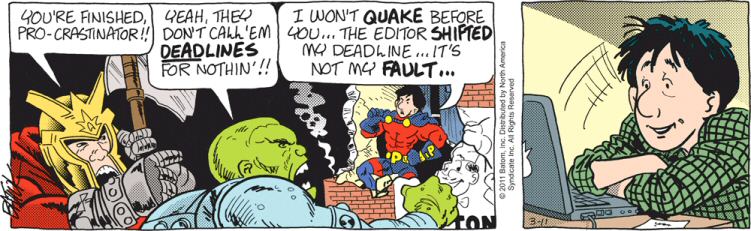
The November 3 Crankshaft strip is perfectly suited to be a comic book cover. It’s already turned sideways. It’s already framed like a comic book cover; there’s empty space at the top where the Atomik Komix livery and price tag would go. There’s more action in this drawing than anything we saw during Pizza Box Monster week. So why isn’t it one?

It could have been a nice little self-callback. It’s hard to remember now, but comic book covers and comic book art in Funky Winkerbean used to be a way of framing the actual story arc. Not-Yet-Dead Lisa would imagine herself as a cancer-fighting superhero. The obstacles in a character’s world would manifest themselves as comic book-style villains, and so on. It had its charms.

Or at least, it had a point. It complemented the narrative instead of replacing the narrative with something that wasn’t narrative. Sometimes it was just in service of a “collecting comic books” story, but that was still in-bounds. It wasn’t just to flesh out Batiuk’s imaginary comic book continuity he never does anything with. Or indulge his fantasy of what he wishes he’d been doing for the last 50 years.

This Crankshaft strip is perfect for that treatment. It’s about urging people to vote, a common theme when an election is imminent. But it could have been so much better, if Batiuk had just leaned into what he’s been forcing onto us for the last two weeks. Put Ed in a America-themed costume. Call him Super-Citizen or something. With the power to change mighty governments in a single vote! Instead of Meckler lamely saying “we’re trying to encourage younger voters”, Ed could have compelled them to join his superhero team! This would have made a garden-variety voting story a little bit fun.

Which is what’s missing from all this. For all the time Tom Batiuk spends in Comic Book Cover Land, it’s just. Not. Fun. Not even to him! The comic book covers aren’t funny. Or interesting. Or skillfully drawn. or passionate. Or frame the story a different way. Or set up anything that gets explored later. Or serve as a entertaining spectacle in themselves. They feel obligatory.

This is like the song “She Keeps Me Up”. It’s an overproduced disco rock song from the humorless band Nickelback, played with complete earnestness. This should be hilarious, but it’s not. And it’s not because the song is bad. It’s fine for what it is. But watch the 70s-style music videos for “Are You Gonna Go My Way” or “I Believe In A Thing Called Love” or “Ooh La La” by Goldfrapp, and you’ll see the problem. Those people are enjoying themselves! They clearly love this type of music, and know how to create it. They have a sense of a humor. They put some thought into merging the disco sound into their usual songwriting.

As much as Tom Batiuk professes to love comic book covers, he draws them like it’s a contractual obligation.

Weekday Comic Book Covers!

Yep, they’re a thing now. How long until Crankshaft is nothing but comic book covers? And how many years will that go on before the strip is cancelled?

Last week was the final full week of October, which means it was the Pizza Box Monster’s time to shine! He showed up on cue and… existed. Pete, Mindy, Darrin, and the PBM talked about decorating and telling ghost stories, but didn’t do either of those things. They also didn’t deal with the power outage, which seems like a serious problem for Montoni’s. Spoiled product cuts into a restaurant’s “thin crust profit margins.” But they sat in the dark and played make-believe like the overgrown nine-year-olds they are. It’s been a year since Pete and Mindy bought the restaurant, and they’ve done nothing but decorate it for holidays (and that’s if you count last week). What was the point of closing Montoni’s or re-opening it?

Then on Sunday, the Burnings story… well, I don’t want to say it “ended”, but I guess it’s done smirking at itself. What is Lillian so pleased about? She did absolutely nothing. Telling people they’re on camera is of no value if you’re not going to do anything with the evidence. Such as, give it to the police so they can identify and arrest the arsonist. The arson footage must exist, because there’s no way someone mounted that camera after the fire but before the protestors, which were implied to happen on the same night. Or, investigate them yourself, something an award-winning mystery writer should know a thing or two about.

Unlike what Tom Batiuk thinks, there’s nothing courageous about reading a book to people you know will never attack you. This is what happens when a story starts with “let my preferred character be the hero of a controversial issue so I can win an award” and then tries to back-form a narrative that leads up to that. The whole story makes zero sense. All the “protestors” had to was report the book to the school board, or maybe just to principal Nate (who was depicted as wanting to obey the school board). All Lillian or Booksmellers had to do was call the police, because nothing about this justifies an arson attack. Again, why is this treated so casually?

At the peak of the stupidity, there were almost 20 people total on Lillian’s lawn, protesting for something that already exists, or counter-protesting for… something, I guess. You sure wouldn’t know what the counter-protestors wanted from their signs. Ban bans! Ban gensor! Words have power! It’s like they were all told to assemble and make signs but weren’t told why. Look at their faces. They all say “I don’t know why I’m here, but I’m really, really angry at you!”

And finally, there’s the small matter of “The Burnings” somehow being a major phenomenon that shut down literacy for two generations. The Village Booksmith “survived the Burnings” by virtue of the fire being too small to cook marshmallows.

Testimony Of Skip Rawlings

(My retelling of The Burnings continues.)

PROSECUTION: Can you please state your name and profession?

SKIP: Skip Rawlings, Publisher-editor-reporter of the Centerville Sentinel.

PROSECUTION: And which of those roles did you perform in the newspaper’s story about the Booksmellers fire?

SKIP: Well, all of them.

PROSECUTION: This story said, quote, “Booksmellers came under attack because students were going to get a book for their school literature course that the school board had banned” and “the protestors said there were things in the book they didn’t want their kids to see.” Is that an accurate description?

SKIP: Yes.

Continue reading “Testimony Of Skip Rawlings”

Further Testimony Of Blaise Ashcomb

(My retelling of The Burnings continues. All episodes of the retelling appear under the “Burnings” tag.)

(Blaise Ashcomb, having sworn to tell the truth, the whole truth, and nothing but the truth, testifies as follows:)

PROSECUTION: Let us now move to the Village Booksmith fire. Can you briefly describe your investigation of that fire?

ASHCOMB: The fire was put out before I got there, and no one was injured. So my first task was to identify and interview witnesses. But when I got there, everybody was already in a huge conversation about book burning. I thought this was very strange. 

PROSECUTION: Why was this strange?

ASHCOMB: When I was walking up to the scene, it looked like a minor cigarette butt fire or something like that. It was way too early to establish if the fire was even intentional, much less a specific motive for it. But they were right in the middle of it. I thought maybe they saw something, or knew more than the newspaper did about this supposed protest. But they didn’t.

PROSECUTION: Who was there? 

ASHCOMB: The neighbors, their adult daughter, the grandfather Ed Crankshaft, and a darker-skinned couple.

PROSECUTION: What did they tell you?

ASHCOMB: Well, the dark-skinned couple didn’t say anything relevant, and didn’t stay long. But the rest of them all bought that newspaper story about the Booksmellers fire. This fire was lit on the 16th, and the Booksmellers fire was on the 5th. And I just said we had ruled the Booksmellers fire accidental by then.

PROSECUTION: Did the witnesses say anything else?

ASHCOMB: Ed Crankshaft started telling me this absurd story about how being unable to read cost him a shot at the major leagues. I remember thinking “yeah, buddy, I’d be quarterback of the Browns if I didn’t tweak my knee in high school.”

PROSECUTION: To be fair, you’d probably be better than DeShaun Watson.

ASHCOMB: Heh. That’s probably true.

PROSECUTION: Anything else?

ASHCOMB: Ed Crankshaft vehemently denied having anything to do with the fire.

PROSECUTION: Did you believe him?

ASHCOMB: Yes, because it quickly became apparent that he had no involvement.

PROSECUTION: Why did you believe Mr. Crankshaft had no involvement in this fire when his, uh, propensity for starting fires is well-known?

ASHCOMB: This fire was clearly the work of an amateur, and Ed Crankshaft is no amateur. He’s actually kind of a genius. Do you know how much energy it takes to launch a 35-pound backyard grill into orbit? Escape velocity is 25,000 miles an hour. And that’s at the equator. Imagine being almost halfway up the globe, and getting a non-aerodynamic object moving that fast, using only store brand lighter fluid. And he’s done this many, many, many times. The laws of thermodynamics don’t seem to exist around Ed Crankshaft. NASA should hire him to build rocket engines. It’s crazy.

PROSECUTION: Why did you think this fire was the work of an amateur?

ASHCOMB: The huge puddles of unignited accelerant at the scene, for starters. That’s a smoking gun for arson. Also, the failure to ignite all the accelerants kept the fire small, almost as if the firestarter didn’t want to do too much damage. They also used a particular accelerant, one that was very easy to track down.

PROSECUTION: And what was that?

ASHCOMB: Creosote oil. It’s a yellowish-brown liquid. There were also traces of gasoline, maybe because they stored it in a container that previously held gasoline. Or maybe they thought it would fool someone. Like I said, amateur. By the way, creosote oil can cause cancer.

PROSECUTION: So this was definitely an arson attack?

ASHCOMB: 100 percent.

PROSECUTION: Did you rule out any other possibilities?

ASHCOMB: It was also quickly apparent that Lillian McKenzie did not start the fire.

PROSECUTION: Why is that?

ASHCOMB: She was inside her house when the fire started, and when I interviewed her, she was pretty shaken up by the attack. But mainly, she had no motive.

PROSECUTION: Why not?

ASHCOMB: Insurance fraud is a major motive for arson, so it’s something I always have to consider. But Lillian’s business was completely uninsurable. She basically hung a plank outside her house and declared her attic “The Village Booksmith.” It doesn’t have any kind of business licensing, much less business insurance. And the fire was so small she wouldn’t have met her deductible anyway. It made no sense from an insurance fraud perspective. And she wouldn’t start an insurance fire at the most fire-resistant point of the house.

PROSECUTION: Can you explain what you mean by that?

ASHCOMB: Much of the McKenzie house, including the stairs, was made out of fire-resistant wood. Clearly Lillian took some extra precautions after a few Crankshaft grill incidents. She wouldn’t have started the fire on the bottom steps, unless she wanted it to fail right away. Which makes no sense in an insurance fraud scenario, or other rational motives like concealment of something. But it does make sense in terms of what we later learned about the firestarter.

Testimony Of Arson Investigator

(My retelling of The Burnings continues. I’m very grateful for all the positive feedback I have gotten from commentors so far.)

PROSECUTION: Please state your name and current job.

ASHCOMB: I’m Blaise Ashcomb, I’m an arson investigator for the State of Ohio.

PROSECUTION: And you investigated both the Booksmellers fire and the Village Booksmith fire, is that correct?

ASHCOMB: Yes, both.

PROSECUTION: Let’s start with the Booksmellers fire. How would you compare that fire to the Village Booksmith fire?

ASHCOMB: I wouldn’t.

PROSECUTION: What do you mean?

ASHCOMB: Well, look how different the two fires were. The Booksmellers fire caused damage to unsold product that had been specially ordered for a class.

Now, think about your typical chain bookstore. They don’t store their unsold products in a place that random arsonists can easily reach. They’re in some kind of storage room, which itself is in a secured, employees-only area of a store. And the store itself is in a public mall or strip mall, with all kinds of security.

It would be extremely difficult to reach such an area, and light a fire, without being seen. You’d either have to break in, or somehow sneak into this area during business hours. There was no evidence either of these things happened.

PROSECUTION: How did the Village Booksmith fire differ from this?

ASHCOMB: The Village Booksmith fire was started from completely outside the building, and did not require this kind of access. Even though it would have been easier to get, since this was an informal place of business bring run out of a home. A guest of Lillian McKenzie’s, or a bookstore patron, could have gotten much closer to the books this fire was supposedly targeted at.

PROSECTION: So what caused the Booksmellers fire?

ASHCOMB: The Booksmellers fire wasn’t arson.

PROSECUTION: Then what caused the fire?

ASHCOMB: A defective space heater. 

PROSECTION: Can you explain?

ASHCOMB: The days before the fire, Booksmellers had a leaky roof in their storage area. This resulted in water damage to some unsold books, which they tried to alleviate by drying them out with store-bought space heaters. One heater had a short, and started a fire. The fire damaged some of the books that were being kept in the storage area, which included the copies of Fahrenheit 451 that are at the center of this case.

PROSECUTION: Did you investigate further?

ASHCOMB: Yes. We found a V-shaped pattern of smoke damage spreading from where the heater was situated.

PROSECUTION: V-shaped pattern?

ASHCOMB: Yes, this indicates the origin of the fire, and how quickly it spread.

PROSECUTION: I’m sorry, go on.

ASHCOMB: There was also a burned wire and melted insulation in the space heater itself. The Booksmellers owner explained all this to us, and there was no reason to doubt it. The fire was ruled accidental. It was an open-and-shut case.

PROSECUTION: But the local newspapers ran a story about this being an arson that was targeted at the book Fahrenheit 451, didn’t they?

ASHCOMB: Yes, they did, but this was speculation on their part. The investigation wasn’t over after the first day, and there was a slim possibility that this was a targeted attack. The next day, we put out a press release explaining that the fire was ruled accidental. But the papers did not report this.

PROSECUTION: Why not?

ASHCOMB: I don’t know. You’d have to ask them that.

PROSECUTION: Did anyone from the local media contact you, after you announced your disposition of the case?

ASHCOMB: No.