I’ve come to realize that my writing style can be… a little harsh. I’ve been making an effort to dial back my vitriol, focus my criticisms less on the creator as a person, and direct them at his work only. I even wrote a genuinely nice anniversary announcement just a couple days ago. But today I saw something that made me realize that the awfulness of the creator and awfulness of his work can never be truly separated.
I don’t usually talk about Tom Batiuk’s e-mail newsletters. They’re a semi-private message, intended for a curated list of fans, not the general public. Because of my J-school background, I feel that airing them in public is a little unethical. But I just can’t let this go uncommented on. Besides, we’ll all see it in the Akron Beacon-Journal soon enough. Here it is:
Just like the Pulitzer Prize-nominated Lisa’s Story, with an even measure of humor, hope and tragedy, tackled breast cancer, raising awareness for and about the leading cause of cancer in women, so I hope the upcoming Jeff’s Story can educate and inform on prostate cancer, the leading form of cancer in men.
Pardon the interruption, but I’m Banana Jr. 6000. If I give you a Susan Smith reaction, will you all stop asking me about it?
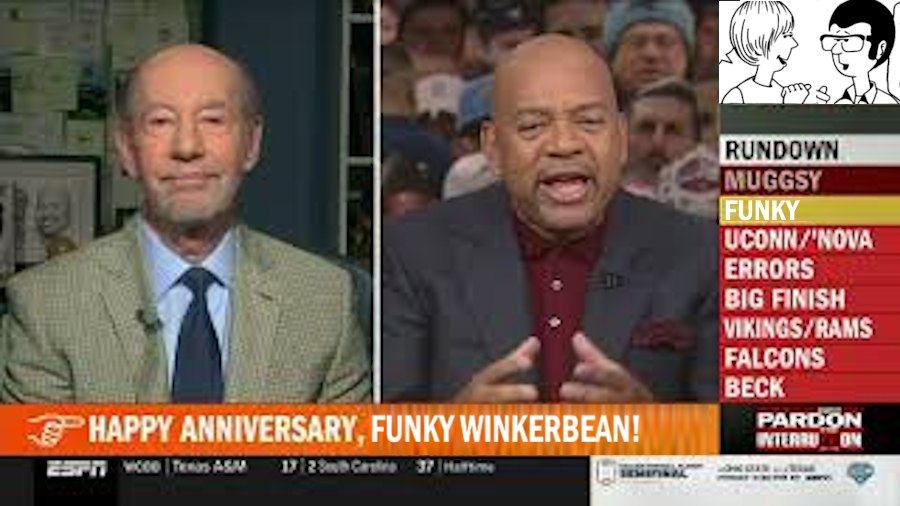
Let’s spend Five Good Minutes on the legacy of Funky Winkerbean. I know we’re here mostly to celebrate its… not-so-good aspects, but let’s take a moment to acknowledge its place in history. For its first 20 years, Funky Winkerbean was a snarky lampooning of life in high school and beyond, long before the word “snarky” was even invented. It even had an iconic debut strip:
“Murder In The Burnings” continues. Today, we see the town’s reactions to Les Moore’s shocking admission. You can read all previous installments under the Burnings tag.
“Murder In The Burnings”, my retelling of Crankshaft‘s burnings plot, continues. You can read all previous installments under the Burnings tag.
PROSECUTOR: There are no anti-Fahrenheit 451 protestors in Westview or Centerville, Mr. Moore. They do not exist. They never existed. You need them to exist, but nobody’s falling for that red herring anymore. The fire at the Village Booksmith was started by you, and only you.
LES: This entire proceeding is an insult to my dignity.
PROSECUTOR: No, it isn’t. All the evidence points to you. You had the means, motive, and opportunity to start that fire at the Village Booksmith. And you’re the only person on earth who did.
PROSECUTOR: Yes, you have. Mr. Moore, do you remember a student of yours named Eric Myers?
LES: I’ve had a lot of students over the years. I don’t remember them all.
PROSECUTOR: This student started two different fires at Westview High School.
LES: You mean Mooch? (scoffs) You can’t be serious. That was ages ago. That was before I let Lisa die.
(commotion)
THE JUDGE: (banging gavel) Order. Order in the court. Order. You may proceed, counselor.
PROSECUTOR: Mr. Moore, could you repeat what you just said?
LES: Oh come on, you all know what I meant, right? I mean, after Lisa made her courageous decision to end treatment! You all saw it! It won an Oscar!
PROSECUTOR: Yes, I do remember that. But, I don’t remember where Lisa ever discussed this decision with anyone. Not even you. Am I remembering wrong?
LES: Uh…
PROSECUTOR: Mr. Moore, did you start the fire at the Village Booksmith?
LES: Ummm….
(click)
VOICE: Hello, this is Lisa Crawford Moore. If you’re watching this tape, my client has chosen to exercise his or her right to remain silent…
THE JUDGE: (banging gavel) Order. All right, that’s enough. Mr. Moore, I’m going to issue a continuance so you can get some, uh, living representation. We will resume this case at a later date. And don’t bring those VHS tapes to my courtroom again. Court is adjourned.
“Murder In The Burnings”, my retelling of Crankshaft‘s burnings plot, continues. Today, the defendant is on the witness stand.You can read all previous installments under the Burnings tag.
PROSECUTOR: Please state your full name and current profession.
LES: I am Les Moore, award-winning writer and high school teacher.
PROSECUTOR: In that order, huh?
CROSS EXAMINATION
PROSECUTOR: Mr. Moore, you taught the book Fahrenheit 451 to your American Literature class, against school board recommendations, and against instructions from your own principal. Is that correct?
LES: Yes, sir.
PROSECUTOR: Why did you decide to teach Fahrenheit 451 to your class?
LES: As I said to my wife, Cayla, it seems to me that if the students are old enough to have active shooter drills, they’re old enough to read whatever they want.
PROSECUTOR: Did any other teachers also teach Fahrenheit 451 that semester?
LES: No, just me.
PROSECUTOR: So no other classes took part in this?
LES: No.
PROSECUTOR: Not even at any other schools?
LES: No, not that I know of.
PROSECUTOR: What did your students think of Fahrenheit 451?
PROSECUTOR: Why would anyone oppose Fahrenheit 451? It doesn’t have any violent or sexual content, or anything like that. It’s a pretty standard book for high school literature. I read it myself in high school.
LES: I don’t know. Some people are just closed-minded, I guess.
PROSECUTOR: Your principal Nate Green testified that you taught Fahrenheit 451 without his permission or approval. Did anyone else ever express any concerns about the content of this book?
LES: No.
PROSECUTOR: Did the school board ever talk to you about your decision, either directly or indirectly?
LES: Nate told me he met with the board, but nothing came of it.
PROSECUTOR: Did any parents talk to you about it?
LES: Nope. I never heard a word. It turned out everyone was on board with my courageous decision.
PROSECUTOR: Well, that’s surprising, Mr. Moore. Because Skip Rawlings of the Centerville Sentineltestified that he received an email from the protestors that said there were quote, “things in the book they didn’t want their kids to see.” But you just said you were the only teacher who taught this book. Which means, the only people whose kids would ever see what was in Fahrenheit 451, were the parents of your students. So I will ask you again; did any parent of your students ever express any concerns to you about your decision to teach Fahrenheit 451? I remind you, Mr. Moore, you are under oath.
LES: Um, no.
PROSECUTOR: I would like to remind the jury of police officer Leo Harshman’s testimony. The police detained several protestors fleeing from the Village Booksmith. Those protestors turned out to be Mr. Moore’s own students, in a misguided prank. After that, the police had many conversations with these same parents. No parent of any of Mr. Moore’s students was ever a person of interest in this case.
LES: Well, these protestors must have come from somewhere.
PROSECUTOR: Correct, Mr. Moore, and I will soon show this court exactly where they came from. Now, after the Booksmellers fire, and the erroneous newspaper story that it may have been an attack on the content of Fahrenheit 451 itself, what happened next?
PROSECUTOR: Lillian McKenzie testified that she was afraid to do this for you. Did you ever consider another way of distributing the books, so she wouldn’t be at risk? Such as, having your students acquire the book online? Or, simply teaching a different book?
PROSECUTOR: The day before the Village Booksmith fire. Who physically moved the books there?
LES: Me, Lillian, the twin girls who work at her store, my friend Pete, and his fiancee Mindy.
PROSECUTOR: That’s Lillian McKenzie, Amelia and Emily Matthews, Pete Roberts-Reynolds, and Mindy Murdoch. Anyone else?
LES: No.
PROSECUTOR: When did you tell your students the new location to pick up the books?
LES: That Monday, at school.
PROSECUTOR: The 16th?
LES: Yes.
PROSECUTOR: And the Village Booksmith fire was that night. Other than your students, yourself, Lillian McKenzie, and the people who helped you move the books, who knew the copies of Fahrenheit 451 were at the Village Booksmith?
LES: Um. Well, my wife, I guess. she was there when I took Lillian’s call.
PROSECUTOR: I mean, who knew the books were at Lillian’s store, and would have lit the store on fire because of that?
LES: Umm….
PROSECUTOR: Your whole reason for doing this convoluted book drop was to circumvent the school board’s “recommended reading” list. Nate Green testified that you were exploiting a loophole in this list, by not ordering the book from the school system. He said he informed you this went against school board policy. Which raises the bar for these protestors even higher. We’ve been looking for a perpetrator who not only was so offended by Fahrenheit 451 they committed arson at two different bookstores. And, who learned the new location of the books within a day of you moving them there, when you had an incentive to keep this location secret. And, who never so much as spoke to anyone about their concerns.
LES: Well, maybe the police could do their jobs and find these protestors.
PROSECUTOR: I think the police did their jobs just fine when they announced criminal charges against you. Because the arsonist was you, the whole time.




 Son of Stuck Funky
