We’re back with the second installment in the history and examination of Sadie Summers, the character who Tom Batiuk wishes we’d all forget, which is exactly why we’ll be remembering her. She’d shown up in the final year of Act I as a visual Mini-Me of her older sister Cindy and proceeded to drive her into fits. But with 1992 comes the jump four years ahead to Act II. Funky, at this point, is bumming around while Les has gotten a job teaching at the high school he hated so much that he spent graduation trashing it and everyone there.
But much like Les, Batty was unable to let go of the old high school so we’re introduced to the new generation of Westview High students which, at the start, is basically just Wally Winkerbean, his best friend Monroe Madison and Sadie. Demon Seed’s Act II incarnation first shows up in early September in the requisite introduction week.
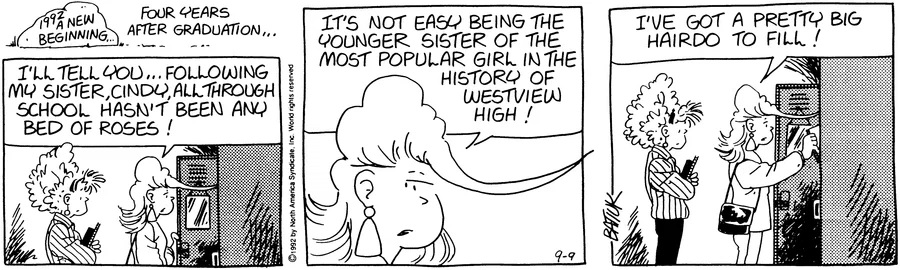
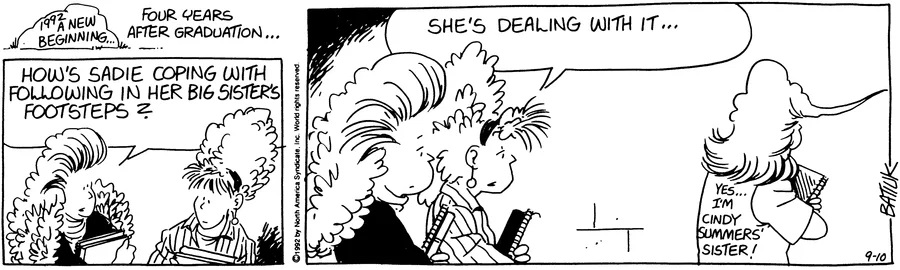
A few things to note. First is that much like her sister, Cindy’s designated role is The Most Popular Girl at Westview HS, a role that will later be filled by Jessica Darling (whose father, Jon Darling, was murdered), Rana Howard (whose biological father was blown up, first adoptive father was also blown up, and second adoptive father was not blown up), Mallory Brooks (cannot speak on father status) and Maris Rogers (ditto) with each being more irrelevant than the last. Also much like her sister, Sadie will have hangers-on though unlike Cindy, who only had Carrie, she’ll one up her sister by having two of them: the girl with the tall hair is Tiffany while the one with the longer hair is Courtney but don’t get too attached because despite hanging around during all of Sadie’s high school time they don’t have much in the way of characterization. So little in fact that Courtney will wind up being an early victim — possibly even the first — of the Tom Batiuk Name Change Special when her name is randomly changed to Brittany a few years later.
The second thing is that we’re introduced to the idea that having to follow in Cindy’s footsteps is somewhat burdensome to Sadie. It’s something that seems tailor made for an easy and long running storyline where she does things like, I don’t know, try and find her own identity instead of retreading the same ground as her sister. But I suppose that if Batty were any other writer this site wouldn’t exist so I’ll leave it to you to guess whether or not Storytelling Rd. is long and winding or a one way dead end.
After the obligatory introduction week Sadie, unsurprisingly, next shows up at the mall after having acquired a credit card.
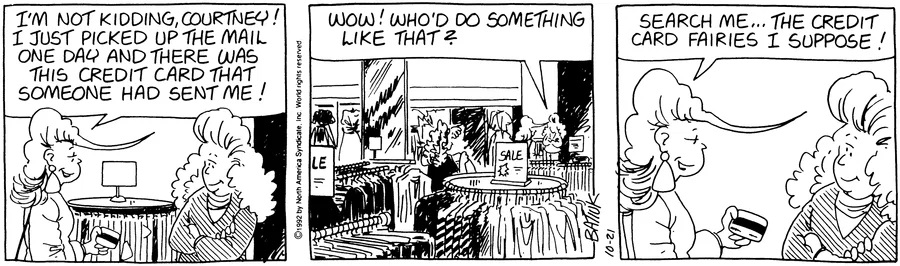
Like any rational person she realizes that she’s been sent free money and uses it responsibly by buying the first thing to catch her eye and immediately maxing out the card.
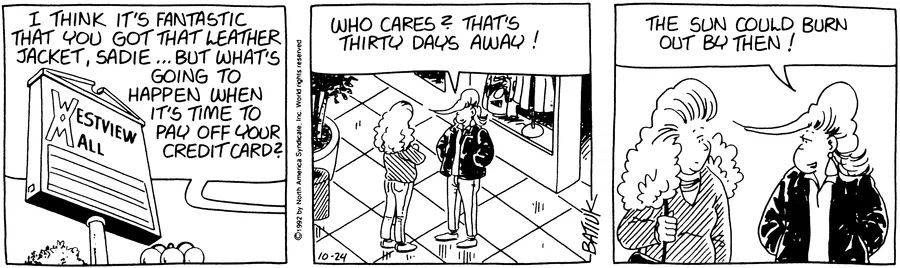
Unfortunately for Sadie, TB will not forget as this more or less begins the one major storyline she’ll be the centerpiece of. But before that happens, she pops up during the oft called back to week where Wally lugs around a band turkey on a leash.
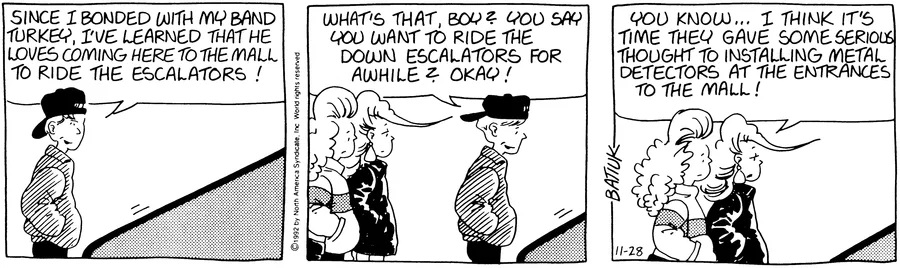
But that’s just a detour for in December her credit card statement arrives and is found by her father.
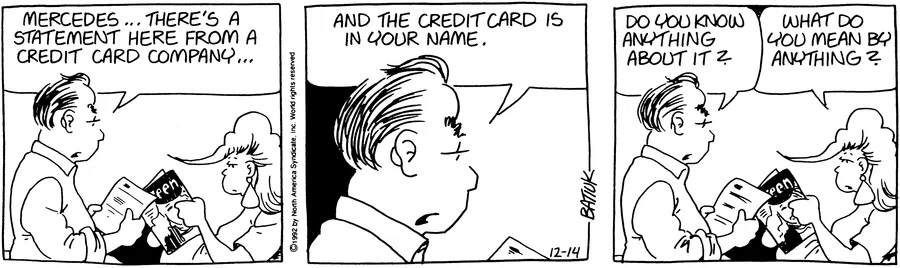
Deciding that she needs to learn some responsibility and pay off her credit card debt, he forces Sadie to find a job and like any other teenager she’s thrilled about the opportunity to wageslave.
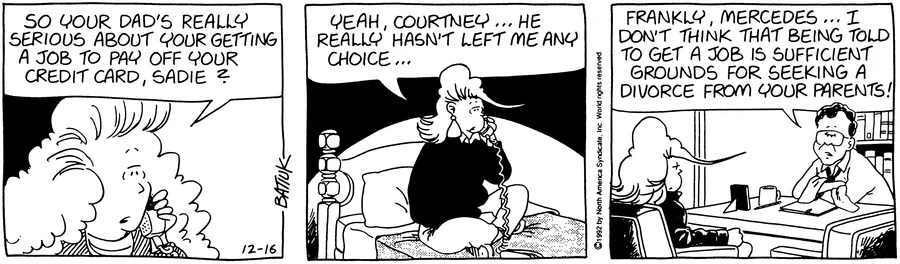
In a twist you’ll never see coming, she winds up having to get a job at Burger Barn, the fast food place that I assume rivals the previous Act I fast food hangout McArnold’s (not to be confused with that anime favorite burger joint, WcDonald’s).
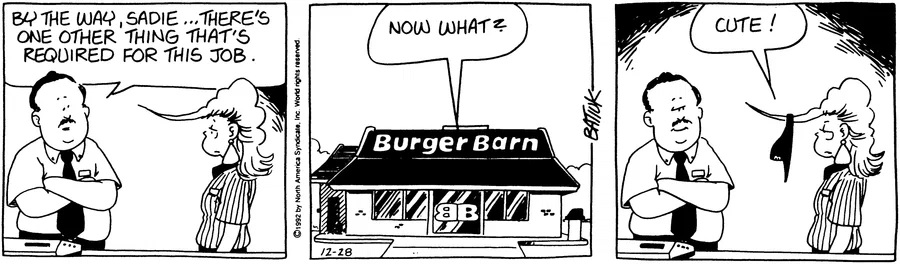
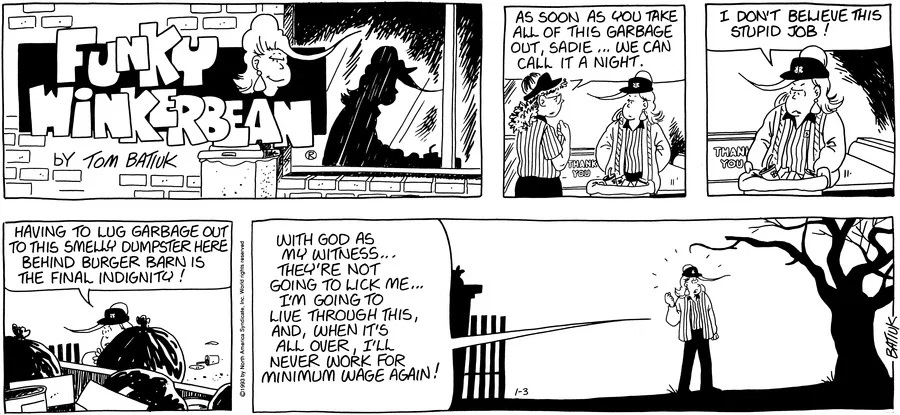
Of course, Sadie treats this as the height of embarassment and pretty much every strip in this story involves her seething such as when she’s unable to take off for New Year’s…
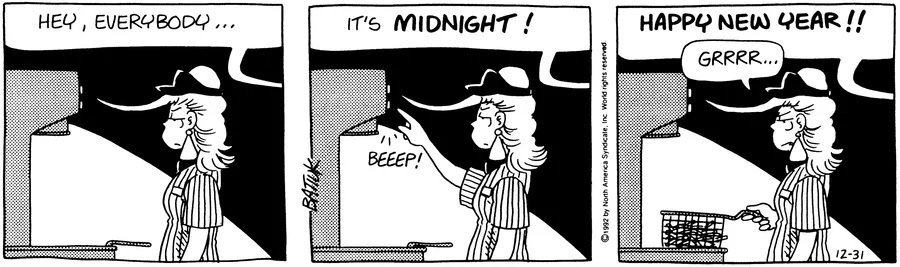
…and her subsequent rage against the heavens for the injustice.
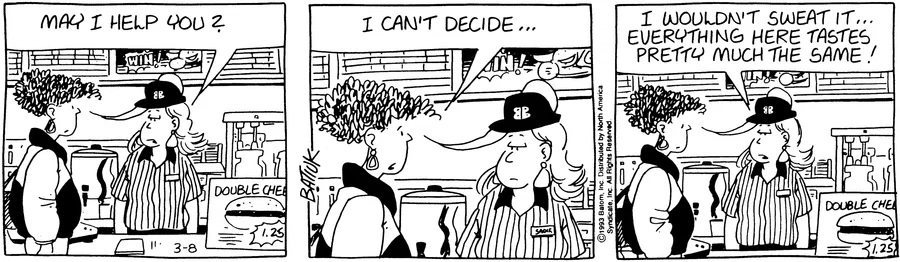
Showing how ahead of her time she is, Sadie takes to the job with all the enthusiasm of a generation that has yet to be born as she hits her customers with the Gen Z stare.
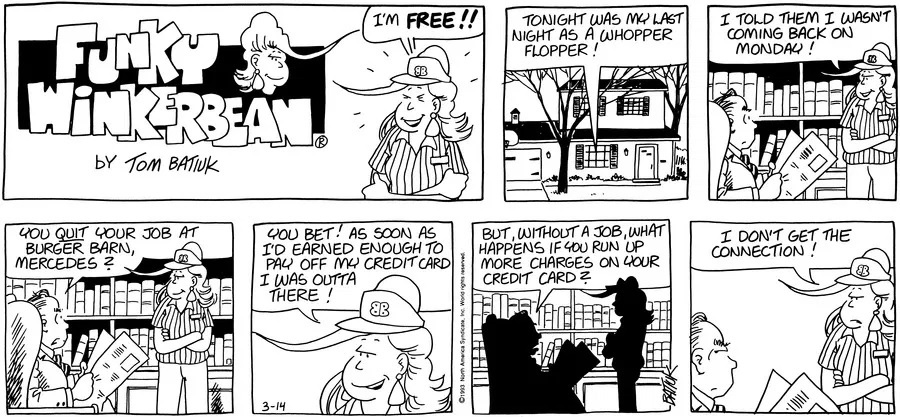
After a few months of this indignity she hits her goal and is free, having learned a valuable lesson along the way.
After this she generally stops being the sole focus of any major storylines herself but isn’t close to disappearing. She’ll continue to get the occasional week dedicated to her and a few months later in May 1993 she’ll share a strip for the first time with what will be probably her one real relationship throughout her time in school.
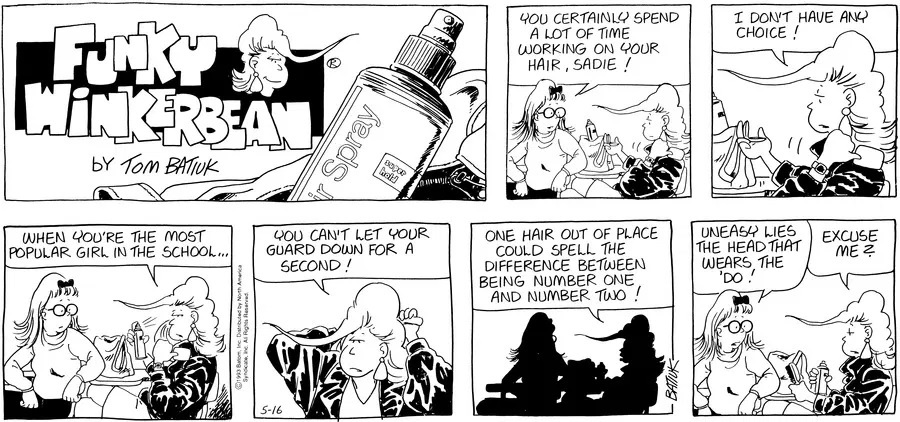
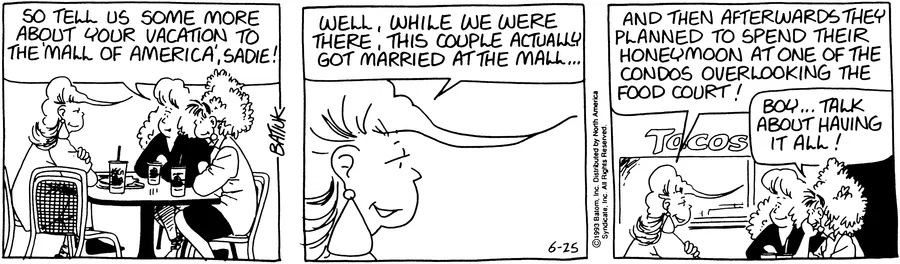
The favorite punching bag of Funky Winkerbean is introduced early in 1993 and a few months later she and Sadie interact for the first time in an otherwise inauspicious manner. We’ll have cause to revisit this pairing shortly but for now things continue to truck along as Sadie spends a week in June talking about her trip to the Mall of America.
She also tells Wally what his issues with the ladies are.
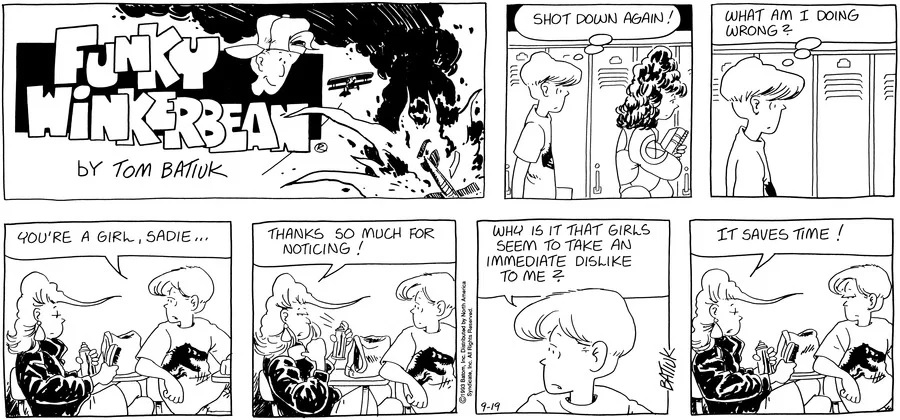
By this point One-Armed Beck’s introduction into the strip is still a few years away and Sadie, being the main high school girl, gets a few interactions like this where she basically calls Wally a dweeb. One gets the feeling that Batty had thoughts of perhaps doing an eventual romantic plot with the two of them; you know the whole pretty girl and schlub thing he loves. But similar to the couple of teased instances with Mopey Pete and Chien, if he did ever want to go with that then for whatever reason he got cold feet.
In November, Sadie joins the Poetry Club much to the surprise of Les though of course it’s simply as a scheme to try and get her grades up.
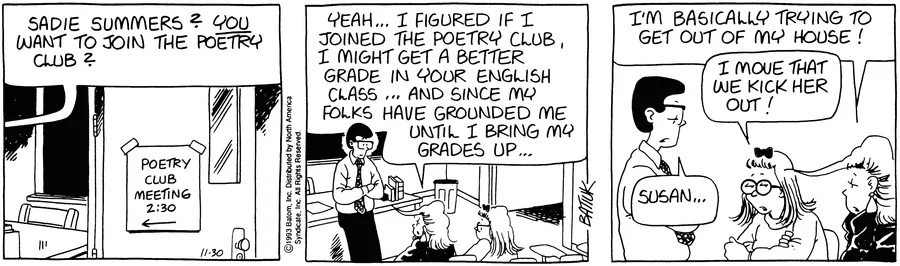
Being a woman of the people, Sadie has no need for high falutin language or fancy metaphors. Her poetry is blunt, showing her inner feelings with a refreshingly simplistic honesty.
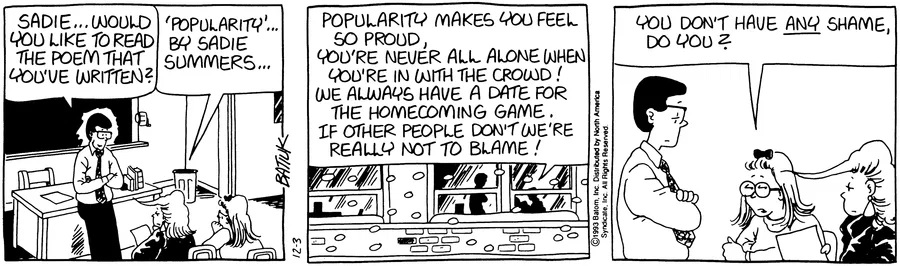
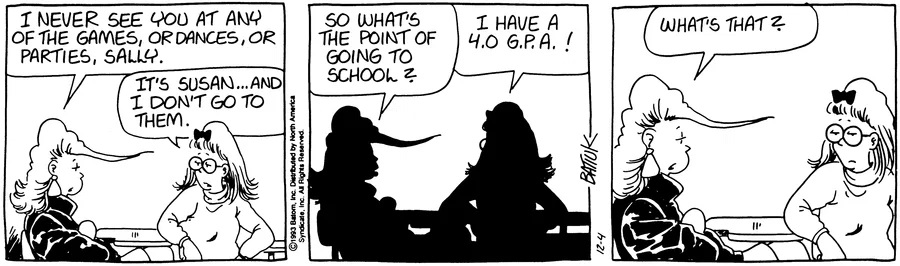
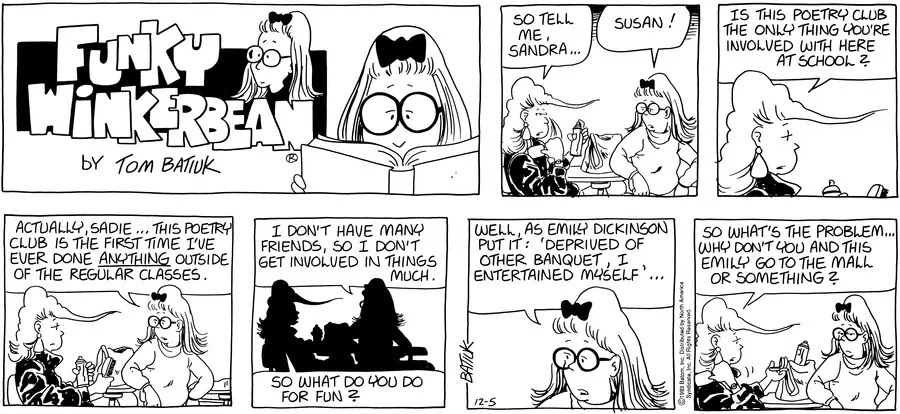
She also makes time to talk with Susan.
A few weeks later Sadie and Mickey Lopez, the football playing daughter of Les’ work wife and eventual morose letter opener Linda Lopez, are at the mall when Sadie discovers, to her horror, that Cindy is working there and even worse is going to be moving back in with her family.
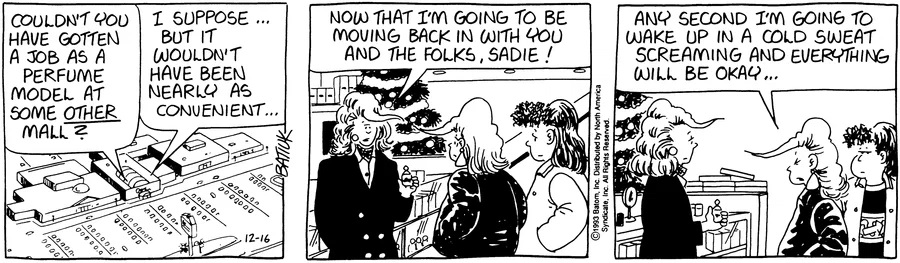
Act II (and beyond) Cindy is a far cry from Act I Cindy but there’s still a faint bit of that old sibling rivalry. Just with the roles reversed.
That closes out 1993 and with it the first couple of years of Act II. Sadie is a teenager and more of her own character so does Batty’s clone accusation stand up? While it’s obvious that he wants her to take the same mall obsessed queen bee role that Cindy had in Act I, at this point I’d say they’re still significantly different characters. Her popularity, beyond just kind of existing, comes off as being slightly less essential to Sadie than it did to Cindy. With Cindy the joke always feels like it’s just “She’s popular, isn’t that funny?” With Sadie, her popularity seems to be more about contrasting it with other things whether it’s putting her in situations meant to flummox her (like the fast food job) or by throwing her into something that otherwise seems at odds (the poetry club). Also, where Cindy was more vain and arrogant and cartoonish, Sadie comes off as a lot more low key. She’s a lot more deadpan and sarcastic than Act I Cindy tended to be.
The biggest difference between the two is that Sadie comes off as a lot nicer. Cindy in Act I is an absolute terror, one of the meanest and nastiest characters in the entire strip. This is the same girl who wanted Funky to admit that he was gay for breaking up with her (a joke that would not fly today and I’d bet was skirting the line even back in the late ’80s) and who had zero issue with trying to ruin anyone she saw as beneath her. Sadie, though, is a lot different. Granted she’s not necessarily nice to Wally as Wally was intended to be the lower rung loser of his generation but she’s not excessively nasty to him either. Nothing like Cindy basically treated Les as if he was a completely separate species as her.
Then there’s Susan. Not once does Sadie ever treat her with the level of disdain that you’d expect from an otherwise stereotypical alpha girl towards a friendless nerd. When she’s talking about how she doesn’t see Susan doing anything or asks her if all she does is poetry it never comes off to me as if she’s doing it out of any sense of meanness. It’s never done as a set up for her to put Susan down or anything like that, it just comes off as a blunt way of getting to know her. The worst you can accuse Sadie of in their interactions is being flippant but she doesn’t seem like she’s attempting to denigrate Susan or anything like that. Act I Cindy definitely would have but not Sadie. And as shown, Sadie is also friends with the ultra tomboyish Mickey, someone the Act I incarnation of her sister would have never been caught dead with. So while on a superficial level they can be similar, I still don’t feel that Sadie deserves TB’s dismissive classification of her.
That finishes part 2 of our Sadie retrospective. Next time, we’ll cover the middle years of her time in Act II to see whether or not any of this holds up.


Today’s Crankfuckery
Day 3 of Beans End Week
(suddenly, a tree falls onto Ed, which instantly kills him)
Guess we know what Tom was watching the night before he whipped up a particular Sunday installment…
Frank Burns: What I don’t understand is why do people take an instant dislike to me?
Trapper John: It saves time, Frank.
Seven panels to meander to a conclusion that simply rips off what was even then a 20-year-old M*A*S*H joke. (Which, given how widely syndicated the show was, had probably run in every English-speaking TV market a few hundred times by that point.)
And what’s worse, it doesn’t work given who these people are.
Batiuk doesn’t understand what he’s written, does he?
4/16: More of the same.
Also, I don’t see Sadie needing to be told that the reason that SHE felt alone is that people aren’t going to warm to a spoiled brat whose idea of an apology tour is whining that she was contractually obliged to be cruel, petty, shallow and malicious so it’d be super nice not to make her feel regret, remorse and shame.
Even Cindy Summers herself didn’t seem to understand that people might have valid reasons for disliking her. Remember when Cindy went to Wicked Wanda’s house in Act II to try to apologize for her behavior in high school? Wanda’s response was “OK, whatever.” Because like most healthy adults, Wanda left high school behind years ago. And Cindy *still* didn’t understand what the problem was.
Though I can appreciate why Cindy genuinely doesn’t understand Wanda’s reaction. It’s because Cindy is a Preferred Character in the Funkyverse, which means Batiuk will always rescue her from the consequences of her own actions. She’s meta-coddled.
What is lost on the delicate genius is that people who peak in high school are lousy company and really easy for Springsteen to mock. Heh. Betcha he hated Glory Days when it first came out .
I suspect Tom Batiuk loves “Glory Days”, because he never got the point of it. Much like how everyone missed the sarcasm of “Born In The U.S.A.” (Which was a problem the music video very much made worse, BTW.)
Mostly because the director didn’t know what The Boss was saying either.
Or didn’t care. You’d think Springsteen would have enough pull to have put a stop to it. But I guess Born In The U.S.A. was the album that first gave him that pull.
Sadie is a perfect example of how Batiuk tells the story he wants to tell, with no regards to what happened in the past, or who the characters even are.
“It’s tough being the younger sister of the titanically popular Cindy Summers” is a great place to start. But few of Sadie’s appearances support this. The first two panels are Sadie lamenting this fact, and then advertising it. The credit card/having to get a job story is fine, but it’s very much a “B” story compared to what should be Sadie’s “A” story: differentiating herself from her sister. She vacillates between trying to duplicate Cindy (the hairstyle), trying to be the opposite of Cindy (joining the poetry club), having the same job as Cindy (working at the mall), and still having sibling rivalry with Cindy.
So why does Tom Batiuk think Sadie was a clone of Cindy? Sadie could be a clone of Cindy sometimes, but most of the time she wasn’t. Being a clone of another character requires more focused writing than Batiuk is capable of. As with Sadie’s actual apperances in the strip, “Sadie was my worst character” is Batiuk once again telling the story he wants to tell, with no regards to what happened in the past, or who the characters even are.
I’m glad Narshe is tackling this subject. I would have had no idea where to begin.
It’s like Costanza says: it’s not a lie if he believes it.
And actually, it seems like there are lots of easy story possibilities here. I’m no writer, but I can see stories where: Sadie grows to become like her sister, or she goes the other way and becomes a true friend to people. Or perhaps she becomes an even more intense version of her sister. Either way, there are lots of interesting possibilities here. But Batty is more interested in writing things that impress him, things that make him appear to be a smart writer.
And here we are, the Sadie strips that TB is so ashamed of are… fine. Potentially, and occasionally actually, interesting even. At the very least, I think it clear that Sadie was not a dead end character after re-reading these strips.
Narshe, I especially like the differences pointed out between Cindy’s queen bee behavior and Sadie’s more toned-down version of that shtick. TB probably made Sadie a sanded-down Cindy-lite because the times and his own sense of what was funny about such a character changed, but in the context of the strip it works perfectly fine. Living in the shadow of a popular (or at least well-known) sibling is an interesting situation for a character to be in, and in real life plenty such people try to imitate their siblings because of that (especially when they are younger). It’s understandable behavior, and in the context of the strip it makes sense that Sadie would be a less intense version of the stuck-up popular blonde than her sister because she actually is quite different from her sister and feels obligated to play a role. TB seemed to realize this to some extent with Sadie after high school, and had her break from the Cindy-like behavior considerably (aslo common for folks who grow up in the shadow of noted siblings, especially as they get older) then only to unceremoniously drop her as a character completely (the John Byrne Act III model sheets notwithstanding). An early and obvious example of TB running far far away from a good idea when it was right in front of him.
But he didn’t know it was a good idea. You have to know what a good idea is before you could use it and he doesn’t.
When I was reading through FW the first time, I knew that Batty disliked Sadie so it wound up causing me to keep an eye on her and yeah, it became obvious to me that she wasn’t really the character he said she was. Maybe by being a toned down version of Cindy that does sort of mean she’s a “pale imitation” of her sister but then… that can sort of be the point, you know? And how he writes, it’s clear he seems to know that there was more there to be mined but for whatever reason he could just never commit himself to doing what he needed to do. You get these like little pieces off cake but never the whole cake itself.
I feel like the reality is that for one reason or another, TB was and is not really interested in writing characters who are too unlike himself. Maybe he worries about being unable to inhabit another character’s headspace or he’s too self-absorbed to consider anything that doesn’t reflect him to be of interest to readers or what; I don’t know. But we see it time and time again, where even if there’s a character who has a solid base and easy stories lined up he’ll avoid them. Or he’ll start a story focused on one of his characters before it eventually turns into actually being a vehicle for the ones more similar to him. The Chien newspaper article storyline is a great example of that. It starts out about Chien being an outcast, how she feels about it and the school environment and bullying, she writes the article… and then is shoved aside so it can turn out to actually be a story about Les, the heroic martyr for free speech and a free press. Chien? Who cares, step aside! Tom Batiuk is not a teenage goth girl so what use do you have? You filled your role, now let the real main character (and Tom Batiuk self-insert) step in.
Hell, look at the Batton Death March or the insertion of Mopey into everything for Crankshaft. Batiuk can’t relate to being a crotchety old bus driver but he can relate to Batton (for obvious reasons) and Mopey so they need to shove everyone else aside.
I think how he glossed over Batton’s/his destruction of private property is telling. He sees an angry person but he needed something so they shouldn’t be.
Tom Batiuk has no theory of mind. He has no clue that taking other people’s stuff is rude, and will irritate other people.
This is why he’s kind of messed up. After all, he doesn’t seem to understand how people perceive him. Being a third grader about to go insane with panic and despair because a funny book is a day late isn’t a good look but he can’t see that.
Yes, you captured what I was trying to say above: TB running far far away from a good idea when it was right in front of him.
I agree, the Sadie strips aren’t bad, they capture the spirit of the times rather well.
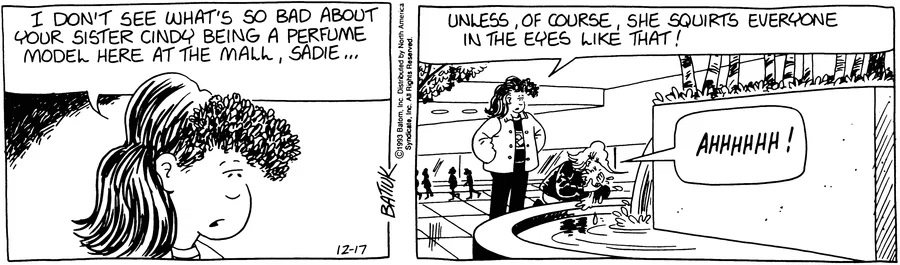
And even by 1993, the “person who sprays you with perfume in front of the mall department store” bit was a discredited trope (where I lived, at least). I think there had been an incident where this practice set off someone’s allergies. Or enough customers raised a fuss about it, because they simply didn’t want scents sprayed on them without their consent. The joke was outdated the day it ran.
Today’s Crankfuckery
Day 4 of Bean’s (Why Wont This Painfully Boring Week) End Week
I have no idea how thats gonna help Ed
Awesome retrospective, Narshe. I also find it funny that Batiuk demonizes Sadie’s creation, when it is far FAR from his most abominable monstrosity. You dissected things like a regular nitpicking champ!
As for today’s Crankshaft. Once again…I get the odd, paranoid feeling, that Batiuk sees me…somehow…and Batiuk knows…a year in advance. Spooky…DOduedudU DOduedudU
Sadie isn’t even the worst character of her type! Narshe mentioned Maris Rogers and Mallory Brooks, who were much more blatant clones of Cindy.
Also: so what if they were? The Queen Bee is a well-known high school archetype. What’s the problem if multiple girls filled that role over the decades? Having a series of high school popular girls was a Justified Trope all along.
But does he realize this? It would seem not.
Not only as a champ, but with the buttery brickle-ness of a talking murder chimp, too.
All aboard for Narshe-ville!
Thank you, Narshe! I have enjoyed all your posts.
In the drunkenbeard Funkyverse, the Cleveland mob runs all the rackets in Northeast Ohio, and Tony Montoni is a made man. As a soldier for boss John Scalish, Tony was the guy If you needed a place torched, bombed, or a bullet put in somebody’s head.
By the time Scalish died and Jack Licavoli took over, Tony was already past retirement age. Jack set Tony up in semi-retirement with a plum – Montoni’s in Westview. Everyone in Westview was bored, so they went to Montoni’s for smack, coke, crack, meth, pot…They could place bets, play the numbers, or get parley tickets. It brought in a lot of money.
When Tony wanted to cut back even more, Funky, who had been an associate in Cleveland, took over. Hiring Wally and Adeela was the smartest thing he did.
I started making parody strips about this in 2017and the newest one is from 2025. All of the strips were posted when they were new, but there are a few alterations. I dug through the db archives and found ten strips that make reference to the mafia or drugs. I’m trying to present them in chronological order, but we’ll see.
I know there’s repetition, but I like having Tony call someone “stunad”.
If you like true crime stories, look up James Licavoli, Shondor Birns, or Danny Greene. I worked as a Teamster, and after I left the union two bombs went off in my union hall parking lot. One of them killed my local president’s brother. I also saw Shondor Birns car shortly after he got blowed up and there was debris and cops everywhere.
https://i.postimg.cc/fL8fTjcV/30-we0c-HAL.jpg
https://i.postimg.cc/V6KWLBqr/50-jf-KMu-M7-AB.jpg
https://i.postimg.cc/brdHGDgZ/cs1imgghj-A.jpg
https://i.postimg.cc/nz3GcY4c/cs231114ART.jpg
https://i.postimg.cc/cHFB4MRL/cs231220AB-Copy.jpg
It took a lot of work to make MP wink!
https://i.postimg.cc/4dWQNb63/cs250111A.jpg
I really enjoy these, because they explain something that’s sorely missing from the Funkyverse: what keeps this town afloat? The high school/published author/comic book-based economy makes zero sense. Whenever Batiuk does mention something that would be a real problem of economically depressed Rust Belt America, like Centerview shuttering its only theater to make way for a strip club, it is never spoken of again. And then the theater magically returns, bigger and even more stupid than it was before.
4/17: It took almost forever for Ed to admit why he buys things. It took even longer for Luann’s mom to realize that Bernice is a terrible friend and incompetent advisor.
Luann’s mom is right, though: Bernice would be much better at law than psychology. She’d have to change majors and backtrack a little. But Bernice is still light years ahead of Luann.
Because of what they’re asking to be allowed. Bernice wants to live in fear. LuAnn wants to not expend effort.
Bernice is still studying for her bachelor’s degree. Law degrees are graduate programs. There isn’t any particular curriculum needed to apply to law school (unlike, say, medical school, where applicants are expected to have taken courses in biology, chemistry, etc.).
If Bernice wanted to become a lawyer, she wouldn’t have to change majors. She would have to complete a bachelor’s degree in something before going to law school, but that something could still be psychology,
That last sentence should end with a period: “… that something could still be psychology.” I don’t want to leave my comment hanging like that.
An 8-year-old brought a loaded gun to an elementary school in Kent, Ohio: https://www.wkyc.com/article/news/investigations/3news-investigates-mother-says-son-warned-2-adults-loaded-gun-kent-longcoy-elementary-school/95-83befeef-bc03-42c4-a9d4-247a47522e0e
Will this be the next prestige arc?
Maybe, maybe not but he’ll post on his blog that Act II story where the kid brought the gun to school and/or the Act III one where they do the walk out.
Today’s Crankfuckery
Day 5 of Beans End Week
(Ed suddenly bursts into flames and dies)
I never officially welcomed you to the SoSF team, Narshe. Welcome to the official SoSF team! We’ll get you a key to the executive washroom asap, until then, just jiggle the door handle, it’ll open. Bring your own TP, though, as we’ve had to cut back. No more free Pellegrino in the break room, either. Shop-Rite sparkling only from now on.
4/18: And the point seems to be that Ed has no sales resistance.
Hahaha, it’s funny because a business put its name and logo and clothing for its customers to wear, thus promoting the company.
If you think that’s not funny and just an everyday occurrence, well, clearly you’re not a certain syndicated comic strip writer.
He’d find slapping company logos on things the employees wear equally hilarious because he’s living in the past.
New Match to Flame, and… man, I have no idea what Batiuk is even trying to say anymore. He talks about other writers recommending a particular book on writing, but he never bothers to identify which book. He lists some of the “rules” of writing that all amount to “Do such-and-such, or don’t”. And I think he thinks there’s some Writer Illuminati that might punish him for either discussing those “rules” (that he got from a book that’s presumably publicly available?) or for saying you don’t need to follow them? I’m not entirely sure.
And Tom’s determined to prove it.