To Everything, There Is A Season

I want to take off my snarker hat for a moment, and talk seriously about the future of Crankshaft.

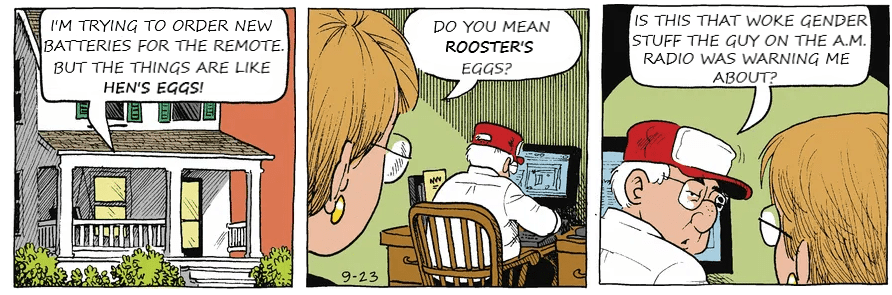
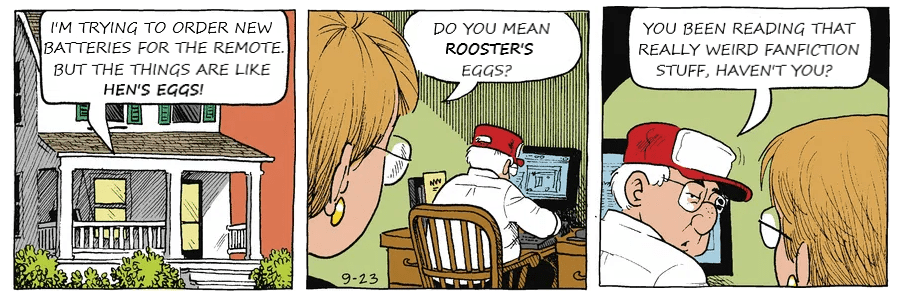
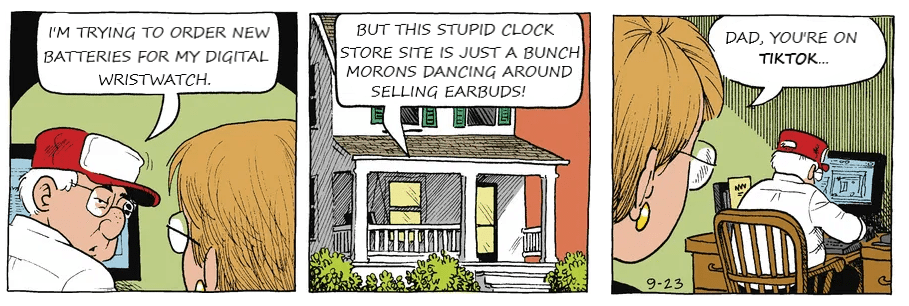
We thought the past week would be yet another week of Skip Rawlings’ endless, pointless, onanistic interview with Batton Thomas. It turned out to be something much worse.

After what we saw this week – Tom Batiuk using the title character of Crankshaft as a tool to bash readers who want to see more of Crankshaft in the strip, and additionally as a strawman for Tom Batiuk’s tired “comic strips have to be funny” canard – there is one inescapable conclusion:

It’s time for Ed Crankshaft to die.

And I don’t mean that maliciously. I mean it in the way that a long-suffering family pet, who can’t be cured or even helped, needs to die. It’s a gut-wrenching decision to have a pet put down, but sometimes it’s the merciful thing to do.

Because the way Ed Crankshaft was used this week is appalling. How much do you have to hate your own creation, and all of its followers, to use that creation to mock their desire for more of it? I haven’t seen a production insult its audience this much since 1968.

Crosses The Line Twice takes Refuge In Audacity.

And this isn’t the first time Batiuk has acted like this. He killed off John Darling so the syndicate could no longer use the character (even though no one would ever want to). He’s bitter about the name Funky Winkerbean, because he thinks it held the strip back; the character Funky Winkerbean got pushed into the background. When Funky did appear, his arcs tended to center on his misfortunes: alcoholism, obesity, ego, incompetence, bad luck. And now Batiuk is bitter that readers want to see Crankshaft in Crankshaft, so he used the character to mock them. Notice a pattern?

The worst part of it is: these are his genuine fans. “Where’s Crankshaft?” isn’t something this blog thought up. It’s a common sentiment in online comment areas, from people who presumably enjoy the comic strip as Batiuk intended. They prefer Ed’s antics to the self-indulgent meandering slop Batiuk has been filling it with since Funky Winkerbean ended.

These are the people Batiuk should be trying to please. Or at least, listen to. “Where’s Crankshaft?” is essentially positive feedback. It affirms his decision all those years ago to give Crankshaft his own world. People seem to enjoy the cranky old bus driver and his antics.

Personally, I have no strong feelings about Ed Crankshaft. I don’t like or dislike him more than any other character. He’s a selfish, egotistical, malicious, unemployable jackass, but so are most male characters in the Funkyverse. But I do think Crankshaft deserves some dignity. He does not deserve to be used as a punching bag by an arrogant creator trying to make a point.

There are several reasons why the death of Ed Crankshaft would be beneficial to Crankshaft as a whole:

  • It’s way, way overdue. Ed Crankshaft is at least 106 years old. I base that on the fact that he played for the 1940 Toledo Mud Hens, and the youngest member of that team was born in February 1919. It’s also consistent with other mileposts of his life. He fought in World War II. He was an advocate for black baseball players in the early days of integration, which would have been the late 1940s. He played professional baseball in Cuba, which ended halfway through the 1960 season. His daughter Pam was a student at Kent State in 1970, making her birth year about 1950, at which time Ed was in his early 30s.

I know there are some individual strips that contradict that chronology. Like when Crankshaft claimed to admire Vic Power and Rocky Colavito growing up. But I think those were all caused by Timemop. If Tom Batiuk can use a time-traveling janitor to fix all his continuity errors, I can use a time-traveling janitor to break them again. Nudge!

If Batiuk truly believes his comic strips are the only ones where characters age realistically, it’s time to let nature take its course.

  • It would attract attention to the strip. Tom Batiuk loves media attention, and he loves killing off his own characters to get it. This would be another opportunity to do that. Alert the New York Times.
  • It would require no new writing or artwork. We already know Ed’s future, because it’s been shown in the strip. During the “Funky Winkerbean is ten years in the future from Crankshaft” era (2007-2022), Ed was depicted in FW as a decrepit husk.
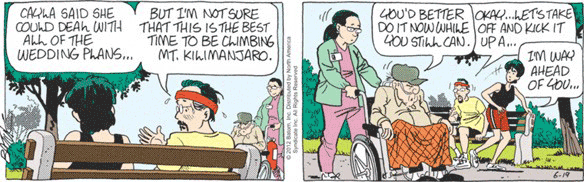
We also know where he’s going to die: at a baseball game. So no new story needs to be written. Existing art can be repurposed or recreated. Which is a common practice in Batiuk’s work nowadays.

  • It would be a nice Continuity Nod. The Funkyverse loves revisiting its own stories, and this would do that.
  • It would be a satisfying end. It would bid farewell to the character in a way that lets readers and other characters say their goodbyes to the cranky old bus driver. In other words, it would be the opposite of what happened in Star Trek: Generations.
  • It would signal the strip’s change in direction. Have you ever seen (or been part of) a couple that really needs to break up, but they won’t pull the trigger on it? They just hang around together, hoping things will get better? Ed Crankshaft’s continued presence in Crankshaft feels like that.

    Batiuk clearly wants to turn the strip into Funky Winkerbean Act IV, full of comic books and writing awards and Dinkle and Montoni’s and the Winnipeg Blue Bombers and interviews of himself and cheap award-baiting. And Ed Crankshaft is in the way of all that.

    If I’m right that Batiuk is bitter about being pressured to include Ed in the proceedings, the best thing he could do for his readers and himself is retire the character permanently. It would end the “Where’s Crankshaft” questions, because readers would know he isn’t coming back. (Though death can be a dubious thing in the Funkyverse.)
  • It would let Tom Batiuk do what he claims he wants to do. Batiuk constantly complains about having to be a gag-a-day writer. If Ed Crankshaft isn’t around anymore, there’s a lot less need for gag strips in Crankshaft. It removes a writing crutch Batiuk has leaned on for far too long. And it calls his bluff. You want to write serious drama, not gags? Fine. Get rid of the main character you have to write gags for.

Of course, he’d also need to get rid of Dinkle. But that would only take one panel:
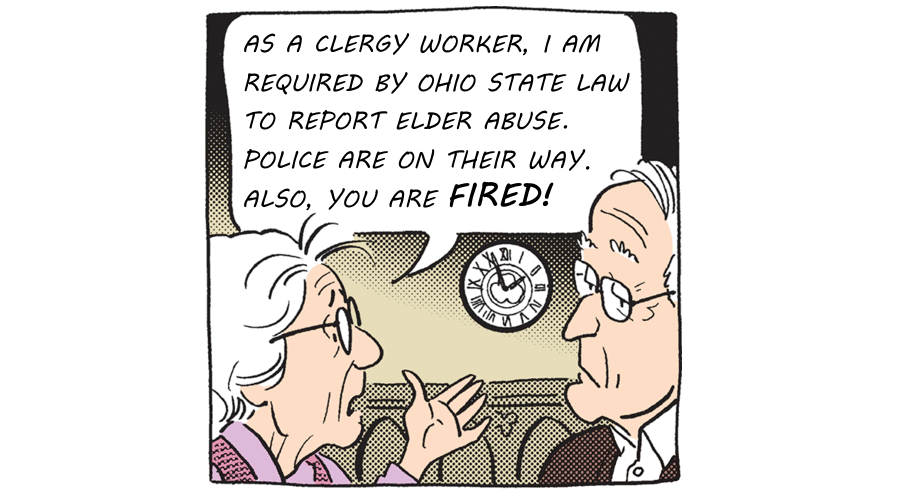
And if Tom Batiuk doesn’t want to kill off Crankshaft or Dinkle, I’ve got another character he can get rid of:

Doppelgängerstadt

Here’s a writing tip: Don’t make jokes that draw attention to your worst tendencies as a writer.

Today’s joke in Crankshaft was that the insufferable Batton Thomas called himself the “doppelgänger” of the slightly less insufferable Jeff Murdoch. Complete with umlaut. One of those worst tendencies is how Tom Batiuk loves to get little details like this right, while ignoring the basic history of his own world and characters.

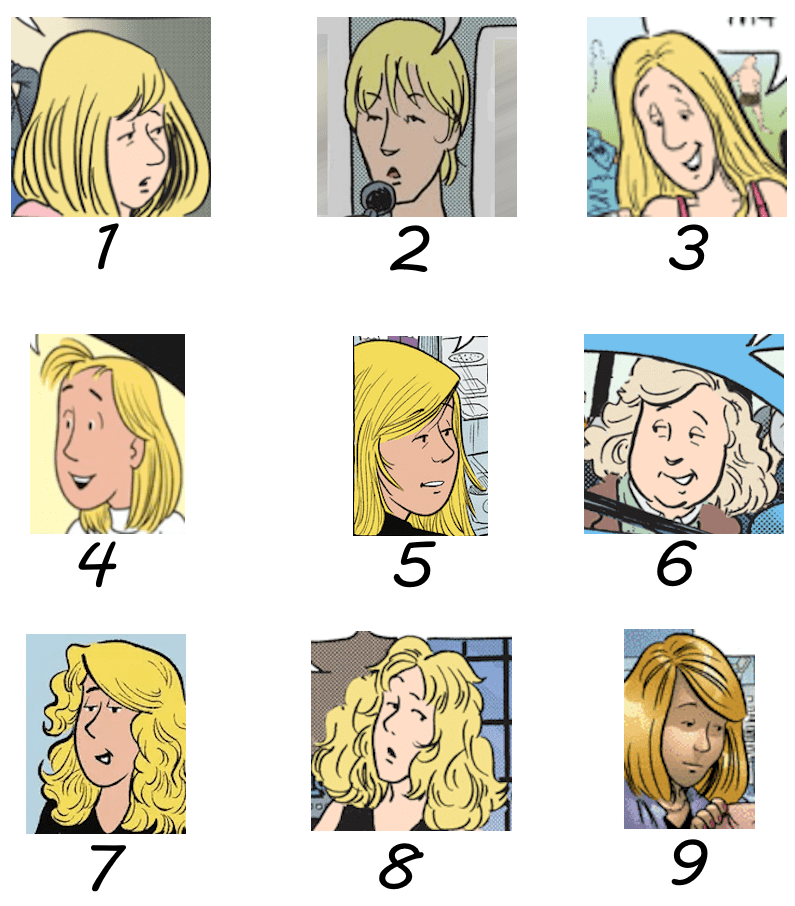
But that’s not the worst tendency I’m here to talk about today. The below images are of nine different women from the Funkyverse:

And to show that they all don’t just look alike, here are some hints about the group:

  • Five of them have made some kind of audio-visual product. (Obviously, #2 is one of those.)
  • Four of them are in long-term relationships with comic book-addicted dorks.
  • Three of them have only been seen as high school students.
  • Two are members of the original high school class of Funky Winkerbean.
  • Two of them are identical twins, who somehow manage to look different despite being indiscernible.
  • The number of characters who also appeared in both Funky Winkerbean and Crankshaft is… well, your guess is as good as mine.
  • Amazingly, only one of them has written a book. And that book was only mentioned once.

Post your guesses in the comments. I’ll give everyone a day or two before I reveal the answer. Have fun!

(UPDATE: CSRoberto aced this quiz in the very first post. Alternate quiz: tell me who these women are, but wrong answers only, a la Y. Knott and The Drake Of Life’s posts. Have fun!)

The Contrarian

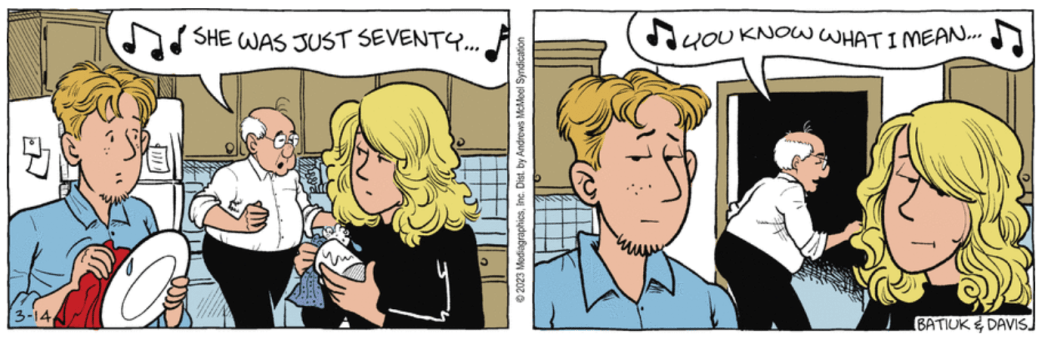
“If you know what I mean…”

It seems ol’ Batiuk has finally taken to heart all the complaints about not enough Crankshaft in Crankshaft. And he has decided to rectify this by shoving ol’ Crank into the St. Spires Choir, even though the ol’ coot has never before shown any musical inclination in his life beyond badly butchering popular lyrics to the chagrin of his family.

The voice of an angle.
Continue reading “The Contrarian”

Meanness, Inaction

Most of us call this “Ed Under The Bed” arc, but PJ202718NBCA came up with a much better name for it.

I have often said that the Funkyverse is very meanspirited, in ways that are hard to quantify. Ed spending two of the last three weeks under his bed is a perfect example of that. While the story appears benign on the surface, it forces us to make a lot of discomforting assumptions about the world these people inhabit.

In art, negative space is the empty space around to the subject of an image. Negative space can be used to give the image balance, or to convey additional meaning. Especially in corporate logos. It also makes a good metaphor for this tendency of the Funkyverse.

I call it Emotional Negative Space: the unpleasant things Tom Batiuk’s writing forces the reader to assume, in order for a scene to make any sense.

The Funkyverse is inoffensive on the surface. Bland characters smirk at each other about the author’s many boring hobbies. But if we look at the negative space around the story – the assumptions that it requires – we can see how nasty it really is. And this is a particularly nasty arc.

A senior citizen suddenly hiding under their bed is a concerning sign. They may be anxious, afraid (perhaps of something that doesn’t exist), trying to regain control of their surroundings, or otherwise coping with dementia. Or it could be something more straightforward, like they’ve begun soiling themselves and are hiding their damaged clothes. Or they’re just ashamed of themselves. Many posters have mentioned seeing their loved ones decline, and lose their independence, as they aged. It’s not a fun thing to see.

In last Monday’s strip, Ed is hiding under the bed and refusing to go to work. We just saw Ed come back from an international trip, so he has no problems with mobility, unless they just started. Ed is also a pretty fearless guy. So this is very out of character.

On Tuesday, Pam is telling Ed (who is her father) that he’s “got to come out from under the bed!” Which is even more out of character. She’s got an angry look on her face, and her arms crossed in a demanding pose she never uses any other time. Especially not when Ed is about to do another $25,000 worth of property damage. Or when Jeff brought her a rock after almost getting himself killed in Bronson Canyon.

In good writing, someone behaving out of character can suggest that this a serious moment. Like when Calvin was heartbroken about the baby raccoon dying, or when the bookish Marcie slugged that sexist prick Thibault. But that’s not the kind of writing we get in this feature. We know the author better than that. This is a week of gag strips! By a man who thinks writing gag strips is beneath him.

By giving one of the characters cancer, (Tom Batiuk) was announcing that comic strips, like comic books, need not be restricted to gag-a-day formats and juvenile subjects. This was even more apparent when the same character’s cancer returned with a vengeance in 2007.

Okay, time to be serious again. Let’s consider the emotional negative space of this moment. Ed is being told he must go to work instead of hiding under the bed. I have just one question:

Why?

Seriously, why does Ed have to go to work? Why can’t he just stay home, or quit his job if he wants to? In a competently written feature, the reason might be “we need the money.” But motivations in the Funkyverse are never as straightforward or realistic as that.

Please note that I’m not being snarky here. I have said nothing about Crankshaft being a jerk who’s intentionally bad at his job; his addiction to online shopping; his propensity for wrecking other people’s stuff; or the male characters’ tendency to be dominated by women in mommy roles. I am trying to engage the feature on its own terms. I’m trying to understand why this scene exists in a “quarter inch from reality” world. It is cruel. It is abusive. It offers no justification for itself. And it is Dude, Not Funny.

I did mention Crankshaft’s age, because it’s relevant to the question of why he needs to go to work. However you want to carbon-date Ed’s life, he is at least three decades into his retirement years. Because his daughter Pam is at least one decade into hers! She and Jeff were traditional-age college students during the 1970 Kent State shootings. Do the math.

And don’t tell me “Timemop.” Timemop has no power here. Ordinary people in realistic worlds can’t live, work, spend unlimited money, get book contracts, and remain absurdly active into their 90s without supernatural involvement becoming obvious. Does anyone remember the movie Cocoon?

Ed seems to be having some kind of panic attack. But nobody ever acknowledges this, or expresses a drop of concern for him. They don’t consider that Ed may be getting too old for day-to-day work. Or that his concerns might be valid. We saw the school children drive an implied Hell’s Angel into quitting during the “bus driver shortage” arc, so he may have good reason to fear them. Which is another justification this story could have used, but didn’t: the community needs him to fill his role during a shortage of qualified bus drivers.

Ed is shown zero compassion, and is browbeaten off-camera into going back to work. And we’re never told why. Did he just cave? If so, to what? To the spineless Pam? Seriously? We don’t know what convinced him to go back to work, or what really drove him under the bed in the first place. He mentions a couple things, but they’re just cheap jokes.

Batiuk is never clear about how his audience is supposed to react to things like this. When Calvin and Marcie broke character, it was serious business, and the tone of the stories reflected that. Batiuk’s tone is all over the place, so we can’t make the inferences we need to.

We have to provide the subtext ourselves, because Batiuk won’t. And the only logical subtext is that Ed’s family is ignoring his distress, and what appears to be some troubling behavior.