“When I was in middle school and creating my own comic strips and comic books, I called my comic book “company” Batom Comics which was a play on my name.”
“Back when I was in middle age and doing regular daily posts at SoSF, I called Tom Batiuk “Batyam”, “BatBrain”, “Batty”, “BatHam”, “BanTom”, “Batty-Bat Bat Bat” and “Tommy Two-Shirts”, which were plays on his name.”
How fascinating! Why, I’d never made that connection before! Sigh. If these blog posts of his were any duller, you could use them to spread jam on toast. Just like the vast bulk of his work, it’s difficult to believe that he actually spent time on this post, or put any thought into it at all. He even makes his dearest passions boring.
Short post tonight, as I am still trying to digest all the amazing, thoughtful, literary discussions you nitters had on the last post. I kept on opening the reply tab, staring at the blinking cursor, but gradually realizing that someone else in the comments chain had already said it better than I had.
Thanks for all the kind words on the James Joyce parody. It really wasn’t as impressive as it sounded since I used the first chapter of the novel as a direct template, and only changed a few words per paragraph to turn it Funky. It’s 90% Joyce, 10% nonsense.
I am trying to organize my thoughts into something concise about Wally Vs DSH. Hope to get that out soon.
In the meantime, please enjoy the preview of Saturday’s Crankshaft I managed to hack out of GoComics.
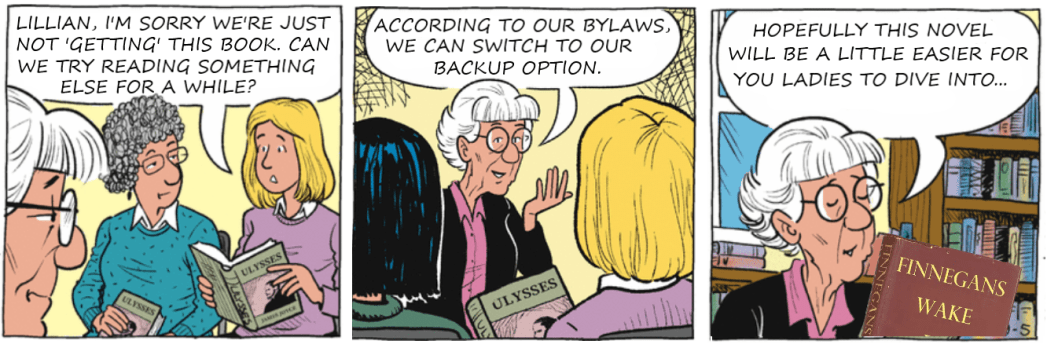
Skeletal, pallid Wally Winkerbean came from the airport, bearing a face of woe on which a smirk and a frown lay crossed. A green dressuniform, hatless, was hung stiffly upon him on the mild afternoon air. He held the door ajar and intoned:
—Introibo ad altare Lisa.
Becky Blackburn Winkerbean Howard, displeased and sleepy, leaned her body on the seat of the parkbench and looked coldly at the shaking gurgling face that regarded her, equine in its length, and at the light closecropped hair, grained and hued like pale oak.
Hey folks, time for another spur of the moment, breaking news-type post regarding everyone’s favorite blog, The Komix Thoughts. This time around, TomBan is doing a “deep dive” into FW’s final week (ugh), and the recent (and maybe even still ongoing, I don’t know) Crankshaft arc about that creepy stupid bookstore. As usual, he briefly repeats the obvious, but at the end, he drops this interesting little nugget in there:
“In the second panel of the Funky strip, Lisa’s mother alludes to the “burnings”. This makes reference to a story that will run in the Fall of 2024 in Crankshaft.“
Looks like SOMEONE will be traveling to the future! Now, I don’t read Crankshaft and I’m certainly not starting now, nor will I be starting in (sigh) the fall of 2024. But it is nice to know he’ll still be generating content for us, as that one oughta be a doozy.
Last Sunday’s Crankshaft, the one that ended last week’s divergence, raised discussion in its own right.
Here’s the strip. The scene is Lillian’s bookstore, with a table of books labeled “Banned Books – Get Them Before They’re Burned!” Visible book covers include 1984, To Kill A Mockingbird, and Maus. In the comments, some of you argued that the threat of banned books is overblown; that being banned actually makes them best-sellers; and other thoughtful takes. All while being respectful and honoring the no-politics rule. This is a great crowd.
While the strip’s premise was good, the overall strip was dreadful, for a reason nobody mentioned. And it’s dreadful for reasons that are common to the Funkyverse. To put it in context, I want to respond to a comment by Bill The Splut:
I will give Tom points for putting it in a new way. The Shining Twins don’t even notice. Book bannings mean Back to School now.
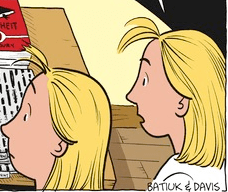
In the strip, one of the two twin girls says “Gee, it’s hard to believe it’s almost time for school to start!” Which certainly could be interpreted as Bill suggests; that the sign’s message had no impact on them. The art supports this theory:
But the art also starts to reveal the problem. These girls look like they’re 9 or 10 years old. Are children this young concerned about book censorship? Should they be? “Oh, this reminds me we have to go back to school” is a perfectly reasonable observation for a couple of soon-to-be fifth graders.
But that’s not the worst part of it. It’s this:
What in the hell is this face? What emotion is Lillian trying to convey here? What emotion are Tom Batiuk and Dan Davis trying to convey to the reader? I’d love to show that picture to 100 people and ask them what they think is being expressed here. My guess is “accidentally farted a little and is looking to see if anyone noticed.”
This is a book store Lillian owns. It’s implied that she set up this “banned books” display. So she must feel strongly about the matter. When her own helpers, probably the most book-aware children in town, fail to get the message, she must feel… something other than this! Angry? Disappointed? Sad? Condescending? Socratic, as if this were a great opportunity to educate the next generation?
Instead, we get: smirk.
Smirk is the universal emotion in the Funkyverse. Smirk is the appropriate emotional response to every single stimulus in life, from “I am mildly annoyed by your joke” to “I am painfully dying of cancer.” The champion of the smirk was, of course, Lisa.
The art puts so much effort into showing how gaunt and feeble Lisa is, but her smirk muscles still work! Cancer can’t kill those, apparently. Even though this horribly awkward remark should have cleared the room. If I met my biological mother for the first time and found out she was this fatalistic and self-pitying, it would also be my last visit.
But let’s get back to Lillian. Her expression kills this scene dead, because it sucks all the emotional stakes out of it. It’s another huge failure of If This Is True, What Else Is True. Put it another way: it’s another failure of Batiuk to view a scene from the perspective of his characters. Lillian should have a reaction here, or know not to be too bothered by it. But she doesn’t do either. The strip attempts to raise a serious issue, but Lillian’s wry, bored disinterest in her own cause stops it cold at second base. If she doesn’t care about what’s happening in the strip, why should the reader?
Batiuk has an infamous blog post about breaking the fourth wall, where he says “I would break the fourth wall by having a character do a side-glance to the reader. I stopped doing that because, while it’s funny, you lose the investment and involvement of the audience. They know the characters are going to be just fine, and they don’t really care about their fate. By breaking the fourth wall, I inject myself into the story to wink at the reader as we share the joke.”
But that’s exactly what the smirk does. The character does a side glance to the reader, and kills the investment and involvement of the audience. We know the characters don’t really care about their fate. By breaking the fourth wall, Batiuk injects himself into the story to wink at the reader as we share the joke. Except there’s no joke here either.

 Son of Stuck Funky