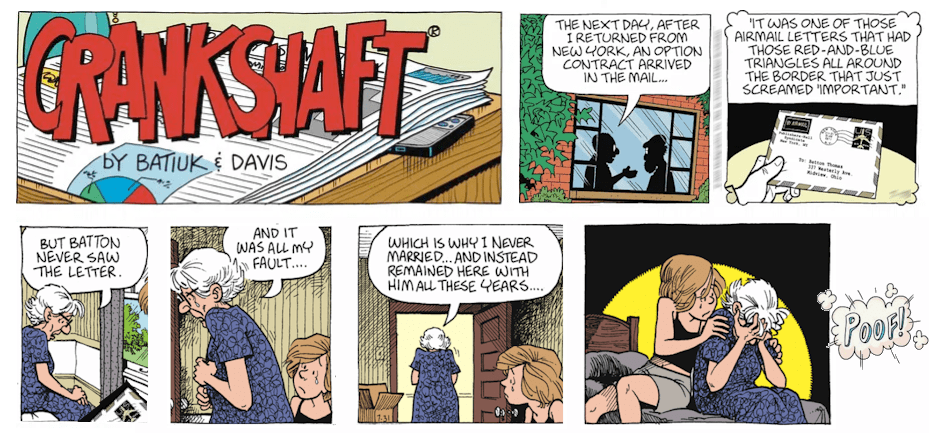
Use this space to react to the Batton Thomas interview, or talk about something less excruciatingly boring. Again, I’ll do this bullet point style:
Batton Thomas has now been talking for well over two hours, finally gets to the part where he gets the cartoonist job, and… skips over it. Absolutely stellar.
Is this how Tom Batiuk thinks interviews are supposed to work? That they just let you drone on for hours and hours and hours about whatever you want? Highlighting Skip’s lack of journalism skills is belaboring the obvious at this point. But sheesh, he could try interjecting a question.
It’s no wonder Tom Batiuk always gets ripped off in his syndicate contracts. Apparently he just signs whatever they mail him.
Finally: have you looked at any other comic strips this week? Batiuk is being out-Batiuked all over the place right now.
Luann is doing a rerun about selling comic books door to door. Rex Morgan, M.D., has spent the last six weeks on a story where an unknown adult man thinks country singer Truck Tyler is his father. SPOILER ALERT: he’s not. Mary Worth is spending a week packing to go to New York to hang out with a 14-year-old. Who knows what Gil Thorp and Mark Trail are even about anymore.
It feels like every drama comic strip is trying to duplicate Batiuk’s lazy, tedious, self-indulgent, exposition-heavy, character-shilling, skip-over-anything-interesting writing style.
Today’s Crankshaft is one of the most incoherent strips in recent memory. To give you a text description:
Ed can’t find his cell phone. He asked Pam to use her cell phone, so he can call his own phone to locate it. His friend Ralph is on the other end of the phone. Ed says “Ralph, what’s my phone doing at your house?” Ralph says “your phone isn’t here.” Ed says “I can hear it ringing.” Pam’s husband Jeff walks into the room wearing a Winnipeg Blue Bombers shirt and carrying a ringing cell phone, and says “somebody looking for their phone?”
At first, I thought the joke was “it’s surprisingly difficult to dial your own phone number, because you’re so used to dialing other people’s phone numbers.” I remember this being true when I was in high school, when I had to do things like call my parents from a friend’s house. But the way cell phones work negates that. You save the number under the person’s name, and pick the name out of the contacts list when you want to call. I don’t even know my friends’ or family’s phone numbers anymore.
Also: Ed never actually dials from Pam’s phone. So Ralph being on the other end of the call only makes sense if Pam is already in a conversation with Ralph. But that doesn’t make sense because Ralph is Ed’s friend, not Pam’s. She also appears to be mid-dial when Ed interrupts her, so there isn’t an active conversation going on. By the same token, Ralph’s number wouldn’t be in Pam’s phone – it would be in Ed’s phone.
The punchline is that Ed’s phone rang in the other room. But why is Ed’s phone ringing if he called Ralph? Why is Ed’s phone ringing if he’s even talking to Ralph? Ed could have done the cumbersome “put one call on hold and dial another call” maneuver, but not enough time passed for that to be possible. It’s also contrary to Ed’s usual befuddlement with technology. But we also just saw him build a sophisticated AI gardening system, so who knows?
Speaking of AI, that’s exactly what this strip looks like. The joke starts with a relatable premise, but then forgets to include an important plot point (Ed dialing his own number), and the punchline contradicts the setup. This looks like a joke an AI would write.
So I decided to fight fire with fire. I asked Galaxy AI’s Joke Explainer tool to tell me what in the hell is going on here. I fed it the textual description above, plus a few clarifications like Pam being Ed’s adult daughter and Jeff being her husband. I called it “American humor” and asked for a simple explanation. Here’s what it said:
This joke is funny because it plays with the idea of confusion and unexpected twists.
Well, I can’t argue with that. “Unexpected and confusing” is Tom Batiuk’s later work in a nutshell.
Setup and Expectation: The joke starts with Ed losing his cell phone and asking his daughter Pam to help him locate it by calling his phone. This sets up a relatable scenario—everyone has misplaced their phone at some point. We expect that Ed will find his phone soon.
Okay, fine.
Miscommunication: When Ed calls his phone, he talks to his friend Ralph, who insists that Ed’s phone isn’t at his house. This creates a little tension because Ed can hear his phone ringing, leading us to wonder where it could be.
But Ed didn’t call his phone. We never saw him do that. And if he did, he wouldn’t be on the phone with Ralph. The AI fails to detect that this series of events makes no sense.
The Twist: Just when you think the situation is getting serious, Pam’s husband Jeff walks in wearing a Winnipeg Blue Bombers shirt (a Canadian football team) and carrying a ringing cell phone. The humor here is in the surprise—Jeff is the one with the ringing phone, which is revealed to be Ed’s phone.
Classic example of “garbage in, garbage out.” The AI has ideas about how humor is supposed to work, and is trying to make this humor-like sequence of words fit that model the best it can. It can’t see Ralph’s involvement for the non sequitir it is. (Or more correctly, non ducit.) It’s an unnecessary detail that confuses the reader. Batiuk’s writing does this all the time.
It’s also not surprising that Jeff found Ed’s phone. The whole scenario implied that Ed misplaced it somewhere around the house, because that’s the only scenario where dialing it would be any help. The actual surprising part was Ralph being on the phone, but the AI had to assume that was an important part of the story.
Visual Humor: The image of Jeff walking in with the phone adds a visual element to the joke. His casual entrance contrasts with the confusion and urgency of Ed trying to find his phone.
Batiuk got “show don’t tell” right today. He visually delivered the punchline instead of having Jeff yell it from off-panel. One point for that, I guess.
Cultural Reference: The mention of the Winnipeg Blue Bombers adds a layer of cultural context. While it might not be essential to the punchline, it gives Jeff a character…
And there you have it. Jeff’s personality is Winnipeg Blue Bombers. Couldn’t have said it better myself.
…and adds a bit of humor through the absurdity of the situation—why is he wearing that shirt while holding Ed’s phone?
The AI correctly identifies why we continue to be fascinated by the Funkyverse: it’s so absurd, it adds humor to itself.
This week’s story in Crankshaft actually offends me.
It offends me because I was a news journalist once upon a time. So I know firsthand what a huge amount of work goes into creating video content. Even a simple 90-second TV news story means you have to write scripts, schedule, shoot, edit, add on-screen graphics, mix sound, fix errors, and manage the whole project.
And YouTube content can be even more complex than that, with fancy animations and the like. Don’t let the lo-fi, “I shot this in my apartment” aesthetic of YouTube content fool you about how much effort it requires.
Computers make these tasks a lot easier now, but that just means you have more competition. Almost anyone can be a content producer nowadays. Which is a good thing! YouTube is full of great stuff, from people whose voices we never would have heard otherwise. It turns out, the world is full of Hal P. Warrens. And they’re making broadcast-quality stuff. (There should be a Warren Award for do-it-yourself filmmakers.)
But Tom Batiuk has decided that Lillian needs to be a media star for the 25th time now, so now she’s going to become The Reluctant YouTuber. As if this were even possible.
This week is a great example of something Epicus Doomus often says: Batiuk never runs out of new ways to be infuriating and boring at the same time. It’s recently become a sport for commenters at this blog to try and guess what the next week of Crankshaft will be about. Known future stories include the upcoming Pete-Mindy wedding; the trip to Winnipeg for a Blue Bombers game; a likely trip to San Diego Comic-Con in late July, even though post-Funky Winkerbean has pivoted away from Atomik Komix; the endless Skip-Batton Thomas interview; Cindy’s pregnancy at Age 75, which is entering its fifth trimester; and standard Crankshaft plots.
Never mind all the practical problems with the story. In today’s strip, it looks they’re shooting a TV commercial for Lillian’s Murder In The Blank series. This book has a limited appeal, and has already been out for months. A promo would serve little purpose. And they’re shooting it with a cell phone? The video quality is going to be crap.
It’s like they’re trying to do a BookTok thing. But BookTok is a community for readers to talk about what they read, not for writers to promote what they wrote. And Lillian’s work is probably self-published, which is another hurdle to clear. Book reviewers usually have a policy against reviewing self-published/vanity press works at all, because they insist that a book have survived the winnowing process of being selected by a publisher. I can’t imagine the BookTok community would be receptive to this old self-promoting crone.
Another thing that annoys me: the girls work for Lillian, not vice versa. Especially after the recent week where they demanded to be paid. I think she hired one, because the other one still works at Centerview Sentinel. (Well, at least we know how the paper is still getting made, while Skip sits in Montoni’s with Batton Thomas for months on end.) But as we all know, no Funkyverse character can refuse to do something some other character wants, even when they’re that character’s boss.
But what galls me the most is how dismissive the Funkyverse is of every profession that isn’t teaching high school, writing, comic books, or pizza.
Making web videos? Pfffft. Easy stuff that anyone can be famous at. Remember when Bingo the Cat wandered into a video, and St. Spires church raised enough money to pay the national debt? Remember when Frankie was handed a reality show to slander and humiliate his sexual assault victim who died of cancer? Remember when Hollywood just stood around and let Les Moore make all the decisions for “his” movie, paid him a bunch of money, and probably took a loss when it failed? Remember how Cindy Summers became a national TV news reporter despite being a lazy, vacuous idiot?
Remember when Funky humiliated that investment planner for no reason at all? Or the many times he was a jackass to a doctor and their staff? Or when he abused his position as support group coordinator to workshop his lame standup? Remember the “Toxic Taco”? Remember “FleaBay”? Remember became how Crazy Harry and Donna/The Eliminator became world champions of a notoriously difficult video game, despite rarely picking up a joystick otherwise?
And before this week is over, Tom Batiuk will make a YouTube star out of a 105-year-old woman who doesn’t even want to be one. Who also can’t even make her own website, or write her own biography. That’s a slap in the face to anyone who’s picked up a camera.
To answer Lillian’s question from Monday’s strip: yes, Lillian, you have lived far too long. But technology has nothing to do with it. Dieplzkthx.
(UPDATE: As of Saturday, Lillian had only two YouTube followers, but still manages to be smug and insufferable about it. The whole week was an exercise in phony humility. “Oh, poor little old me doesn’t know anything about YouTube.” Then starting on Thursday, she knows she needs a professional voiceover artist, and knows what a follower is.
Which speaks to the underlying problem of it all. All the books, all the videos, all the signings, all the awards, all the interviews that get created by the dozens of characters in the Funkyverse serve only one purpose: an ego wank for the creator. We never even see them creating the content, or even having any real desire to create it. Just like we didn’t see it this week. The plot is always: 1. Declare self a writer. 2. Receive praise.)
UPDATE: As of now (about 12:30 AM Eastern time), I have gleaned two more theories from the comments here and at joshreads.com, and added a sixth one of my own:
“Buy physical books instead of eBooks.” (HAT TIP: Colonel Chrome in the comments). Lillian is as a brick-and-mortar bookstore owner, writer of books that are presumably not in eBook form, and resident of a place where physical book signings are central to the economy and social structure. So this makes total sense as a position she would hold. (I include Y. Knott’s “download only from spinner racks” in this category.)
“Download from somewhere other than the Internet.” This is a new reading that I noticed. It makes no sense, but that’s never been an obstacle in the Funkyverse.
I can’t edit the poll without losing existing results, so if you want to vote for one of these, use the “something else” poll option above, and also like the appropriate post in the comments.
Everybody’s humouring ol’ Skipper. “Great edition this week, Skip! Read the whole thing cover to cover! And all for 10 cents — what a bargain!”
There hasn’t been a newspaper published in years, of course. But it makes the old man happy in his dotage to “interview” people, to write “stories”, and to have “interns” around who will give him someone to talk with.
It’s the same for Les Moore, who wrote some “books”, won an “Oscar”, “teaches”, and “climbed” Mount Kilimanjaro — although he hasn’t left his house since he finished high school.
That would explain a lot about this world, and why it’s so focused on literature when its inhabitants (and its creator) can barely read, write, or even speak.
Take this week’s Crankshaft, for example. It’s yet another book signing arc, starring the insufferable Lillian McKenzie. This week, Lillian bends over backwards to prove she’s incapable of writing a sentence, much less a book series that’s been showered with awards. This on top of her usual smug condescension, and Tom Batiuk’s spammy corporate logos of real world events that still tolerate him. We get:
Monday: Lillian gets in line for a book signing, not realizing the line was to see her. (I guess those pre-teen twin assistants of hers set everything up, which is usually the host’s responsibility.)
Tuesday: A fan gives an incoherent title suggestion for Lillian’s next book. Lillian seems to be sarcastically mocking her.
Wednesday: Lillian wasn’t mocking her. The fan jokes that Lillian is “all done except for the book part!” This may be the most self-unaware joke Tom Batiuk has ever made, for reasons I’ll get to.
Thursday: A line of signing attendees spits out more title suggestions, which are all “Murder” followed by a preposition, and then random words. How would Murder On The Zoom Panel even work? The meeting attendees are all in their own homes, and anything that happens is video-recorded while an AI generates a transcript. Doesn’t leave much room for mystery. But Tom Batiuk Lillian doesn’t think this far ahead.
Friday: Lillian repeats Wednesday’s joke. We also see that she wrote down the suggestions, further confirming that she is serious about using them.
Saturday: Lillian goes even further to show how dull and uncreative she is. She says “White-Collar Crime at the Book Publisher just isn’t as attention-grabbing” as the Murder titles.
Well, Lillian, I’ve read the books Bringing Down The House about the M.I.T. blackjack team, and Fake: Forgery, Lies, and eBay about art forgery in the early days of online shopping. They were compelling reads. There are also many great movies about white-collar crime: Wall Street, The Big Short, Catch Me If You Can, and others. That Lillian rejects this concept out of hand, but wrote down Murder At The Airport Book Kiosk as a worthy suggestion, is a greater indictment of her talent than anything I could say.
Les Moore is another person who can’t possibly have written the books he’s credited with. This one strip exposes him as a fraud:
How can Les write Lisa’s Story when he’s too emotionally fragile to even read Lisa’s story?
Les can’t give his readers a raw, emotional look into the world of dealing with cancer, because he never even dealt with it himself. He spent the whole time avoiding anything other than his own feelings, mostly leaving Lisa and Summer to fend for themselves. Real-life cancer sufferers, like Alex Trebek was, can at least be honest about their condition, and acknowledge the role loved ones play in support and survival. The short personal stories at thisislivingwithcancer.com are light-years ahead of anything Les Moore or Tom Batiuk has ever hinted at in the 20 years Lisa’s Story has been attracting attention to itself.
So Lillian and Les are frauds. Skip Rawlings is a fraud, because there’s no way one man with one arm is creating a full-featured daily newspaper alone, especially when that man is over 100 years old. (He was also the villain in a white-collar crime story, but Tom Batiuk is too blind to see it as that.)
Pete Roberts-Reynolds is a fraud, because all we ever see him do is design comic book covers and steal ideas from his girlfriend. He never actually writes anything, even though he supposedly wrote this world’s Star Wars. And since today is May 4th, may the force be with you. You see what I mean? Starbuck Jones has been around for decades, and it doesn’t even a catchphrase!
You know which author I do believe in, though? Harry Dinkle. He’s the one person in this world I can believe wrote an actual book. Unlike most of the others, we’ve seen him work on it. Dinkle at his typewriter writing bad puns was a staple joke in Act I. It was replaced by the self-indulgent “lord of the late”, “le chat bleu”, and book signings in Act II. Dinkle has the work ethic and obsessiveness you need to get the job done. Nobody would ever read it outside of historical research, but it would get written.
Lillian, Les, and Atomik Komix are lazy. They write books like most people buy lottery tickets. They’re certain this is the one that will make them rich and famous. But even if they win awards, Monday morning they’re still working their dead-end jobs in their dying poverty suburb. (A dying poverty suburb with a strip club, which was an unexplored plot point in Crankshaft after the Valentine Theater closed.)
Which brings me back to the original question: what is the purpose of book publishing in the Funkyverse? Because it sure as heck isn’t quality literature. Lillian thought an arson attack on her own home was a great inspiration for a book, even though she never bothered finding out who did it. (We will, though.) Does the Hercule Poirot of this series solve murders by giving smug lectures and astroturfing flash mobs?
If Murder At The Bookstore Burning and The Centerville Sentinel and Lisa’s Story and Starbuck Jones and Singed Hair and Fallen Star and the entire output of Atomik Komix aren’t actual books, then what are they?
I think the Funkyverse is a cargo cult. When European and American cargo ships started showing up at remote South Pacific islands, the locals invented a narrative about John Frum. Who was probably an ordinary person who introduced himself as “John from” wherever. The locals made him a god figure, and started doing rituals intended to bring John Frum back to their island, with a cargo ship full of goodies. They made a god out of some shmoe who worked for a shipping company.
On top of that, the book scene in Westview has elements of joss paper. In Chinese culture, it is common to give gifts of money for New Year’s, to deceased loved ones at funerals, or to use in burnt offerings. A whole industry of printing fake money for these purposes exists.
If you combine these two concepts, that’s what these books are. The residents are simple natives in a forgotten place who know book writing is a path to fame and fortune, and absolutely nothing else about it. They are performing a ritual to try and appease a fickle god. But they need physical books for that ritual. The book can’t exist as merely a Word file. It has to exist on paper, with a title and a cover. It doesn’t have to have any content, just a title and a cover. Which is why Funkyverse denizens spend so much effort on titles and covers, and absolutely nothing on the contents of the book, even if it’s just a comic book.
It’s why Chester Hagglemore puts so much effort into creating comic book covers of characters his staff can’t possibly support.
It’s why they spend hours in line at each other’s book signings, buying books that aren’t even new anymore, and which no one would ever want to read even if they existed.
It’s why they spend so much time acting like Hollywood’s idea of a writer, smirking at each other over incoherent sayings. It’s like they’re trying to be witty, but don’t know what wit actually is.
And when they’re not on panel, Lillian and Les and Pete and all the others are in line buying other people’s books. The whole town belongs to the cargo cult, and they all reinforce each other’s behavior. It’s basically the local economy.
That’s my fan theory, and I’m sticking to it. In the Funkyverse, when you’re “all done except for the book part,” you’re done.