As always, it’s impossible to follow up the amazing posts of CBH, but here I go.
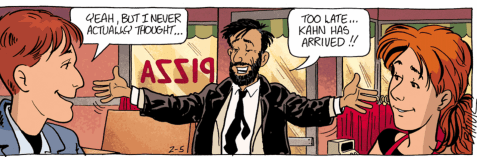
I’m guessing Rocky is carrying on Crankshaft’s illiteracy? Because I don’t know why Cory is reading that sign out loud if she can read it for herself. It’s also weird because it’s easily legible for anyone reading the strip, so there’s nothing at all added by him reading it. Of course the joke is “Cory’s mom is excited for him to get married” which I don’t think is a joke or really worth spending a day of a strip on, but that’s Batiuk for you.
Yup. Batiuk doesn’t even have the decency to end this on a Sunday Strip. And has instead given us six panels of pointless nonsense. It’s like ending a contentious divorce arbitration with a pie in the face.
So let’s ignore it, and move on down memory lane.
Just a reminder, as we continue the saga of Jefferson Jacks.
A baseball player younger than Crankshaft, mentored by Crankshaft.
A baseball player slightly older than Crankshaft, played with Crankshaft.
Cuban League professional baseball was definitely a thing. Up through the abolition of professional sports in Cuba in 1961. Since it was played in the winter, American players, black and white, often participated. It was one of the first baseball leagues to be completely integrated. There were usually four or five teams, including, Almendares Alacranes ‘Scorpions’, Petroleros de Cienfuegos ‘Oilers’, Habana Leones ‘Red Lions‘, Tigres de Marianao ‘Tigers‘, and the Havana Sugar Kings.
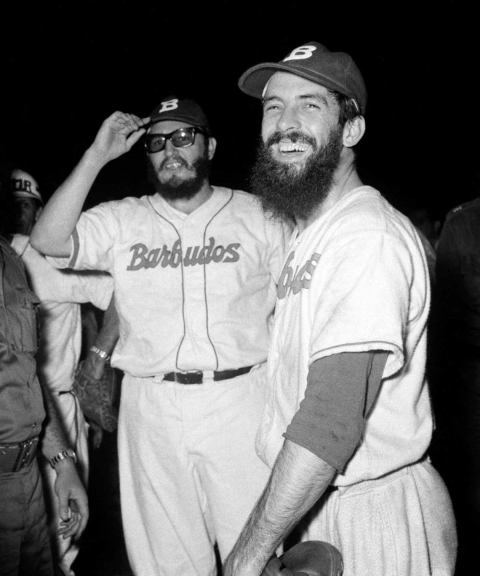
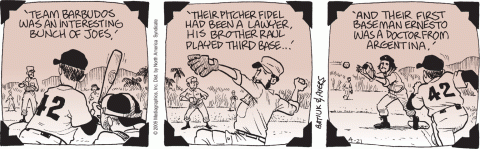
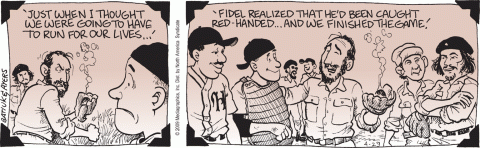
I wasn’t able to find any evidence that Fidel Castro and Che Guevara paid the Havana Reds to play against them in a sugar cane field in the early 50’s though. Maybe I was searching the wrong sources.
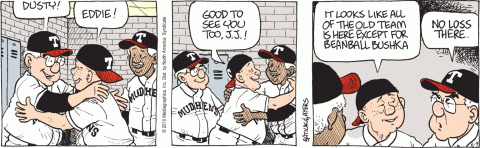
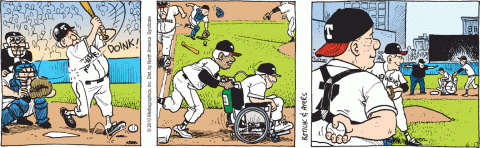
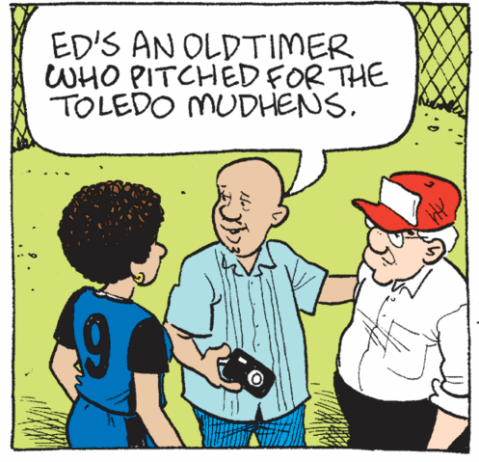
Following the Jefferson vs the communists story, we next see Jefferson Jacks in June 2010. Crankshaft and various other former Toledo Mud Hens are invited to play an exhibition game at a Mud Hens reunion.
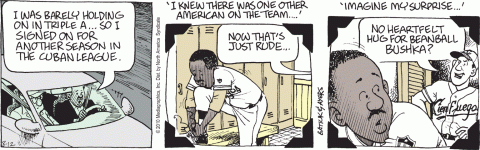
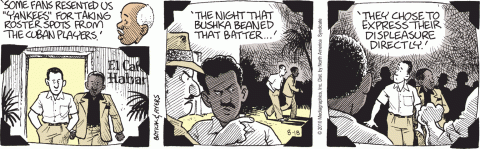
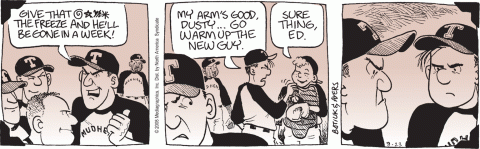
Cute right? Or Schmaltzy? Depends on how jaded you’re feeling or how manipulative vs genuine you feel the writer’s intentions were. While it seems Jacks decided to help Bushka around the bases after seeing how frail his old tormenter had become, a few months later, in August 2010, we’re given a little more depth into their détente.
I’ll just re-repeat my comment from the last two threads: “Cayla’s whole presence in this arc seems to be adding up to, ‘Yeah kids, but whaddaya gonna do, right?’” (This time with better punctuation.)
Sourbelly
Cayla says, earlier this week, “Frankly, I don’t know how we’re going to change things.” She says this to two young kids who had baited a confrontation with a woman they didn’t know because they didn’t like how they were treated different for looking different.
And I just want to slap Cayla.
Because there are dozens of avenues to change. Some less contentious than others.
And one of those roads is the road of forgiveness. Not silent forgiveness, but an open hand presented. Offering a human connection to someone on ‘the other side’ and hoping that the relationship can be the key that releases them from their cage of prejudice.
It’s a more contentious road than you’d think. There are so many who see the weight of ignorance and hate as a burden that people deserve to be crushed by, because they willingly chose to carry that hate. They want to shut those spiteful people away in the dark prison of their own malice, and throw away the key. Because hateful people have not earned our efforts. Because they have not yet received back the pain they’ve inflicted.
And to withhold forgiveness is their right. No one should force the wronged to reach out.
But I feel that pure, healing change comes from batting away the fingers that pry into scars and want to hold open wounds. The past is prologue, but it is also a mirage we can’t visit, and revenge is an illusion because it destroys to pay for something already gone. What matters is now, and the future, and what will make things better there, whether it be punishment or mercy.
Sometimes change can’t be so kind. But when we can, isn’t better to convince people that the change we want makes things better for everyone? To convince people that the world you’d like to see has a place for them too?
And someone at their back to protect them, who will help push them home.
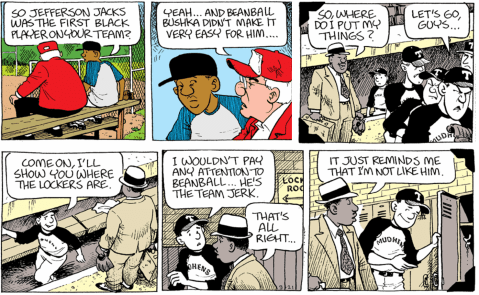
So Cayla states, AND I QUOTE, “He told me that one thing that gave him some solace…was reminding himself that he wasn’t like them.”
And so, I am willing to rest my case, and conclude that in an arc about racial profiling Batiuk and his team got two black characters confused because they looked too much alike.
There remains the outside chance that I am wrong, that the ‘wisdom’ Cayla spouts is also something her father, Smokey Williams, will be shown saying in his original arc. I will let you know my findings in the comments section when my copy of Strike Four! arrives. And I will add a retraction statement to this post if I was wrong.
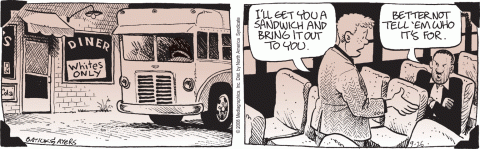
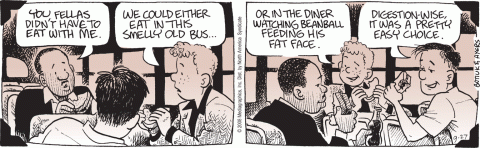
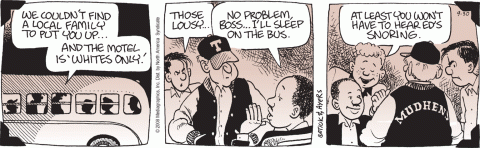
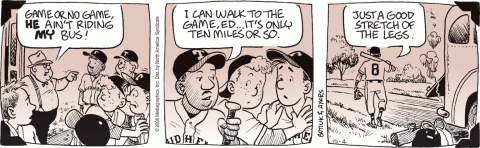
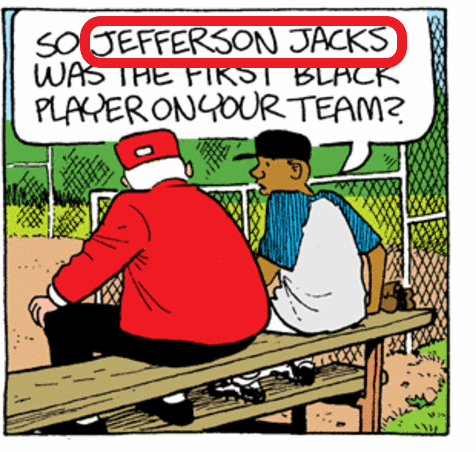
But for now, lets look a little closer at the Jefferson Jacks arc. In truth, it was the first thing that came to my mind when I saw last Saturday’s strip, because it was the most significant arc I could think of that tackled racism. The storyline ran in Crankshaft from September 15 to October 12 in 2008. The following are some highlight strips, to give you all an abridged rundown.
First things first. I tried digging through the Toledo Mud Hens rosters to see if they ever integrated before the team moved to West Virginia in ’52. I couldn’t find any black players, though many didn’t have easily googleable pictures. But the Mud Hens integrating in ’47 is a bit of fictional license.
Second. While I couldn’t in my quick and dirty internet search blitz find instances of players confronting disgruntled potentially violent townsfolk, or a black player having to walk to a game, much of what is depicted in the arc is similar to what early integration-era ballplayers went through. I could find instances of heckling from the stands, eating and sleeping on buses,being boarded with local families, and having some white teammates be cold and others be friendly. Crankshaft being ‘one of the good ones’ is, of course, heavy-handed and self-serving. But I really didn’t hate this little story. And the art was especially nice.
This feels so oddly well researched for Batiuk work, doesn’t it?
Well…
Finally, in a bit of Crankshaft news, the Crankshaft story dealing with the black baseball player Jefferson Jacks has been nominated for a Glyph Award in the Best Comic Strip category by the East Coast Black Age of Comics Convention which takes place on May 16th at the Crowne Plaza Hotel in Philadelphia. Just a bit of backstory here… a good friend, Tony Isabella, had suggested I write a story about a black minor league ballplayer who would have played with Ed Crankshaft on the Toledo Mud Hens. I was out of pocket on the Lisa’s Story book tour around that time, so I suggested to Tony, a fine comics writer in his own “write”, that he do it… and he did. Later, when Tony’s scripts came in, I wrote the Sunday strips to wrap around the story and they were then beautifully illustrated by Chuck Ayers. If I say so myself, it’s a fine story and I’m very pleased that it was nominated by the judges.
Finally, part two… the current Jefferson Jacks story was written by me as I recuperated after my accident last year, but Tony and I had such a good time with J.J., that we’re working on some new stuff for down the road.
He had a ghost writer for the story! Tony Isabella is a fellow Ohio native who’s written for Marvel and DC. He’s best known as the creator of Black Lighting.
The ‘current Jefferson Jacks story’ referenced in the blog post was, of course when Jacks played ball in pre-revolution Cuba. Since it was penned by Batiuk, I’m sure was just as well researched and substantiated as the arc Isabella wrote.
Note, the above was a vertical slice of the story. The full arc ran from April 13 to May 2, 2009.
Tomorrow is the last day of my shift. I can continue the saga of Jefferson Jacks for you all, if you’d like. Show you the conclusion to another Funkyverse story of prejudice.
Or, it’s not to late to learn all the exciting facts about Styrofoam and linoleum.
When I first read today’s strip, it seemed to make sense. (Except for the last panel, of course.) I remembered Cayla’s dad.
His first and last in-the-flesh appearance in Funky Winkerbean.
ULTRA CLOSEUP ACTION
I remembered that Smokey Williams had been friends with Crankshaft.
The seasoning is piss and vinegar.
And I remembered, from my very earliest comic strip snark fandom days, that Crankshaft had a flashback prestige arc about Cranky befriending his black teammate during the early integration era.
Still, not as hamfisted as this week.
And I chuckled to myself over how it was just PEAK Batiuk to reference by name an obscure character that has only been seen in Funky Winkerbean once, who further references an awards bait arc he wrote in Crankshaft back in 2008. Are any readers, even among the dedicated snarkers on SOSF, CK, Curmudgeon, and elsewhere, going to remember who Smokey Williams was?
I tried to do a little mental math, if it would work if Cayla’s dad was a young man in ’47. But I just chocked it up to time skip weirdness. Then, I went back to the archives for Crankshaft to reread the Diet Jackie Robinson arc.
Wait…
Umm…
But….what?
One of these names….
Is not like the other….
And then I looked at the Crankshaft-meets-Cayla strip from 2011 a little closer.
Any closer and I could’ve counted the blackheads on Cranky’s nose.
Smokey calls Crankshaft an ‘Old-Timer.’ Cranky is a grandfather of adult grandkids at this point, and Cayla is Smokey’s daughter and a college student. Smokey is drawn slightly younger looking than Ed Crankshaft.
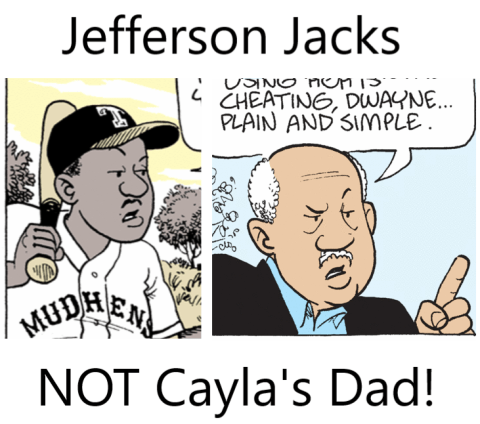
Guys. I don’t think that Crankshaft and Smokey Williams played on the same team. I think Smokey Williams is decades younger than Crankshaft. But then, who is he?
In the bedeviled Comics Kingdom hellscape, Crankshaft only goes back to late 2002. When Smokey calls Crankshaft up in 2011, it is the first time he’s mentioned or seen in the archives. But he isn’t treated like a new character. The Toledo Blade didn’t carry Crankshaft. In desperation I started googling madly into the void. And got this little clue from a book review of the Crankshaft baseball collection: Strike Four!
Memorable storylines include the time Ed became a coach and mentor to struggling Aeros pitcher Smokey Williams, and a flashback to Ed’s support for his team’s first black player, who took some harassment from both the public and other players.
Crankshaft is certainly not a coach or mentor to Jefferson Jacks in the integration arc. And Jefferson Jacks isn’t playing for the Aeros, and doesn’t seem to be a pitcher.
So Jefferson Jacks and Smokey Williams…I think…are two different people. Evidence for this supposition is that Jefferson Jacks shows up at the end of the 2008 arc.
He does look like Cayla’s dad will look…thirteen years in the future.
And this strip from when Crankshaft was inducted into the Centerville Sports Hall of Fame in 2012.
See the cluster of three bald heads to the left? The white one is Dusty Bottoms, Crankshaft’s catcher. Is the tall white haired one Jacks and the shorter one Williams?
So my working hypothesis right now is that some time in the first fourteen years of Crankshaft there is an arc where Smokey Williams was introduced. Was he the victim of racism then? I don’t know yet. But my Ebay order for Strike Four is in the mail.
Because one of two things is happening here. And I absolutely must know which it is.
1.) Smokey Williams, Cayla’s father, was also subjected to racism in the arc I haven’t read yet.
2.) Batiuk got his black baseball players confused, probably because he made the older Smokey at Cayla’s wedding look just like Jefferson.
You may think actually purchasing a Crankshaft book is taking my obsession with Funkyverse lore a little too far. To that I have the following two rebuttals.
1.) I took it too far a long long time ago.
2.) I actually like Crankshaft.
It’s funny about once a week.
The superior protagonist in every way. Even when it comes to conversing with his long dead wife.
Malcolm is now pouting like a child, which I guess fits one of the two ages he claims to be.
It’s okay Mal, you won’t have to feel seventy and seven for much longer. Because you’ll soon be completely forgotten. As a Westview student who isn’t a child of a main cast member, you were always cursed to be swallowed by the memory hole. I’m just sorry you had to go through this awful plotline first.
It could be worse. At least you weren’t initially created with sermonizing in mind, and then forced to linger in the background long after you were no longer wanted.
Commenter Bad Wolf had this to say yesterday:
I’m going to pin a lot of it down to his dismissing any of the (potentially) interesting characters he’s thrown in over the years—like that couple from Hong Kong he was so proud of—so that they aren’t around when he does want to use them for some social message. If he had built up Westview into a little Springfield of different quirky characters he could bounce back to whenever he wanted I’d be a bit more generous in how i looked at the strips.
I talked a couple days ago about culture as opposed to race, pointing out that any of the recurring non-white characters in the Funkyverse are culturally indistinguishable from anyone else. That doesn’t mean Batiuk hasn’t tried to introduce culturally distinct characters. He is just completely unable to sustain them. We’re seeing it happen in real time with Adeela the Iraqi immigrant. She was introduced for a big prestige arc in 2018 and was given the typical Montoni’s nepotism position.
After that she had nothing more than sporadic appearances for months. Appearances where she was a non-character, interchangeable with anyone else. She got another prestige arc in 2020 so Batiuk could preach at us about ICE. Then she showed up ONCE and said NOTHING in all of 2021, and is yet to appear in 2022.
Introduced as a prop in service of a ‘message’, then pointlessly kept around in case he wants to use her again. She’s walking the same path Kahn the Afghani immigrant walked before her. The same path Zhang Li and his wife Liu Lin trailblazed years before.
I don’t have access to the actual 1997 prejudice arc that Batiuk talks about in his blog. The incompetent misers over at Comics Kingdom only have Funky Winkerbean going back to October 1998. Maybe Billy The Skink can fill us in on the details. But what is clear from looking at 1998 and 1999 is that for a while Batiuk intended for Zhang Li and Liu Lin, along with their grandmother La Choi San, to be integrated into the crew.
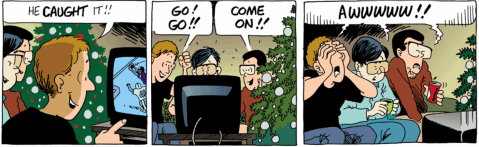
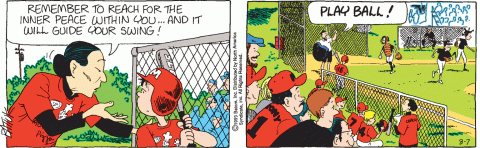
Watching football with the boys.
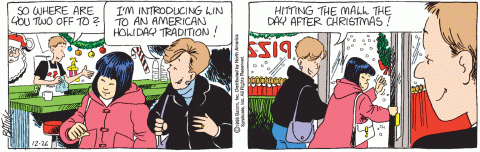
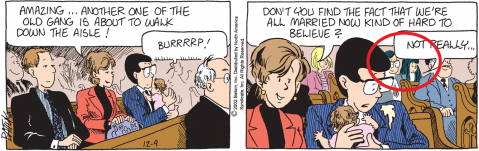
Going Shopping with with the girls.
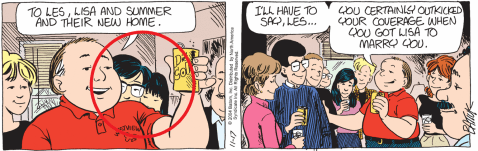
Playing backyard football.
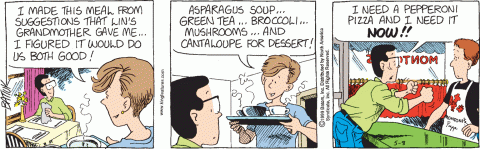
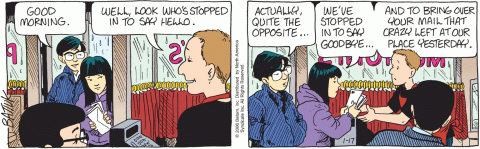
Discovering cancerous tumors.
And what’s more, the integration of the Chinese family was supposed to allow for a different culture to be presented, and positive cultural exchange to take place. (I’ll leave it up to you to decide if this presentation is offensive or not.)
But after the arc where La Choi San offers her herbal remedies, and the arc where La Choi San coaches the Montoni’s Little League team to a championship, the Chinese family falls into the background. Literally. They do nothing more than show up in the background of various parties and social functions for the next six years.
Les and Lisa’s Anniversary, 1999.
Thanksgiving 1999.
Party for Lisa’s roommate, Allison, 2001.
New’s Years Eve, 2001-2002.
Funky’s Birthday, 2002.
Uhhhh……(Halloween, 2002.)
Crazy and Donna’s Wedding, 2002.
Les and Lisa’s housewarming, 2004.
That one time John got arrested for selling Hentai to Becky’s Mom. 2005.
Lin gets one maybe almost arc in 2004, when she watches men move a desk for a week and then walks all over Crazy Harry.
One arc in six years. And it’s to massage a male character.
And then, early in 2006.
They’re gone.
Within a week of Li and Lin leaving, Montoni and Funky hear of someone interesting in moving into the Jade Dragon’s space.
I heard you had an opening for ethnic boondoggle?
Why does Batiuk keep doing this?
Because, as a writer, in order to sustain interest in a character of a different culture beyond the initial introduction you have to make them deeper than their surface level identity. You have to give them goals, interests, and problems that aren’t related to them being black, or asian, or middle-eastern. And you have to be able to understand both the parts of the character that are different from you, and the parts that are the same. Star Trek TNG and DS9 were great at this. Worf was Klingon. Quark was Ferengi. Riker was a slut. But all of them had more going on than just their species.
But in the Funkyverse only a very select few are allowed to have unique personalities different from Tom’s. And most of those are muted hold-overs from Act I, like Cindy’s vanity or Dinkle’s ego. I don’t think when Batiuk sits down to write the next pointless Westview student body he’ll be saying, ‘This one will be fiery and intelligent but too brash, and interested in sports and action. This one will be level headed, but often hesitant and aloof, and interested in music and poetry. And this one will be Captain Kirk.’
He just decides which cheap flash clone of his own brain will be the nerdiest nerd.
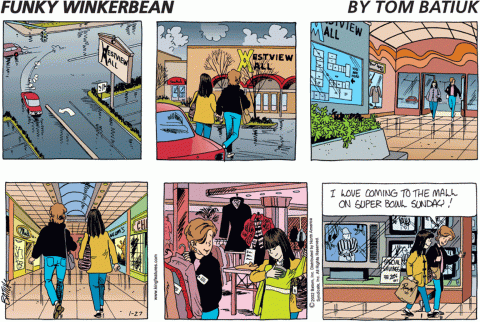
In other news, I guess Westview did still have a mall in Act II. At least through 2002. Because Lisa and Lin go shopping there on Super Bowl Sunday.