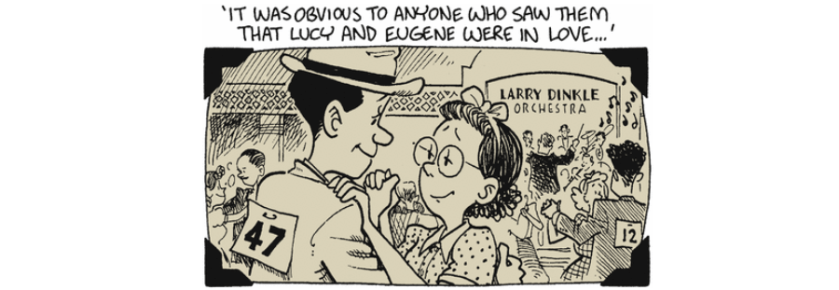
My post from 9 days ago didn’t age well.
I bemoaned Tom Batiuk’s lack of ambition about his ambitionlessness, then he turns around and gives us his most ambitious ambitionless week yet.
This week is certainly trying to be something. And you don’t have to squint too hard to see what it is: a collection of noble statements about what America claims to be, juxtaposed with perceived current American realities.
A lot of commenters had great things to say about this week. Here’s the perfect place to start:
At no point has the conversation descended into arguments over politics. Though we all may have definite, even passionate, opinions on various political issues that are both compelling and well thought out, this isn’t an appropriate forum for that.
Y. Knott
To try and keep that tone, I will start by saying that I’m not here to talk about the rightness or wrongness of this week’s content. I’m here to talk about how well or poorly it is expressed. (You can probably guess which side I’m going to land on.)
Tom himself literally stated in the puff piece that he is not saying anything in the strips and is letting people make the commentary.
wherescrankshaft
Let’s dive into that puff piece! It is https://www.gocomics.com/extras/tom-batiuk-crankshaft-america-essay (hat tip to J.J. O’Malley).
Tom Batiuk Believes Comic Strips Can Do More Than Make Us Laugh
We’re not even past the headline yet, and it’s already obvious Batiuk wrote it.
As I said about Tom Batiuk’s interview with Terence Dollard awhile back: the people who interview Tom Batiuk do nothing but build strawmen out of softballs. One of Tom’s favorite notions is that he’s some kind of visionary for thinking comic strips don’t have to be funny. No one ever said they did! And some of the funniest strips are best remembered for their least funny moments.
From cancer to immigration, the “Crankshaft” creator has never shied away from difficult subjects.
OK, I’ll give him that.
For years, Tom Batiuk—creator of “Funky Winkerbean” and “Crankshaft”—has strived to expand the concept of a comic strip, challenging the idea that the art form is simply for laughs. This week’s “Crankshaft” storyline is a prime example: it uses recent news events to examine what it means to be an American today.
The center panel in four of the upcoming strips features a line of cursive handwriting plucked from a fictional essay written by Batiuk’s alter ego, cartoonist Batton Thomas, who we met back in the days of “Funky Winkerbean,” the comic Batiuk produced from 1972 to 2022. In one of the new strips, the line reads: “To me, America means home. A home where I feel safe and protected.”
In stark contrast, the very next panel features an illustration of Liam Conejo Ramos, the 5-year-old boy detained by ICE agents alongside his father in January 2026 outside their home in Columbia Heights, a Minneapolis suburb. Dressed in a bunny hat and Spider-Man backpack, the child was held with his father for nearly two weeks at a family detention center in Dilley, Texas. In a February interview with MPR News, his father said Liam continued to suffer from psychological trauma.
This sounds exactly like a high school essay, doesn’t it? The confident mastery of the obvious, the general air of pretentiousness, the tacked-on sentence clauses and irrelevant details.
Spider-Man backpack
Knowing what Tom Batiuk is really like, how important is that detail? If it was a Buzz Lightyear backpack, would Batiuk have ever learned of Ramos’ existence? He seems like the kind of guy who would have a Google News alert set up for the name of any comic book he thinks he should be the writer of.
The student essay by Batton Thomas in the “Crankshaft” strips echoes a real-life essay Batiuk wrote as a high school senior in 1965. He received an award from the local paper for the piece.
And now it has been written in a blog Tom Batiuk received an award and was written about in the newspaper. Will the next puff piece writer say “Batiuk has received an award and was written about in a newspaper and a blog”? Oh crap, now it’s a newspaper and two blogs.
A dream about that essay sparked the idea for the storyline, he says by phone
You heard it yourself, folks. Straight from the horse’s mouth. Tom Batiuk dreams about awards he won in high school 60 years ago. He said it. Not me.
In addition to young Liam Ramos, the images running this week include a masked ICE agent, the barbed wire fence outside an ICE detention center, and Jan. 6 rioters storming a barricade at the U.S. Capitol.
This article ran on Tuesday, and Batiuk just tipped off most of his shock moments for the upcoming week. And shock moments are all he has.
“The thing I like about the approach to this storyline,” Batiuk explains, “is that I don’t really say anything.
Same thing you’ve been doing for 25 years: not telling us anything. Just like you didn’t tell us where Eugene moved to or why. But you wrote two weeks of him saying goodbye slowly, and starting to go somewhere even more slowly.
I kind of left it to people to make their own decisions.
This is one of those things Batiuk likes to say about himself without really understanding it. He thinks it makes him sound noble, but he doesn’t realize how much his life’s work contradicts it. Tom Batiuk’s existence is a monument to his belief that all decisions should be made by him, or at least approved by him.
That doesn’t mean he’s not prepped for pushback—and he’s received plenty of that in his career.
Really? When? From who? Is he talking about that one time he got pulled from the Northern Wisconsin News over a joke that should have gotten him nationally roasted? Because it happened to Bobby Knight when he said a very similar thing.
Does he mean us? We don’t give pushback. We give thoughtful, critical analysis of his work. We don’t take him to task about his subject matter, except in his general choices of what to write about (“oh Lord, not another Batton Thomas week”).
Even Comics Curmudgeon rarely mentions his work anymore. And from what I’ve found on the Internet, genuine fans stopped bothering 15 years ago.
In his 54 years as a comic artist, Batiuk has used his strips to touch on thorny subjects such as teen suicide, book banning, capital punishment, and same-sex couples at the prom.
Again: I never said he didn’t try. However half-assed all four of those attempts were.
Six years ago, he penned a story arc in “Funky Winkerbean” about an Iraqi immigrant named Adeela seized by misguided ICE agents while delivering a pizza. She narrowly escaped deportation.
And we all know how she narrowly escaped deportation: by having Montoni’s ask Bill Clinton to do them a solid! During the first Trump administration. I wonder why the puff piece didn’t mention that.
Batiuk wrote himself into a corner, couldn’t write himself out, and then had to cover up his own incompetence in his own propaganda. Politics was this man’s true calling. North Korean politics.
Lisa Crawford-Moore
And here we are, folks! Somehow we went from real children and real American issues to Tom Batiuk’s Dollar Tree Lenore. Who’s been dead for 20 fucking years now. And who nobody ever really liked anyway.
But, in 2008, Batiuk was named a Pulitzer Prize finalist in editorial cartooning for this work, which is collected in the book Lisa’s Story: The Other Shoe.
10/10 no notes.
In “one of the best moments ever,” he says, he met a woman at a book signing…
You know how we always joke about there never being people at those book signings? Well, there’s your proof.
OK, I selectively quoted that to make a joke.
…who had read the strips and decided to get a mammogram.
Yet another real incident from Tom Batiuk’s life that ended up in the comic strip. Because of Lisa’s Story (available near you!) Marianne Winters discovered her own cancer, thanks to the great Les Moore! Marianne gave Les her Oscar Trophy, $1,000,000, a new car, the Pulitzer Prize, and a handjob.
Her doctors discovered a growth, which they safely removed. “I thought, wow, that’s all you can ask for from a comic strip,” Batiuk says.
It is unclear whether the growth or the comic strip was safely removed. I think they’re both equally toxic.
Batiuk is not the only comic strip artist to wrestle with challenging subject matter. Garry Trudeau used “Doonesbury”
Yes, let’s talk about Doonesbury, shall we? Let’s compare these two visionary cartoonists, since you’re trying to imply that Batiuk is on Trudeau’s level. Here’s how they each handled the same “difficult subject”:
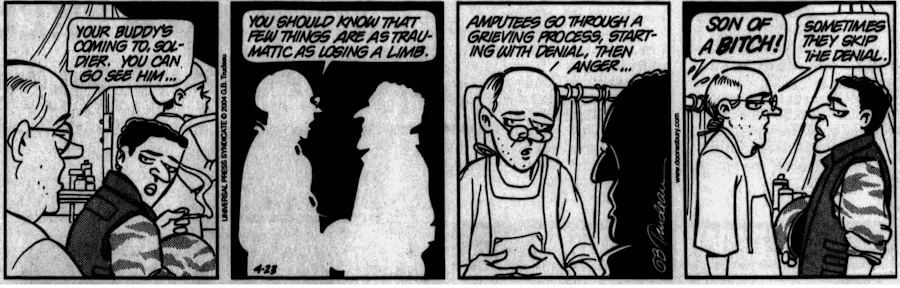
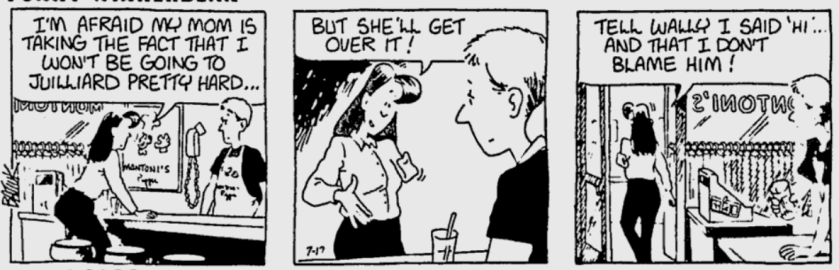
Trudeau kept the gore offscreen to center the moment on the human emotion; Batiuk did the exact opposite. Keep in mind that Trudeau’s character is a soldier who would have been trained that limb loss was a possible outcome. Batiuk’s character was a high school girl who just won a prestigious music scholarship. Notice which one isn’t the least bit bothered. And which strip actually had a joke.
Notice also that Becky leads with “tell him I said hi”, as if her monumental act of forgiveness were the less important message. And the effects on her family were even less important! “Yeah, my mom’s a little bummed that I lost a 6-figure scholarship and a direct path to a prestigious career, and she’s suddenly gonna have to figure out how to pay for Kent Fucking State like everyone else in this craphole. But she’ll get over it.” And even a socially inept high school girlfriend on an ordinary day should have something more meaningful to say than “tell him I said hi.” Ugh.
the vast majority [of newspapers] do go along for the ride [by carrying controversial FW/CS strips]
Remember what I said about Batiuk being kicked out of the Northern Wisconsin News that one time? Thanks for proving my point. That joke was pretty accurate, wasn’t it?
And Mort Walker saddled Beetle Bailey with nightmares in 2013 to raise awareness of post-traumatic stress disorder.
The “Sarge beats Beetle into a puddle for no good reason” jokes sure haven’t stopped.
[comic strips] come right to your house. There’s no privilege whatsoever.
Just like ICE!
people see their lives reflected in [the characters]
Yeah. So did I once.
With or without the laughter.
Large bet on “without.”