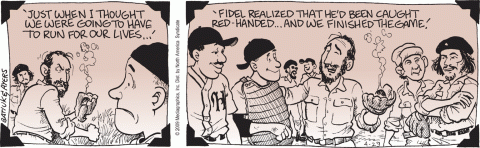
Stop, Collaborate And Listen

My post from 9 days ago didn’t age well.

I bemoaned Tom Batiuk’s lack of ambition about his ambitionlessness, then he turns around and gives us his most ambitious ambitionless week yet.

This week is certainly trying to be something. And you don’t have to squint too hard to see what it is: a collection of noble statements about what America claims to be, juxtaposed with perceived current American realities.

A lot of commenters had great things to say about this week. Here’s the perfect place to start:

At no point has the conversation descended into arguments over politics. Though we all may have definite, even passionate, opinions on various political issues that are both compelling and well thought out, this isn’t an appropriate forum for that.

Y. Knott

To try and keep that tone, I will start by saying that I’m not here to talk about the rightness or wrongness of this week’s content. I’m here to talk about how well or poorly it is expressed. (You can probably guess which side I’m going to land on.)

Tom himself literally stated in the puff piece that he is not saying anything in the strips and is letting people make the commentary.

wherescrankshaft

Let’s dive into that puff piece! It is https://www.gocomics.com/extras/tom-batiuk-crankshaft-america-essay (hat tip to J.J. O’Malley).

Tom Batiuk Believes Comic Strips Can Do More Than Make Us Laugh

We’re not even past the headline yet, and it’s already obvious Batiuk wrote it.

As I said about Tom Batiuk’s interview with Terence Dollard awhile back: the people who interview Tom Batiuk do nothing but build strawmen out of softballs. One of Tom’s favorite notions is that he’s some kind of visionary for thinking comic strips don’t have to be funny. No one ever said they did! And some of the funniest strips are best remembered for their least funny moments.

From cancer to immigration, the “Crankshaft” creator has never shied away from difficult subjects.

OK, I’ll give him that.

For years, Tom Batiuk—creator of “Funky Winkerbean” and “Crankshaft”—has strived to expand the concept of a comic strip, challenging the idea that the art form is simply for laughs. This week’s “Crankshaft” storyline is a prime example: it uses recent news events to examine what it means to be an American today.

The center panel in four of the upcoming strips features a line of cursive handwriting plucked from a fictional essay written by Batiuk’s alter ego, cartoonist Batton Thomas, who we met back in the days of “Funky Winkerbean,” the comic Batiuk produced from 1972 to 2022. In one of the new strips, the line reads: “To me, America means home. A home where I feel safe and protected.”

In stark contrast, the very next panel features an illustration of Liam Conejo Ramos, the 5-year-old boy detained by ICE agents alongside his father in January 2026 outside their home in Columbia Heights, a Minneapolis suburb. Dressed in a bunny hat and Spider-Man backpack, the child was held with his father for nearly two weeks at a family detention center in Dilley, Texas. In a February interview with MPR News, his father said Liam continued to suffer from psychological trauma.

This sounds exactly like a high school essay, doesn’t it? The confident mastery of the obvious, the general air of pretentiousness, the tacked-on sentence clauses and irrelevant details.

Spider-Man backpack

Knowing what Tom Batiuk is really like, how important is that detail? If it was a Buzz Lightyear backpack, would Batiuk have ever learned of Ramos’ existence? He seems like the kind of guy who would have a Google News alert set up for the name of any comic book he thinks he should be the writer of.

The student essay by Batton Thomas in the “Crankshaft” strips echoes a real-life essay Batiuk wrote as a high school senior in 1965. He received an award from the local paper for the piece.

And now it has been written in a blog Tom Batiuk received an award and was written about in the newspaper. Will the next puff piece writer say “Batiuk has received an award and was written about in a newspaper and a blog”? Oh crap, now it’s a newspaper and two blogs.

A dream about that essay sparked the idea for the storyline, he says by phone

You heard it yourself, folks. Straight from the horse’s mouth. Tom Batiuk dreams about awards he won in high school 60 years ago. He said it. Not me.

In addition to young Liam Ramos, the images running this week include a masked ICE agent, the barbed wire fence outside an ICE detention center, and Jan. 6 rioters storming a barricade at the U.S. Capitol.

This article ran on Tuesday, and Batiuk just tipped off most of his shock moments for the upcoming week. And shock moments are all he has.

“The thing I like about the approach to this storyline,” Batiuk explains, “is that I don’t really say anything.

Same thing you’ve been doing for 25 years: not telling us anything. Just like you didn’t tell us where Eugene moved to or why. But you wrote two weeks of him saying goodbye slowly, and starting to go somewhere even more slowly.

I kind of left it to people to make their own decisions.

This is one of those things Batiuk likes to say about himself without really understanding it. He thinks it makes him sound noble, but he doesn’t realize how much his life’s work contradicts it. Tom Batiuk’s existence is a monument to his belief that all decisions should be made by him, or at least approved by him.

That doesn’t mean he’s not prepped for pushback—and he’s received plenty of that in his career.

Really? When? From who? Is he talking about that one time he got pulled from the Northern Wisconsin News over a joke that should have gotten him nationally roasted? Because it happened to Bobby Knight when he said a very similar thing.

Does he mean us? We don’t give pushback. We give thoughtful, critical analysis of his work. We don’t take him to task about his subject matter, except in his general choices of what to write about (“oh Lord, not another Batton Thomas week”).

Even Comics Curmudgeon rarely mentions his work anymore. And from what I’ve found on the Internet, genuine fans stopped bothering 15 years ago.

In his 54 years as a comic artist, Batiuk has used his strips to touch on thorny subjects such as teen suicide, book banning, capital punishment, and same-sex couples at the prom.

Again: I never said he didn’t try. However half-assed all four of those attempts were.

Six years ago, he penned a story arc in “Funky Winkerbean” about an Iraqi immigrant named Adeela seized by misguided ICE agents while delivering a pizza. She narrowly escaped deportation.

And we all know how she narrowly escaped deportation: by having Montoni’s ask Bill Clinton to do them a solid! During the first Trump administration. I wonder why the puff piece didn’t mention that.

Batiuk wrote himself into a corner, couldn’t write himself out, and then had to cover up his own incompetence in his own propaganda. Politics was this man’s true calling. North Korean politics.

Lisa Crawford-Moore

And here we are, folks! Somehow we went from real children and real American issues to Tom Batiuk’s Dollar Tree Lenore. Who’s been dead for 20 fucking years now. And who nobody ever really liked anyway.

But, in 2008, Batiuk was named a Pulitzer Prize finalist in editorial cartooning for this work, which is collected in the book Lisa’s Story: The Other Shoe.

10/10 no notes.

In “one of the best moments ever,” he says, he met a woman at a book signing…

You know how we always joke about there never being people at those book signings? Well, there’s your proof.

OK, I selectively quoted that to make a joke.

…who had read the strips and decided to get a mammogram.

Yet another real incident from Tom Batiuk’s life that ended up in the comic strip. Because of Lisa’s Story (available near you!) Marianne Winters discovered her own cancer, thanks to the great Les Moore! Marianne gave Les her Oscar Trophy, $1,000,000, a new car, the Pulitzer Prize, and a handjob.

Her doctors discovered a growth, which they safely removed. “I thought, wow, that’s all you can ask for from a comic strip,” Batiuk says.

It is unclear whether the growth or the comic strip was safely removed. I think they’re both equally toxic.

Batiuk is not the only comic strip artist to wrestle with challenging subject matter. Garry Trudeau used “Doonesbury”

Yes, let’s talk about Doonesbury, shall we? Let’s compare these two visionary cartoonists, since you’re trying to imply that Batiuk is on Trudeau’s level. Here’s how they each handled the same “difficult subject”:
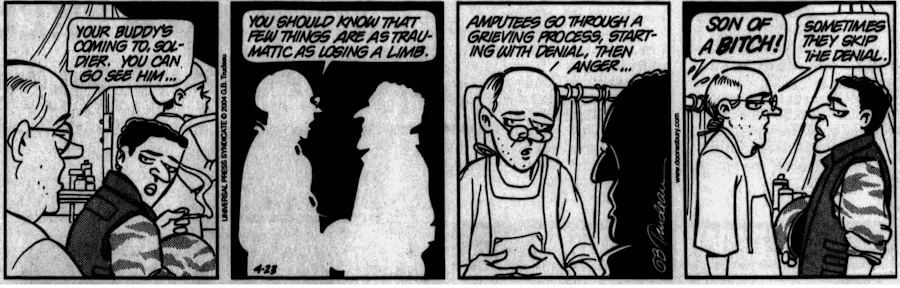
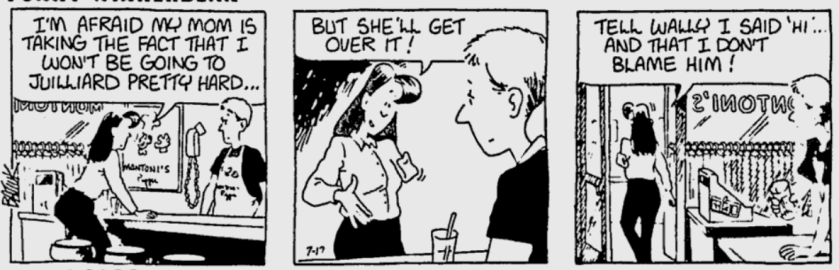
Trudeau kept the gore offscreen to center the moment on the human emotion; Batiuk did the exact opposite. Keep in mind that Trudeau’s character is a soldier who would have been trained that limb loss was a possible outcome. Batiuk’s character was a high school girl who just won a prestigious music scholarship. Notice which one isn’t the least bit bothered. And which strip actually had a joke.

Notice also that Becky leads with “tell him I said hi”, as if her monumental act of forgiveness were the less important message. And the effects on her family were even less important! “Yeah, my mom’s a little bummed that I lost a 6-figure scholarship and a direct path to a prestigious career, and she’s suddenly gonna have to figure out how to pay for Kent Fucking State like everyone else in this craphole. But she’ll get over it.” And even a socially inept high school girlfriend on an ordinary day should have something more meaningful to say than “tell him I said hi.” Ugh.

the vast majority [of newspapers] do go along for the ride [by carrying controversial FW/CS strips]

Remember what I said about Batiuk being kicked out of the Northern Wisconsin News that one time? Thanks for proving my point. That joke was pretty accurate, wasn’t it?

And Mort Walker saddled Beetle Bailey with nightmares in 2013 to raise awareness of post-traumatic stress disorder.

The “Sarge beats Beetle into a puddle for no good reason” jokes sure haven’t stopped.

[comic strips] come right to your house. There’s no privilege whatsoever.

Just like ICE!

people see their lives reflected in [the characters]

Yeah. So did I once.

With or without the laughter.

Large bet on “without.”

Vaguely Politics-Shaped Content

This blog has a longstanding “no politics” rule. But we have to tiptoe into it sometimes, such as when Tom Batiuk makes another saving throw for relevance. The July 25 Crankshaft was one such strip. It’s such a mess I have to respond to it in bullet point form rather than an essay.

  • Tom Batiuk must have really liked this joke, because he shortened a week of Batton Thomas gushing over The Flash #123 at Komix Korner to squeeze it in. I wonder if we’ll get today’s Batton Thomas strip as bonus content, as an alrernate version on Arcamax, or if there will be a later week where… never mind, I answered my own question.
  • Timing! July 25 is not the time for a joke about July 4 celebrations. It’s still better than this, though:
Vuvuzelas were the symbol of the 2010 World Cup. At least the 2026 World Cup just ended.
  • Nice epiphany, Dinkle. It shouldn’t be distracting that the focus of a long story arc makes his next appearance in a one-off joke strip. But putting Dinkle back in front of his choir destroys anything that In The Name Of The Father might have been about. It is the final proof that Dinkle never realized that he is a clone of his father: an egotistical, abusive, widely despised band director.
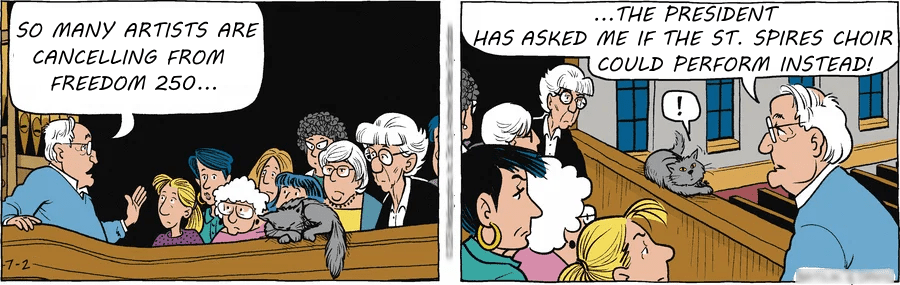
  • The fake name destroys the joke. Tom Batiuk loves his phony brand names… sometimes. And there’s no pattern to it. Today’s strip names the “Celebrate America 250” concert. The real names of the two competing celebrations were America250, established by Congress in 2016, and the Freedom 250, established by Donald Trump and the Trump Administration for their usual reasons.

    Freedom 250 – not America250 – is the one that had the problem of artists cancelling once they found out what they’d signed up for. Country singer Martina McBride had an eloquent response:

I’ve been blessed with the opportunity to be a voice for those who have felt like they didn’t have one. It greatly upsets me that any fan who has been moved by my music may now feel like I’m abandoning the meaning behind those songs. I assure you, that is not the case. I appreciate every single fan who has reached out. 

Martina McBride (@martinamcbride) / what used to be Twitter. Note also that Martina McBride gets actual fan mail.

Today’s strip is clearly referencing the problem of big artists like McBride cancelling their appearances at Freedom 250. The made-up name of the wrong celebration confuses the joke. But the clear intent also means:

  • Batiuk picked a side, even if he thinks he didn’t. Poster Marty DaVille made this point. Mocking the cancellation fiasco technically puts Batiuk in the same category as comedians like Jimmy Kimmel and Stephen Colbert, who came under fire for daring to suggest that any Donald Trump project wasn’t quite as successful as its press releases claimed.
  • He missed an actual good joke. The above problems aside, this would have worked:
If Funky Winkerbean can have Bill Clinton on speed dial, it makes total sense that Dinkle would have Trump.
  • The punchline makes no sense if you don’t follow the Funkyverse closely. Dinkle – and other “content creator” characters like Pete and Les – spend their entire lives being handed every opportunity they want on a silver platter. If you didn’t know that, the punchline revealing that an elderly church choir had a gig at a national Independence Day celebration would be confusing. (I know I’ve been using the word “confusing” a lot.)
  • And it misses another actual good joke. Considering the generally unimpressive roster of artists who did perform at Freedom 250, Harry Dinkle might as well have been a real-life headliner. You know who else cancelled? Milli Vanilli.

    (Well, kind of. There’s some drama over who Milli Vanilli even is. But the band name is such a universal joke that there’s no need to process semantics. Or whether they performed or not. Or whether they performed or not, even if they did go on stage. Like I said previously, I did stand-up in the late 1980s. Piling on Milli Vanilli is practically a reflex.)
  • The church’s tax exempt status is an unnecessary detail. Batiuk seems to draw his word balloons before he writes what they contain. This often results in them being full of words that detract from the strip’s point. A better joke would have landed on something that actually happened in real life. Such as, Dinkle losing his job like Colbert did. But Batiuk wouldn’t dare even joke about that.

Batiuk crammed everything he could think of into this joke. None of it works, works together, resembles the real-life event it’s riffing from, or makes any sense.

Testosterony’s really neat! Hooray! For testosterony!

We’ve teased you with her face at the top of the page for a full week now… but she’s finally here folks! Please welcome Ruby Lith to the climage damate/pandemic/supply chain issues story arc (now with comic book misogyny or something) in today’s strip.

Is Ruby just annoyed that all of the damate climage comic books Atomik Komix is putting out don’t feature female characters or are too muscle-bound action man violence explosions so many explosions-oriented (did she forget about The Oceanaire?.. well, she doesn’t appear to be the only one) or does she believe that these issue du jour comic books would somehow be more effective in changing the hearts and minds of the world citizenry if they weren’t so… ugh, “testosterony”? And why is she addressing Batton like he works at Atomik Komix? Unless… oh no. Surely it won’t come to that, will it?

Not So Different

Link to Today’s Strip.

So Cayla states, AND I QUOTE, “He told me that one thing that gave him some solace…was reminding himself that he wasn’t like them.”

And so, I am willing to rest my case, and conclude that in an arc about racial profiling Batiuk and his team got two black characters confused because they looked too much alike.

There remains the outside chance that I am wrong, that the ‘wisdom’ Cayla spouts is also something her father, Smokey Williams, will be shown saying in his original arc. I will let you know my findings in the comments section when my copy of Strike Four! arrives. And I will add a retraction statement to this post if I was wrong.

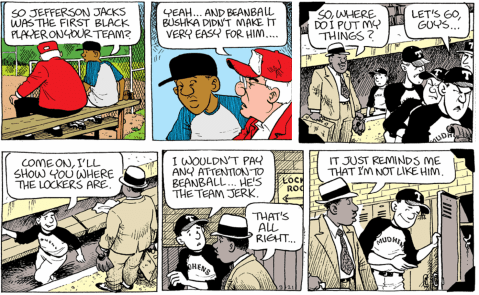
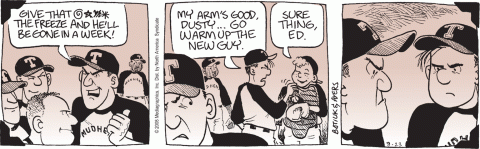
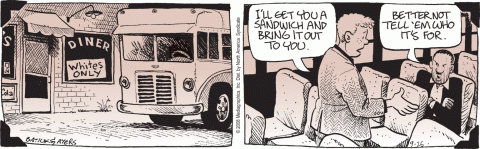
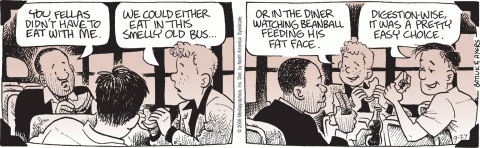
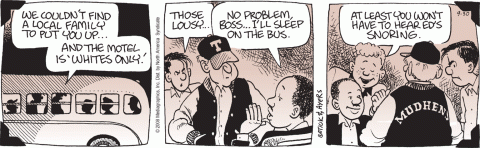
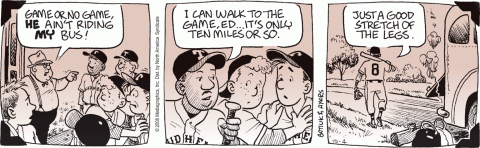
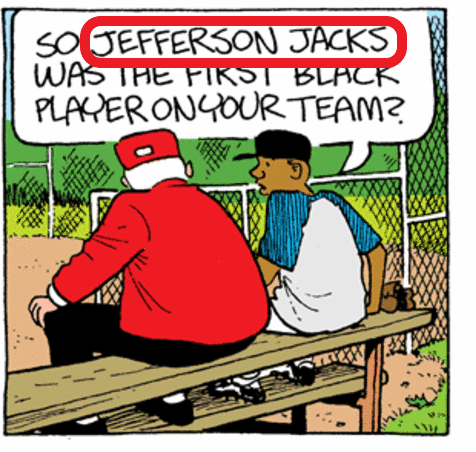
But for now, lets look a little closer at the Jefferson Jacks arc. In truth, it was the first thing that came to my mind when I saw last Saturday’s strip, because it was the most significant arc I could think of that tackled racism. The storyline ran in Crankshaft from September 15 to October 12 in 2008. The following are some highlight strips, to give you all an abridged rundown.

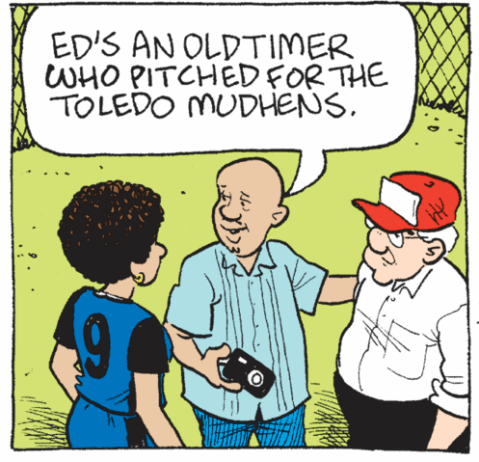
First things first. I tried digging through the Toledo Mud Hens rosters to see if they ever integrated before the team moved to West Virginia in ’52. I couldn’t find any black players, though many didn’t have easily googleable pictures. But the Mud Hens integrating in ’47 is a bit of fictional license.

Second. While I couldn’t in my quick and dirty internet search blitz find instances of players confronting disgruntled potentially violent townsfolk, or a black player having to walk to a game, much of what is depicted in the arc is similar to what early integration-era ballplayers went through. I could find instances of heckling from the stands, eating and sleeping on buses, being boarded with local families, and having some white teammates be cold and others be friendly. Crankshaft being ‘one of the good ones’ is, of course, heavy-handed and self-serving. But I really didn’t hate this little story. And the art was especially nice.

This feels so oddly well researched for Batiuk work, doesn’t it?

Well…

Finally, in a bit of Crankshaft news, the Crankshaft story dealing with the black baseball player Jefferson Jacks has been nominated for a Glyph Award in the Best Comic Strip category by the East Coast Black Age of Comics Convention which takes place on May 16th at the Crowne Plaza Hotel in Philadelphia. Just a bit of backstory here… a good friend, Tony Isabella, had suggested I write a story about a black minor league ballplayer who would have played with Ed Crankshaft on the Toledo Mud Hens. I was out of pocket on the Lisa’s Story book tour around that time, so I suggested to Tony, a fine comics writer in his own “write”, that he do it… and he did. Later, when Tony’s scripts came in, I wrote the Sunday strips to wrap around the story and they were then beautifully illustrated by Chuck Ayers. If I say so myself, it’s a fine story and I’m very pleased that it was nominated by the judges.

Finally, part two… the current Jefferson Jacks story was written by me as I recuperated after my accident last year, but Tony and I had such a good time with J.J., that we’re working on some new stuff for down the road. 

Tom Batiuk, blog post dated April, 15, 2009

He had a ghost writer for the story! Tony Isabella is a fellow Ohio native who’s written for Marvel and DC. He’s best known as the creator of Black Lighting.

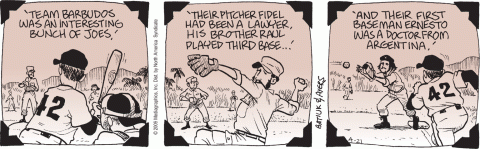
The ‘current Jefferson Jacks story’ referenced in the blog post was, of course when Jacks played ball in pre-revolution Cuba. Since it was penned by Batiuk, I’m sure was just as well researched and substantiated as the arc Isabella wrote.

Note, the above was a vertical slice of the story. The full arc ran from April 13 to May 2, 2009.

Tomorrow is the last day of my shift. I can continue the saga of Jefferson Jacks for you all, if you’d like. Show you the conclusion to another Funkyverse story of prejudice.

Or, it’s not to late to learn all the exciting facts about Styrofoam and linoleum.

All the Same to Tom?

When I first read today’s strip, it seemed to make sense. (Except for the last panel, of course.) I remembered Cayla’s dad.

His first and last in-the-flesh appearance in Funky Winkerbean.
ULTRA CLOSEUP ACTION

I remembered that Smokey Williams had been friends with Crankshaft.

The seasoning is piss and vinegar.

And I remembered, from my very earliest comic strip snark fandom days, that Crankshaft had a flashback prestige arc about Cranky befriending his black teammate during the early integration era.

Still, not as hamfisted as this week.

And I chuckled to myself over how it was just PEAK Batiuk to reference by name an obscure character that has only been seen in Funky Winkerbean once, who further references an awards bait arc he wrote in Crankshaft back in 2008. Are any readers, even among the dedicated snarkers on SOSF, CK, Curmudgeon, and elsewhere, going to remember who Smokey Williams was?

I tried to do a little mental math, if it would work if Cayla’s dad was a young man in ’47. But I just chocked it up to time skip weirdness. Then, I went back to the archives for Crankshaft to reread the Diet Jackie Robinson arc.

Wait…
Umm…
But….what?
One of these names….
Is not like the other….

And then I looked at the Crankshaft-meets-Cayla strip from 2011 a little closer.

Any closer and I could’ve counted the blackheads on Cranky’s nose.

Smokey calls Crankshaft an ‘Old-Timer.’ Cranky is a grandfather of adult grandkids at this point, and Cayla is Smokey’s daughter and a college student. Smokey is drawn slightly younger looking than Ed Crankshaft.

Guys. I don’t think that Crankshaft and Smokey Williams played on the same team. I think Smokey Williams is decades younger than Crankshaft. But then, who is he?

In the bedeviled Comics Kingdom hellscape, Crankshaft only goes back to late 2002. When Smokey calls Crankshaft up in 2011, it is the first time he’s mentioned or seen in the archives. But he isn’t treated like a new character. The Toledo Blade didn’t carry Crankshaft. In desperation I started googling madly into the void. And got this little clue from a book review of the Crankshaft baseball collection: Strike Four!

Memorable storylines include the time Ed became a coach and mentor to struggling Aeros pitcher Smokey Williams, and a flashback to Ed’s support for his team’s first black player, who took some harassment from both the public and other players.

Akron Beacon Journal, June 7, 2014

Crankshaft is certainly not a coach or mentor to Jefferson Jacks in the integration arc. And Jefferson Jacks isn’t playing for the Aeros, and doesn’t seem to be a pitcher.

So Jefferson Jacks and Smokey Williams…I think…are two different people. Evidence for this supposition is that Jefferson Jacks shows up at the end of the 2008 arc.

He does look like Cayla’s dad will look…thirteen years in the future.

And this strip from when Crankshaft was inducted into the Centerville Sports Hall of Fame in 2012.

See the cluster of three bald heads to the left? The white one is Dusty Bottoms, Crankshaft’s catcher. Is the tall white haired one Jacks and the shorter one Williams?

So my working hypothesis right now is that some time in the first fourteen years of Crankshaft there is an arc where Smokey Williams was introduced. Was he the victim of racism then? I don’t know yet. But my Ebay order for Strike Four is in the mail.

Because one of two things is happening here. And I absolutely must know which it is.

1.) Smokey Williams, Cayla’s father, was also subjected to racism in the arc I haven’t read yet.

2.) Batiuk got his black baseball players confused, probably because he made the older Smokey at Cayla’s wedding look just like Jefferson.

You may think actually purchasing a Crankshaft book is taking my obsession with Funkyverse lore a little too far. To that I have the following two rebuttals.

1.) I took it too far a long long time ago.

2.) I actually like Crankshaft.

It’s funny about once a week.
The superior protagonist in every way. Even when it comes to conversing with his long dead wife.

You may think this is a sign that I’ve gone mad.

I have no rebuttal for this.