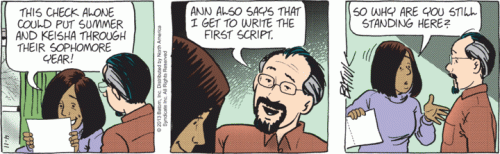
Greetings, BChasm back for another stretch driving the Funky Phantom. In today’s episode, the most notable thing is another amazingly punchable face by Les in panel three. It’s so punchable, in fact, that it looks as if Tom Batiuk beat us all to the punch (so to speak) and just kept punching. I’ve never seen a visage as scrambled as that, outside of Beetle Bailey after Sarge scrunches him to the ground.
As to the “content,” why would Darin ask Les about his Hollywood experience? I’m going to assume for the sake of argument that Darin actually wants to work on this movie, and to see it through to completion, thus possibly getting a good-paying job. Les, you’ll recall, worked tirelessly to torpedo his movie and make certain that Hollywood would never call him again. It’s hard to think of a greater example of non-success, or, to give it its proper name, failure. Unless Darin is planning on doing the exact opposite of everything Les says, he’s doomed.
The feeling on my part is that the movie won’t be made anyway. Given the absolute sacredness with which comic books are viewed in this strip, coupled with how Evil Hollywood always wants to alter the purity of the material it has been given, means that all the cast and crew will resign en masse in order to keep from sullying the wonder that is Starbuck Jones. If it doesn’t come from Les, it’s not allowed to happen.
By the way, I think I’ve figured out what it is that I dislike most about the art in this strip as it appears throughout Act III. It’s not the smirks, it’s the half-lidded eyes, the ones that seem to be carrying on their own conversation. “You know, right?” “Of course I know. And you know, too.” It’s that unspoken superiority to all things that is totally unearned. It makes me want to punch Les all the more, although all the characters do it.
 The idea that Lisa’s thoughts should be part of this script is really just begging for a nice case of Writer’s Block excuse (“How can I possibly write her thoughts for Hollywood,” Les preened). Her thoughts would naturally be expressed, visually and through dialogue, in how she interacts with her friends, her family, her doctors and so on. It’s all about relationships and how cancer would impact them. All things that could be shown on screen without too much difficulty. It’s called writing.
 Son of Stuck Funky