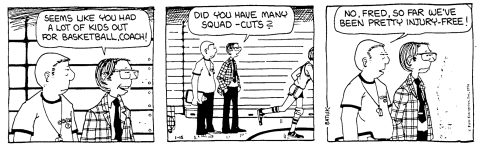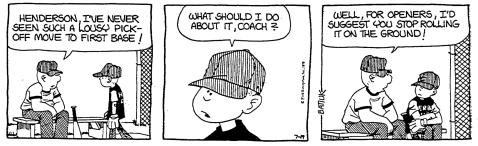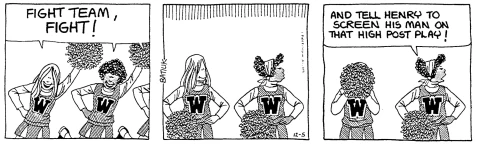
The Secret Life of the B-Tiers.

Link to today’s interesting new wrinkle.

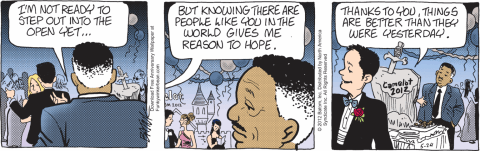
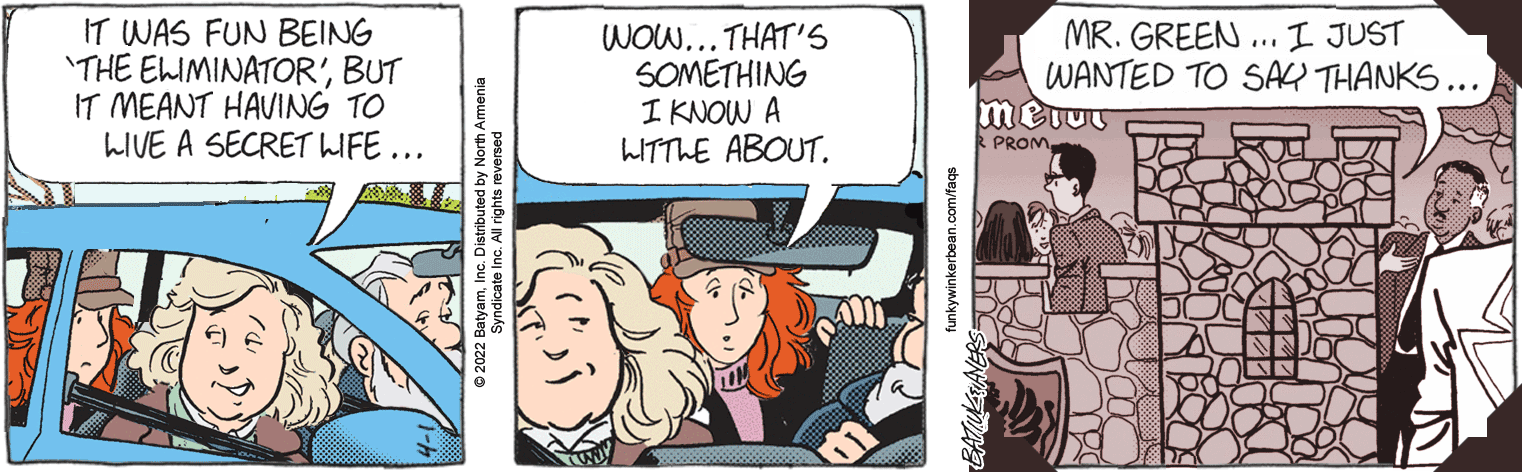
I mean, uh, wow. I guess that is one reason to have Maddie come back. Cross one off my list of Long Standing Funky Mysteries. For those of you more recently jumping on the Beady-Eyed-Nitpicker wagon, the Big Gay Castle Mystery goes all the way back to Summer, Keisha, Jinx, and Maddie’s senior year prom in May 2012. In that plotline two unnamed boys buy tickets to go to prom together, Becky’s mom whips up a protest, Principal Nate holds an assembly where he clarifies that there’s nothing in the Student Handbook prohibiting people taking other people of the same gender to the prom, and then everyone cheered.

Of note was a couple strips at the very end of the arc.

Who was this kid obscured by The Big Gay Castle? It could have been anyone but Keisha. For ten years I’ve wondered, and I guess we’re finally getting our answer. Maddie Klinghorn. And it makes sense, Maddie was there.
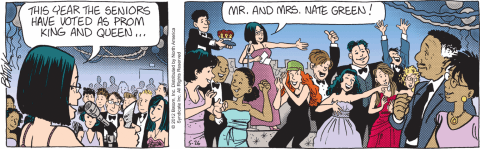
Really, I’m just relieved that it wasn’t Summer. Les didn’t need another reason to virtue signal his greatness, and I didn’t want the cliché of the sporty tomboy being a lesbian all along. Especially since Summer has been shown mooning over Masone Jarre, though I guess she could be sporty enough to play for both teams.

This does fix the most glaring issue with Batiuk’s preachy Big Gay Prom arc: that the ‘gay’ couple is a nameless prop. They show up for TWO strips, looking like they just left their Hardy Boys cosplay competition.
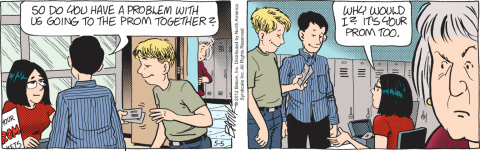
And then they’re just an idea, never seen again, not even at the prom. In fact, there don’t appear to be ANY gay couples at the prom, except for maybe this panel of two guys standing shoulder to shoulder.
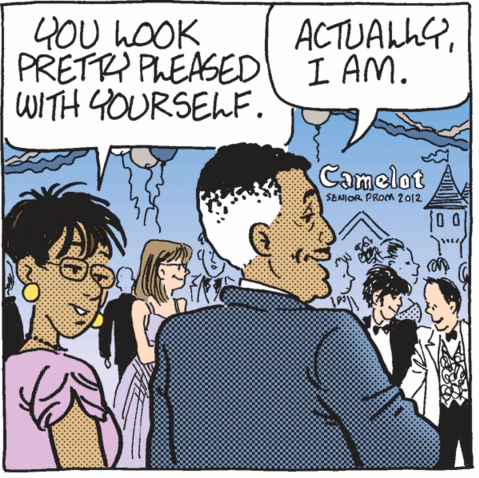
Bumping shoulders is the height of homosexuality.

So I’m curious to see where Batiuk takes this new revelation. How will he handle his first named queer character? Is this going to be a big arc? Or are we in for a Northstar revelation, similar to Masone Jarre’s bipolar disorder, where Maddie’s sexuality is confirmed once and then dropped for years or forever?

It’s not like in the 70’s, where a Boston Marriage between socialites could be depicted in great detail in a comic strip, and yet the heteronormativity of both women strictly enforced and accepted prima facie.

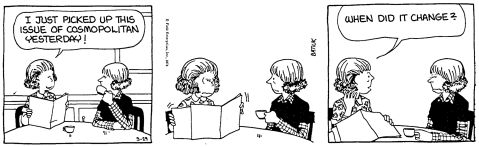
These two ladies are Marcia and Jan, the two most baffling recurring characters in early Funky Winkerbean. They are introduced as Women’s Club members that run the ‘Rap Cellar’. Which seems to be some kind of afterschool program for high schoolers, that Marcia usually is the one leading.
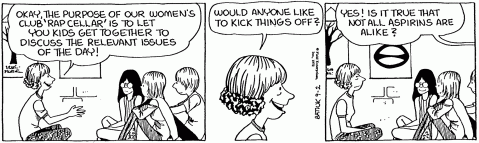
The joke in the Rap Cellar strips are that these well-meaning but dim-witted ladies have completely different priorities, life styles, and interests than the hip kids they’re trying to counsel. They are from a decade before, not old enough to be their parents, but not young enough to understand them. And their Brady Bunch names might be a joke on their squeaky clean and sunny simple outlook.
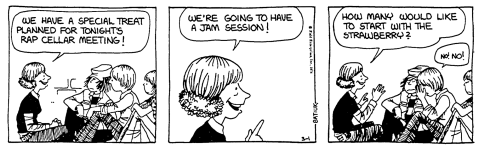
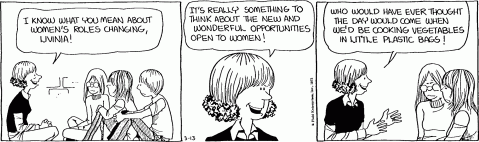
But, the actual ‘Rap Cellar’ strips are few and far in between. Maybe a dozen or so, and they’ve mostly fallen off. Yet, these two ladies keep showing up. Talking over coffee, exercising, playing tennis, shopping, and watching TV.
Many of you have pointed out the Peanuts parallels to early Funky Winkerbean. They definitely exist, in the art style and the humor, but one big difference is that in Peanuts adults are unseen alien creatures warbling in nonsense lines, in Vintage Funky Winkerbean both the teachers and the students have equal parts as characters.

But these ladies aren’t teachers at Westview, they aren’t even parents like Roland’s Chair!Dad. The connection between Jan and Marcia and the Funky Bunch is tenuous to begin with…and by 1976 has almost completely disappeared. Yet these two ladies keep showing up for one-off gags, or a disconnected week of tennis strips.
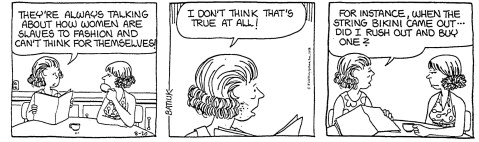
Who are these ladies? Why are they still here? Given the eyebags on their cheek bones, is one of them Pete’s mom? Maybe they’re a weird repository for ‘upper middle class lady’ humor that Batiuk just HAD to get out there, tone and setting of his comic be damned.

I don’t know. The nicest thing I can say about them is that Batiuk usually does a good job of drawing their faces and bodies consistently different, so you can tell who is Marcia and who is Jan despite their hair being the almost the same.
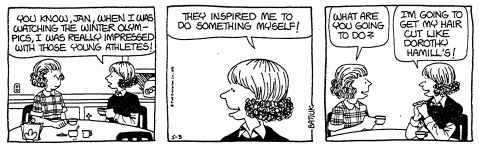
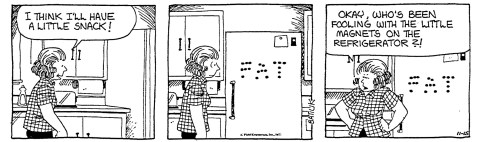
Jan is also the fat one.

And in a strip where almost everyone is already cynical and jaded, they at least provide a nice contrast.

What’s in a Name?

Link to a redraw of a strip we’ve seen plenty of times before.

Like 20 years ago in 2002.
And eight years ago in 2014.

Donna’s devolution from gender ambiguous nerdy tween, to leather clad motorcycle hottie, to generic shapeless Westview-woman lump, is one of the great tragedies of the Funkyverse. But it is typical of Batiuk’s style, and has been from the very beginning.

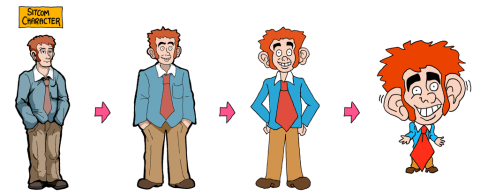
If you’ve spent any time falling down the link-clink rabbit hole of TVTropes, you’re probably familiar with the term Flanderization. The term even has it’s own REAL Wikipedia article. Visually it looks like this:

Over time certain details become exaggerated, and other finer details are lost. The character becomes caricature.

The thing is, a little Flanderization can be a GOOD thing, especially in comedy. Characters need to be different from each other in the reader’s mind and a few exaggerated characteristics make a strong foundation for ensemble humor.

Funky Winkerbean characters, at least in Act III, go through a different process.

Whatever Batiuk’s initial conception of a character, it gets lost in the average. The minute differences in temperament between Holly and Donna, or Jessica and Mindy, or Funky and Darin, or Pete and Les need an electron microscope to measure. Even a character like Crazy Harry has lost all his edges. I’ve seen nuttier former postmen buying Pall Malls at the gas station, talking to me in all seriousness about how JFK Jr. is running for president next term.

This isn’t a new phenomena for him. He seems to subconsciously WANT his characters bland so he can use any of them in any combination to tell a story. No matter how he designs them, the distinguishing bits get knocked off. You can see this clearly with the early Act I character Miss Rita Wrighton.

Miss Wrighton, (Get it? Right On? Like… so hip,) was initially introduced as the young, idealistic, counter-culture teacher. She was dressed with chunky peace sign earrings, pants as well as skirts, and hair worn long and down instead of a shellacked professional up-do. She was at Westview fresh out of college and full of passion and hope to empower the youth to change the system.

The joke is, of course, that she was trying to teach in the way she’d spent years of college learning about, but the theory is different from the practice. No one, not even most of the other teachers, were taking this as seriously as she was taught.

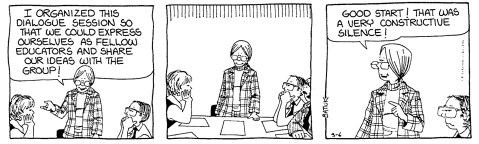
Midway through that first year the peace sign earrings disappear. She’s regularly butting heads with Crazy Harry, and seems to have a hard time controlling her class in general.

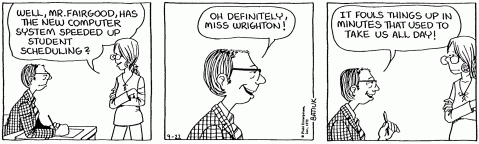
At the beginning of the next school year, she’s jaded. Though more cynical in outlook, she still seeks positive change in the school. This would be a fine character progression, if she wasn’t moving into a space already occupied by Fred Fairgood. At this point they’re practically interchangeable, similar in temperament and tone, with the only difference being his additional experience.

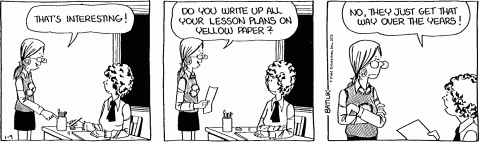
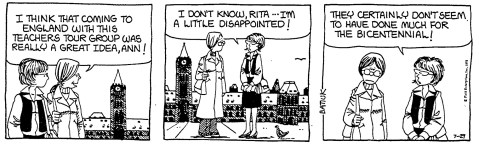
During the summer of 75, she goes on a vacation to England with her friend Ann. Batiuk is now just using her for bland whatever gags. He’s losing her personality to the pun void.

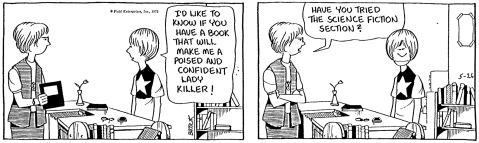
I’m pretty sure this is Fred’s future wife, Ann Randall. I can’t tell if she’s also supposed to be the school ‘librarian’ seen early on in 1972.

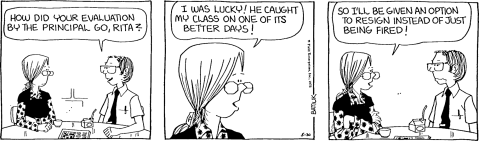
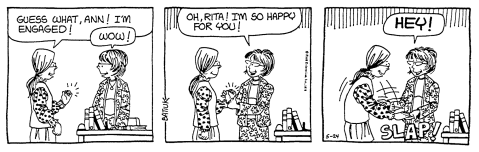
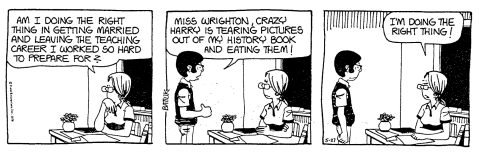
The story arc currently being released on CK has Rita newly engaged and contemplating quitting teaching.

The whole story line has commenters confused. It’s unclear if Rita is considering quitting simply because her new husband can now support both of them on a single salary; or if Batiuk was pulling a Skunky Funkybuns and got confused as to when the ‘marriage-bar’ was outlawed, (the sixties.) Either way, it’s a pretty big regression, from counter-culture activist to contemplating giving up a career to be a housewife.

Will she disappear into the Phantom Zone of characters who lost their ‘edge’ now? Or will the last vestiges of her ‘modern-woman’ persona manifest itself and we’ll have another few years with poor neutered Ms. Wrighton? I’m genuinely interested to find out.

By the way. Have YOU seen Skunky Funkybuns? The greatest piece of stand up comedy this decade.

For the Love of the Game

YOUR MOM.

Westview. Where the ancient battle for the top slot on an arcade video game is a community epic, gradually passing into legend, recited to the younger generation as a solemn verbal patrimony.

But, it wasn’t always that way.

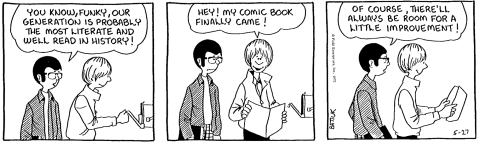
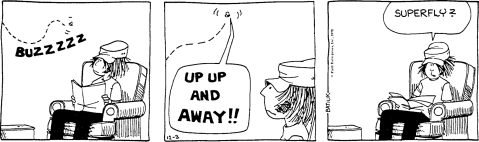
Four years into Vintage Funky Winkerbean, and what has shocked me more than the politics is the almost complete lack of comic book references. There’s been maybe four, and in every case comic books haven’t been heralded as the sacred texts imparting lifelong wisdom for the darkest days. They’ve been the punchline.

Shun the Non-Believer…Shuuuuuuuuuuuuuuun.

This seems weird, doesn’t it? Batiuk hasn’t been the least bit shy over the last couple decades squealing about how much he loves comic books, and science fiction in general. Gushing about how formative comics were to his young mind. He gives old Flash comics the same kind of reverential, tender feelings the lifelong faithful reserve for their Sunday School songs.

I will always love you singing donut puppet that taught me to fear hell.

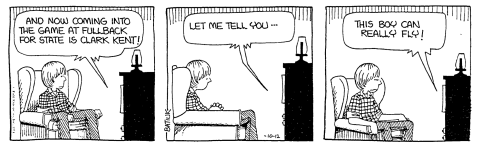
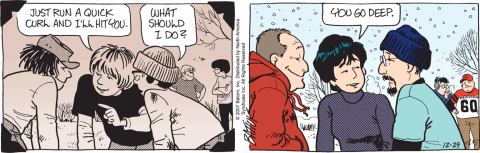
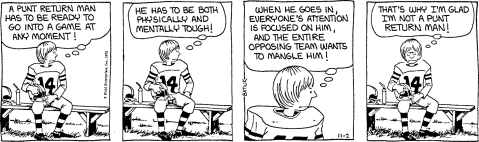
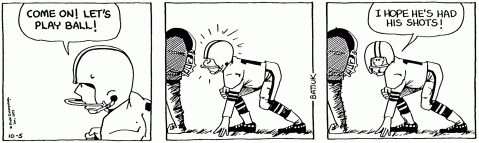
You know what there IS a lot of in Act I so far? Sports.

Is this some kind of feigned smokescreen to hide his geekery behind?

Naw. Dude likes sports.

I’ve seen comments over the years about Batiuk using Les’ success in adulthood as a way to get back at the ‘sportos’ that made fun of him when he was in school. But I think this is drawing a false equivalency between Les and Tom. While Tom might see himself in Les more than any other character, I don’t think it means Tom was similarly hapless in school. And there’s a difference between being a bullied weakling, and being uninterested in sports. Plenty of bullied weaklings are interested in sports. That’s why The Orioles exist.

Have you guys even SEEN The Sandlot?

And while he may not have played on a high school football team, in one of his Flash Fridays, Batiuk talks about playing football with friends.

At one point in the story, KF runs past some kids playing sandlot football which hit a soft spot for me since I loved playing backyard football, at least until I broke my ankle and dislocated my shoulder. As risky as my comic book writer/artist stratagem was, it was a lot less risky than playing football.

Flash Fridays – The Flash #122

He goes into more details in the foreword to one of his volumes.

It happened on a snowy night in 1969 during my senior year at Kent State. I was riding home with a fellow student teacher named Ronnie from Kent. She was driving because I had my arm bandaged to my chest following surgery for several shoulder dislocations from playing football (the lawless backyard variety as opposed to the sanctioned school activity). 

From The Complete Funky Winkerbean Volume Four

And as nebbish as Les is, and as pathetic as he is climbing that rope, Batiuk has consistently shown him playing backyard football and tennis.

He always makes the school bully a football player, whether it be Bull or an endless series of Wedgemans. But at least in Act I so far, it isn’t like the football team is a cabal of sneering jocks. Funky and Derek are on the team. It’s Westview. Even the football players are bullied.

And I like Coach Stropp. The juxtaposition between him and Dinkle is interesting. Dinkle, Act I, is ramrod straight shouting all the time. Stropp is much more human. He’s got a softer side. And I love the subtlest hint that he’s got cauliflower ear, like an old wrestler or boxer. Batiuk’s jokes show an understanding of deeper sports vocabulary.

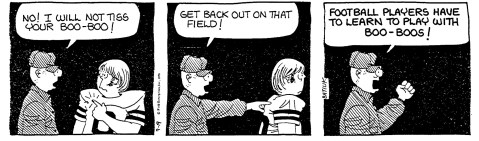
Coach Stropp has a Funky Winkerbean strip that makes me laugh out loud every time I see it.

Harsher in hindsight? Yes. Still laughing? Yes.

So, for the first four years, Batiuk found ways to work his interest in sports into the strip, but hardly ever his love of comics. Was it out of embarrassment? Did he figure the sports strips had a wider appeal? Did he just not know how to integrate trademarked geekdom into his universe yet? I don’t know….but Star Wars is right around the corner, and I can already feel the walls starting to crumble.

Running Up the Score

Link to a story Maddie’s probably heard before, and we definitely have!

One of my main problems with Donna’s ‘The Eliminator is a Girl!’ story is that Donna states she HAD to dress as a boy to play video games with the boys. This is regressive even within Batiuk’s own work. It’s the worst excuse for the reveal possible, because it’s either insulting to the world he had created or insulting to the intelligence of the characters.

The very first years of Funky Winkerbean are populated with many girl characters with traditionally ‘boy’ interests. And I’m not just talking about tone deaf jokes like Wanda playing fullback. Livina learns chess, enjoys watching golf, happily munches popcorn through violent movies, and is willing to wade through polluted mud to clean up the environment.

Junebug offers specific basketball advice, showing knowledge and interest in the game.

Vicki, who dated Funky for a few months, seems pleased at the prospect of watching performative car maintenance.

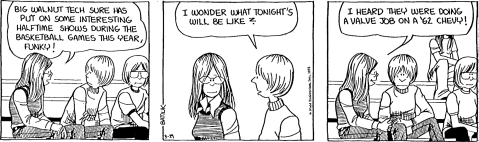
Also first mention of Big Walnut Tech, I think.

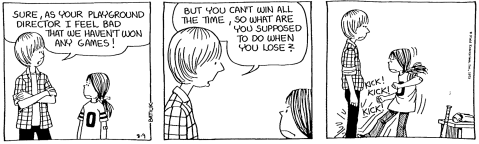
During the second and third summer breaks of the strip, Funky gets a job as a neighborhood playground supervisor. A job that also involves coaching the playground’s baseball team, which appears to be co-ed.

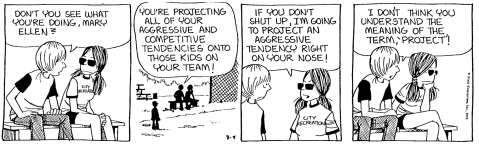
And his rival playground’s supervisor is someone I WISH Batiuk had spent more time on. She might just be one of my favorite characters of Act I so far.

Is this a shameless bit of virtue signaling? Yes.

But is Mary Ellen the joke? No.

Or, at least, the idea of a girl coaching baseball isn’t the joke.

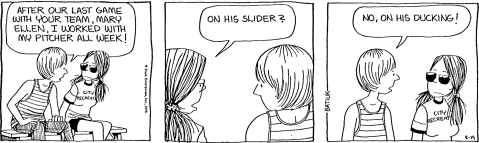
The joke is, girl plays to win and GIRL PLAYS DIRTY!

Mary Ellen is AMAZING. Just bask in the glow of this.

Notice how, in all of these, Funky is treating her with respect as equals and coworkers. And never questions her obvious love of baseball, or even calls it unfeminine.

In a world where Mary Ellen exists and Funky doesn’t bat an eye, why would Donna need to disguise herself to play video games? Video games are even less gendered than sports, because in the world of ones and zeros physical limitations or advantages are nullified.

As a woman who is both a baseball fan AND a massive nerd, one of my major frustrations with Act III is Batiuk’s failure to build any of his females with the sort of fun obsessions that have flavored my entire life. Even Donna, from the moment she ripped off her biker helmet in 2002, has just been another bland woman, never allowed to geek out again. The closest we got was Holly’s Starbuck Jones comic book hunt, but she was only doing that for her son. It’s like he’s forgotten that girls are just as capable of salivating over ERA’s and MISB’s and CGC VF/NM’s as their male counterparts.

So. To Mary Ellen. Proof that Batiuk could do it right when he tried.

Proof that he could never sustain it.

This girl gets it. This is the dream.

My mother, the car

Quite the crowd on hand in today’s strip, with the first panel serving as the Batiukverse equivalent of the semi-famous crowd reaction photo from the 2017 Academy Awards’ wrong envelope incident. While the crowd of stars watching Marianne are not quite of the same wattage as those in the 2017 audience, I still spy some big names.

  1. OK, I don’t know who this is, but his mouth is huge
  2. The shirtless Nazi who gets shredded by a propeller in Raiders Of The Lost Ark
  3. George Foreman
  4. Dorothy Hamill (what’s with all the sports people?)
  5. The giraffe that stole David Cassidy’s hair
  6. A Dilbert cosplayer
  7. General/President Ulysses S. Grant
  8. Who invited Creepy Pete?
  9. Christopher Columbus (not that one)
  10. Soft-serve ice cream
  11. SHEMP!

Quite the menagerie present to hear Marianne call back to the time she went AWOL, nearly committed suicide, and then quoted her mother quoting an actress who was one of Hollywood’s most famous suicides. Anything to fulfill your parent’s dreams. How inspiring!