I thought Phil said he needed someone to ‘write it to life’, but apparently he already has dialogue written for this story. So he’s not really looking for a writer but an editor.
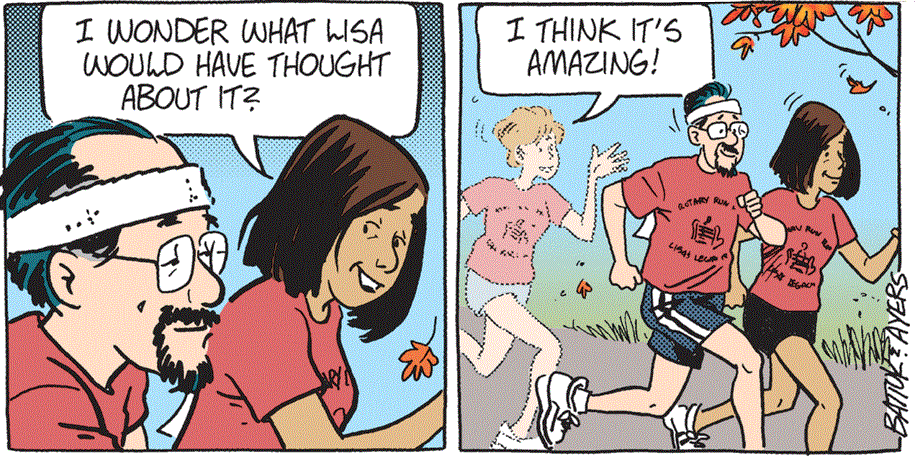
And whooo boy, that is some old timey sexism there. It’s so bad that all the background men have disappeared. Mindy looks grumpy! Which is nice to see, because she’s done nothing else but smile blandly for an entire month.
Let’s give him the benefit of the doubt though. Maybe Phil meant that line as a really weird homage to the Rankin-Bass Rudolf the Red Nosed Reindeer special.
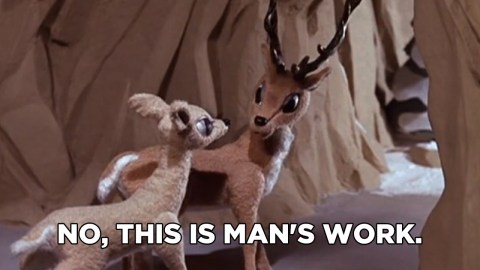
I can think of plenty of contexts where that line would still be acceptable. Maybe the speaker is an anviliciously sexist villain or otherwise flawed character that needs to be punished and educated. I mean, comics today seem to be nothing but virtue signaling and navel gazing. The twelve people that still read modern superhero stuff would love to see puff-pieces on The Mary Sue about how brave Phil Holt is for burning his past self in effigy. The Subterranean is obviously a monstrous stand-in for the basement dwelling creatures, fueled by misogyny, destroying comics by complaining online about ‘the feminist agenda’.
To be sure, the old Marvel comics Kirby and Lee created back in the day were laughably sexist. But you know who was writing the dialogue? Stan Lee. So why is the Stan Lee stand in correcting Kirby?

And you know who Jack Kirby created? Big Barda, the wife of Mr. Miracle. A character where literally the gimmick is she is stronger, more prone to violence, and more physically imposing than her husband. Apparently the interplay between them was inspired by his relationship with his wife, Roz.


Maybe if Phil Holt wasn’t a cantankerous hermit with only a single friend he would be better at writing women. It’s funny how that works, knowing other people helps you understand other people. And understanding other people helps you understand yourself. Cutting yourself off from engaging with other perspectives, even ones you fundamentally disagree with, can take you to some pretty strange places.
I said yesterday that I thought Phil Holt was too antisocial and reclusive to be pure Jack Kirby cariacature. If I wanted to give Batiuk credit, I would say that he intentionally infused his Kirby Clone with a bit of essence of Steve Ditko. (Like 90’s Superboy having a bit of Lex Luthor DNA in him, gahIamsuchanerdgah.)
Ditko was the artist and co-creator of, among others, Spider Man, Dr. Strange, The Question, and The Creeper. Like Jack Kirby he had a falling out with Stan Lee over author credits and creative direction, and left Marvel to freelance for Charlton and DC. But unlike Jack Kirby, Ditko was an intensely private man, who didn’t give interviews, or go to conventions, or converse with fans.

Some of you more comics savy may be thinking, “Oooh, The Question! That’s who Alan Moore based Rorschach on!” And you would be mostly right, except that The Question was really a watered down version of another character that Ditko created. While Ditko made his living doing freelance work, he also created superhero comics with smaller indie publishers. Like Mr. A.


Yup. Ditko was a Randian Objectivist that would make Andrew Ryan blush. His principles, combined with his anxious and shy nature, made it easy for him to alienate everyone around him. In many cases it seemed he wanted to. He never married. He broke off friendships. He surrounded himself with the few he thought he could trust not to betray or challenge his ideals. To quote Flash Freeman, “He spent most of his time at war with the world and everyone in it.”
I read two informative articles, and watched one fascinating documentary about this weird, weird, strangely admirable and slightly pitiable guy.
This Vulture article was the most negative, but also the most psychologically insightful. Vulture writers are a bunch of liberal pantywaist hippies who hear the word ‘objectivist’ and rear back like Dracula at a Crucifix, (sorry, channeling the spirit of poor Steve for a moment) but lots of good facts there.
This article was a little more even-handed, very focused on his work output, and covered the characters he continued to create for Marvel and DC into the 90’s.
And finally, this charming BBC4 documentary was probably the most sympathetic to Steve Ditko. Several comics creators, including Alan Moore, weigh in on his art, philosophy, and legacy.










 Son of Stuck Funky