Happy Labor Day! and a tip of the SoSF hardhat to the estimable Epicus Doomus for seeing us through the latest installment of Les’ Story. Epicus usually throws himself on the grenade of having to post on a holiday weekend, but I have seen fit to give him the holiday off for a change. You’re welcome.
Though he’s really not dead after all, Phil Holt has arrived in that Old Comics Creator Heaven known as Atomik Komix. He’s even greeted by Saint Mopey Pete himself. Phil and Flash have leeft behind their earthy grievances (to the point where they are now living together), and, thanks to Chester’s beneficence, have reunited to “write to life” the Subterranean, the project that led to the team’s breakup years ago. This development easily pushes the median age of the Atomik Komix staff well north of sixty.
Many of us have wondered why Phil felt it necessary to fake his own death in order to “work without being bothered.” He was already toiling in obscurity when Darin spotted him doing caricatures at a kiddie party. If Phil wanted Darin to have those original Batom covers (which Darin immediately decided to liquidate), it didn’t have to be via his last will and testament. What I think was behind it was this: Phil knew that his “death” would cause Flash to be wracked with guilt over losing the opportunity to reconcile. Now that he’s turned up alive, Phil gets to bask in Flash Freeman’s beaming bonhomie.
As it was foretold in the comments section, today we get a commissioned sideways comic cover. And whadda ya know? The Subterranean looks like if you ripped the spikes off of Doomsday. Or dipped The Hulk in concrete. Or shaved Solomon Grundy and had him running around nude.
Past comments by numerous commenters have been harsh on the Atomik Komix lineup.
There’s not a single AK title that would have sparked my interest back when I was reading comic books. Not a thing. Back then they would have bored me just as much as they do now.
“No new comics to read? Just these Atomix Komix things? Sheesh, I think I’ll go home and do schoolwork.”
Beckoning Chasm
And I would agree. Though I thought the concept and first cover of Stardusters did show some promise with a cast of differentiated characters, a Star Wars-esque grungy space look, and an action heavy tableau. So props to Rick Burchett and Rob Ro on that tip of the Funky Felttip.
But for the rest, all we have is a dumb name, a dumb costume, and maybe a gimmick or a gimmicky backstory. They have to be terrible, right?
Well, yes; because they’re being written by Funky Winkerbean characters, who–in turn–were written by Tom Batiuk. A man who seems stuck in the era of “Why is Superman Forcing Jimmy Olsen to Marry a Gorilla! Twice!”
But if we’re just going off the names, the gimmicks, and facts, the covers…
As we exit this weirdly awful comics arc, and brace ourselves for the blandly awful Les arc that will follow, let me tell you a little story.
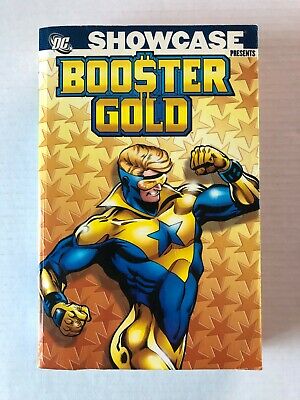
Two of my best friends were at a local comic shop picking up Batman, Nightwing, and Transformers comics, when one of my friends saw this.
And I mean LOOK at this! Some kind of smarmy, cocky, swaggering douchebro with a giant star on his chest and a MONEY SIGN in his name.
My friend said. “Who the f**k is Booster Gold?!” And became very offended, (mostly facetiously,) that a character like this: some kind of boring-looking, stupid character, would be worthy of his own DC omnibus collection.
So it was a running joke for us for months that Booster Gold was our friend’s arch nemesis. And to further the joke, I bought her a copy of the first issue of the 2007 relaunch of Booster Gold’s solo title for her birthday.
And we read it. And then the next. And then the series. And you know what? It was great.
Written by Geoff Johns, Jeff Katz, and drawn by Dan Jurgens, it told the story of a time travelling superhero who wasn’t respected by other superheroes. Because for most of his career he’d tried to use his super-heroics to accumulate fame and fortune . But Booster Gold now was a superhero who had recently gone through the most traumatic experience of his life. An experience that spurred growth in him. The death of his best friend, Blue Beetle.
The first major arc involved Booster Gold going back in time to try to prevent his friend’s murder, only for the new future they create to be a terrible dystopia. Eventually Ted Kord (Blue Beetle) decides that the only way to put things right is to go back in time to die again.
The Bromance is real guys.
Look at Blue Beetle, that’s a weird looking costume if I’d ever seen one! And the thing was packed with a million references to old nonsense that we hardly understood, and a dozen weird characters with wacky gimmicks. But that didn’t matter, because the book was funny, the characters were crisp and distinct, and the story was heartfelt, and we ate it up. And then we went back, and read Booster Gold and Blue Beetle’s old adventures in the Justice League International. We started reading ANYTHING with these two. Because their friendship was one of the best things ever in a universe that included BATMAN. One of my friends and I went to a convention dressed as them.
And all because my friend thought that a cover looked stupid.
What I’m saying is that, in the right hands, ANYTHING can work, any name, any costume, any gimmick, any backstory. That fact is born out in comics history again and again and again. Some of the most critically acclaimed books were made up of D-list characters cobbled together from the Scrappy Doo heap. The New Suicide Squad movie is hoping to make a billion dollars on this premise.
But in the wrong hands the tearful reunion of two elderly men and former friends after literal decades apart can be as emotionally thrilling and meaningful as watching paint dry.
Those of you who DIDN’T guess that Phil and Flash would be asked to take The Subterranean to Atomik Komix, please report to the front desk for your free brain scan.
And really, Phil Holt is accusing Flash of grandstanding? Isn’t Phil the man who loudly crashed a ComicCon panel to come back from the dead, then stormed the stage to have a reunion with his former partner that ended with both of them in tears.
Since when have we ever seen Flash Freeman grandstanding? We’ve all been treating Mr. Freeman as the stand-in for Stan Lee, but he’s even less like Stan Lee than Phil Holt is like Jack Kirby.
Visually, Flash is drawn as an old guy with a weirdly long face and a receding hairline, kinda like an elderly Stan Lee. And on the surface they’ve done similar things: being a head writer, giving the writers and artists in their employ pet nick names, making up behind the scenes stories, and being blamed for stealing credit from others.
Chester’s wailing about the ‘Batty Batom Bullpen Boasts’ is an obvious reference to things Stan Lee did to drum up enthusiasm and company loyalty in kidsoomers. Things like the Marvel Bullpen Bulletins and the Merry Marvel Marching Society, which put out a record that has been BURNED INTO MY MIND.
“You belong, you belong, you belong, you belong, you belong you belongyoubelongyoubelong…
But in personality? Flash Freeman has been presented as an affable, laid-back guy. Down to earth, level-headed, and even reserved. He’s usually drawn with a slight smile and relaxed face, like he’s bemused about everything around him.
That is not Stan Lee.
Stan Lee was a man who treated every conversation as a performance. A man who only stopped flashing his toothy grin when he was posing or playacting a ‘serious’ moment. A man who rearranged his life into entertaining stories, and if he had to sacrifice the facts to do it, so be it. This is not Flash getting wrong the street address of a diner he last visited 60 years ago. Lee was a man who told a story to a convention about how he’d gotten hired, then called a former coworker who could expose the fib, and tried to convince him to go along with the ‘enhanced version’ of the truth.
Here’s an excerpt from the transcript of that coworker’s panel at ComicCon in 1998.
Stan Lee; is Stan here? No? (laughter) Stan Lee called me about two or three years ago, and says, “Joe, I opened my convention with the story that I answered an ad in the newspaper to get my job. I answered an ad in the newspaper for a job in comic books and then I went. You hired me and I was walking in the hall and I ran into Martin.” Well, I knew Martin was his uncle; well, his relative. Actually it was Stan’s mother’s cousin, something like that.
[Stan continues:] “So, Martin said to me, “Stan, what are you doing here?” And I said, ‘I work here.’ And Martin says, “Is that right? I didn’t know.””
I said, “Stan, that story can’t be true. We only had three offices and a bunch of relatives in the building. We didn’t even have a hall.” (laughter) So Stan says, “Is that right? My memory is going.” (laughter) I thought it was a pretty good story. (laughter) I figured at that time, he’d stop doing it. He’s still doing it. A month later I read the same story in Newsday. But, God bless Stan, he’s got a good story and he’s sticking with it. (laughter) He did a wonderful job. He did a miraculous job. I’m proud of him.
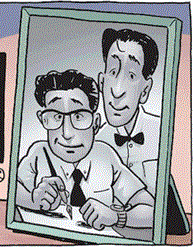
Who was that coworker? Why Joe Simon, the man who hired Stan Lee. The first editor of Timely (later Marvel) comics. And Jack Kirby’s creative partner for the first 15 years of his career. Theirs was truly a partnership where credit can’t be sorted. They both wrote, they both drew, and scripted, and inked. There are covers and pages with both their names on them, where not even experts can parse out who did what.
They first met working for Fox Features Syndicate, an early comics publisher run by Victor Fox who Joe Simon characterized more clearly than any Act III Funky Winkerbean character could hope to be:
It was at Fox Comics. I guess you all know about Victor Fox. He was a little chubby guy. He was an accountant for DC Comics. He was doing the sales figures and he liked what he saw. So, he moved downstairs and started his own company called Fox Comics, Fox Publications, Fox Features Syndicate, Fox Radio, Fox this, Fox that… He was a very strange character. He had kind of a British accent; he was like 5’2″–told us he was a former ballroom dancer. He was very loud, menacing, and really a scary little guy. (laughter) He used to say, “I’m the King of the Comics. I’m the King of the Comics. I’m the King of the Comics.” (laughter) We couldn’t stop him. So that’s the task I had when I went in to start that job.
Hmmmmm…….
When Joe Simon left Fox comics for Timely, he took Jack Kirby with him, and there they created Captain America. Then when they felt they were getting the short stick by Timely, Joe began negotiations for both of them to move on to National Comics (now DC.) There they wrote Boy Commandos and the Newsboy Legion, both very popular at the time, even if they’re mostly forgotten now.
After the War, they worked freelance, basically creating the Romance Comic genre. All the while, they were living across the street from each other with their young families.
Their partnership more or less ended in the mid-fifties, after comics hit a huge slump. The self-imposed censorship and moral panic in the wake of The Seduction of the Innocent and the Senate hearings made it an uncertain financial field. So Jack and Joe parted ways amiably. Jack stuck it out with comics, and Joe moved on to advertising and magazine publishing; though he would occasionally dip his toes back into the comics business. In 1974 he and Kirby worked together on a relaunch of ‘The Sandman’ for DC. They remained on friendly terms for the rest of their lives.
I’ll say this for Jack–Jack went back to Marvel, he switched to Marvel from DC. We got together a couple of times in-between. But every time I called Jack I’d say, “Jack, I’ve got a project to do; come do it with me.” He was there the next day–and in those days, we were always together when we had to be, when we wanted to be. He always came back to me. I never paid him the way I’d pay the other artists; I always split with him, everything we had. We had kind of a nice relationship.
Is Flash Freeman a poorly written Stan Lee? Or is he intentionally tempered with the soul of Joe Simon?
The prosecution presents the following evidence.
Now we needed a villain for inside the comic, too. … Even sitting at lunch, I was always thinking about heroes and villains, with all sorts of ideas swimming around in my head. Next thing I know, I had a hot fudge sundae sitting in front of me, with the vanilla ice cream, and the hot fudge is running down the side. It was intriguing.
The hot fudge looked like limbs—legs, feet, and hands—and I’m thinking to myself.
Gee, this’d make an interesting villain, I mused. We’ll call him Hot Fudge … Just put a face on him, and have him ooze all over the place.
You have to be stupid to be in this business. Nevertheless, I did some sketches, right then and there. And I Iooked at them.
Nah, I thought. Who would believe anything like that?
But I looked again at the sundae, and I saw the big cherry on top. The cherry looked like a skull.
“Wow,” I said to myself. “Red Skull … that sounds good.” And it made a lot more sense.
I thought Phil said he needed someone to ‘write it to life’, but apparently he already has dialogue written for this story. So he’s not really looking for a writer but an editor.
And whooo boy, that is some old timey sexism there. It’s so bad that all the background men have disappeared. Mindy looks grumpy! Which is nice to see, because she’s done nothing else but smile blandly for an entire month.
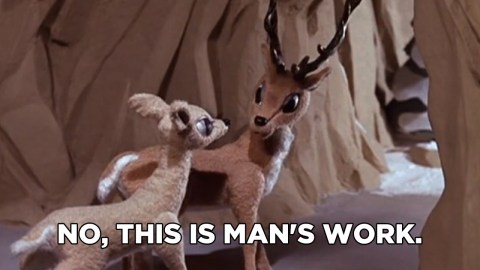
Let’s give him the benefit of the doubt though. Maybe Phil meant that line as a really weird homage to the Rankin-Bass Rudolf the Red Nosed Reindeer special.
But, darling, you’re a reindeer?
I can think of plenty of contexts where that line would still be acceptable. Maybe the speaker is an anviliciously sexist villain or otherwise flawed character that needs to be punished and educated. I mean, comics today seem to be nothing but virtue signaling and navel gazing. The twelve people that still read modern superhero stuff would love to see puff-pieces on The Mary Sue about how brave Phil Holt is for burning his past self in effigy. The Subterranean is obviously a monstrous stand-in for the basement dwelling creatures, fueled by misogyny, destroying comics by complaining online about ‘the feminist agenda’.
To be sure, the old Marvel comics Kirby and Lee created back in the day were laughably sexist. But you know who was writing the dialogue? Stan Lee. So why is the Stan Lee stand in correcting Kirby?
Still not as cringe as the Fan4stic movie.
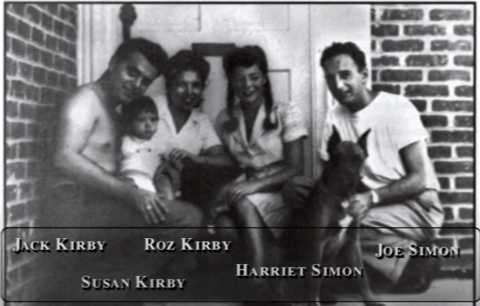
And you know who Jack Kirby created? Big Barda, the wife of Mr. Miracle. A character where literally the gimmick is she is stronger, more prone to violence, and more physically imposing than her husband. Apparently the interplay between them was inspired by his relationship with his wife, Roz.
Maybe if Phil Holt wasn’t a cantankerous hermit with only a single friend he would be better at writing women. It’s funny how that works, knowing other people helps you understand other people. And understanding other people helps you understand yourself. Cutting yourself off from engaging with other perspectives, even ones you fundamentally disagree with, can take you to some pretty strange places.
I said yesterday that I thought Phil Holt was too antisocial and reclusive to be pure Jack Kirby cariacature. If I wanted to give Batiuk credit, I would say that he intentionally infused his Kirby Clone with a bit of essence of Steve Ditko. (Like 90’s Superboy having a bit of Lex Luthor DNA in him, gahIamsuchanerdgah.)
Ditko was the artist and co-creator of, among others, Spider Man, Dr. Strange, The Question, and The Creeper. Like Jack Kirby he had a falling out with Stan Lee over author credits and creative direction, and left Marvel to freelance for Charlton and DC. But unlike Jack Kirby, Ditko was an intensely private man, who didn’t give interviews, or go to conventions, or converse with fans.
This is one of only three or four confirmed pictures of Ditko. THINK.
Some of you more comics savy may be thinking, “Oooh, The Question! That’s who Alan Moore based Rorschach on!” And you would be mostly right, except that The Question was really a watered down version of another character that Ditko created. While Ditko made his living doing freelance work, he also created superhero comics with smaller indie publishers. Like Mr. A.
I mean, I like objective reality as much as the next philosophical conservative, but this is taking it a little far.
Angel was a delinquent who stabbed the lady being carried btw. He just fell off a building and died. Yay!
Yup. Ditko was a Randian Objectivist that would make Andrew Ryan blush. His principles, combined with his anxious and shy nature, made it easy for him to alienate everyone around him. In many cases it seemed he wanted to. He never married. He broke off friendships. He surrounded himself with the few he thought he could trust not to betray or challenge his ideals. To quote Flash Freeman, “He spent most of his time at war with the world and everyone in it.”
I read two informative articles, and watched one fascinating documentary about this weird, weird, strangely admirable and slightly pitiable guy.
This Vulture article was the most negative, but also the most psychologically insightful. Vulture writers are a bunch of liberal pantywaist hippies who hear the word ‘objectivist’ and rear back like Dracula at a Crucifix, (sorry, channeling the spirit of poor Steve for a moment) but lots of good facts there.
This article was a little more even-handed, very focused on his work output, and covered the characters he continued to create for Marvel and DC into the 90’s.
And finally, this charming BBC4 documentary was probably the most sympathetic to Steve Ditko. Several comics creators, including Alan Moore, weigh in on his art, philosophy, and legacy.
Let me see if I’ve got this straight, Phil. You faked your own death so you could work without being bothered, and in the literal years since you’ve managed to draw and layout a single issue? Seriously? GRRM works faster than you! I swear to Galactus, if there isn’t Berserk levels of detail to every single panel of this book…
Jack Kirby would be ashamed! You know, the guy you’re supposed to be based on? Jack Kirby was a legend for his output and work ethic. He could complete multiple pages a DAY. The man was a machine. If Jack Kirby faked his death to work on a project for four years, the final output would rival Henry Darger.
But how close are you really to Jack Kirby? I took the time this week to watch a few documentaries, read a few articles and interviews. Let’s see how close Phil Holt stacks up to The King. The glorious co-creator of Captain America, The Fantastic Four, The Hulk, Mr. Miracle, The New Gods and so many more.
First of all, the physical resemblance is as close an approximation as the art style allows, especially in the earliest appearances. The poofy, swept back hair, the cigar, the squarish head and round face, all look like a caricature of Kirby. Even more, they look close to how Kirby depicted himself in comic form. The strip even goes out of it’s way to show that Phil is shorter, just like Kirby who was 5’6″.
The only difference is the glasses, and even then, the glasses seem to serve the function of giving him the boxed off square brow and deep set eyes he had naturally.
But does Phil resemble Jack in personality?
Not really. Phil is prickly, he snips and snaps at everyone. He might have depths of generosity, and hidden warmth, but twice he is described as someone whose resting state was antagonistic.
The Jack Kirby described by others, and I saw in interviews was not this person. Yeah, he was a pugnacious guy, who could hold a wicked grudge against people who he thought slighted him. He even lashed out at people he was frustrated with by creating comic villains to RESEMBLE those people.
Funky Flashman (Stan Lee) and Houseroy (Roy Thomas) from Mister Miracle #6, 1972
But to anyone else, he was warm and welcoming. He had a wide circle of friends. People liked working with him. The documentary I watched talked about how random people would show up at his house and he would let them in, show them his studio, and his wife would feed them sandwiches.
Did you know he had a wife? And kids too! People he was financially supporting. Relationships that drove him to look for work and and fight for contracts that paid him his fair share of the profits he was creating, and get rights to royalties that would allow him to continue to provide for his family in the future.
And Jack Kirby never disavowed comics. Sure, in the 80’s he moved on to animation for Hanna-Barbara, but he created comics intermittently through the 80’s and early 90’s. He continued attending conventions and meeting with fans right up until the year he died. He was proud of his work, and went through a legal slugfest with Marvel trying to get his artwork back.
I might think it was petty to draw a sniveling caricature of poor Roy Thomas, and print it in the pages of DC; but I’ll give Jack Kirby this, he didn’t stomp out of an entire industry in a huff and never work again. Jack Kirby worked hard his entire life. He fought hard for his credit, and switched comics companies multiple times, because he wanted that hard work to be recognized. Not just for himself, but for his wife and kids.
Is Phil Holt meant to be Jack Kirby? Probably. But he’s a Jack Kirby that existed in a world where he had nothing to fight for but his own ego.
This was my favorite of the documentaries I watched. It’s probably more hagiography than strict history, but peeling back the veneer of eulogy you can still see that the truth of the man beneath. If you’ve got the time, and the inclination, I’d recommend.
DID YOU KNOW? Despite being drawn 24 times, Mindy has only been allowed to speak twice this entire month?
 Happy Labor Day! and a tip of the SoSF hardhat to the estimable Epicus Doomus for seeing us through the latest installment of Les’ Story. Epicus usually throws himself on the grenade of having to post on a holiday weekend, but I have seen fit to give him the holiday off for a change. You’re welcome.








 Son of Stuck Funky