Closer to the Heart

Back in 2011, Tom Batiuk would take a knife to what vestiges of whimsy and fun might have remained in Funky Winkerbean by offhandedly killing longtime football coach, and by that point the longtime retired, Jack Stropp. Stropp of course died of that favorite of all Funky diseases, cancer, and was later on euologized by his former star player Bull Bushka. Bull would then attempt to take Stropp’s ashes to scatter in the endzone but would instead trip and fall, scattering them just short of the goal line.

In a sense that would be insulting but as Coach Stropp’s character was that of the perennial loser I think that was a fitting way to send him out. It showed that someone still cared about him and ultimately his end having one more instance of falling just short works for a guy who had a running gag of being tied to a goal post and threatened with execution because of how lousy he was at coaching football.

2011 would not be Coach Stropp’s first brush with death, however. See, by the early ’80s it seems as if ol’ Batty was starting to get a little restless. He’d been doing Funky Winkerbean for around a decade and by that point he was seemingly looking to change things up a bit. There were some status quo shifts such as Crazy Harry moving into a home for troubled youths or taking up a job at Montoni’s. There were some attempts at longer form ongoing stories, notably the oft-called-back-to teacher’s strike which ended with Fred and Ann getting together and would then lead to the ups and downs of their relationship throughout the ’80s that would end with the adoption of Darin.

One such instance of this attempt to change things would be in 1982 and involve the very tone of the stories themselves.

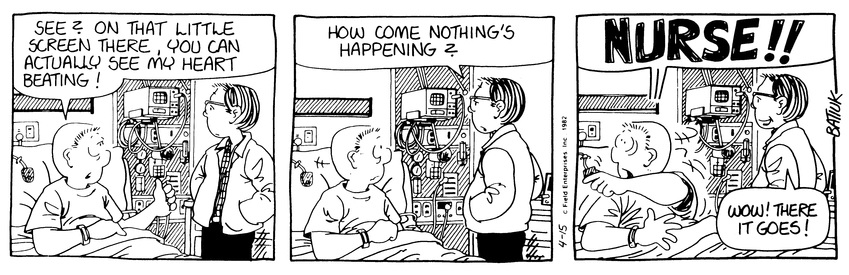
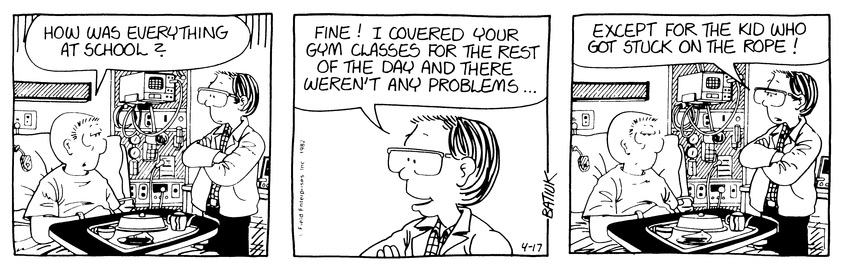
In the middle of April, the week would open by showing that something was clearly wrong with Coach.
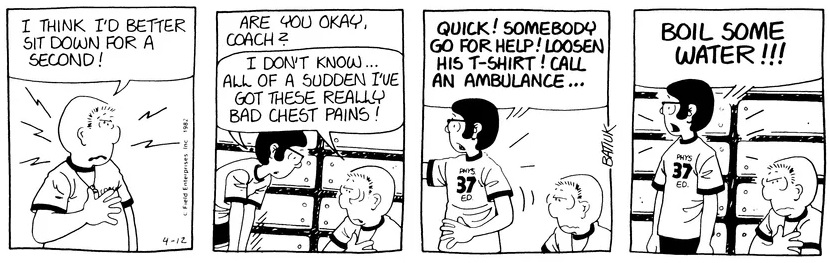
Stropp would have a heart attack to begin a story that would carry off and on for most of the next month and this, what I would consider to be the strip’s first attempt at a more serious story, is what I’ll be covering today.

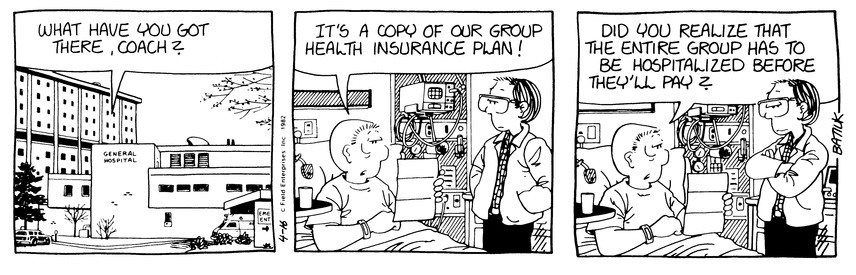
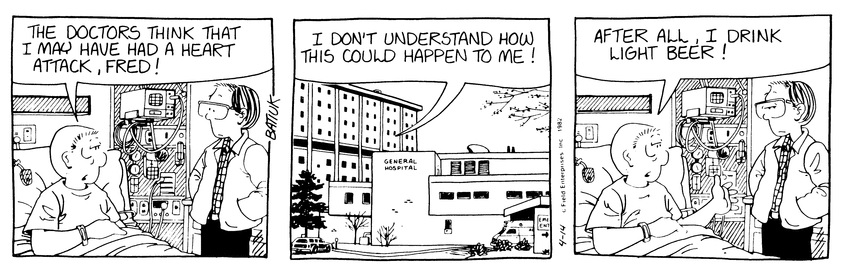
Much of the rest of the week is spent determing that yes, Stropp had a heart attack with Fred visiting him to provide some goofy interactions between the two teachers.
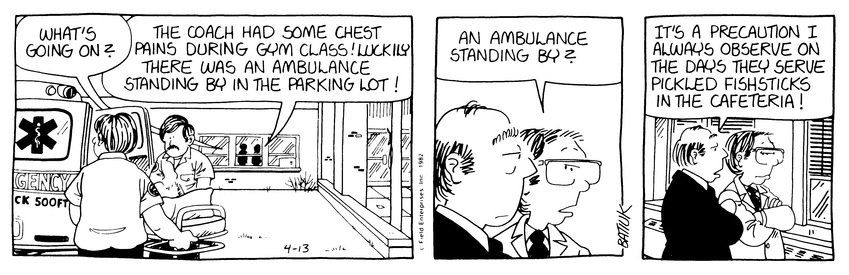
Remember when Westview was supposed to be a giant shithole?
Either Fred is screwing with him or the machine just sucks. Either was possible at this time.

Batty also manages to work in a “Les climbing the rope” gag without Les being around.
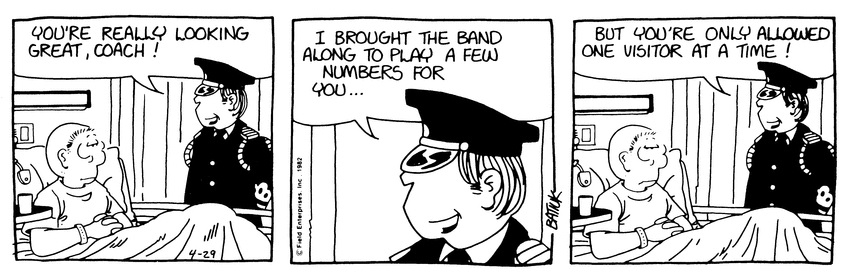
The week after is spent on Senator Noah Vale (somehow still alive and still a Senator and unaging per recent Crankshaft strips) calling a congressional hearing on the dangers of video games in general and Pac-Man specifically. Afterwards it’s back to the Coach with the week being dedicated to him getting various visitors to prepare him for his upcoming operation.
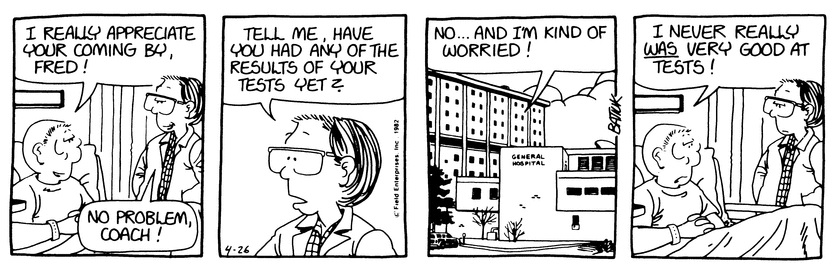
This includes what’s one of my favorite jokes in the entire half-century run of the strip.
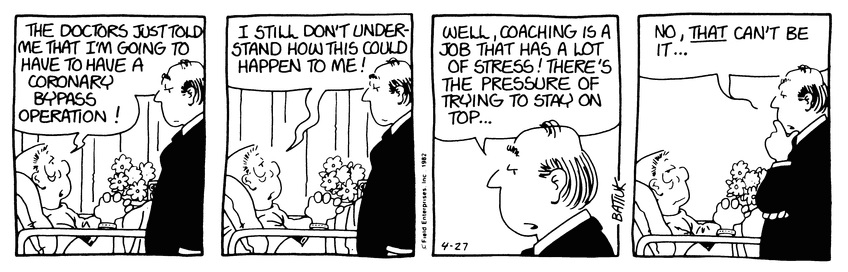
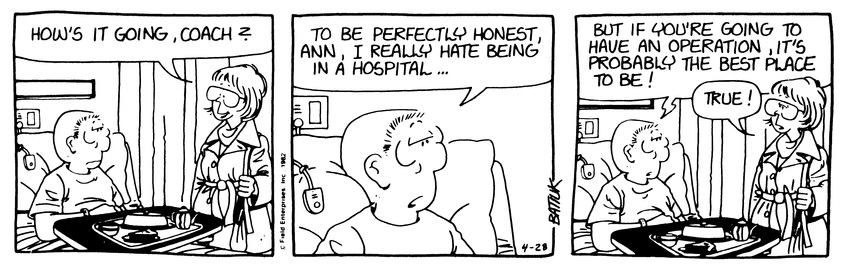
I’ll also mention that Al is one of my favorite Act I characters.

Even Dinkle shows up, not being a giant jackass for once. Or at least not as much of a jackass as he could have been.
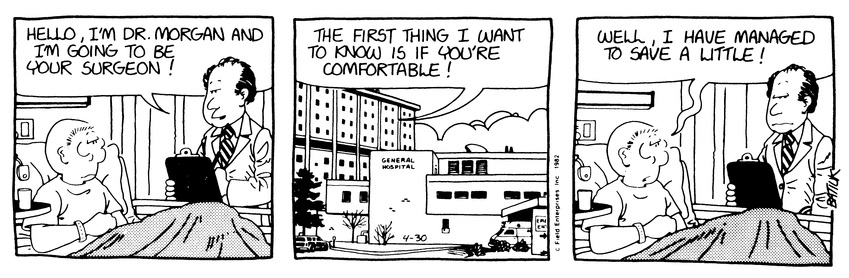
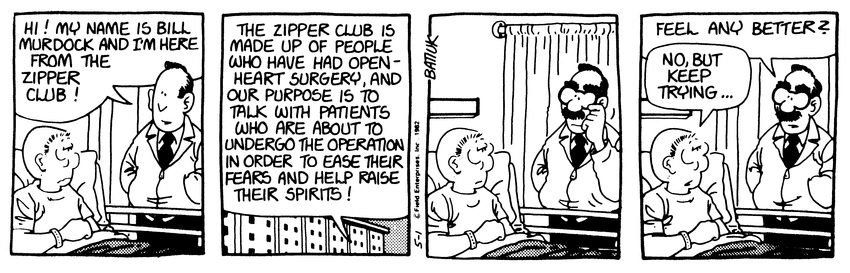
Then it’s a visit from his surgeon and another open-heart surgery survivor.
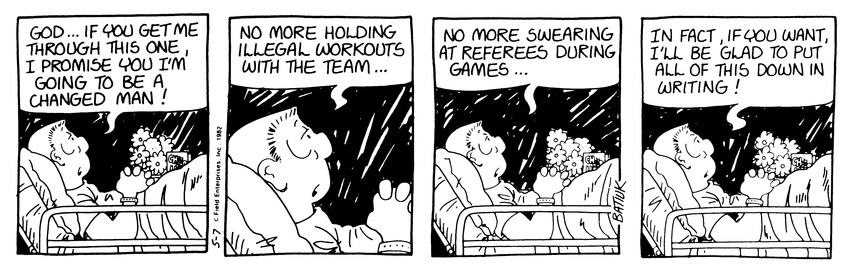
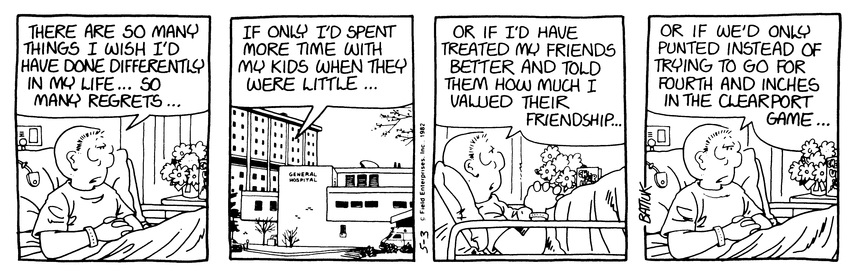
With surgery imminent and Stropp nervous about his chances, he begins to ruminate on what he feels may have been a wasted life.
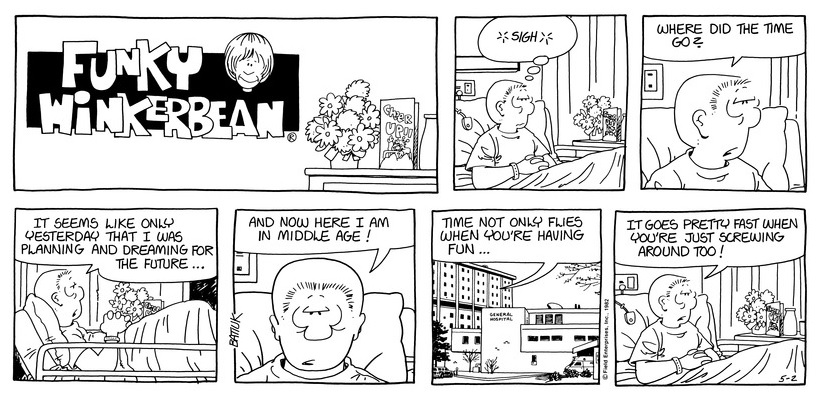
Which is basically a more effective, though far less unintentionally hilarious, version of a strip that Batty would bust out in Act III.
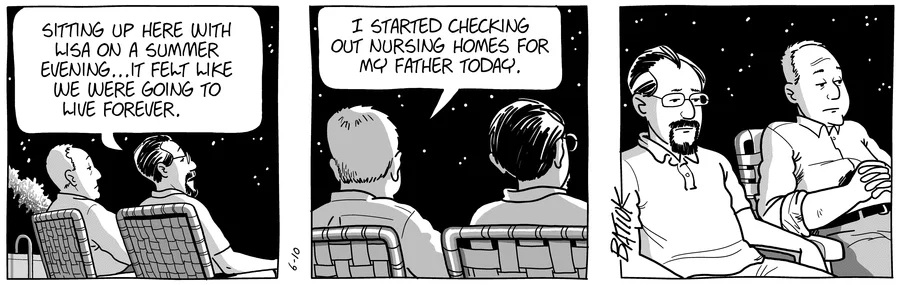
This would definitely make the list of Most Emblematic Funky Winkerbean Strips.

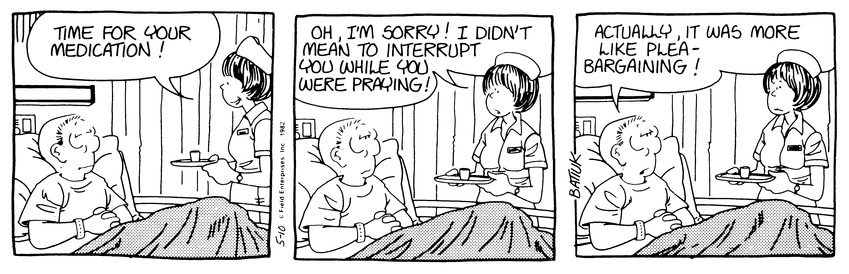
His anxiety also begins to fill Stropp with regret at the things he may have done wrong and how he could have been a better person. This leads to him turning to prayer for the first time in a long time, bargaining with God and claiming that he’ll be a changed man if he can make it through this.
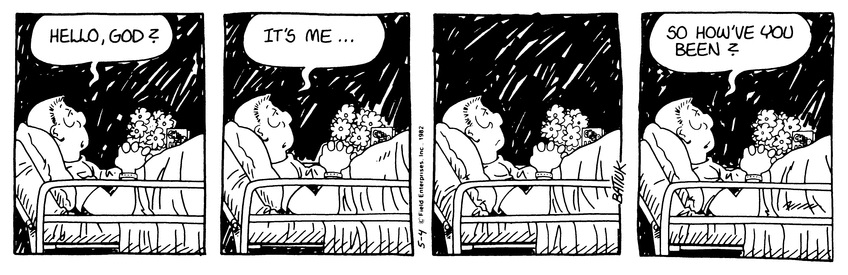
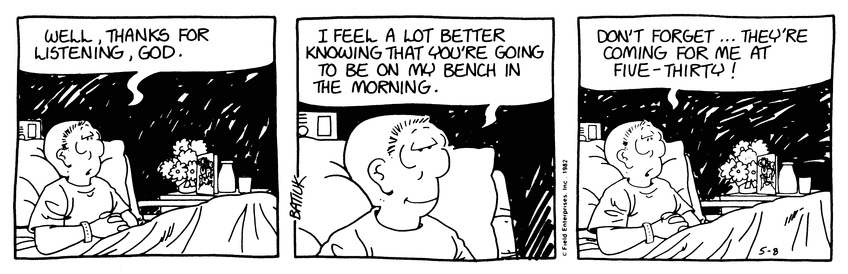
Funny enough, at this point Stropp doesn’t actually have a name. Off the top of my head I can’t really recall when he’s officially named Jack Stropp but at this point he’s still just the Coach and even refers to himself as such.
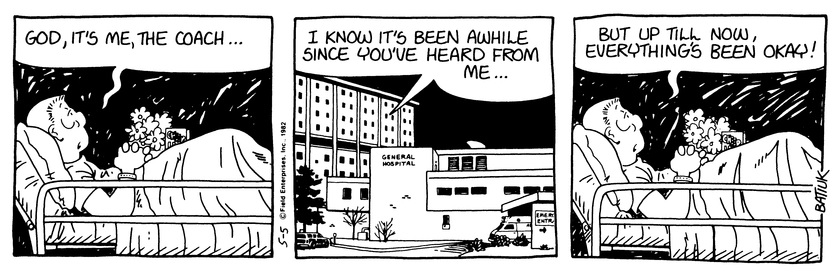
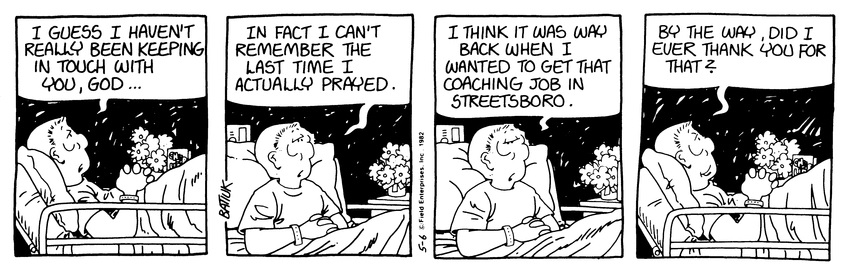
With his impending surgery now at hand, Stropp’s decided to put his trust in the competency of his doctors.
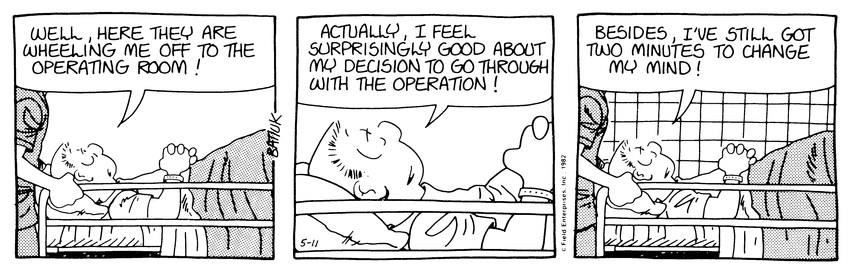
Thankfully for him, this is one of the rare times in Act I where competency is actually available in Westview as the operation goes off without a hitch and Stropp pulls through.
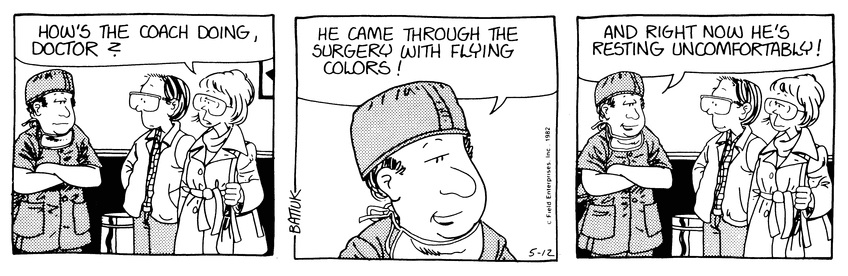
That’s actually how this story ends, right in the middle of the week oddly enough. The one problem is that we don’t really get any follow up of Coach Stropp doing something like returning to school or even just seeing his coworkers in his hospital room to put a bow on things. The rest of the week after this strip is spent on Claude Barlow jokes.

So how was Batty’s first attempt at doing a serious story in the pages of his otherwise goofy comic strip? Truthfully, it’s not that bad. I won’t even give a qualifier and say that it’s good by TB’s standards. It’s not a masterpiece but it’s a pretty decent story overall. There’s gallows humor to provide levity but it never feels as if it’s there to undercut the seriousness of what’s happening and likewise, despite the serious nature of the story Batty doesn’t forget that this is first and foremost a humor strip so he still peppers it with jokes… some of which are even pretty good!

Outside of the kind of damp way that he ends it, it feels like Batty really tried with this story to do something that was at that point fairly different from what the strip had been while still making sure it fit and didn’t at all feel out of place. In that respect he largely succeeds and while he’d try again a few times in Act I–from a story about Barry Balderman to Lisa’s pregnancy–before shifting full time to light soap opera mode in Act II, I think he managed to somehow nail it the first time in a way he never was quite able to ever again.

We of course know how his later attempts at moving the strip in a more serious direction and telling more dramatic stories would go. They would lean heavy on the soap operatics, they would be incredibly hamfisted, practically screaming at you about how you should feel. They would be absurd but not in the way where the reader is supposed to find it absurd and thus derive amusement. No, they are unintentionally absurd and so the reader finds amusement in that unintended hilarity despite the fact that they’re supposed to be emotionally invested in how serious the story is.

But here, in the more jokey days of Act I, I feel like it’s actually much easier to get invested in what’s happening. Batty’s said in his blog posts that part of his approach with Funky Winkerbean was doing a riff on teen humor comics like Archie from the perspective of the outsiders. The nerds, the bums, the put upon and questionably competent faculty… people like that.

Coach Stropp then kind of embodies that approach as much as any other Act I character except perhaps for Les. He’s a loser but he’s a lovable loser. He tries his best time and time again, no matter how crushing the defeat or how impossible the odds. His motto and catchphrase throughout these years is how the opponent “puts their pants on one leg at a time” and I think that sums up the character well which makes him fairly likable. People will always want to side with an underdog so there’s a certain relatability in a poor schmuck like Coach Stropp coming face-to-face with his own mortality and worrying about how he may have wasted his life. There’s a real possibility that he could die and for the most part it’s out of his hands. He has crappy healthcare and has no choice but to rely on it and entrust himself to the care of others and so he looks for comfort wherever he can find it.

There’s a realness to it that, as ridiculous a character as the Coach is, makes him and his situation relatable because it’s a situation that many readers of the strip have likely been in themselves, either directly or through friends and family. But it’s not overblown, it’s not made out to be anything bigger or more important than it is. A middle-aged man has a medical scare and has to face his mortality and the story handles it briskly, seriously, but doesn’t forget to still have a little fun and not beat the reader over the head with how this is a serious situation that needs to be treated with grave solemnity as if it’s the most important thing to ever happen.

So on his first attempt at doing a story like this, I’ll say that Batty managed to hit a home run. Too bad for him that he didn’t take the correct lessons from it and the best he could subsequently manage was grounding out to first.

When Everything Goes Pear Shaped.

I know I promised you guys the distant past. But first, a brief timeline of the last couple years.

December 2019 to March 2021: Life in Westview proceeds as normal; people self-medicating with comics to stave off the usual nihilistic despair. No mentions of pandemics, lockdowns, masks, or quarantines.

March 2, 2021: Les Moore mentions a previously unrecorded flu quarantine from when Lisa was undergoing breast cancer treatment. A week of retrospective strips on the ‘famous Flu Epidemic of 2007.’

April 2021: Funky Winkerbean attends an Alcoholics Anonymous meeting and begins blathering about ‘last year’s pandemic’. It’s as if from a moment in the future the past has been altered, Flashpoint style, so that a pandemic occurred ‘last year’ but is mostly over.

September 30, 2021: Holly Winkerbean breaks her ankle. During her time in the hospital we see people wearing masks in the present, though no one at the football game was masked. (Consistent with late pandemic trends.) She begins a recovery that sees her using a pair of crutches through at least January.

TODAY: Holly Winkerbean is implied to have broken her ankle at the beginning of the pandemic.

You know, when I did the Funky Award for Most Puzzling Continuity Question, I really figured it would be a one time deal, since many of the continuity snarls had been kicking around for a while. I never imagined that by MARCH 2022, we would already have three or four potential nominees.

But Batiuk is no stranger to continuity snarls. They cropped up in his VERY FIRST month of Funky Winkerbean.

The fifth ever printed Funky Winkerbean strip, 3/31/72 introduces Fred Fairgood as the school counselor.

And yet, the next time we see him, 5/9/72, he introduces himself as if he is just arriving.

And that isn’t the only first month snafu. On 4/5/72, we see first see Les working on the school paper, an early running gag.

And a few weeks later, he announces to Funky that he is applying for the position.

Now, both of these are understandable within the context of trying to launch a strip. You’ve got (I’m guessing) a few months of strips prepared, but then you want to lead off with your best and most easily digestible material. So strips are put out of order.

Batiuk actually has some good insight into why starting a strip is difficult.

Starting a comic strip is a unique proposition that requires a slightly different skill set from the one you’ll hopefully be using a few years later.

When I was just beginning with Funky, I read a Peanuts strip that completely frustrated me. The strip in question had come after a week during which Linus had had his blanket taken away, and he was lying on the ground shaking as he went through withdrawal. In the second panel, Snoopy walks up wearing his WWI flying helmet and scarf. He pauses to look down at Linus shaking on the ground and then walks off saying, “Poor blighter, his kind shouldn’t be sent to the front.”

It was an elegant strip that Schulz had taken twenty years to set up. Twenty years in which he had developed the theme of Linus and his blanket, developed the character of Snoopy and Snoopy’s fantasy world as a fighter pilot in WWI—all so he could create the opportunity to eventually dovetail them into that one perfect strip. Twenty years that I didn’t have behind me in those first few weeks of Funky.

Instead, what you have in a beginning strip is a great deal of expository dialogue trying to establish your characters’ names, personalities, and situations. Oh, and have them say something funny. I’ve often likened it to a stand-up comic who has to win over new audiences each night with a series of individual jokes.

Later, if he’s lucky, he moves on to a sitcom where the situational humor allows him to extend the comic narrative. Finally, if he’s really lucky, he gets to make movies, where there’s room for the subtleties of behavioral humor. It takes a long time to establish your characters and develop their personalities.

From the introduction to The Complete Funky Winkerbean Volume One

We can debate all day if he ever established his characters or developed their personalities into something consistent, but the above does, I think, point to one reason that Funky Winkerbean maintains it’s ironic audience. History. Any one year of Funky Winkerbean is mostly unremarkable. If it had only lasted a decade, any decade of its lifespan, it wouldn’t catch our attention.

But 50 years of this? 50 years of the Cronenberg-esq transformations of these strange sad-sack characters within a single universe, generated by a single mind.

When Marianne Winters pulled two VHS tapes out of her purse last week, that was the awful entrancing Funkyverse flipside to Snoopy as the Red Baron pitying Linus. It was a nauseating non sequitur built from years of disdain for a fictional character compounded with decades of facts and moments being referenced incorrectly.

Oh. And Batiuk was already creating inexplicable continuity biffs all the way back in 1973. Only a year after Les announced that he had applied for the position of school paper editor, the entire thing is retconned to being recruited by the school principal.

Never change, Tom. It’s too late to start.

Did I Stutter?

Link To Today’s Strip

Back in 1994 BatYak was considered something of a modern-day Nostradamus, courageously addressing timely social issues of the day long before they became fashionable. Guns in schools, teen pregnancy, drunk prom driving, alcoholism, divorce, talk radio, medical chart snafus…BatHack saw these broad social trends coming and tried to communicate these truths to us via his unique brand of obtuse wry banter, which unfortunately was just a bit too far ahead of its time for the “average” comic strip reader to properly appreciate. In an era marked by noisy dissonant pop-culture phenomenons like Nirvana and “For Better And For Worse” Batiuk’s subtle, more writer-ly take was lost in the shuffle. It was truly America’s loss.

Anyhow, it’s a real delight to see the still-dying Fred manage to weakly mutter his approval for the #hashtag movement as his loveless wife and reluctant caretaker Ann looks on with barely interested disgust at the frail wretch of a man her philandering ambition-crushing husband has become. So it turns out that the whole #anti-guns in schools arc was just a prop to take a victory lap acknowledging that FW addressed the issue way before it became trendy and fashionable. Nicely done. If any “young people” get teen pregnant or let talk radio inspire them to blow up post offices he’ll have that covered too. Sigh.

Everything’s So-So

Link to today’s strip.

Ah, the perils of drawing your comic strip, word balloons and all, a year before you write the dialogue.  I feel certain Tom Batiuk wanted to have some reference to “medication” in Dullard’s word balloon, but alas he couldn’t make the word fit.  Too bad, as it would clarify the mysterious “they” in Ann’s balloon (supposed to be “medications” I guess) and make her reference to a “booster shot” tie it all up neatly.  It still wouldn’t be funny or good, but one could point to it as (at least) well constructed.

Oh well, can’t stop now!  Onward, ever onward, toward that 50th!

I try to point out things I like whenever I can, and I like the shadow pattern of the window on the far wall.   Somebody took his time applying craftsmanship to make that, and it is appreciated.  And unless I’m mistaken, the picture on the wall looks a little like “Christina’s World” by Andrew Wyeth.  It may not be, but I like to think someone tried to slip something of quality into this dreary waste.

Basket Case

Happy Easter, gang, and a tip of the ol’ SoSF Easter bonnet to Epicus and SoSFDavidO for their guest stints over the last several weeks! Your pal TFH is stepping in to ramp up the “festivities” marking the fifth anniversary of Son of Stuck Funky this week!

Before laying eyes on today’s tableau, I’d have wagered that today’s holiday would have passed unremarked (as it is in today’s Crankshaft, but then Easter 10 years ago might have fallen on a different Sunday). Despite the abundance of baskets, bunnies, and eggs, this scene suggests Christmas (specifically the Epiphany) more than Easter, as Westview’s Holy Family is surrounded by the Magi bearing gifts. I recognized dowdy, nondescript Kerry, Fred’s daughter from his first marriage, though she’s not been seen since Thanksgiving 2013. It took me a lot longer to surmise that the big smirking blonde to the right is Jessica’s mom Jan Murdoch Darling (you’re welcome).

Anyway, it’s a good thing for Skyler that this mob showed up bearing baskets, else he’d have had to content himself with that pitiful tiny basket before him, which I don’t think even contains any chocolate—that green rabbit’s probably made of carob or some crap. It’s certain that the basket’s chintzy size has less to do with “keeping Skyler away from candy”—on one of the two big candy holidays all year, for goodness’ sake—and everything to do with Boy Lisa’s meager Montoni’s salary.