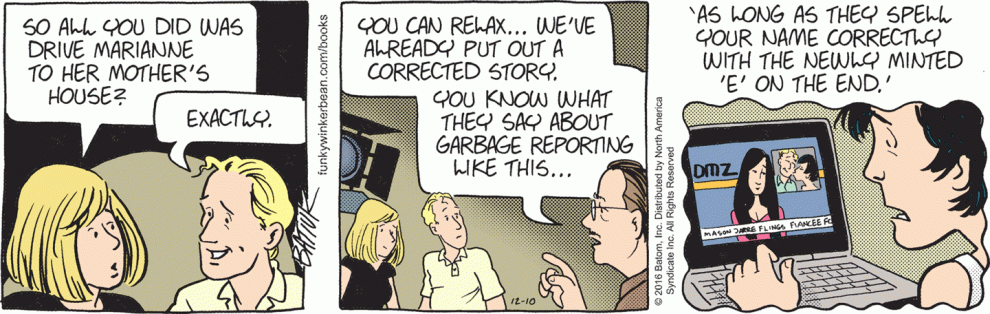
Hip hip hip hip hip
Today's strip more of the same
It just never ends

Chipmunks to Springsteen
Crazy's music tastes cover
'58-'80

Only now Crazy?
How hip did you feel during
The last 40 years?!

"You can become hip,
Just listen to new music"
- Captain Funkvious

Funky's bald advice
Somehow smartest thing in years
In this comic strip

Funky's silhouette
Recognizably human
Crazy's, not so much

Listening to this
No wonder no customers
Are at Montoni's

Make it stop make it
Stop make it stop make it stop
Make it stop oh please
Tag: Montoni's
Quoth the unshaven “Anymore”
If today’s strip is to be believed, Crazy Harry is completely unaware of a genre of music that has been a major force in popular music for three-and-a-half decades now, and is arguably well into its second decade as the dominant genre of music in the United States. Where has Crazy been? Living under a rock (booooooooo!) since the Reagan administration?
Funky lives up to his name for once, brimming with mildly more modern musical knowledge than Crazy, the Act I gang’s resident music fan and audiophile dating back even to his early appearances. I guess he’s now not only channeling NASCAR legend Mark Martin’s haircut but also Martin’s unexpected rap music fandom.
Licorice Pizza
OK, I’ll start positive today. Here’s something I like about today’s strip, Ayers uses bubble panel borders correctly, to denote a memory of dream sequence. Yeah, that doesn’t sound like much, but coming from TB’s pencil for decades it meant “present day in-strip setting change”, a maddening misinterpretation of longstanding comic art language.
And now, for everything else…
A pizza spinning on your turntable used to be a sort of shorthand for “cool”, in that it signified you were someone cool enough to have just a had a party wild and “crazy” enough that some nut tried to play a pizza and everyone was having too much “fun” to notice (see this well-known scene from Sixteen Candles, for example). However, a pizza spinning on your turntable when you are alone in your own room with your headphones on is not “cool”. Silly, whimsical, weird, crazy? Sure… but not cool. One could even describe Crazy’s memory as rather sad, given the contrast between him listening to his pizza alone in his room compared to the sight of a pizza on a turntable signifying a really good time shared by friends.
Furthermore, was the music produced by the pits of a pizza ever “cool”? Since every Youtube video of someone “playing” a pizza on a turntable is just a gag to dub in “That’s Amore”, I am forced to assume that it actually sounds like an EP for a British New Wave band. In that case, yes, it actually was cool.
Relics of the Past
(It’s a long one today folks. Sorry ’bout that.)
Link to another dumb question from Maddie that I can’t believe she’s never asked her mom before. And how has Maddie not seen the picture at Montoni’s? She worked there.
Who doesn’t at least know the very basics of how their parents met? Heck, I referenced my own parents’ story of sneaking out to the county fair behind my grandma’s back in the very first post of my shift. I will admit, sometimes I pretend like I haven’t heard a story, just so I can hear it again; but that doesn’t seem to be the case here.
And, as many of you have commented, this story has more holes than Swiss Cheese. The real backstory here is that in 2001 or 2002 Batiuk realized that he had married off Les to Lisa and Funky to Cindy and wondered who he should set Crazy Harry up with. He then had the idea to reveal that The Eliminator kid was a girl all along, and have her and Crazy fall in love. Not the worst idea, really. Done right it could have been a cute reference to ‘Samus is a girl!’. The problem was in the execution.

In Metroid, Samus isn’t ‘hiding’ her gender because the Mother Brain is sexist and won’t fight a woman. She’s just in an androgynous space suit for most of the game. Players might assume she’s male, but it’s not confirmed either way until the end.

I haven’t read all the old The Eliminator strips; I don’t know how often she self-refers as male. So I don’t know how feasible it would be to present Donna’s past actions as allowing the people around her to think she was a boy because she didn’t care to clarify, or because she thought it was funny. (“I was named for your Grandpa Donald. My mom always called me that when she was angry.”)
But the only other way to salvage this would be writing a more serious story about Donna as an insecure little girl who thought she needed to disguise herself coming to the realization as an adult that she was wrong. Because she didn’t need to. Period. Mary Ellen, and Livinia, and Junebug, and even Wanda have proved that handily almost a decade before The Eliminator is introduced.
Batiuk is repeatedly guilty of recontextualizing his own past to suit the narrative of the now. I found some old puff piece newspaper articles that just plain don’t make sense after reading the first few years of Funky Winkerbean.
To Batiuk, delving back into the high school years with the gay prom issue underscores the generational changes and contemporary challenges his characters faced once he decided to let them begin aging along with Batiuk and the rest of us.
“I had crossed the threshold and I had grown up and the characters wanted to grow up too, it seemed like,” Batiuk said in an interview in his cozy and bright studio jammed with books and mementos.
“Funky Winkerbean” might have a lower profile in mainstream culture than, say, “Doonesbury,” possibly because “Funky” was a gag cartoon in the early years when society was highly politicized in the Vietnam era and has become more issue-oriented since the 1990s…
The San Diego Union-Tribune
Thomas J. Sheeran, AP
May 29, 2012
When he began “Funky Winkerbean” on March 27, 1972, Batiuk was a 25-year-old cartoonist who seemed to be purposely unaware of the furor then affecting American society. The Vietnam War was still a focus of the nation’s rage, Watergate was just beginning to heat up and all the rest of the post-‘60s-era concerns – sexism, racism, the Cold War, social-welfare programs – hogged the daily headlines.
In the midst of this, Batiuk’s strip existed as if in another dimension. His characters were mostly students whose main interests involved air-guitar contests, flaming-baton routines, bullies roaming the hallways, student popularity polls and how to survive the daily humiliations of gym class.
The Spokesman-Review
Dan Webster
July 20,1997
In the 90’s and beyond, Batiuk wanted to pretend he hadn’t been talking about ‘serious issues’ in Act I, because he wanted attention for talking about them now.
The first years of Funky Winkerbean didn’t exist in a ‘different dimension.’ They were more contemporary than the modern strip has been in years.
VIETNAM
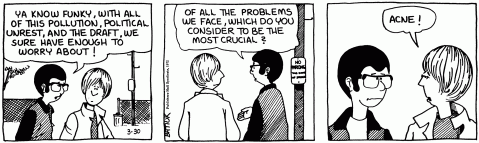


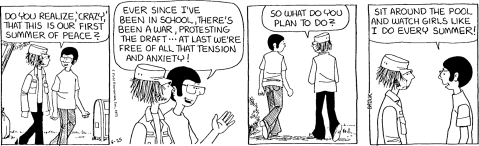
WATERGATE


THE BICENTENNIAL
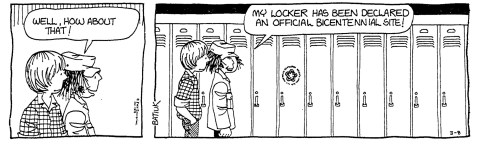

PLANE HIJACKINGS

LABOR STRIKES

SUGAR PRICE SPIKE OF 1974.

Some of these events were very much ‘of their time.’ For someone like me, born after this era, reading through is a fun little history lesson. Like when I was a kid, learning about the 80’s by reading Dave Barry’s Greatest Hits and watching old VHS of Saturday Night Live.


But other ‘current events’ only serve to prove that time is a flat circle, and the more things change…the more they stay the same.


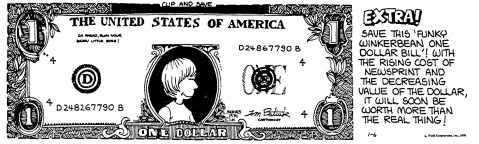

Pennies Dreadful
Funky, Cory, and the Force Ghost of Tony head on into one of Montoni’s many expansive and infuriatingly unorganized storage areas in today’s strip. People were joking about department stores putting up their Christmas decorations in August decades before I was born… but what can be said about decorating for Christmas less than a week before Santa slides down Montoni’s pizza oven chimney?
This is one of the most flabbergasting Funky Winkerbean strips I’ve ever read. Not because of penny socks, or laughably late Christmas decorating, or hologram Tony… but because Funky is apparently capable of feeling shame. Never would have guessed.
 Son of Stuck Funky