Today’s strip marks Summer’s first appearance since… oh wait, yeah, sorry, that’s (Marianne) Winters, not Summer.
Summer actually has appeared in this strip as recently as 7 weeks ago, which is not something you could often say since she graduated high school. Even so, it’s kind of remarkable that Les and Cayla have interacted more over the past few years with a now-Oscar-winning actress than they have with their own children, both of whom (still!) appear to go to Kent State… less than an hour away from where Westview is generally considered to be.
And by “remarkable” I mean 1/4 inch AU from reality. I think I would have found it more relatable and more entertaining had we focused instead on the adventure that must have been Marianne’s efforts to bring an Oscar stuffed in a small drawstring bag through a TSA checkpoint.
Ah, the classic tug-of-war between privacy-invading exuberance and false modesty… who wins that race to the bottom in today’s strip?
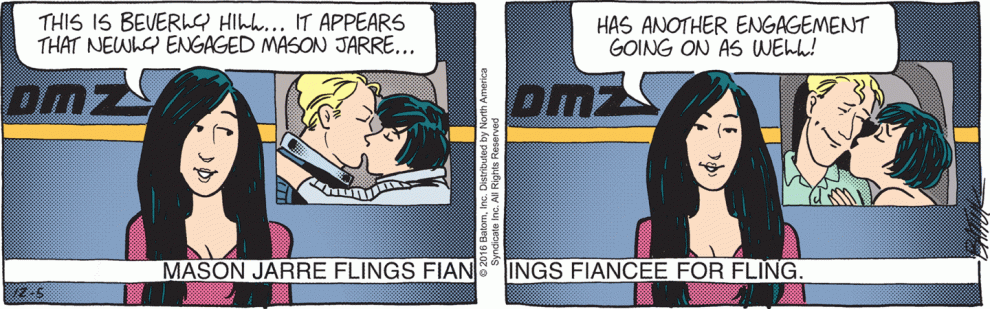
Les’ false modesty does, of course. For one thing, it’s coming from Les, which makes it an additionally off-putting version of an already off-putting behavior. The biggest reason, though, is that Cayla’s desire to “let people know” is essentially moot, everyone already knows. Anyone who cares saw Marianne tell the television cameras that she was coming to give her Oscar away to Les this week. Yeah, if she’s trying to organize a mob to meet Marianne then that might not work if by “on the way” Marianne means that she’ll be there within the hour… but with Marianne’s very public announcement of her planned visit and the relatively specific time frame she gave, the Taj Moore-hal should have been descended upon by pushy celebrity obsessives and Starbuck Jones fans days ago. Where are they? Where’s Lenny and Frankie and (ugh) DMZ? Why am I asking you?
Here is today's strip
Is it worse than we all feared
Or simply as bad

If I was popcorn
I would be quite offended
By this portrayal

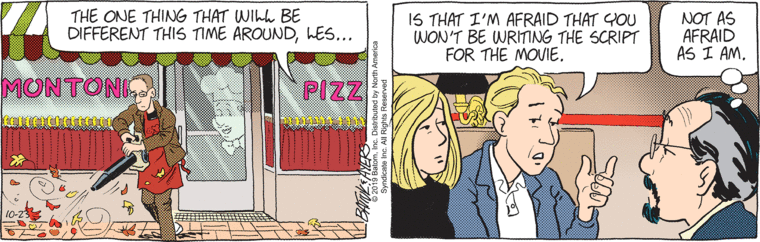
Les hated this film
Why would he even watch this
Was happy it failed

In this case, "writer"
Would not describe Les as he
Did not write the script

This deserves more scorn
I'm a skink, I can't rant, so
I'm counting on you

Rip this thing to shreds
Kill it with all of the fire
Or just acetone
So after all of Les’ passive aggressive pouting yesterday, he’s actually happy the movie flopped. Peak Les. He’s happy at the failure of others, because it allows him to remain in his own comfort zone. Cassidy Kerr said the movie was going to change his life, and he worried if it was going to be changed for the worse or the better.
May 17, 2020
And ultimately he’s smugly satisfied to realize that his own life hasn’t changed at all. Millions of dollars of vainly wasted money; hours and hours of actors’ and crewpeoples’ lives; none of that is weighed against Les’ own desire to remain static.
Banana Jr. 6000 posted an awesome video in the comments of Tuesday’s post. It dissects what makes a character unlikable. I’m reposting it in case someone missed it, and I highly recommend it to anyone with writing aspirations.
The most damning criticism in the video, as it pertains to Les Moore, is the subject of repeated, fruitless, character arcs: where a portion of the story is dedicated to a character trying to overcome as struggle or flaw only to end up right back where they started from.
“The storytelling, in this case, puts our arc and character into the protagonist’s driver’s seat and makes a sort of promise that this is going somewhere. Instead, the wheel is turned all the way left and they’re going in circles. They’re left complaining about the same thing or acting in the same selfish way they have before. And it becomes harder for us to identify with a universal struggle that they’re going through, and instead we start to get frustrated with them personally.”
How many times have we seen Les pulled in circles? Like a dog lazily chasing its tail, half knowing it doesn’t want to catch it. Just killing time because it’s been chained to the same place for years, and it gives it a sense of a goal.
For my Funky/Cranky crossover continuity review a few days ago, I reread an obscene number of Crankshaft strips. And you know what? Crankshaft is so much better. I’m not saying it’s great, or even consistently good. The recent newspaper closing arc was Funky levels of unbearable. But the characters in that strip choose to do things. Cranky has decided he’s going to electrocute a tree using jumper cables and multiple cars, and he’s making it happen. Lillian decides she’s going to write a book, so she does. Then she writes ten more books and becomes famous in the same time it takes Les Moore to write a prequel about his dead wife in the strangest self-own I have ever seen.
While there are always exceptions: Crankshaft characters act, Funky Winkerbean characters react. In Funky Winkerbean there are a few ancillary characters, like Mason and Chester, who present the main characters with life changing propositions to react to. And in general the characters are happiest when they’re NOT moving. Everyone lives above Montoni’s, everyone works at the High School, or the restaurant. Darin, Pete, and Jess would rather take the nepotism hires close to home than capitalize on their Hollywood successes.
Les is happy the movie flopped. Inertia and entropy are the twin suns that warm his withered soul, and his only hope is to decay in place.
Yesterday I did something relatively unorthodox in these parts: I found something to praise Tom Batiuk for. Of course, the overly-long post ended with me screaming at Batiuk in all caps, but that is part of the reason I did it. I never want to get to the point in my beady-eyed nitpicking where everything is a bug to me. Because when I force myself to admit what is good, what is acceptable, and what is innocuous, then when I am confronted with the unbearably bad I can nail it to the wall with confidence.
Today is really really bad guys. Just so bad. This is worst-case-scenario Les Moore at his most insufferable. Self-pitying, sarcastic, complaining, self-absorbed, quipping without being clever. The strip is worse than pointless. It’s not funny. It does nothing to further any ongoing plot, or even advance the conversation in a meaningful way. And the only way it develops character is to further metastasize the tumorous-asshole side of Les’ personality.
And it’s a shame. Because the art today is kind of interesting. One, Les is in pain in panel 2. Which is always nice to see.
And two, he’s putting a pumpkin on a stump.
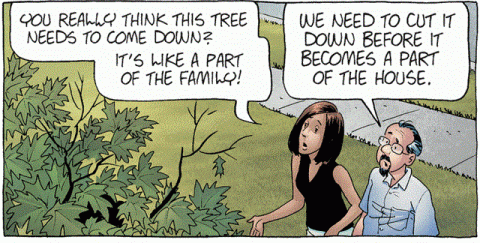
I can only assume that it’s the stump of the large maple tree in their front yard that was cut down back in 2015.
And before we have our normal reaction, ‘Ah, a relic of Dead St. Lisa, of course it is fetishized,’ the tree was also a favorite of Cayla’s, who wanted to be married under its branches, and felt like the tree was ‘part of the family.’ Plus, Summer grew up eating the fallen leaves from under that tree.
I understand grief at the loss of a tree. Emerald ash borer beetles came through my state a couple years ago and took out seven massive beautiful ash trees on my parents’ farm. It makes me sad in a very Batiukian way, wandering across the acres of yard at home, and so many sentinels of my childhood are missing. Nothing left but weed filled dimples where oceans of shade once marked out the borders of fantasy continents.
Les and Cayla left the stump of the tree they were married under. They’ve left it for years. They decorate it in the trappings of fall it can no longer produce. Because they’d rather have the reminder of the tree for a while longer, than a pristine yard. And all of this is told visually. It develops their characters much better than the awful dialogue on display today. It rewards long time readers. It gives the strip a continuity of place. And there’s that word again, continuity.
When Batiuk chose to have his strip move forward in time, he subjected his strip to the harsh and beautiful realities of continuity. In the measured compliments I’ve given the strip the last couple days, I hope I’ve pointed out how continuity can lead to deeper and more meaningful storytelling. But Batiuk wants all the blessings of continuity, without paying the price of its restrictions. He’s not shy about how little he cares. In fact he revels thumbing his nose at it, like an edgy atheist in Sunday School. And that is why his storytelling so often fails, because we don’t trust it any more.
But still. I would miss that tree too. It was a good tree. After all, it once trapped Les high in its branches, to the joy of all the neighborhood children.
And the very first thing it did upon being introduced to Les Moore was smack him right in his dumb smug head.




 Son of Stuck Funky